Gosashi Kofun: A Possible Yamato Royal Tomb in Nara, Japan


Site at a Glance
- Rating
- 4.1
- Popularity
- Very Low
- Country
- Japan
- Primary era
- Classical
- External website
- Open
- Eras represented
- Classical, Modern
- Civilizations
- Japanese, Yamato
- Site type
- Burial
- Remains
- Burial Mound
On this page13 sections
History
Gosashi Kofun is a large Japanese burial mound in Nara, Japan, built by the Yamato polity in the late fourth century during the early Middle Kofun period. The Yamato polity was an early centralized power based in the Kinai region, including the Nara Basin, and is commonly regarded as a predecessor of the Japanese imperial state. The tomb stands on the Saki Hills in the northern Nara Basin and forms part of the western group of the Saki Tatanami Kofun Group. It is regarded as a possible royal tomb, although its actual occupant is unknown.
Late Fourth-Century Royal Tombs
Gosashi Kofun followed Saki Miyayama Kofun, Horaiyama Kofun, and Saki Ishizukayama Kofun in the sequence of large tombs built in the northern Nara Basin. These earlier mounds are traditionally identified with the tombs of Hibasuhime-no-Mikoto, Emperor Suinin, and Emperor Seimu respectively. Gosashi Kofun’s presumed western projecting platform is especially notable because such extensions are chiefly associated with Middle Kofun-period tombs and may have provided space for ceremonies or offerings connected with funerary rites. At Gosashi, the platform may represent an early example of this arrangement.
The Imperial Household Agency, the Japanese government institution responsible for managing imperial residences, tombs, and mausoleums, designates Gosashi Kofun as the mausoleum of Empress Jingū. Its formal mausoleum name is Saki no Tatanami no Ikenoe Mausoleum. Empress Jingū is traditionally described as the consort of Emperor Chūai and as a regent who ruled after his death until her son, Emperor Ōjin, succeeded her. Her historicity and chronology remain disputed. If she was a historical figure, she may have been a regent in the late fourth or late fifth century, while the mound itself probably belongs to the fourth century.
Imperial Identification and Historical Records
Historical records use the name Saki no Tatanami no Ikenoe Mausoleum and describe efforts to distinguish the tomb from the mausoleum of Emperor Seimu. The Engishiki, an early tenth-century compilation of administrative regulations and court procedures, classified it as a distant imperial mausoleum. It assigned the precinct a measurement of two chō from east to west and two chō from north to south, and provided five households for its guardianship. Mausoleum envoys were sent in connection with the Jōgan invasion of 870 and the Mongol threat of 1268.
The tomb’s imperial identification changed more than once. In 1697, Gosashi Kofun was regarded as the mausoleum of Emperor Shōtoku, while Saki Miyayama Kofun was identified with Empress Jingū. During repairs and mausoleum investigations in 1863 and 1864, Gosashi Kofun was reassigned to Empress Jingū on the basis of historical cadastral and temple-site maps. The government of the Meiji period formally retained that identification.
Looting, Management, and Archaeological Investigation
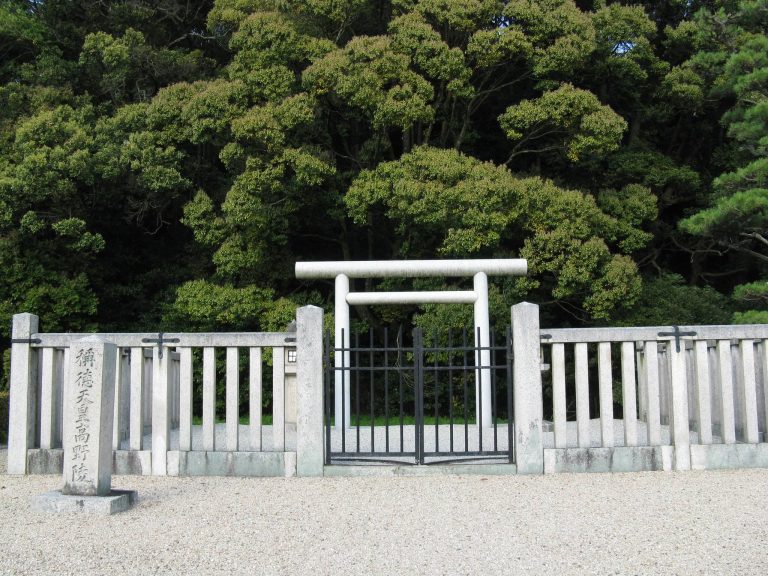
A record describes the looting of the tomb in 1849, when it was still identified as the mausoleum of Emperor Shōtoku. The Imperial Household Agency has since managed Gosashi Kofun as an imperial mausoleum. A stone fence and iron gates were installed in 1889. In 1976, archaeological access was restricted because of concerns for the tranquility and dignity of the imperial tomb.
A preliminary investigation and survey of the mound’s external form took place in 2003 during maintenance work by the Imperial Household Agency’s Archives and Mausolea Department. On February 22, 2008, representatives of 16 archaeological and historical societies entered the precinct in the first academic investigation of an imperial mausoleum. That investigation probably placed the mound in the fourth century and identified haniwa, clay funerary figures and cylinders arranged on or around Japanese burial mounds.
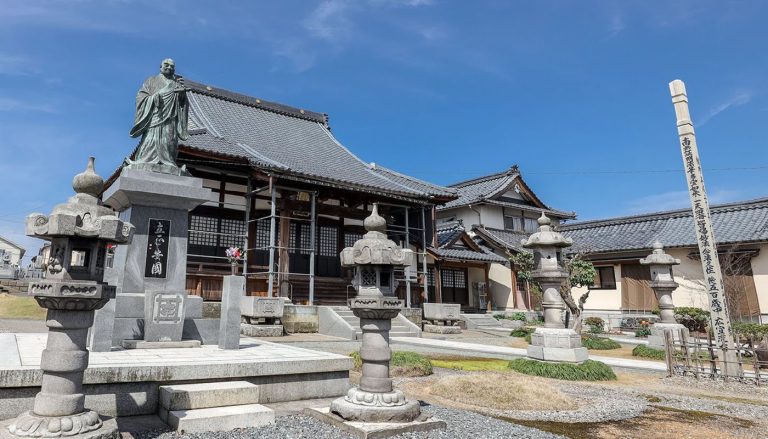
The mausoleum designation also includes five subsidiary tombs, one within the surrounding precinct and four detached from it. Their details are unknown, although, if they are ancient burial mounds, they may represent an early example of the practice of constructing subsidiary tombs. Eight stone lanterns dedicated between 1745 and 1790 at the former site identified as Empress Jingū’s mausoleum, Saki Miyayama Kofun, were transferred to Gosashi Kofun’s worship area after the nineteenth-century reassignment and remain there.
Remains
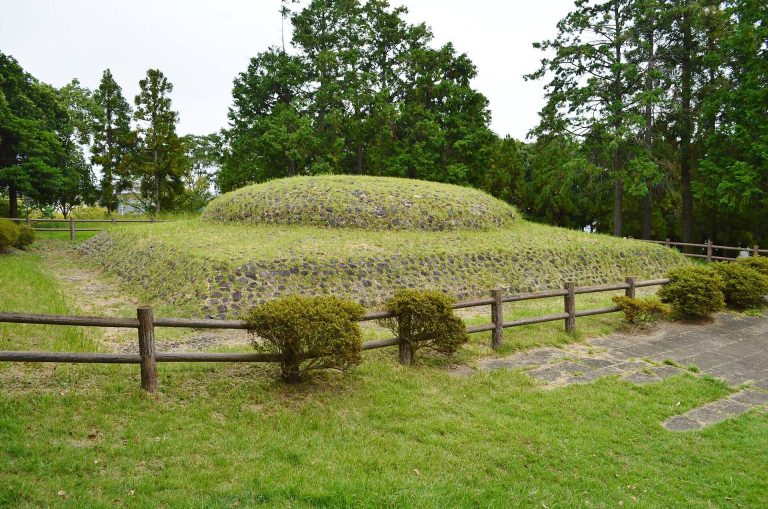
Gosashi Kofun is an asymmetrical keyhole-shaped mound, combining a rectangular front section with a rounded rear section. Its reconstructed total length is approximately 267 meters. It is the largest mound in the Saki Tatanami Kofun Group and ranks twelfth in size among Japan’s kofun. Stone facing covered parts of the exterior, while the mound’s surrounding peripheral band is presumed to date from the original construction. A moat now encircles the mound, but its original date and purpose remain debated because its present form has also been associated with nineteenth-century repairs.
The Mound and Its Principal Sections
Front Section
The square front section points south and rises in three tiers. It measures approximately 150 meters in width, 115 meters in length, and 20.5 meters in height. The first tier does not continue around the rear of the mound. A natural hill remains to the south. One interpretation proposes that this hill and the mound’s hill once formed a continuous ridge before the surrounding ridge was cut during construction, but a survey by the Imperial Household Agency rejected that interpretation because the gap between the natural hill and the front section is relatively wide.
Rounded Rear Section
The rounded rear section is built in four tiers. It measures approximately 190 meters across from east to west and about 27 meters in height, with a summit approximately 40 meters in diameter. The name Gosashi derives from a shrine that formerly stood on this summit. The mound’s length was once estimated at 275 meters, but examination of the mound foot in 2003 produced the revised reconstructed figure of approximately 267 meters.
Western Projecting Platform
The connecting waist is approximately 110 meters wide. A platform is presumed to have projected from its western side, measuring about 28 meters by 83 meters. A projecting platform is a deliberately built extension from a burial mound that could serve as a place for ceremonies or offerings. At Gosashi Kofun, this feature is important for understanding the mound’s possible ritual arrangement and its position within the development of Middle Kofun-period tombs.
Exterior Features and Burial Facility
Stone Facing and Haniwa
Stone facing was detected on the mound’s exterior. Excavated haniwa include cylindrical, morning-glory-shaped, jar-shaped, shield-shaped, house-shaped, and umbrella-shaped figures. These clay forms belonged to the exterior arrangement of the tomb and included both simple cylinders and representations of objects or structures.
Burial Chamber and Sarcophagus
The burial facility is presumed to have been a vertical stone chamber containing a nagamochi-type stone sarcophagus. This is a distinctive long stone coffin form used in some large kofun of the period. The reconstruction is based on historical descriptions connected with the Edo-period looting of the tomb, and it provides the basis for interpreting the mound’s internal burial arrangement.
Peripheral Area and Subsidiary Tombs
The mound is surrounded by a peripheral band believed to belong to its construction. The mausoleum precinct also incorporates one subsidiary tomb within the surrounding area and four detached subsidiary tombs. Their physical details remain unknown. Eight eighteenth-century stone lanterns, originally dedicated at the site then identified as Empress Jingū’s mausoleum, stand in the worship area after their transfer following the nineteenth-century change in identification.