Nakagawa-dera Temple Ruins: A Buddhist Monastic Center in Nara
Site at a Glance
- Rating
- 5
- Popularity
- Very Low
- Country
- Japan
- Primary era
- Medieval
- Eras represented
- Medieval
- Civilizations
- Unclassified
- Site type
- Religious
- Remains
- Monastery
On this page12 sections
History
Nakagawa-dera temple ruins in Nara, Japan, preserve the site of Nakagawa-dera Seishinin, a Buddhist institution founded by the monk Jippan. Construction is thought to have begun in 1112 and concluded in February 1114. The temple became an important center for the study and revival of Buddhist monastic discipline, the rules and practices governing the conduct of monks and nuns, particularly during the Kamakura period.
Foundation and medieval development
Jippan was a Japanese Buddhist monk and scholar closely associated with the study of monastic discipline. At Nakagawa, he composed writings on the subject. A tradition preserved in the Genko Shakusho says that he reached the location while gathering flowers, recognized the quality of its landscape, and established Seishinin there.
Nakagawa stood along the Kasagi Road, near a branch leading from Kofukuji toward Kasagidera and Enjoji. Kasagidera was a major center of devotion to Maitreya, the bodhisattva expected in East Asian Buddhism to become the future Buddha. The area lay beside the clear waters of the Saho River and within a region where mountain temples developed near the historical boundary between Yamato and Yamashiro, provinces corresponding broadly to areas around present-day Nara and southern Kyoto.
During the Kamakura period, Nakagawa-dera became a principal center of the revival of monastic discipline in the southern capital region. Under the cloistered rule of Emperor Toba, a system in which a retired emperor who had entered Buddhist religious life continued to direct political affairs, the temple was regarded with Kakuban’s Daidenbo-in at Koyasan as an exceptionally extensive and richly decorated complex. Learned monks criticized its broad estates and splendid halls and monks’ quarters.
Cloisters and religious traditions
By the late Muromachi period, Seishinin stood at the center of a complex described as having nine subsidiary cloisters and the Tile Hermitage. Named cloisters included the Maitreya, Pure, Jizo, Northeast, Buddha-Eye, Ten-Wheel, Medicine Buddha, and Tripitaka institutions. Several related establishments appear in records from earlier centuries: the Ten-Wheel Cloister existed by 1162, the Immeasurable Waves Cloister by 1186, the Reliquary Hall by 1246, the Jizo Cloister by about 1251, the Aspiration Cloister by 1271, and the Northeast Cloister before 1302.
Nakagawa-dera’s transmission lineage included Myoe, Kozen, Keiga, Kakua, Choyo, Eishin, and Sokan, also known as Daishin. Daishin learned Buddhist chant from Jippan and became recognized as a master of the tradition. Buddhist chant, or shomyo, is the ritual vocal performance of Buddhist texts and liturgical formulas. Nakagawa-dera became the headquarters of Daishin-style chant, later called the Daishin or Yamato Daishin tradition.
In 1235, Shoshin, the forty-first administrative head of Koyasan, asked Jigo at Nakagawa-dera to transfer the chant tradition to Koyasan. Jigo had formerly lived as a monk at Kofukuji and had studied under Shokai, a disciple of Daishin. He sought support from temples in Nara and Kyoto, after which the tradition developed around Koyasan and became known as Nanzan Shinryu chant. Koyasan was a major center of Shingon Buddhist practice, while Kakuban was a leading Japanese monk associated with the Shingon tradition.
Fire, affiliation, and decline
From the medieval period onward, Nakagawa-dera was a subsidiary temple of Kofukuji, a major Buddhist temple in Nara. A fire in July 1481 destroyed the complex except for the main hall. In 1486, a theatrical performance was organized to raise funds for its revival, although the outcome is unknown.
During the Edo period, Nakagawa-dera remained a Kofukuji subsidiary and had no land income. Its buildings were listed as the main hall, pagoda, bell tower, and guardian shrine, under the care of Ichijo-in. By the Meiji Restoration, the complex had reportedly been almost completely destroyed. The surviving site and related cultural properties preserve material associated with the temple’s long religious history.
Remains
Precinct and memorial monument
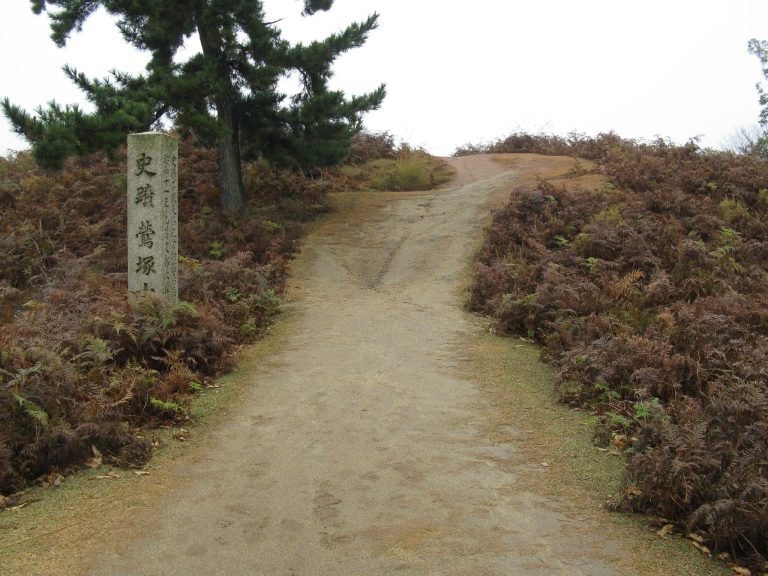
The former temple precinct is thought to have covered several hectares, including woodland. This extent is inferred from local place-names that preserve the names of subsidiary temples and from a measured map of Nakagawa village made in 1889. Seishinin was associated with a large group of halls, monks’ quarters, and subsidiary institutions, whose interiors were described as exceptionally elaborate and refined.
Jippan’s five-ring stupa
A granite five-ring stupa remains on the former temple grounds as a memorial to Jippan. More than 3 meters high, it stands on a tiered masonry base. The five-ring form represents earth, water, fire, wind, and space, and its shape is characteristic of the Kamakura period.
Objects associated with Nakagawa-dera
Jizo Bodhisattva
A Jizo Bodhisattva image was moved from the ruins to a roadside junction along Nara Prefectural Route 33, the Nara-Kasagi road. An inscription on both ends of its halo states that it was dedicated for the posthumous benefit of Keien on June 24, 1517.
Yakushi Buddha
A Yakushi Buddha image at Sainenji in Kaseyama is traditionally said to have come from Nakagawa-dera. The connection survives as an oral tradition concerning the image’s origin.
Seishinin bronze bell
The Seishinin bronze bell is now held at Tokushoji in Kobe. Its cast inscription states that Tajihi no Yor tomo made it on April 7, 1129. After thirty-six years of use, the bell broke and was recast by the monk Sonchi on July 2, 1164.
Bishamonten sculpture
A standing wooden image of Bishamonten measures 102.5 centimeters in height. Bishamonten is a Buddhist guardian deity associated with protection and military power. The sculpture is assembled from joined wooden pieces and has polychrome decoration, balanced proportions, and crystal-inlaid eyes. Small votive images of Bishamonten and other materials were placed inside its head. Writing on the reverse of one paper identifies the sculpture as the former image from the Ten-Wheel Cloister’s private Buddhist hall at Nakagawa-dera.
The sculpture represents an early stage in developments associated with Kamakura-period sculpture. It was formerly held in the collection of the painter Kawabata Ryushi and is now in the Tokyo National Museum. Together with the memorial stupa, the relocated religious images, and the bell, it preserves evidence of the institutions and practices once connected with Nakagawa-dera.