Hokke-dō: A Nara-Period Buddhist Hall at Tōdai-ji


Site at a Glance
- Rating
- 4.4
- Popularity
- Low
- Country
- Japan
- Primary era
- Classical
- External website
- Open
- Eras represented
- Classical, Medieval
- Civilizations
- Kamakura shogunate
- Site type
- Religious
- Remains
- Temple
On this page16 sections
History
Hokke-dō, also called Sangatsudō, is a Buddhist hall in Japan at Tōdai-ji in Nara. Built during the Nara period, probably in the second quarter of the eighth century, it belongs to the Upper Precinct on the eastern hills of the temple grounds. The hall and its sculptures preserve an important group of Tenpyō-period art, an eighth-century phase of Japanese Buddhist art associated with Nara and known for monumental figures, naturalistic modeling, and technically complex materials.
Origins at Tōdai-ji
A predecessor institution occupied this part of the temple precinct before the eye-opening ceremony for Tōdai-ji’s Great Buddha in 752. Hokke-dō formed part of the early institutions later absorbed into Tōdai-ji, including Konshō-ji, also called Konshō Mountain Cloister. The hall may have served as the main hall of the institution later known as Konkomyō-ji, the provincial temple of Yamato, although the relationships among Konshō-ji, Fukujū-ji, and Konkomyō-ji remain uncertain.
The Tōdai-ji Records attribute the foundation to the monk Rōben in 733. Rōben was a prominent eighth-century Buddhist monk traditionally regarded as Tōdai-ji’s founder, but the exact date of the building remains debated. Suggested dates extend from the later 730s or 740s to the middle of the eighth century. Roof tiles connect its construction with tiles used at the Kuni capital between 740 and 744, supporting a date in the second quarter of the eighth century.
The hall was formerly called Kensakudō, after its principal image, Fukūkenjaku Kannon, and the surrounding complex was known as Kensaku-in. An illustrated boundary map made in 756 identifies a Kensakudō at the site of the present building and shows it as one of the principal structures in the complex. A document from 747 records an order for iron intended for the halo and lotus pedestal of a “Kensaku Bodhisattva,” suggesting that the principal image may still have been in production at that time.
The Hokke-e and later history
The name Hokke-dō and the alternative name Sangatsudō are traditionally linked with the Hokke-e, a ceremony centered on the Lotus Sutra and held in the third month. By the eleventh century, during the late Heian period, the ceremony had moved to the lecture hall. It returned to Hokke-dō in 1618, when it was held in November. The ceremony is no longer performed.
Much of Tōdai-ji was destroyed in the fires of war involving Taira no Shigehira in 1180 and in the conflicts between Miyoshi and Matsunaga forces in 1567. Hokke-dō survived these disasters and is the only surviving Nara-period Buddhist hall at Tōdai-ji. The present worship hall was added during the Kamakura period. One interpretation dates the work to 1199, during the tenure of the priest Chōgen, while an inscription on a structural member has been used to propose 1264.
Investigation, conservation, and status
An investigation carried out during roof repairs in 1971 and 1972 found numerous inscribed roof tiles made in the style associated with the Kuni capital. Examination of the octagonal double platform in 1996 identified six former pedestal positions. These traces helped establish the probable original arrangement of the principal images and the Four Heavenly Kings now kept at Tōdai-ji’s ordination hall.
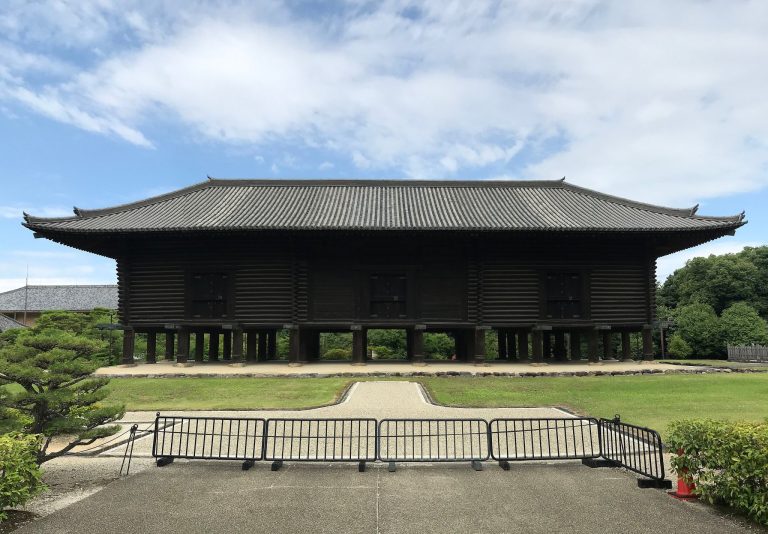
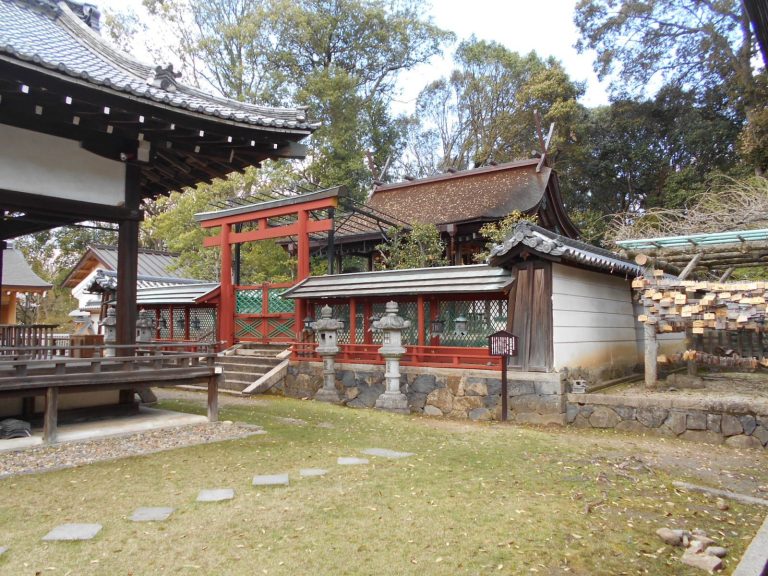
In 2011, six images formerly housed in Hokke-dō were moved to the Tōdai-ji Museum, where seismic-isolation measures were provided. The hall then underwent altar repairs, and the principal image was temporarily moved to the museum during the work. Public access resumed on 18 May 2013. The hand-washing pavilion behind the hall was built in 1335, while the north gate leading toward Nigatsudō dates from 1240. A scripture storehouse south of the hall is an early Heian-period raised-log storehouse, and a stone lantern at the southern entrance bears a maker’s inscription dated 1254.
Hokke-dō was designated an Imperial-era National Treasure under the Ancient Shrines and Temples Preservation Law on 28 December 1897, the first designation made under that law. It became a National Treasure under the postwar Law for the Protection of Cultural Properties on 9 June 1951 and forms part of the Tōdai-ji component of the UNESCO World Heritage property. Its principal images and several associated sculptures are National Treasures, while related buildings and selected furnishings are Important Cultural Properties.
Remains
Building layout and construction
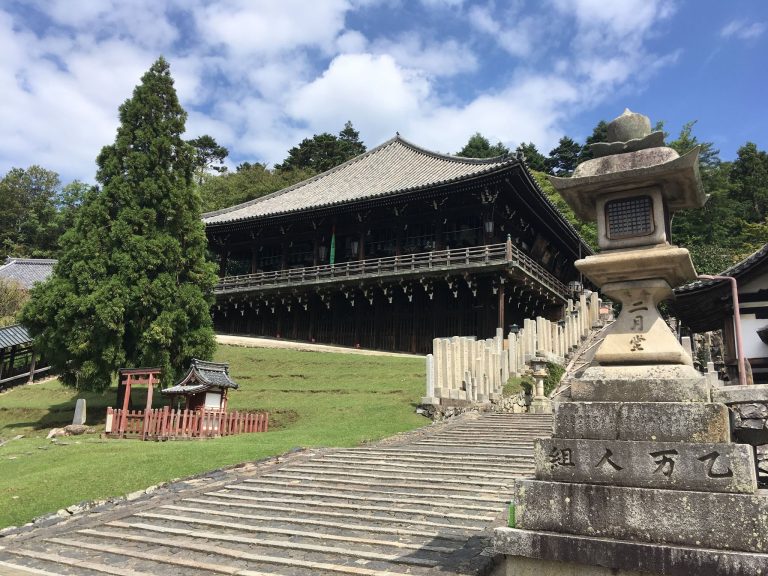
Hokke-dō stands on hilly ground east of the Great Buddha Hall, with its principal facade facing south. The rectangular building measures five bays across the front and eight bays in depth. Here, a bay means the interval between columns rather than a fixed measurement. The structure combines a rear main hall, or shōdō, with a front worship hall, or raidō, joined by an intermediate section. The rear four bays form the main hall, the front two bays form the worship hall, and the two intervening bays make up the connecting section.
The original arrangement was probably a double-hall composition, with the main hall and worship hall standing as separate buildings one behind the other. Traces in Nara-period structural members show that a worship hall existed in some form at that time, although the present front hall belongs to the Kamakura period. Both sections retain traditional tile roofs and bracket complexes based on the projecting-bracket system. The main hall has a hipped roof and an entrance on the eaves side, while the worship hall has a gabled-hipped roof with its gable facing forward.
Evidence of the two building phases
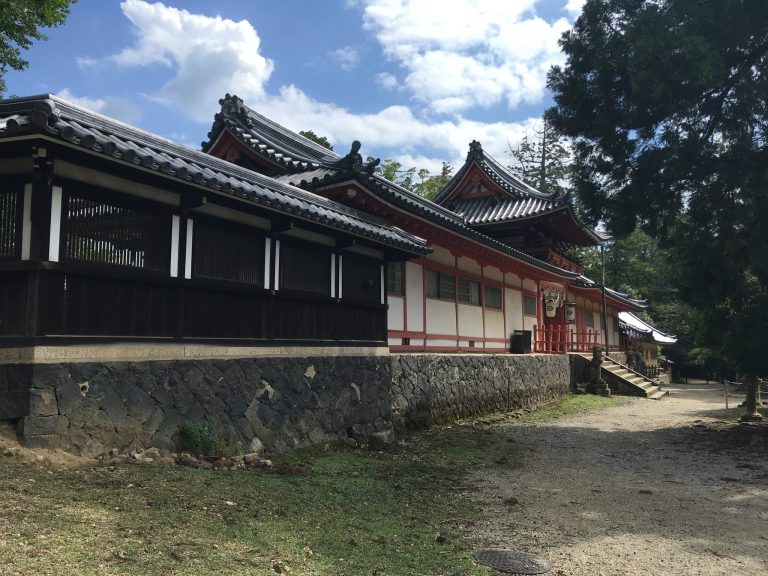
The western side displays the distinction between the two phases particularly clearly. Its northern four bays belong to the Nara-period main hall, while its southern four bays belong to the Kamakura-period worship hall. A remnant of a roof gutter above the fourth column from the southern end marks the former division between the separate buildings.
The Nara-period section uses horizontal tie-beams called nageshi. The Kamakura-period section uses lower penetrating tie-beams called nuki. Their bracket complexes also differ. The older brackets have taller bearing blocks and gently curved arms, while the later brackets have lower blocks, more sharply curved arms, and projecting noses associated with the Daibutsuyō style. Paired bearing posts in two vertical tiers occupy the spaces between the intermediate brackets, a feature retained in the later worship hall.
The eaves have two tiers of rafters, and all the rafters are square in section. The worship-hall side of the interior, including the forward part of the connecting section, has a wooden floor. The main-hall side is earthen-floored today, while surviving traces show that it originally also had a wooden floor, an unusual arrangement for a Nara-period Buddhist hall.
Main hall interior
A large altar fills the central part of the main hall, extending three bays across and two bays in depth. The central bay has projecting brackets, raised wall supports, and a coffered ceiling with an upward-stepped form. Straight structural members and transverse curved beams beneath the ceiling retain Nara-period characteristics.
Three canopies hang below the ceiling. Each is organized around a large lotus surrounded by eight radiating lotuses, with a bronze mirror at the center of each of the nine lotus forms. The central canopy is a later replacement. The altar and ceiling provide the architectural setting for a group of sculptures made in dry lacquer and clay during the Tenpyō period and later eras.
Principal image and altar sculpture
Fukūkenjaku Kannon
The principal image is a 362-centimeter-high hollow dry-lacquer Fukūkenjaku Kannon standing on a black-lacquered octagonal double platform. Hollow dry lacquer was formed by layering lacquered textiles over a temporary core and removing the core after the shell had hardened. Fukūkenjaku Kannon is a form of Kannon, the Buddhist bodhisattva of compassion. Its unfailing noose represents the power to reach and save all beings, while the three eyes and eight arms reflect an iconographic relationship with Maheshvara.
The statue has three eyes and eight arms. Two hands meet before the chest around a crystal bead, two lower hands are empty, and four others hold a lotus, a noose, and a ritual staff. These attributes are later replacements, while the object once held in the remaining hand has been lost. The figure wears a representation of a deerskin over the left shoulder. Its six-tiered pedestal and wooden openwork halo are original. The halo has a lotus-petal frame and forty-eight rays, but it now hangs substantially below its proper position, probably because part of its original support was lost.
Lacquer gilding covers the image, and the halo and crown reinforce its radiant appearance. The silver crown is 88 centimeters high. Three superimposed silver bands support a cage-like framework decorated with openwork floral plaques, a flaming jewel, a small silver image of Amida, and hexagonal mirrors. More than 20,000 pieces of amber, jade, lapis lazuli, pearls, crystal, and other gems adorn the crown, whose plaques combine openwork with finely engraved ornament.
Brahmā and Indra
Dry-lacquer figures of Brahmā and Indra stand beside the Kannon at heights of 402 and 403 centimeters. These ancient Indian deities were incorporated into Buddhist cosmology as heavenly protectors. Brahmā holds a Buddhist scripture and wears a large robe with a breastplate visible beneath it. Indra has no attribute, lacks the breastplate, and wears an open-front garment. Most of the surface coloring on both figures comes from later restoration.
The identities of the two figures may have been switched in later tradition because the armor-bearing figure stands on the viewer’s left. Their forms, together with the principal Kannon and other major images, belong to the complex sculptural program associated with Hokke-dō.
Kongō-rikishi
A pair of dry-lacquer Kongō-rikishi, or Niō, stand near the altar. The open-mouthed figure measures 326.4 centimeters and stands on the viewer’s left with his right hand raised. He originally held a vajra, a thunderbolt-like ritual weapon associated with indestructibility and the destruction of spiritual obstacles, but that attribute is lost. The closed-mouthed figure is 306.0 centimeters high and holds a vajra before his chest.
Unlike the generally bare-chested guardians often represented at gates, these figures wear armor and armored sleeves. Painted patterns remain comparatively well preserved on parts of the armor. The figures are related to the protective imagery of the Four Heavenly Kings and Shukongō-jin, who also bear the vajra in defense of Buddhist teaching.
Four Heavenly Kings
Four dry-lacquer images of the Heavenly Kings occupy the four corners of the altar. These guardian deities protect the four directions. Jikoku-ten stands in the southeast, Zōchō-ten in the southwest, Kōmoku-ten in the northwest, and Tamon-ten in the northeast. Their heights are 309, 300, 304, and 310 centimeters respectively.
Jikoku-ten and Zōchō-ten support tridents. Kōmoku-ten holds a brush and a scripture scroll, although the brush is lost. Tamon-ten holds a trident, while his other attribute is lost and was probably a pagoda. Original painted patterns survive on several areas of their armor.
Clay and wooden images
Shukongō-jin
Behind the principal image, a 170.4-centimeter clay statue of Shukongō-jin faces north inside a lacquered shrine. The figure is shown in armor, raising a vajra in the right hand and clenching the lowered left hand. Exposed veins, a furious expression, and carefully modeled armor give the statue an intensely physical character.
Shukongō-jin is a secret image, meaning a sacred statue normally concealed and shown on a specified ritual day. It is opened on 16 December, the anniversary of Rōben’s death. Its original colors remain unusually clear because of the long-standing restricted access. Floral patterns cover clothing on red, green, and blue grounds, while the armor carries auspicious-cloud and floral-scroll designs. Alternating armor plates display paired-flower and peacock-feather motifs.
Two Kamakura-period iron hanging lanterns beside the shrine bear bee designs. These motifs are connected with the image’s legendary association with the suppression of the rebellion of Taira no Masakado.
Images transferred to the museum
Before 2011, the hall contained eighteen images. Six were moved to the Tōdai-ji Museum: the figures traditionally identified as Nikkō and Gakkō, Kichijō-ten, Benzai-ten, a seated Jizō-bosatsu, and Fudō-myōō with two attendants. The ten images remaining in the hall are Fukūkenjaku Kannon, Brahmā and Indra, the two Kongō-rikishi, the four Heavenly Kings, and Shukongō-jin.
The clay figures traditionally called Nikkō and Gakkō measure 207.2 and 204.8 centimeters. Their original identities remain uncertain. They may have served as attendants to Yakushi, or they may originally have represented Brahmā and Indra. Their plain costumes do not clearly correspond to either conventional category. Red and green colors with cut-gold decoration have largely disappeared, leaving exposed finishing clay containing mica, while small traces survive inside the sleeves.
Traces on the octagonal double platform indicate that the principal image was originally surrounded by these two figures and four clay Heavenly Kings now kept at the ordination hall, with Shukongō-jin positioned behind it. Kichijō-ten and Benzai-ten are generally considered to have been transferred from Kichijō-in, another building that burned in 954.
The clay Kichijō-ten is 202 centimeters high and Benzai-ten is 219 centimeters high. Both suffered extensive damage, particularly Benzai-ten, whose facial clay had flaked away and whose eight arms had become disordered. Between 1992 and 1995, Benzai-ten underwent complete dismantling and repair, which restored its earlier appearance. Kichijō-ten remains important as one of Japan’s earliest surviving images of the deity.
The seated wooden Jizō-bosatsu is a Kamakura-period work. The wooden Fudō-myōō and his attendants, Seitaka-dōji and Kongara-dōji, date from the Northern and Southern Courts period. Fudō-myōō served as the principal image for the early modern “Thousand-Day Continuous Flower” practice, during which flowers were offered continuously for 1,000 days. A seated wooden Maitreya image from the early Heian period, popularly called the “Trial Great Buddha,” was also formerly housed at Hokke-dō and is now kept at the Tōdai-ji Museum.
The sculptures associated with Hokke-dō include a major group of Tenpyō-period hollow dry-lacquer and clay figures. Fukūkenjaku Kannon and the principal clay figures may have been produced in the same workshop, or at least during the same period. Some of the other dry-lacquer figures appear to belong to a later group with different stylistic qualities.