Uguisuzuka Kofun: A Keyhole-Shaped Burial Mound in Nara


Site at a Glance
- Rating
- 4.4
- Popularity
- Very Low
- Country
- Japan
- Primary era
- Classical
- External website
- Open
- Eras represented
- Classical
- Civilizations
- Yamato
- Site type
- Burial
- Remains
- Burial Mound
On this page8 sections
History
Uguisuzuka Kofun is a large ancient Japanese burial mound in Nara, Japan, built on the summit of Mount Wakakusa during the latter half of the early Kofun period. The Kofun period, conventionally dated from approximately the third to the sixth centuries, was an era associated with large earthen burial mounds. Rising 342 metres above sea level in the northeastern outskirts of Nara, the mound occupies the Kasugano area.
Early Kofun-period construction
The tumulus was constructed as a keyhole-shaped mound, a form combining a circular rear section with a rectangular front section. Its orientation toward the south-southwest places the side facing the plain in the direction of the front section. The size and form of the mound reflect the burial traditions of the early Kofun period, although the person buried there has not been identified.
Names and Edo-period history
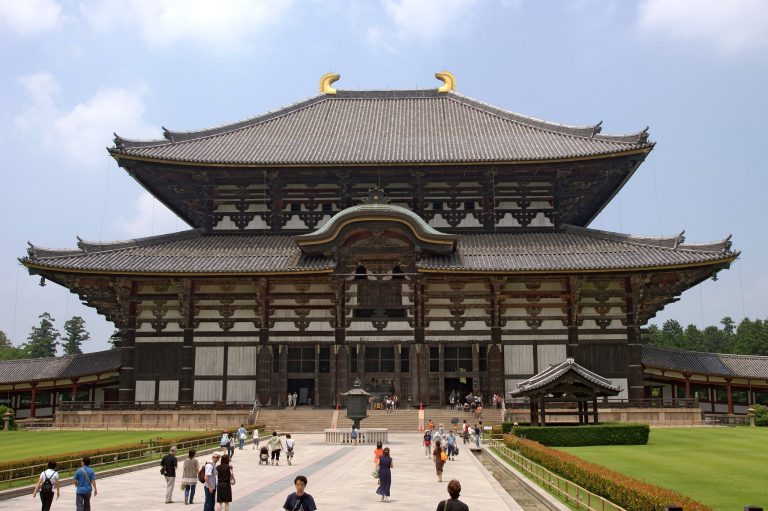
The name Uguisuzuka comes from a tradition connecting the mound with the “Uguisu no Misasagi” mentioned by Sei Shonagon, a Heian-period court writer traditionally associated with The Pillow Book. An early Edo-period general plan of the grounds inside and outside Tōdai-ji called the mound “Ox Tomb.” Tōdai-ji, a major Buddhist temple in Nara historically connected with imperial and state-supported Buddhism, owned the land containing the tumulus during the Edo period.
In 1733, a Tōdai-ji monk erected a stone monument on the summit of the mound. Its inscriptions connect the site with the Engishiki, the identification made by Sei Shonagon, and the hope that the inscription would endure. The monument preserves the Edo-period association between the ancient burial mound and literary tradition.
Modern protection and survey
Uguisuzuka Kofun was designated a National Historic Site of Japan on 3 September 1936. The mound has been surveyed without archaeological excavation. A three-dimensional survey carried out in fiscal year 2020 produced findings reported in 2023. As part of Nara Park, the tumulus is maintained and repaired through measures including grass planting, protective fencing, signposts, and information boards.
Remains
Keyhole-shaped mound
Uguisuzuka Kofun extends approximately 107 metres, although some publications give a length of 103 metres. The circular rear section measures about 66 metres across and rises roughly 9 metres high. It appears to have been built in three tiers. The rectangular front section is about 72 metres wide and 8 metres high, with evidence suggesting two tiers. Thick layers of crushed stone cover the outer slopes, protecting and reinforcing the earthen surface.
Cylindrical haniwa were arranged in rows on the mound. Haniwa are clay objects placed on or around burial mounds, and they included both boundary pieces and figurative forms. At Uguisuzuka, the figurative examples took the shapes of houses, boats, and lids, adding representations of constructed and functional objects to the mound’s surface.
Front feature and subsidiary mounds
The 2020 three-dimensional survey identified an island-like facility measuring 25.0 by 16.6 metres in front of the rectangular section. A land bridge connects it to the mound. This feature forms part of the area before the front section and contributes to the surviving spatial arrangement of the tumulus.
One small square mound and two small circular mounds remain in front of the front section. They may be baizuka, subsidiary burial mounds associated with a larger tumulus.
Burial finds and summit markers
A small bronze mirror with an inward-facing floral design was found at the southwestern corner of the front section in 1953. A talc axe-shaped stone object was also found on the mound. Both are regarded as possible grave goods. The objects are kept by the Museum of the Archaeological Institute of Kashihara in Nara Prefecture and are not on permanent display.
The stone monument erected in 1733 stands on the summit of the rear circular section. Its front carries the inscription “Uguisuzuka,” while the rear records the monument’s erection by a Tōdai-ji monk who held the title of great superintendent. A third-order triangulation point called “Mikasa-yama” is also located on the summit.