Daitoku-ji Temple: A Rinzai Zen Complex in Kyoto


Site at a Glance
- Rating
- 4.3
- Popularity
- Medium
- Country
- Japan
- Primary era
- Early Modern
- External website
- Open
- Eras represented
- Medieval, Early Modern
- Civilizations
- Ashikaga shogunate, Tokugawa
- Site type
- Religious
- Remains
- Monastery
On this page27 sections
History
Daitoku-ji Temple is a Rinzai Zen Buddhist temple in Kyoto, Japan, founded in the early fourteenth century by the monk Shūhō Myōchō. The complex developed in the architectural and religious traditions of medieval Japanese Zen and became the head temple of the Daitoku-ji branch of the Rinzai school.
Foundation and Imperial Patronage
Shūhō Myōchō, also known as Daitō Kokushi, established a small hermitage called Daitoku-an in Murasakino, north of Kyoto, in either 1315 or 1319. His uncle, Akamatsu Norimura, supported the foundation and donated land. The institution received formal recognition during the reign of Cloistered Emperor Hanazono. In 1325, Hanazono designated Daitoku-ji as an imperial prayer institution, and a dedication ceremony followed the construction of the Dharma Hall and the abbot’s quarters around 1326.
Daitoku-ji gained broad imperial and aristocratic support during the final years of the Kamakura Shogunate and the beginning of the Kenmu Restoration, an attempt by Emperor Go-Daigo to restore direct imperial rule. In 1334, Go-Daigo issued an edict placing Daitoku-ji above Kyoto’s Five Mountains, the medieval system used to rank and administer major Zen institutions under government and court patronage. The temple also received support from Emperor Kōgon, Nakamikado Tsunetsugu, Prince Moriyoshi, Nitta Yoshisada, and other aristocrats. By about 1333, its estates extended across Harima, Settsu, Kii, Shinano, Shimōsa, Mino, and other provinces, producing approximately 7,600 koku.
A document written by Go-Daigo on 24 August 1333 recognized the exclusive residence at Daitoku-ji of members of Shūhō Myōchō’s transmission line. This policy and the accompanying estate donations strengthened the temple’s independent institutional identity. Daitoku-ji became associated with the Ōtōkan transmission lineage, linking the teaching traditions of Nampo Jōmyō, Shūhō Myōchō, and Kanzan Egen.
Withdrawal from the Five Mountains
After the collapse of the Kenmu Restoration and the establishment of the Muromachi Shogunate, Daitoku-ji’s close association with Go-Daigo weakened its relationship with the Ashikaga rulers. The temple was removed from the Five Mountains system and in 1386 was ranked ninth among the Jissetsu, a group positioned just below the Five Mountains.
In 1432, Yoso Sōi, the temple’s twenty-sixth abbot, withdrew Daitoku-ji from the increasingly politicized Five Mountains and Jissetsu hierarchy. He emphasized independent Zen practice instead. Daitoku-ji thereafter belonged to the Rinka, or “under-the-woods,” tradition, meaning Rinzai temples operating outside the officially administered Five Mountains system. Its lineage became one of the most influential in Japanese Zen, although the related Myōshin-ji lineage later surpassed it in institutional importance.
Destruction and Rehabilitation
Fires in 1453 and during the Ōnin War, a late fifteenth-century conflict that devastated Kyoto and involved rival warrior factions, destroyed the Buddha Hall, Dharma Hall, and other early buildings. In 1474, Emperor Go-Tsuchimikado appointed the monk Ikkyū Sōjun as head priest. Ikkyū directed the temple’s rehabilitation with assistance from merchants in Sakai, restoring Daitoku-ji’s religious and cultural influence.
Under Ikkyū and his successors, Daitoku-ji became an important center of Zen painting and tea culture. Murata Jukō, associated with the development of wabi-cha, studied with Ikkyū. Tea masters including Takeno Jōō, Sen no Rikyū, and Kobori Enshū maintained connections with the temple. Its association with tea became so strong that it was popularly described as having the “tea face.”
Warrior Patronage and the Sanmon
Military leaders frequently sponsored affiliated sub-temples, known as tatchū, for family memorial rites or in preparation for their own deaths. After Oda Nobunaga was killed in the Honnō-ji Incident in 1582, Toyotomi Hideyoshi held Nobunaga’s funeral at Daitoku-ji. Hideyoshi founded Sōken-in in 1583 as Nobunaga’s memorial temple.
Sen no Rikyū completed the upper story of the Sanmon in 1589 and donated the reconstructed gate to Daitoku-ji. A wooden image of Rikyū wearing sandals was later installed above the passage. Tradition holds that Toyotomi Hideyoshi’s anger at being forced to pass beneath the image contributed to Rikyū’s ritual suicide, or seppuku, in 1591.
Tokugawa Regulation and Modern Preservation
During the early Edo period, the Tokugawa Shogunate subjected Daitoku-ji to tighter control. Its former abbot Takuan Sōhō was exiled in connection with the Purple Robe Incident, a dispute over the shogunate’s regulation of imperial recognition for senior Buddhist monks. Relations later improved partly because the third shogun, Tokugawa Iemitsu, became Takuan’s follower. A policy issued in 1615 imposed further rules on Daitoku-ji and Myōshin-ji, including requirements for abbots’ Zen training and restrictions on the imperial distribution of purple robes. Takuan helped secure an improvement in the temples’ status in 1641.
During the Edo period, Daitoku-ji had more than 280 branch temples in 25 provinces and over 130 affiliated sub-temples. Its landed endowment exceeded 2,011 koku, although much of this property was confiscated by the Meiji government after the Restoration. In 1878, the complex was reduced in size to preserve its remaining buildings. Thirteen sub-temples were merged or effectively abolished, four were reduced through the sale of parts of their buildings, and twenty were retained as permanent sub-temples.
Daitoku-ji continued as a functioning temple after these changes. The grounds became a National Historic Site in 2016. The Abbot’s Chamber Garden had already been designated a Historic Site and Place of Scenic Beauty in 1924 and a Special Place of Scenic Beauty in 1952. Major buildings, paintings, calligraphic works, and other features also carry National Treasure or Important Cultural Property designations. The complex remains associated with the independent development of Rinzai Zen and with the history of Japanese religious art and tea culture.
Remains
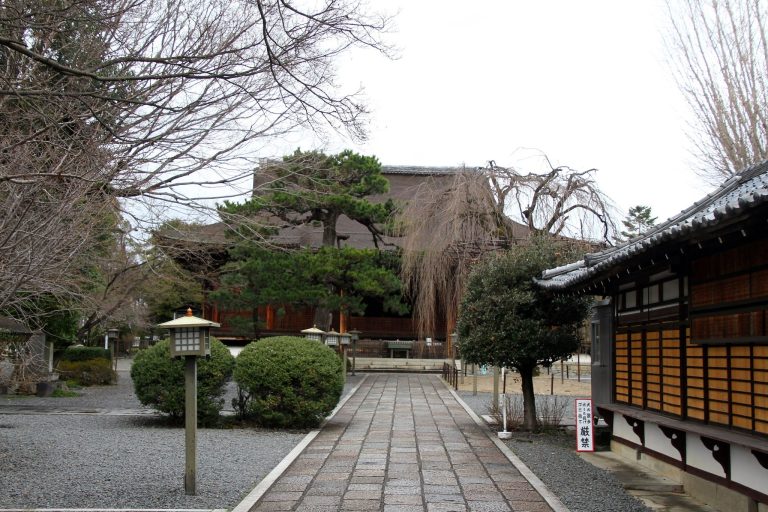
Daitoku-ji covers approximately 23 hectares. Its principal buildings follow a predominantly north-south orientation, although the central group lies east of the site’s central axis. The Imperial Envoy Gate, Sanmon, Buddha Hall, and Dharma Hall form an almost straight line. More than twenty sub-temples extend mainly to the north, south, and west. Walls enclosed the central group, while additional buildings stood outside it. The complex includes halls for worship and teaching, the abbot’s residence, a bathhouse, sutra library, entrance buildings, corridors, service structures, and numerous wooden sub-temples, with brick and stone also used among the building materials.
Central Buildings and Gates
Buddha Hall
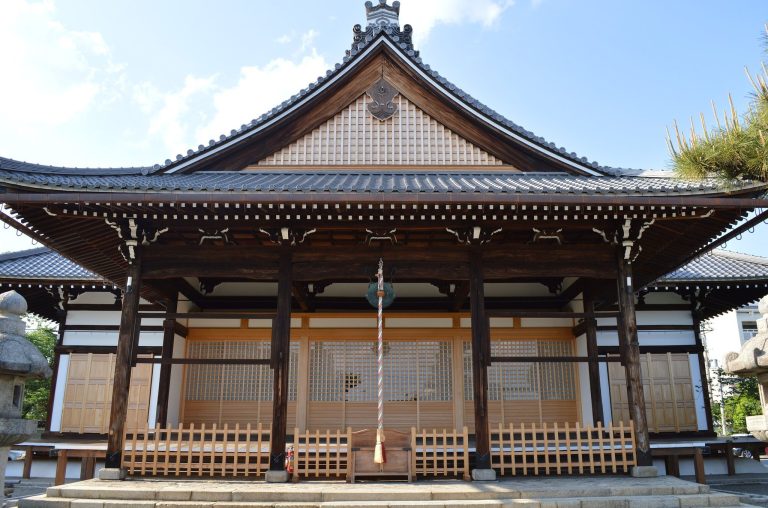
The Buddha Hall, or Butsuden, was rebuilt in 1665 through a donation from the Kyoto merchant Nawa Jōyū. It enshrines Shaka Nyorai, the Japanese name for Shakyamuni Buddha, the historical founder of Buddhism. Wall paintings by Kaihō Yūshō decorate the hall, while its ceiling carries a flying celestial figure painted by Kanō Motonobu. That ceiling painting was reused from an earlier Buddha Hall rebuilt in 1479 with support from the Sakai merchant Owa Sōrin. The image of Shaka Nyorai is traditionally described as a one-tenth-scale prototype of the Great Buddha of Hōkō-ji.
Dharma Hall
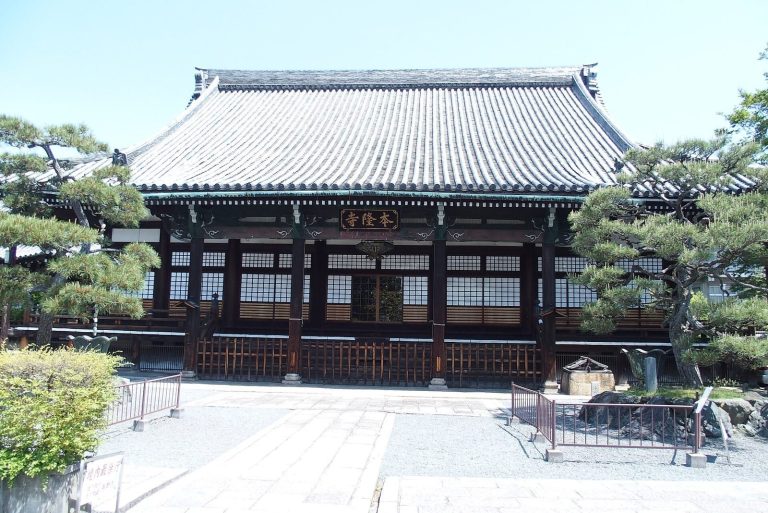
The Dharma Hall, or Hattō, was rebuilt in 1636 by Inaba Masakatsu, lord of Odawara Domain. Used for teaching and religious ceremonies, it contains a ceiling painting of a Cloud Dragon by Kanō Tan’yū, made when the painter was 35 years old.
Abbot’s Chamber
The Abbot’s Chamber, or Hōjō, was rebuilt in 1635 to commemorate the 300th anniversary of Shūhō Myōchō’s death. Its Japanese-style design differs from the Zen architectural forms of the Buddha Hall and Dharma Hall. The building measures approximately 29.8 metres across the front and 17.0 metres along the sides. Its gabled roof was originally covered with cypress bark and was later described as shingled.
The Hōjō has an unusual eight-room plan arranged as two rows of four, rather than the more usual six-room arrangement. Two rooms on its right-hand side form Unmon-an, which contains Shūhō Myōchō’s tomb. Part of Unmon-an projects northward beyond the northern veranda. The building’s partitions originally held 84 paintings by Kanō Tan’yū. A Monkey Trainer scene was destroyed by fire in 1966, leaving 83 panels. The remaining program includes monochrome landscapes, Zen assemblies, dragons and tigers, birds among bamboo, birds among plum and willow, hermits, a Monkey Trainer panel, reeds and geese, further landscapes in the guest and assistant offices, and a phoenix screen in a subsidiary hall.
Entrance and Formal Gates
The entrance to the Hōjō was built in 1636 with a donation from the wealthy merchant Goto Masukatsu. It is a single-story structure six bays wide, with a karahafu-style roof and shingled covering. The building stands north of the central complex within earthen walls.
The Karamon is an early-modern, four-legged formal gate with a gabled roof covered in cypress bark. Traditionally counted among the Three Karamon Gates of the Momoyama period, it stands north of the Buddha Hall and Dharma Hall and connects with the earthen wall south of the Hōjō. A gate associated with Akechi Mitsuhide formerly occupied this position. It was sold to Konchi-in of Nanzen-ji in 1886, and the present gate, traditionally said to have come from the Jurakudai Palace, was moved to the front of the Hōjō.
The Sanmon, also called Kinmokaku, is a two-story gate. Its lower level was completed in 1529 with a donation from the renga poet Sōchō, and Sen no Rikyū completed the upper level in 1589. The gate is also connected with the tradition that a statue of Rikyū was placed on its upper story.
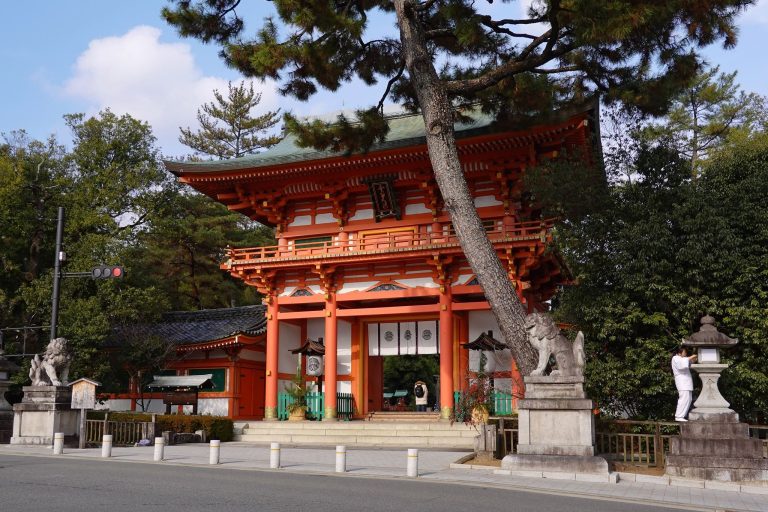
The Imperial Envoy Gate, also called the Imperial Palace Gate, dates from the Keichō era, approximately 1596 to 1614. Emperor Go-Mizunoo presented it from the Imperial Palace, and it was moved to its present position in 1640.
Service and Tea Buildings
The Kuri, a temple service and kitchen building, was rebuilt around 1636 using materials from the former Hōjō. A tea hall built in 1630 by Masuda Motoyoshi, a chief retainer of the Chōshū Domain, is accompanied by a corridor that is also designated an Important Cultural Property. A Samurai Shinryō building dates from the late Muromachi period.
Gardens and Sub-temples
Abbot’s Chamber Garden
The Abbot’s Chamber Garden is a Japanese dry landscape garden, or karesansui, attributed to the priest Tenyu. Karesansui gardens use stones, gravel, sand, and sometimes moss instead of ponds or streams. The garden forms part of the nationally protected Hōjō complex.
Daisen-in
Founded in 1509, Daisen-in contains a six-room arrangement, highly valued sliding screens, and a dry landscape garden of approximately 100 square metres. The garden’s creation is attributed to Kogaku or Sōami and expresses nature through Zen ideas. Daisen-in also preserves what is described as Japan’s oldest surviving recessed decorative alcove, or tokonoma, and oldest entrance area, or genkan.
Shinju-an and Ryōgen-in
Shinju-an was established in connection with Ikkyū Sōjun. Its garden is traditionally attributed to Murata Jukō and includes a well-known stone dry garden. Ryōgen-in has five gardens arranged around its buildings. In its largest garden, gravel represents the universe and rocks represent islands. A moss-covered island with two projecting rocks represents a tortoise and a crane, symbols of longevity and health.
Kōtō-in
Kōtō-in was established in 1601 by Hosokawa Tadaoki and is associated with the Hosokawa family. It contains the graves of Tadaoki and his wife, Gracia, together with a grave traditionally attributed to the founder of kabuki, Izumo no Okuni. Its notable garden is composed mainly of maple trees and stone lanterns. The sub-temple also contains the tea house Shōkōken, said to have been used by Tadaoki at the Kitano Tea Gathering, and a reception room said to have been transferred from Sen no Rikyū’s residence.
Zuihō-in and Kōrin-in
Zuihō-in was established in 1535 by the Christian daimyō Ōtomo Sōrin. Its dry garden contains stones arranged in the form of a cross. Kōrin-in was founded by Hatakeyama Yoshifusa and later became a memorial temple of the Hatakeyama and Maeda families after repairs sponsored by Maeda Toshiie. Its Abbot’s Chamber alcove is described as the earliest tokonoma in Japan.
Jukō-in and Sōken-in
Jukō-in contains National Treasure wall paintings by Kanō Eitoku and the tomb monument of Sen no Rikyū, which reuses a stone pagoda dating from the Kamakura period. Sōken-in was founded by Toyotomi Hideyoshi as Oda Nobunaga’s memorial temple. It was merged administratively with the main temple in 1878 and revived during the Taishō period.
Ōbai-in, Sangen-in, and Gyokurin-in
Ōbai-in was founded by Oda Nobunaga for memorial rites for his father, Oda Nobuhide. It contains the grave of Gamō Ujisato and was merged with Shōrin-an in 1878. Sangen-in was founded by Ishida Mitsunari, Asano Yoshinaga, and Mori Tadamasa. Its graves include those of Furuta Oribe and Ishida Mitsunari, and its tea room Kōan follows Furuta Oribe’s preferences. In 1878, Sangen-in was merged with Seisen-ji and Daigen-an and moved to the site of Ryūkō-ji.
Gyokurin-in began with a building founded by Manase Shōrin, a physician to emperors and members of the imperial family. It includes a memorial hall for the warrior Yamanaka Shikanosuke and the Daitoku-ji nursery. Daikō-in was the Toyotomi family’s memorial temple. Toyotomi Hideyoshi and Toyotomi Hideyasu founded it for prayers for the repose of Toyotomi Hidenaga, whose grave is located there. Daikō-in merged with Seigen-an in 1878.
Ryūkō-in, Hōshun-in, and Kohō-an
Ryūkō-in was founded by Kuroda Nagamasa for memorial rites for his father, Kuroda Kanbei. It contains the graves of Kanbei, Nagamasa, and Kanbei’s wife, together with Kuroda family memorial tablets associated with the Fukuoka Domain. Its buildings also house Mintan, a tea room counted among the Three Great Tea Rooms and designated a National Treasure. Graves of members of the Arisugawa-no-miya family and Kikkawa Hiroie are also located there.
Hōshun-in is the Kyoto memorial temple of the Maeda family and preserves memorial associations with Maeda Toshiie and later family members. Kohō-an was founded by Kobori Enshū within Ryūkō-in and later moved outside the main grounds to the west. It contains Bōsen, a tea room designated an Important Cultural Property.
Other Affiliated Temples
Ryūsen-an was founded during the Meiō era, became defunct after the Meiji Restoration, and was revived in 1958 when Sasaki Ruth, also known as Shōkeini, established the Japanese branch of the First Zen Institute of America. Tokuzen-ji was originally an independent Zen temple founded east of Funaokayama by Tettō Gikō. After its destruction during the Ōnin War, Ikkyū moved and revived it at its present location. In the early Meiji period, it was used at different times as an agricultural experiment station and as a temporary isolation hospital during epidemics.
Ryūshō-ji began as the memorial temple of Nampo Jōmyō in western Kyoto. It entered the Jissetsu in 1386, was damaged during the 1527 Battle of Katsuragawa, and was later revived within Daitoku-ji. Yamaguchi Gendō rebuilt it in 1925 on the former site of Tenzui-ji. Nyoi-an was founded during the Ōan era in the latter half of the fourteenth century. After several relocations, its present structure was revived in 1973.
Yōtoku-in originated as Myōun-ji, founded near Gion during the Ōei era by Ashikaga Mitsuakira for memorial rites for his wife, Zenshitsu. It was later renamed Yōtoku-in after Mitsuakira’s posthumous name and moved into the Daitoku-ji grounds during the Meiō era. Former or external sub-temples also include Raikō-ji, Unrin-in, Zuiunken, Shōgen-in, Tenzui-ji, Kinryū-in, and Daigen-an. Unrin-in began as an imperial villa established in 829, became a Buddhist institution, and was revived at the site in 1706 by the Daitoku-ji abbot Kōsei Sōkan.
Zuiunken was established in the early Shōwa period through the relocation of the second-floor shoin section of the former Arisugawa-no-miya residence. During repairs to its Hōjō in 2022, it served as the temporary location for a statue of Shūhō Myōchō.
Paintings, Calligraphy, and Historical Documents
Guanyin, Monkeys, and Cranes
The National Treasure image group Guanyin, Monkeys, and Cranes consists of three thirteenth-century Southern Song paintings attributed to Muqi. The central Guanyin measures 171.9 by 98.4 centimetres, the Monkey painting 173.3 by 99.4 centimetres, and the Crane painting 173.1 by 99.3 centimetres. The group belonged to the Ashikaga shogunal collection known as the Higashiyama Treasures and was reportedly donated to Daitoku-ji by the monk Taiyuan Xuezhai of the Imagawa family. Seals associated with Ashikaga Yoshimitsu remain on the paintings.
Portraits, Calligraphy, and Documents
A National Treasure portrait of Shūhō Myōchō dates from 1334 and measures 115.5 by 56.7 centimetres. It is regarded as a foundational example among surviving portraits of the founder. Another National Treasure is a thirteenth-century Southern Song ink inscription by Xutang Zhiyu, measuring 41.7 by 120 centimetres. It records incense words written for the Bodhidharma memorial rite. The work passed through the tea master Yamanoue Sōji and the household of Toyotomi Hidenaga before being donated to Daitoku-ji.
The National Treasure document written by Emperor Go-Daigo on 24 August 1333 measures 48.8 by 87.9 centimetres. It recognizes the exclusive residence at Daitoku-ji of members of Shūhō Myōchō’s transmission line and reflects the imperial policy and estate donations that accompanied the collapse of the Kamakura Shogunate.
Other Designated Works
Other designated works associated with the complex include portraits of Emperor Go-Daigo, paintings of the Ten Kings, several Willow Guanyin images, a Nirvana painting by Kanō Shōei, a Buddhist admonition text by Konoe Iehiro, bird-and-landscape screens by Soga Nikaian, dragon-and-tiger paintings attributed to Muqi, and a hibiscus painting attributed to Muqi with an inscription by Sen no Rikyū. The collection also includes a Shaka Triad by Kanō Masanobu and seasonal pine paintings by Kanō Tan’yū.