Daihōon-ji Temple: A Kamakura-Period Buddhist Temple in Kyoto


Site at a Glance
- Rating
- 4.2
- Popularity
- Medium
- Country
- Japan
- Primary era
- Medieval
- External website
- Open
- Eras represented
- Medieval, Early Modern, Modern
- Civilizations
- Japanese, Toyotomi regime
- Site type
- Religious
- Remains
- Monastery
On this page17 sections
History
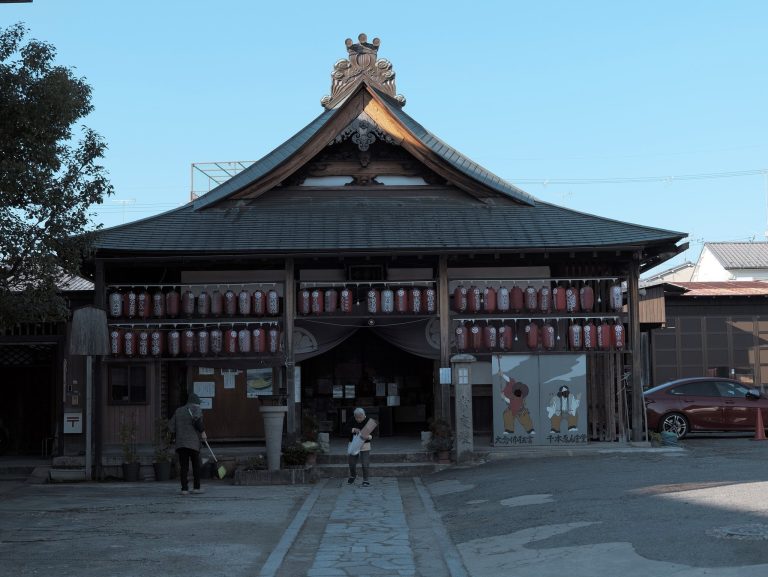
Daihōon-ji Temple is a Buddhist temple in Kyoto, Japan, whose surviving main hall dates to the Kamakura period and whose traditions connect it with imperial prayer, Buddhist learning, and the Senbon Shaka Chanting. Located in Kamigyō Ward, the temple is affiliated with the Chizan-ha branch of Shingon Buddhism and is also known as Senbon Shakadō. Its mountain name is Zuiō-zan, and it is the sixteenth temple on the New Saigoku Pilgrimage.
Early foundation and Kamakura revival
Temple tradition attributes the original foundation to Emperor Yōmei, who is said to have established it as an institution for imperial prayers. After the institution fell into ruin, the monk Gikū, also known as Guhō Shōnin, revived it around 1220 or 1221, during the Kamakura period, the era of samurai government conventionally dated from 1185 to 1333.
Gikū was a grandson of Fujiwara no Hidehira and had trained on Mount Hiei. A medieval fundraising document states that Kishitaka, a retainer of Fujiwara no Mitsutaka, known as Nekoma Chūnagon, donated the temple land. The first building was a simple thatched hall. The court later authorized Daihōon-ji to study and teach the Kusha, Tendai, and Shingon traditions. In 1235, Gikū petitioned the emperor for permission to spread these teachings and pray for the lasting prosperity of the realm. Daihōon-ji consequently became an imperial prayer temple.
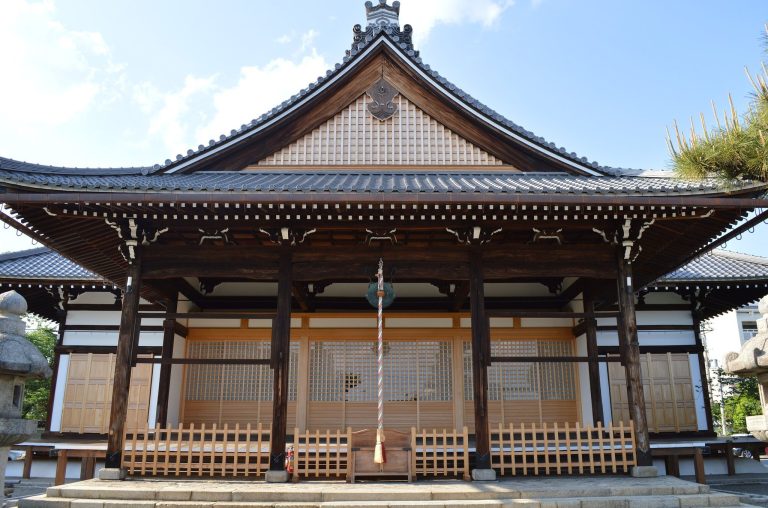
Timber merchants from Amagasaki in Settsu Province provided donations that enabled construction of the present main hall. A prayer text by Gikū, found during the hall’s dismantling and repair in 1951, records that the ridge-raising ceremony took place in 1227. The hall survived the Ōnin War, a fifteenth-century civil conflict that caused extensive destruction in Kyoto, as well as other conflicts. It is now the oldest surviving building in central Kyoto and one of the city’s few surviving medieval structures. The Japanese government designates it a National Treasure.
Religious practices and institutional history
During the temple’s early history, its second abbot, Chōkū, encouraged the chanting of the Sutra of the Buddha’s Final Teachings and a rite venerating the Buddha’s relics. During the Bun’ei era, from 1264 to 1275, the monk Nyorin established the collective recitation called the Senbon Shaka Chanting. The practice is also mentioned in section 228 of Tsurezuregusa.
In 1299, the imperial court ordered Daihōon-ji to conduct the Lotus Samādhi practice for the protection and safety of the four quarters of the realm. During the Edo period, the temple was also called Ikyōgyō-ji and served as a retirement residence for the head of Chishaku-in.
Kitano Kyōōdō and later changes
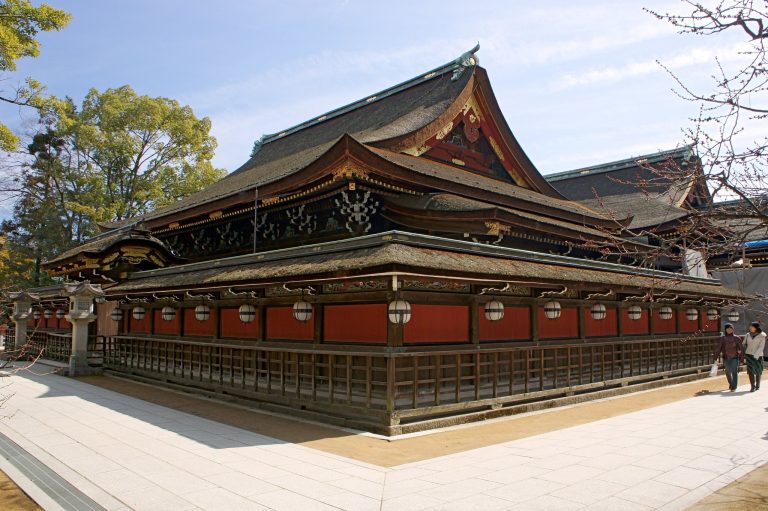
Daihōon-ji preserves material transferred from the Kitano Kyōōdō, a Buddhist institution formerly located within the grounds of Kitano Shrine, now known as Kitano Tenmangū. Ashikaga Yoshimitsu established the Kitano Manbukyō-e in 1392 to commemorate people killed in the Meitoku War, including Yamana Ujikiyo. A temple called Kitano Kyōōdō Ganjōjū-ji was built there in 1401.
The Kitano Kyōōdō burned together with Kitano Shrine during the Bun’an Disturbance in 1444. Toyotomi Hideyori ordered its rebuilding in 1605 under the supervision of Katagiri Katsumoto. Deterioration led to a reduction in scale and remodeling in 1671. After the Meiji-era separation of Buddhism and Shinto, the building was dismantled and transferred to Daihōon-ji as a smaller Kannon Hall.
Okame traditions and continuing observances
A legend associated with the main hall concerns Okame, the wife of the chief carpenter Nagai Hida no Kami Takatsugu. In 1223, Takatsugu accidentally cut a donated pillar too short. Okame advised him to correct the error with a bracket complex. The hall was successfully raised on 26 December 1227, but the story says that Okame took her own life before the next day’s ceremony so that people would not learn that her advice had solved the construction problem.
Takatsugu, or in another version Gikū, is said to have commemorated Okame by erecting a hōkyōintō, a Buddhist reliquary pagoda often used to enshrine sacred texts or sacred formulas, known as the Okame-zuka. The ceremony’s fan-shaped gohei was decorated with a good-fortune mask. The story fostered devotion among carpenters, and gohei bearing an Ōtafuku mask continue to be used at ridge-raising ceremonies. Okame worship developed around protection from misfortune and the granting of good fortune.
The temple’s established observances include the Senbon Shaka Chanting, the December Daikon-daki rite, and the Okame Setsubun ceremony. Daikon-daki is a Jōdō-e service held on 7 and 8 December. Tradition connects it with the Kamakura-period monk Jizen, who wrote a Sanskrit character on cut radishes while praying for protection from illness. The radish is now associated with protection from paralysis and other diseases.
In 2024, the six wooden Kannon statues, previously designated Important Cultural Properties, were designated National Treasures together with a wooden standing Jizō Bodhisattva statue. Kannon is the bodhisattva associated with compassion, while the six Kannon represent forms believed to aid beings in the six realms of Buddhist rebirth.
Remains
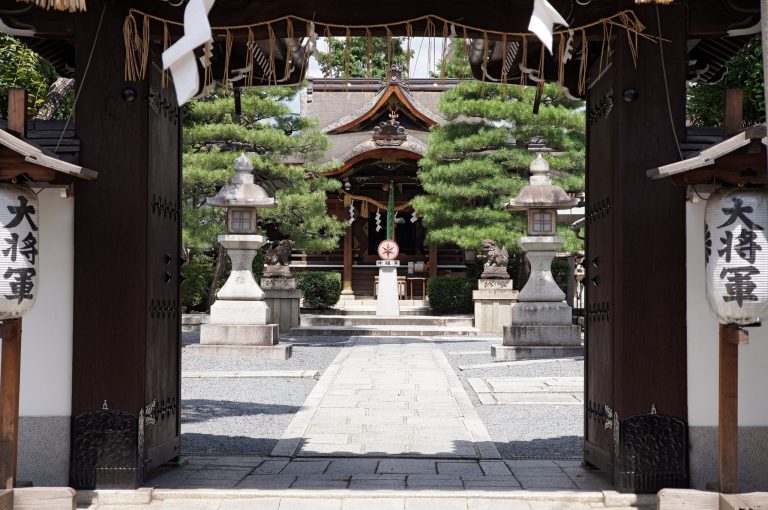
Daihōon-ji’s surviving buildings and collections center on the Kamakura-period main hall, also called the Shakadō, and the Reihōden treasure hall behind it to the west. The precinct also contains the relocated Kitano Kyōōdō, a monks’ residential and service building, a hall for the great master, the Yamana Mutsu-no-kami Ujikiyo monument, an Inari shrine, Okame monuments and statues, a hall dedicated to Fudō Myōō, and a temple gate.
Main hall
Structure and exterior
The main hall is a single-story building with a hip-and-gable roof covered in cypress-bark shingles. Its principal dimensions are five bays across the front and six bays in depth, with a one-bay projecting worship porch. Another measurement gives the front as 19.53 metres across and the depth as 23.19 metres. In that description, the counts refer to pillars rather than bays.
Five front bays are fitted with shitomi lattice shutters, traditional hinged or lifted lattice screens. On each side, the first bay has double-leaf doors, the next has lattice shutters, and the four rear bays have sliding doors. This mixture of lattice and sliding doors gives the building a residential appearance that is unusual for a Buddhist hall.
Interior plan and sacred image
The plan has a three-by-three-bay inner sanctuary, with a two-bay-deep outer area in front and side and rear aisles one bay wide. Four heavenly-king pillars enclose the central one-bay space of the sanctuary. Within it stands an altar and a shrine containing the seated image of Shakyamuni Buddha, the historical Buddha.
Unlike the usual plan of an esoteric Buddhist hall, this arrangement allows worshippers to circumambulate the principal image and belongs to the tradition of walking-practice halls. Behind the shrine, between two of the four heavenly-king pillars, is a mural painted on both sides. Its imagery is based on Shakyamuni’s preaching on Vulture Peak.
Reihōden collections
Disciples of the Buddha
The Reihōden houses Buddhist statues designated as National Treasures or Important Cultural Properties, apart from the seated principal image. Among them is a complete group of ten wooden standing statues representing the Buddha’s principal disciples. Each figure is between 94.4 and 98.0 centimetres high, and members of the workshop of Kaikei produced them between 1218 and 1220.
Inscriptions on the foot tenon of the Maudgalyāyana statue and inside the Upāli statue bear the name “Master Sculptor, Dharma-Eye Kaikei.” Kaikei is therefore thought to have worked personally on those two figures.
Six Kannon statues
The six wooden Kannon statues form a complete group and serve as the principal objects of the sixteenth stop on the New Saigoku Pilgrimage. They are made from unpainted and ungilded wood, with sutras placed inside all six figures. The seated Nyoirin Kannon is 96.1 centimetres high, while the five standing images measure between 173.4 and 180.4 centimetres.
The group came from the Kitano Kyōōdō. An inscription inside the Juntei Kannon dates its production to 1224 and names the sculptor Higo Bettō Jōkei, also known as Higo Jōkei. The figure has a lifelike face, elaborate hair, and deeply cut drapery characteristic of Jōkei’s strong Song-style manner. The Eleven-Headed and Sacred Kannon images also draw on features associated with late Nara- and early Heian-period sculpture, suggesting that older sculptural models were recreated in the Kamakura period.
The attribution of the other five figures to Jōkei personally remains debated, although the group has a strongly unified style and Jōkei may have directed its production. Eight sutras found inside the statues identify Fujiwara no Korehisa’s daughter as the principal donor. They include Lotus Sutra and dhāraṇī texts, ritual manuals for Horse-Headed Kannon, and texts associated with Thousand-Handed, Eleven-Headed, Juntei, Nyoirin, and Sacred Kannon.
Colophons in the Horse-Headed and Nyoirin texts date their copying and the commission of the images to 1224. They name Fujiwara no Korehisa and his daughter as donors, linking the sculptures and their internal manuscripts to the same act of patronage.
Other Buddhist images
The temple’s principal image is a wooden seated Shakyamuni Buddha made during the Kamakura period by Gyōkai, a disciple of Kaikei. It is a hidden image, accompanied by a canopy, and is designated an Important Cultural Property. Other Buddhist images include a bronze standing figure of the newly born Shakyamuni Buddha, a wooden standing Thousand-Handed Kannon, and a wooden standing Jizō Bodhisattva. The Jizō statue joined the six Kannon group in the 2024 National Treasure designation.
Relocated Kitano Kyōōdō material
Building and associated images
The relocated Kitano Kyōōdō, also called the Kannon Hall or Taishidō, stands within the present precinct. Its scale was reduced during the 1671 remodeling and again when it was moved to Daihōon-ji in the Meiji period. A stone monument to Yamana Ujikiyo, erected by Yamana Noritoyo, stands in front of the building.
The Fudō Myōō Hall houses an image of Fudō Myōō that had been the personal devotional image of Yamana Ujikiyo and Yamana Sōzen. The wooden images of Futaishi and his two attendants were made in 1418 by the sculptor Inryū. They originally stood beside the revolving sutra repository of the Kitano Kyōōdō before being preserved at Daihōon-ji.
Handwritten Buddhist canon
Daihōon-ji preserves the complete Kitano Kyōōdō Buddhist canon, comprising 5,048 fascicles, including 232 replacement or recopied fascicles. The collection remains with 550 lacquered sutra boxes and documents connected with the Kyōōdō’s Kakuzōbō.
The monk Kakuzōbō Zōhan commissioned the canon in 1412. It is regarded as the last complete handwritten Buddhist canon copied in Japanese history rather than printed from woodblocks. The temple also preserves a pair of drum rims associated with the Kitano Kyōōdō.
Okame and precinct features
Okame statues stand inside the main hall and elsewhere in the precinct, while numerous Okame dolls and masks donated by worshippers are displayed in the hall. The Okame-zuka is a hōkyōintō pagoda identified as Okame’s grave. Together with the Inari shrine, the Fudō Myōō Hall, and the temple gate, these features preserve the varied religious traditions connected with Daihōon-ji.