Myōō-in Temple in Ōtsu: A Tendai Mountain Sanctuary
Site at a Glance
- Popularity
- Medium
- Country
- Japan
- Primary era
- Early Modern
- Eras represented
- Medieval, Early Modern
- Civilizations
- Tokugawa
- Site type
- Religious
- Remains
- Sanctuary
On this page17 sections
History
Myōō-in Temple in Ōtsu is a Tendai Buddhist sanctuary in Japan, traditionally established in 859 by the monk Sōō as a secluded place for mountain ascetic practice. It is the inner sanctuary of Mudoji, a subtemple of Enryakuji in the Eastern Pagoda on Mount Hiei. Tendai is a Japanese Buddhist school, and the temple became closely associated with its mountain-based austerities.
Foundation and sacred tradition
Sōō, who lived from 831 to 918, was a disciple of the prominent Tendai monk Ennin and is regarded as the originator of the thousand-day circuit pilgrimage, a practice of repeated long-distance walking among sacred sites. Tradition holds that a local guardian deity gave him the site, where two youths guided him to Three Falls in the Hira Mountains. After seven days of fasting and austerities, Sōō saw Fudō Myōō, a Buddhist wisdom king associated with protective practice, in a vision at the waterfall. He then recognized that what he had taken for the deity was an old katsura tree and carved an image of the Thousand-Armed Kannon, a bodhisattva of compassion, from its wood.
The founding story also explains the temple’s drum ceremony, whose participants leap onto and off a large drum in memory of Sōō’s legendary leap into the waterfall. The form of the thousand-day pilgrimage practiced at Mudoji is said to have developed after Oda Nobunaga’s attack on Mount Hiei in 1571.
Pilgrimage and retreat practice
By the late Heian period, an era associated with classical court culture, the mountain was known for ascetic practice. A song in Ryōjin Hishō describes the pilgrimage route, while a diary entry by court noble Kujō Kanezane records a retreat beginning on June 18, 1181. Its participant was a cleric holding the rank of Hōgen, a level in the Buddhist clergy. By the late Heian period, the temple complex had also taken a form broadly similar to its later layout.
The retreat at Myōō-in, known as the Katsuragawa retreat, was once held twice a year, for seven days in the sixth and tenth months of the lunar calendar. The sixth-month observance continues as a five-day summer retreat from July 16 to 20. Practitioners undertaking either the hundred-day or thousand-day circuit pilgrimage fast and perform austerities beneath waterfalls. Completing the retreat is required for a hundred-day pilgrimage to count as finished. On the night of July 18, participants perform the drum ceremony associated with Sōō’s legendary leap.
Temple, community, and land
From the medieval period into the early modern era, retreatants presented wooden votive tablets shaped like stupas, Buddhist reliquary monuments. The practice drew people from different ranks of society, including Ashikaga Yoshimitsu and Ashikaga Yoshihisa, shoguns, or military rulers, and the aristocratic political figure Hino Tomiko.
Myōō-in was under the authority of Shōren-in, a Tendai temple historically associated with the imperial court, and Mudoji. Local residents were considered residents of the temple community rather than estate peasants, and their principal responsibilities included maintaining and repairing temple buildings. Because the area was a sacred center for Tendai ascetic practice, forest development was prohibited. Competition over rights to forest resources contributed to repeated disputes.
A boundary dispute with the neighboring estate to the south began in 1256, and six such disputes took place during the Kamakura period, when Japan’s first shogunate ruled. The conflict of 1317–18 was particularly severe and generated nearly 100 related documents. More than 4,000 records preserved at Myōō-in, dating from the late Heian period through the late Edo period under Tokugawa rule, illuminate the mountain settlement, retreat practice, relations with local residents, and arguments over land and forests.
Modern changes and preservation
During the Meiji period, a period of rapid modernization under imperial government, the separation of Buddhism and Shinto made the former guardian shrine south of the temple independent. From 2005 to 2011, a major conservation project repaired the main hall and restored its wooden-board roof. The main hall, Goma Hall, hermitage, and Mandokoro front gate, together with about 9,500 square metres of precinct land associated with Myōō-in and the former shrine, are designated Important Cultural Properties. Myōō-in is also a station on the Kinki Thirty-six Fudō pilgrimage and the Lake Biwa 108 Sacred Sites pilgrimage.
Remains
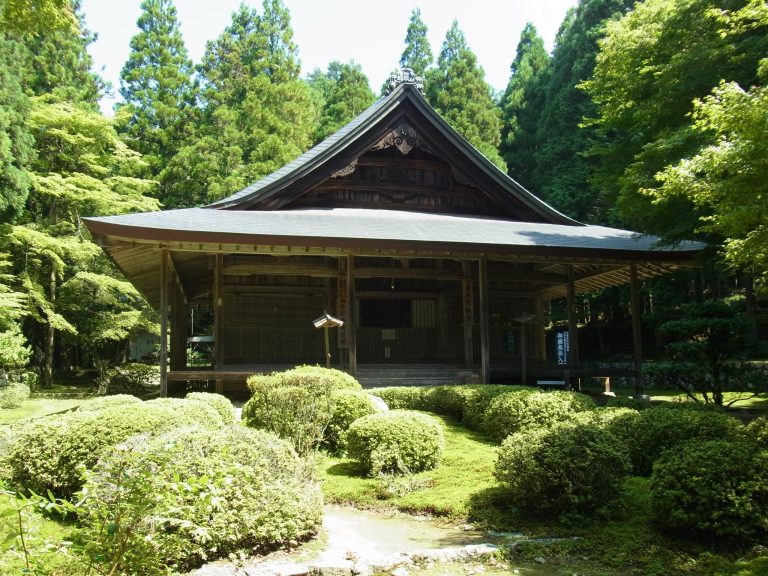
The precinct occupies a mountain slope on the north bank of a tributary valley, east of the main river. The former guardian shrine stands across the valley to the south. The temple’s buildings and spaces form a terraced arrangement, with stone walls retaining the slope. The main hall stands on a raised, levelled terrace, and the buildings have roofs of wooden boards or shingles.
Precinct and supporting structures
From the bridge in front of the former shrine, the northward alignment passes the administrative precinct on the left and Goma Hall and a hermitage on the right. Steps beside Goma Hall lead up to the main hall. Building positions closely follow those shown on medieval maps. Other structures within the precinct include a shrine to the Eight Vajra Youths, attendants of Fudō Myōō, a storehouse, a Benzaiten shrine to the Buddhist goddess associated with water and the arts, and priests’ quarters.
Main buildings
Main hall
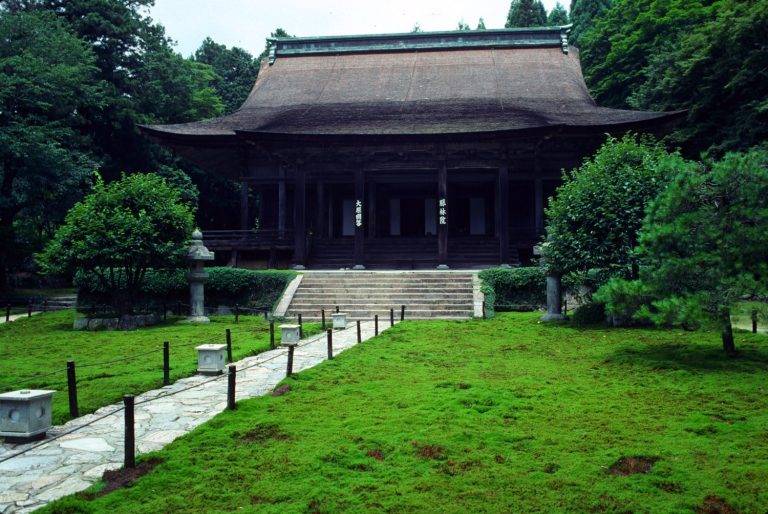
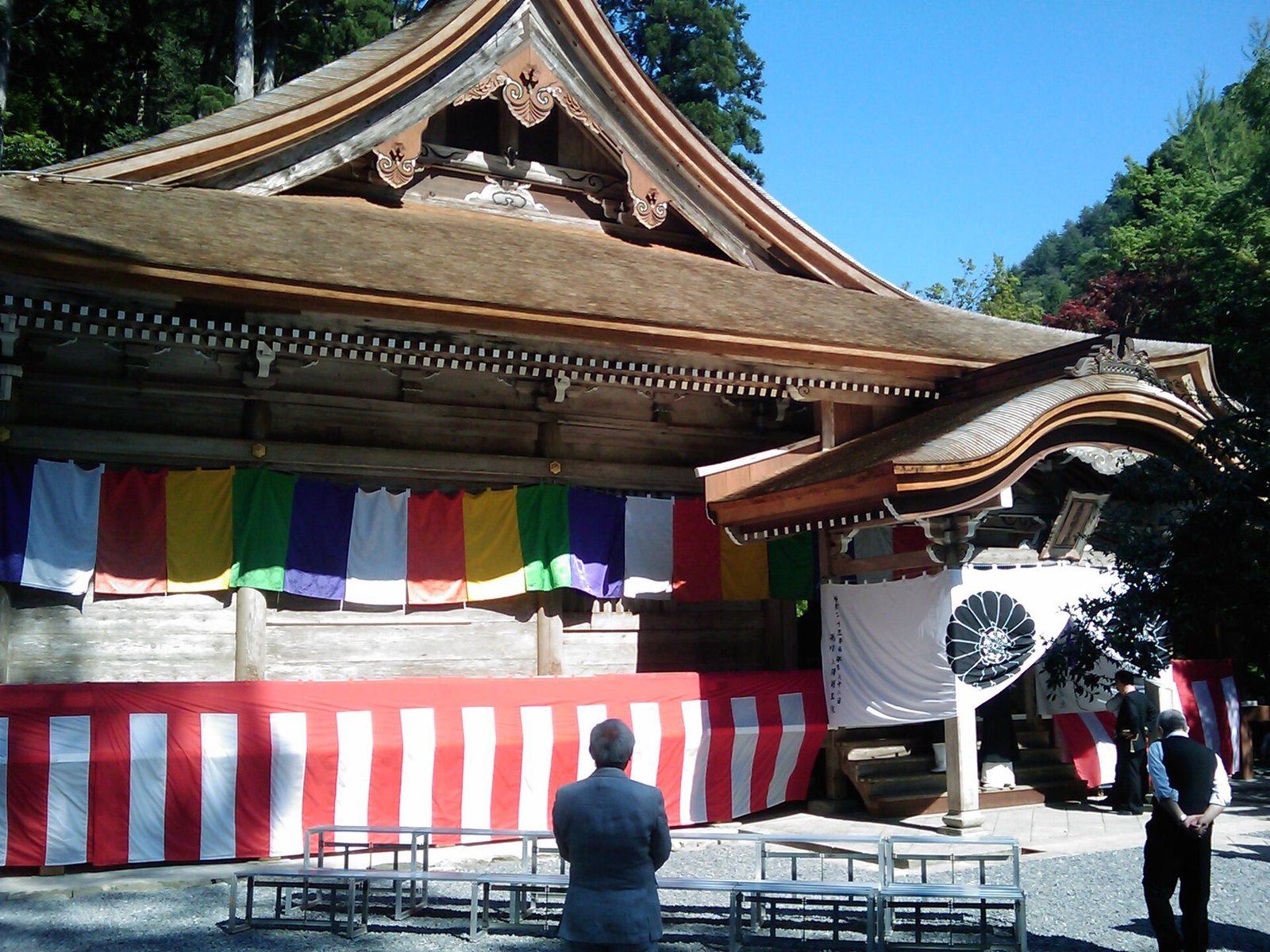
Rebuilt in 1715, the main hall faces south and has a hip-and-gable roof, which combines sloping roof planes with gabled ends. Its frontage is three bays and its depth five bays, with a bay marking the interval between structural posts. The interior plan comprises a three-by-three-bay sanctuary and a three-by-two-bay worship space in front; the building’s sole entrance is on the west. Repairs revealed that parts of an earlier hall had been incorporated into the present structure. Tree-ring analysis dates the felling of those timbers to about 1100. The earlier building had a roof of thick, overlapping wooden boards. After a metal roof was removed, the present hall was restored to that board-roof form.
Goma Hall
Rebuilt in 1755, Goma Hall is used for goma, a Buddhist fire ritual. The building is three bays square and has a pyramidal roof, which slopes on all sides toward a central peak. Its roof is covered with thin wooden shingles.
Hermitage
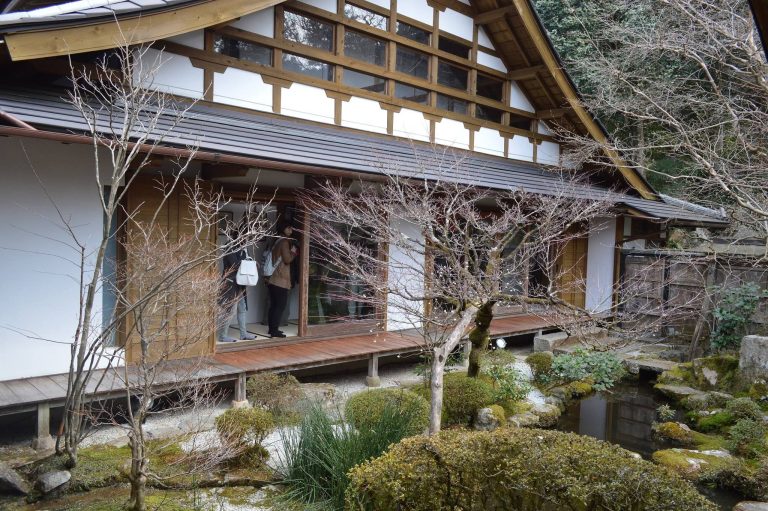
Built in 1834, the hermitage has a hip-and-gable roof of thin wooden shingles. Its interior, covered with tatami mats, provided sleeping quarters for practitioners attending the retreat.
Mandokoro front gate
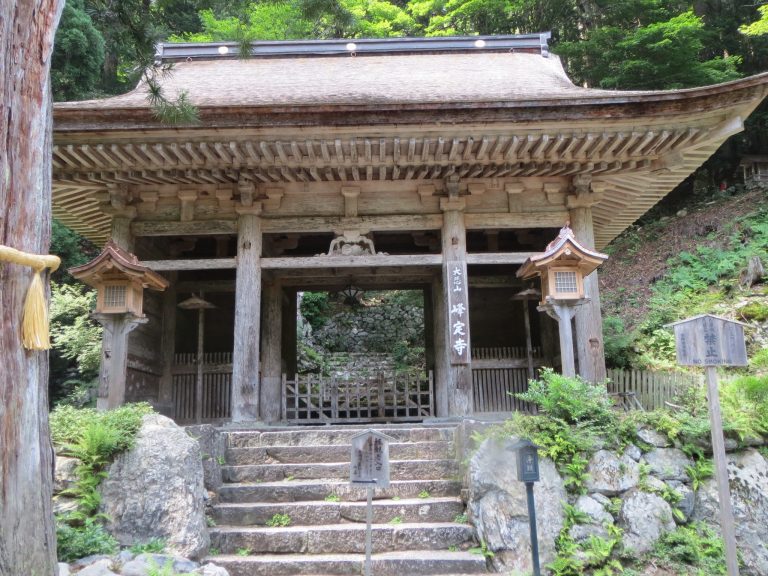
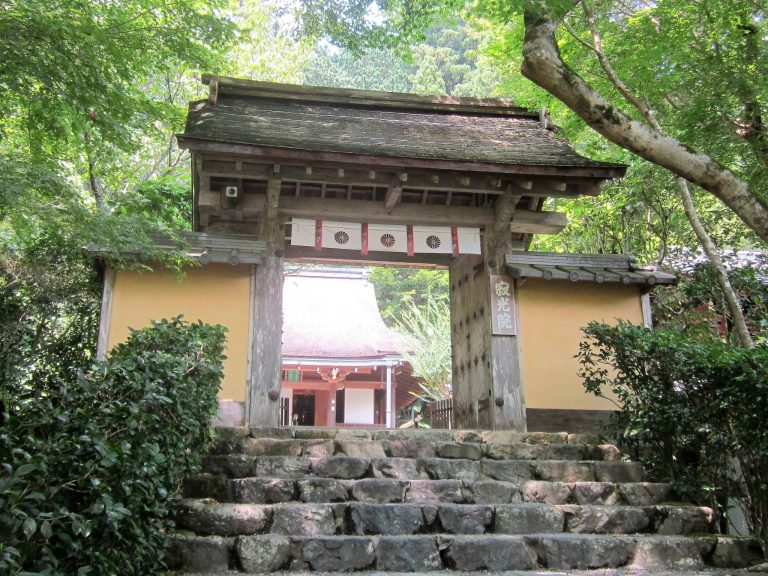
Mandokoro refers to an administrative office or precinct. The front gate, rebuilt in the early Edo period, is the oldest surviving building at the temple. It has a gabled roof covered with thin wooden shingles.
Images, documents, and ritual objects
Principal images
The principal image group is thought to date to the twelfth century. A standing Thousand-Armed Kannon occupies the center, with Bishamonten, a Buddhist guardian deity, on the viewer’s right and Fudō Myōō on the viewer’s left. The Kannon has a lacquered and gilded surface, with gently modeled features and shallow carving of the face and drapery. The two attendant figures are painted.
Documents and boundary maps
The preserved collection contains 4,336 documents, the earliest dated 1117, as well as three document chests associated with 1318. Two maps relate to the dispute with the southern estate: a simpler map dated 1317 and a colored map dated 1318.
Votive tablets
A total of 501 wooden retreat tablets survive from the Kamakura through Edo periods. The earliest dates to 1204. At 391 centimetres tall, it is exceptionally large and was offered by seven people.
Bell and other metal objects
An associated bell was cast in 1363 by Tachibana Sueyasu; an inscription on its rim records repairs in 1805. A copper bowl commissioned in 1335 is a dated example from western Japan. An incense burner bears an engraved date of September 1513, while an inscription beneath its base notes that damaged components were remade in 1753.