Bujō-ji Temple: A Mountain Shugendō Temple in Kyoto


Site at a Glance
- Rating
- 4.5
- Popularity
- Very Low
- Country
- Japan
- Primary era
- Medieval
- External website
- Open
- Eras represented
- Medieval
- Civilizations
- Unclassified
- Site type
- Religious
- Remains
- Sanctuary
On this page10 sections
History
Bujō-ji Temple is a mountain temple in Kyoto, Japan, established in February 1154 during the late Heian period, Japan’s imperial court era from 794 to 1185. It belongs to Honzan Shugenshū, a Shugendō denomination historically associated with Shogoin. Shugendō is a Japanese mountain ascetic tradition that combines Buddhist, Shinto, and other religious practices. The temple’s mountain name is Daihizan, meaning “great compassion,” and its principal image is Senju Kannon, the thousand-armed form of Kannon, the Buddhist bodhisattva of compassion.
Foundation in the late Heian period
The foundation tradition preserved in the Record of the Foundation of Daihizan Bujō-ji, written by the court figure and scholar Fujiwara no Michinori, also known as Shinzei, attributes the temple’s establishment to the imperial vow of Emperor Toba and to Kanku Sainen, who was also called Mitaki Shonin. Emperor Toba was a retired emperor who continued to exert religious and political influence after abdication.
The same tradition identifies Emperor Toba’s personal devotional image of Senju Kannon as the temple’s principal image. Fujiwara no Michinori and Taira no Kiyomori were associated with the construction of the main hall and Niō Gate. Kiyomori was a leading military and political figure of the late Heian period.
Shugendō and Daihizan
Kanku Sainen trained at Mount Omine and in Kumano, two renowned areas of mountain ascetic practice. Daihizan contains training places associated with this tradition, including locations known as Bell-Hanging Rock and Ant’s Crossing. Because of these practices and its mountainous setting, Daihizan was traditionally called the “Northern Omine,” linking it symbolically with the better-known Omine training grounds.
Medieval rebuilding and later restoration
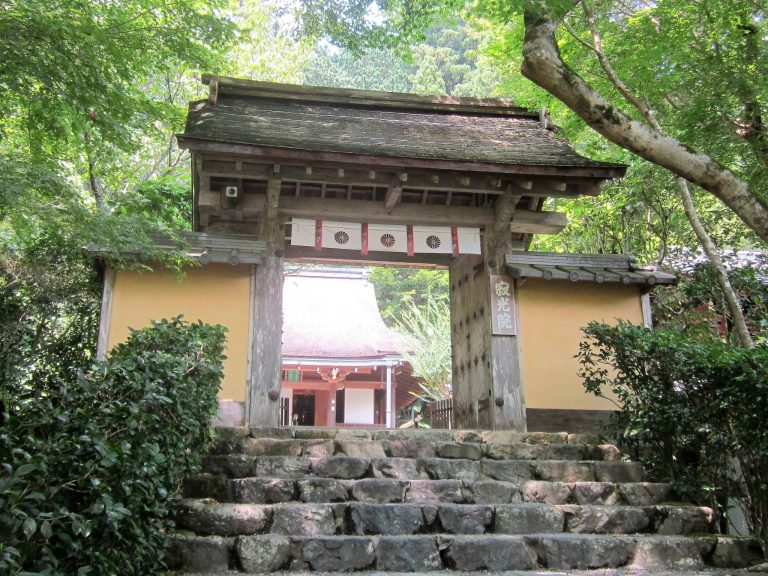
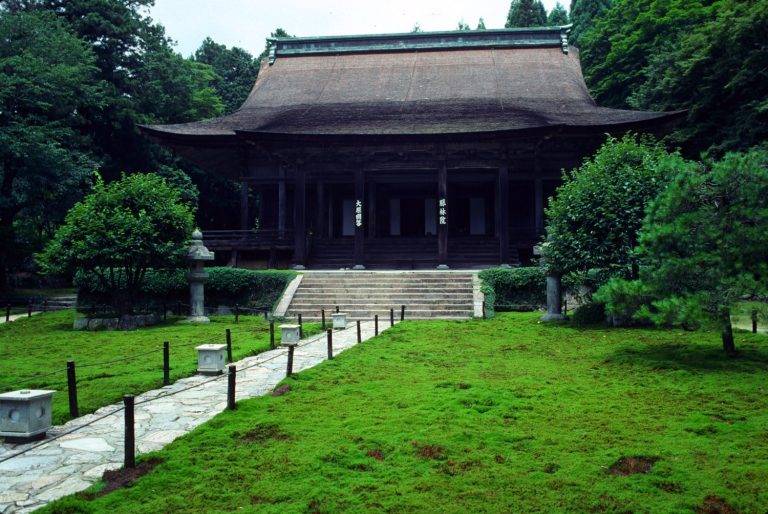
The present Niō Gate was rebuilt in 1350, and the main hall is thought to have been rebuilt around the same time. Bujō-ji appears to have remained prosperous until this period, after which it gradually declined. During the early modern period, the complex fell into disrepair.
In 1676, Emperor Go-Sai ordered the tonsured imperial prince Doyu of Shogoin to direct Genkai of Kibune Jojuin in restoring the temple complex. The restoration is also assigned to the period from 1716 to 1736, so its precise date remains uncertain. After this work, Bujō-ji became a subordinate temple of Shogoin and part of Honzan Shugenshū.
Bujō-ji is regarded as a twelfth-century foundation that preserves Buddhist images and other cultural properties associated with its foundation period. Its main hall, water-supply facility, Niō Gate, and several statues are designated Important Cultural Properties. The principal image and associated Buddhist statues, once deposited with the Nara National Museum, have returned to Bujō-ji and are kept in a storage repository.
Remains
Mountain setting and approach
The temple complex lies in the mountainous Hanase district near the northern edge of present-day Kyoto, on the southern mid-slope of Daihizan, a mountain about 747 metres high. The Niō Gate stands beside the Teradani River, one of the headwaters of the Katsura River. From the gate, a mountain approach climbs toward the main hall, rising by roughly 400 stone steps and taking approximately fifteen minutes uphill. This route lies within a designated historical natural-environment conservation area.
Ascetic training places are distributed across Daihizan. Behind the main hall, a rocky area contains chains associated with Shugendō practice, connecting the surviving temple landscape with the mountain exercises traditionally carried out there.
Temple buildings
Niō Gate
The Niō Gate is a temple gateway associated with paired Buddhist guardian figures. Standing beside the Teradani River, the present gate dates from its rebuilding in 1350. It forms the lower point of the mountain approach to the main hall and is one of the buildings included among Bujō-ji’s Important Cultural Properties.
Main hall
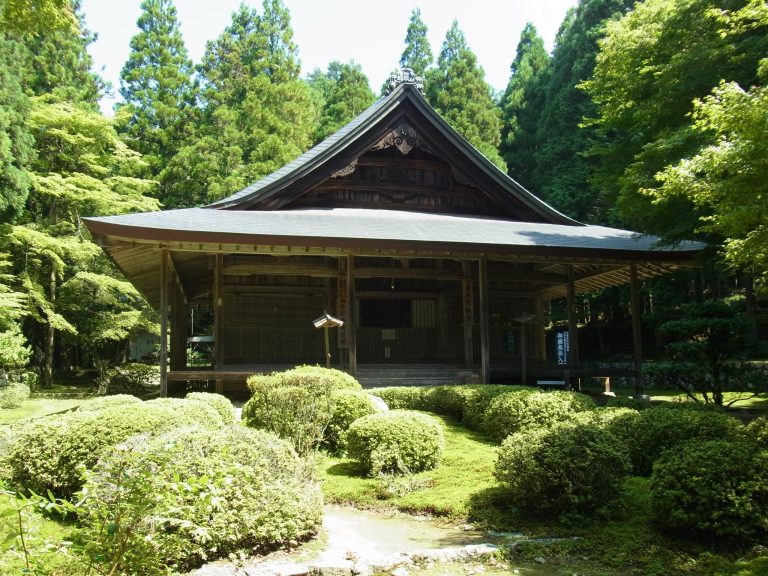
The main hall stands uphill from the gate on the mountainside. It is a stage-style timber building, meaning that it is raised on a projecting wooden platform supported by posts on sloping or uneven ground. The hall is thought to have been rebuilt around 1350 and is designated an Important Cultural Property. The rocky training area with chains lies behind it.
Buddhist sculptures
Bujō-ji preserves a seated Senju Kannon as its principal image. Images regarded as works from the foundation period include this sculpture, a standing Fudō Myōō with two attendants, and a standing Bishamonten. Fudō Myōō is a Buddhist Wisdom King associated with immovable resolve and the overcoming of obstacles, while Bishamonten is a guardian deity associated with protection and martial power.
The temple’s Kongorikishi statues, muscular guardians traditionally associated with temple gates, contain an interior inscription dated to 1163. A standing Shaka Nyorai is dated to 1199 through objects placed inside the statue. These sculptures are small but carefully executed works in the Kyoto style. The Senju Kannon, Fudō Myōō group, Bishamonten, and Shaka Nyorai are kept in the temple’s storage repository rather than routinely displayed.