Jakkō-in: A Tendai Buddhist Nunnery in Kyoto


Site at a Glance
- Rating
- 4.3
- Popularity
- Medium
- Country
- Japan
- Primary era
- Early Modern
- External website
- Open
- Eras represented
- Early Modern
- Civilizations
- Japanese, Toyotomi regime
- Site type
- Religious
- Remains
- Monastery
On this page9 sections
History
Jakkō-in is a Tendai Buddhist nunnery in Kyoto, Japan, traditionally founded in 594 during the reign of Empress Suiko. Its mountain name is Seikōzan, and its formal temple name is Seikōzan Jakkō-in Gyokusenji. Temple tradition attributes its establishment to Prince Shōtoku as a memorial institution for his father, Emperor Yōmei, and gives its original name as Gyokusenji. Tamateru-hime, also known as Ezen-ni, is traditionally regarded as its first abbess.
Competing Foundation Traditions
Jakkō-in preserves several accounts of its origins. Other traditions attribute the foundation to Kūkai or to Ryōnin, the late-eleventh-century founder of the Yuzu Nembutsu movement, who lived in Ohara and is associated with the completion of Ohara Shōmyō, a tradition of Buddhist liturgical chant. These accounts place the temple within the religious history of Ohara, although its precise early development remains unclear.
Awa no Naiji, the daughter of Shinzei, is regarded as the second abbess. She served Kenrei Mon’in before entering religious life and becoming abbess of Jakkō-in. Tradition also regards her as a model for the Oharame, a figure associated with the women of Ohara.
Kenrei Mon’in and the Taira
Jakkō-in’s best-known historical association began after the Taira clan was defeated and destroyed at the Battle of Dan-no-ura in 1185. Kenrei Mon’in, the consort of Emperor Takakura and mother of the child Emperor Antoku, entered Jakkō-in through Awa no Naiji. She became a nun under the name Shinyokaku Bikuni and is traditionally regarded as the temple’s third abbess.
Kenrei Mon’in spent the rest of her life at the temple praying for the souls of the Taira family and for those of Emperors Takakura and Antoku. Fujiwara no Sukeko, the wife of Taira no Shigehira, also became a nun and served her there. The association between Jakkō-in and the defeated Taira court gave the nunnery a lasting place in Japan’s religious and literary memory.
The Ohara valley was a place of practice for Nembutsu devotees, whose discipline centered on reciting the name of Amitabha Buddha, and a retreat for aristocrats. In 1186, Retired Emperor Go-Shirakawa visited Kenrei Mon’in at Jakkō-in. The meeting appears in the “Ohara Pilgrimage” episode of The Tale of the Heike, a medieval war epic about the rise and fall of the Taira clan. Its central Buddhist theme is impermanence, the transience of worldly power and existence.
Nunnery and Later Reconstruction
During the medieval and early-modern periods, Jakkō-in functioned as a nunnery combining Tendai teachings with Pure Land practice, which centers on devotion to Amitabha Buddha and rebirth in the Pure Land. Tradition holds that successive abbesses from aristocratic families maintained the temple’s religious lineage.
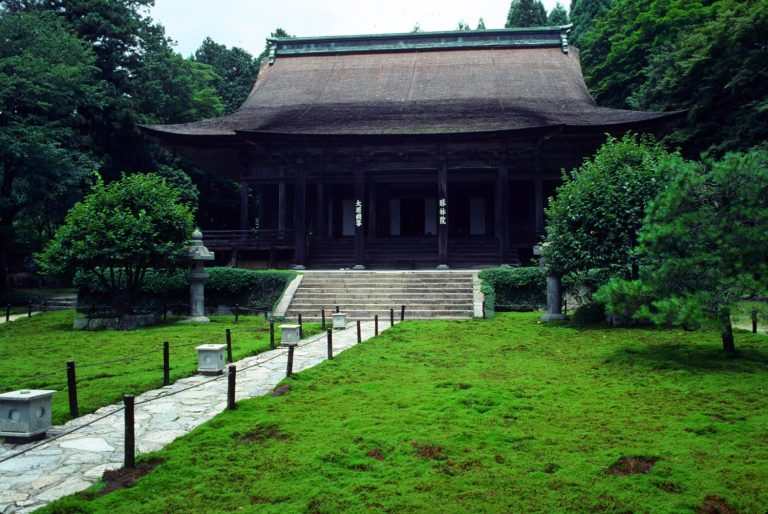
The main hall was rebuilt or repaired during the Keichō period, from 1596 to 1615, at the order of Yodo-dono and Toyotomi Hideyori. Katagiri Katsumoto served as construction commissioner, and one tradition dates the repair specifically to 1603. The hall was repaired again in 1936.
On May 9, 2000, arson destroyed the main hall. The fire also damaged the principal Jizō statue and destroyed the papier-mâché images of Kenrei Mon’in and Awa no Naiji. The perpetrator was not apprehended, and the prosecution became time-barred on May 9, 2007. A new main hall was rebuilt on June 2, 2005, with new images of Jizō, Kenrei Mon’in, and Awa no Naiji.
Jakkō-in’s wooden standing Jizō image was designated an Important Cultural Property in 1986. Its internal deposits were added to the designation in 1988, followed by 3,210 small Jizō figures formerly installed around it in 1989. After the fire, the designation name was changed in 2001 to identify the image as fire-damaged. The temple is also associated with Kenrei Mon’in’s adjacent mausoleum, Ohara Nishino-misasagi, which is administered by the Imperial Household Agency. Nearby graves are traditionally attributed to several of her attendants, including Awa no Naiji, Dainagon no Sakyoku, Jibu-kyō no Tsubone, Ukyo no Daibu, and Ko-shōshō no Tsubone.
Remains
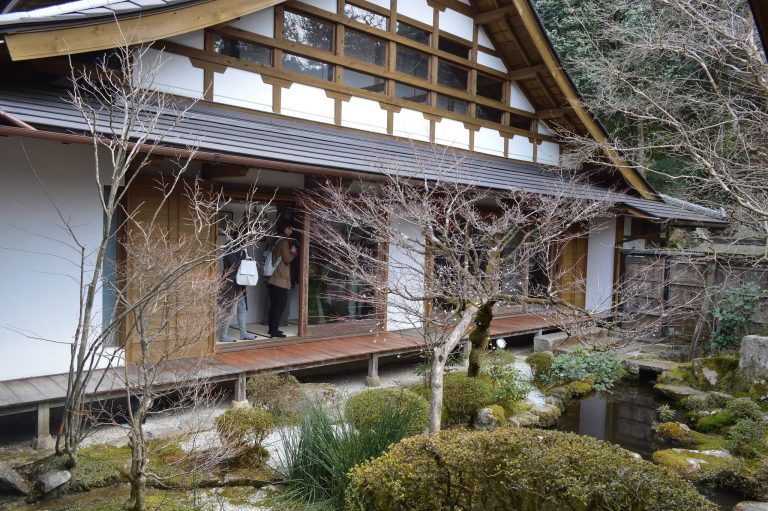
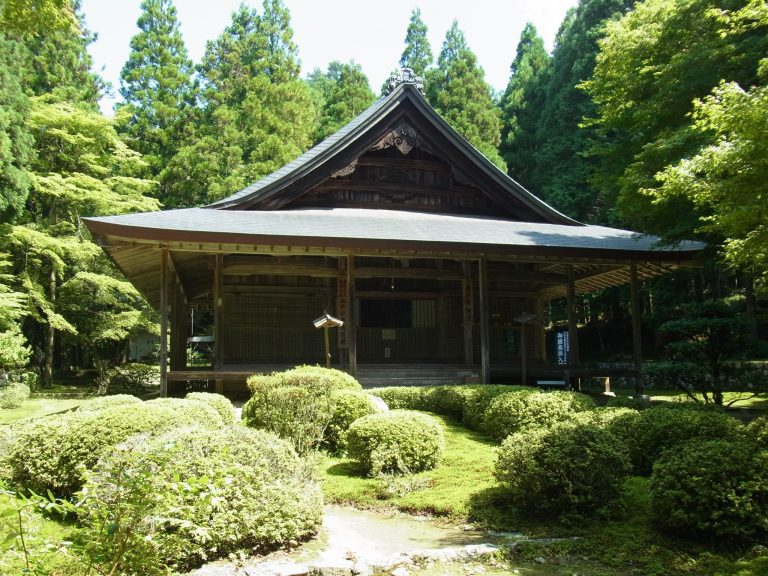
Jakkō-in is a small temple complex in the wooded mountain setting of Ohara, above Kyoto. A long stone staircase climbs the mountainside to the buildings. Within the complex are a small garden and the main hall, while the surrounding woodland forms the physical setting associated with Kenrei Mon’in’s retreat. The garden and setting are traditionally described as closely resembling the place presented in The Tale of the Heike.
Temple Grounds and Literary Setting
The temple’s surviving layout is reached by the long stone stairway leading up the slope. The main hall and garden form the principal visible elements of the complex. The Tale of the Heike describes Kenrei Mon’in’s retreat as a plank-floored room of approximately five square metres, where she is said to have lived in prayer for nearly thirty years. This literary description belongs to the tradition surrounding the site rather than serving as an independently verified measurement.
Sculpted and Commemorative Images
Standing Jizō
The former principal image was a wooden standing Jizō Bodhisattva, a compassionate Buddhist figure associated with protecting travelers, children, and beings in difficult states of existence. The statue stood 256.4 centimetres high. Tradition attributed it to Prince Shōtoku, while a prayer text placed inside the image bears the date 1229.
The statue was known as the “Sixty-Thousand Jizō Bodhisattvas.” Approximately 30,000 small Jizō figures were said to have been placed on shelves around it, with another 30,000 inside the statue. The designated group of surrounding figures consisted of 3,210 images. The 2000 fire burned and damaged the old statue’s main body, but its internal deposits survived. The fire-damaged image and those deposits are kept in a repository on higher ground than the main hall and are shown to the public on specified days.
A replacement principal image was completed in 2005 after three and a half years of work by the sculptor Hisayuki Onodera at the Fine Arts Institute’s National Treasure Restoration Workshop. It was made from assembled hinoki cypress wood, meaning that multiple joined sections were used rather than a single block, and was reconstructed to the original dimensions and form. Its appearance followed the presumed form of the old statue when newly made.
Images of Kenrei Mon’in and Awa no Naiji
The former images of Kenrei Mon’in and Awa no Naiji were papier-mâché figures reportedly made with Kenrei Mon’in’s letters and copied sutras. Both were destroyed in the fire. For the reconstructed hall, they were remade in wood. The image of Kenrei Mon’in was made by the sculptor Eri Kōei of Heian Buddhist Artworks, while the image of Awa no Naiji was produced by the same workshop.