Hōsen-in Temple: A Tendai Buddhist Subtemple in Kyoto


Site at a Glance
- Rating
- 4.6
- Popularity
- Medium
- Country
- Japan
- Primary era
- Early Modern
- External website
- Open
- Eras represented
- Early Modern, Modern
- Civilizations
- Ashikaga shogunate, Japanese, Tokugawa
- Site type
- Religious
- Remains
- Monastery
On this page15 sections
History
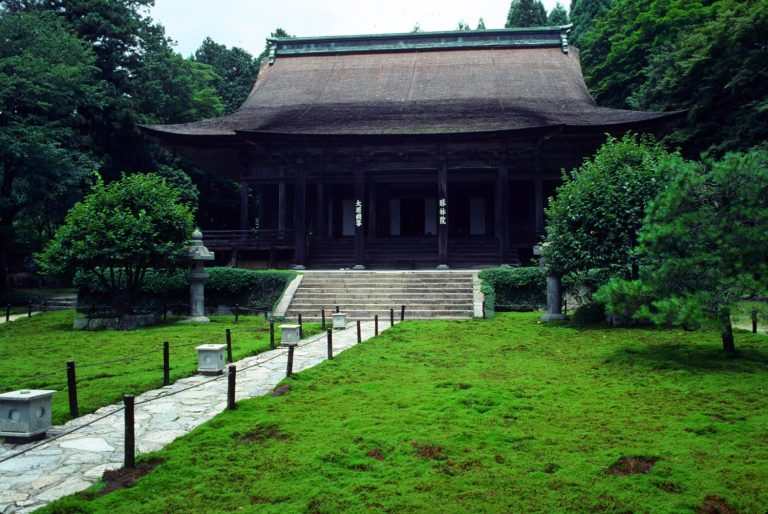
Hōsen-in Temple is a Tendai-shū Buddhist temple in Kyoto, Japan, and a subtemple of nearby Shōrin-in. Tendai-shū is a major Japanese Buddhist school rooted in the Chinese Tiantai tradition, while a subtemple is a smaller institution attached to a larger temple. Hōsen-in stands at the far end of the approach to Sanzen-in, one of three Tendai monzeki temples, traditionally associated with the imperial family or nobility. Its mountain name is Uosan, and its principal image is Amida Buddha, the Buddha associated with rebirth in the Western Pure Land.
Early institutional history
The temple’s origin remains uncertain. One chronology places its construction in 1012, during the reign of Emperor Sanjō, as quarters for priests serving Shōrin-in. Another account dates its foundation to 1235–1238, when Sōkai Hōin, a prominent authority on shōmyō, the Japanese tradition of Buddhist liturgical chant, established the institution. In this second tradition, it was originally called Ryōseibō.
Ryōseibō continued to be recorded until 1466–1467, after which it is considered to have ceased to exist. A new monastic residence, Hōsenbō, was rebuilt on the former site probably in the early 1570s, during the Genki era, the Japanese era of 1570–1573. This reconstruction is associated with a religious figure whose lifetime was 1477–1559. The figure’s appearance at a memorial Buddhist service for Emperor Go-Tsuchimikado in September 1571 corresponds with the traditionally assigned date for the reconstruction of the shoin, the formal reception and study hall.
Renaming and later development
The institution was renamed Hōsen-in in May 1716. Its later history is also reflected in the gardens and buildings that form the present temple complex. Nisshin-an, the tea house, was built in 1905 and moved to its current position in 2013.
Remains
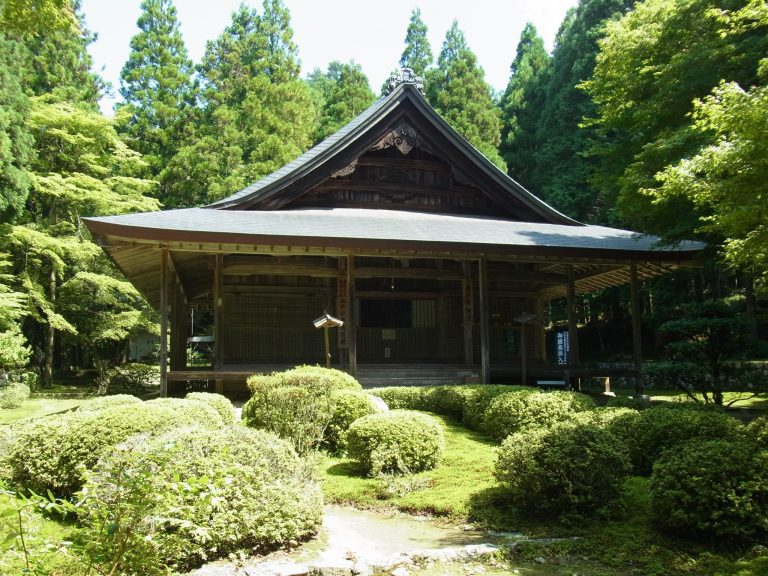
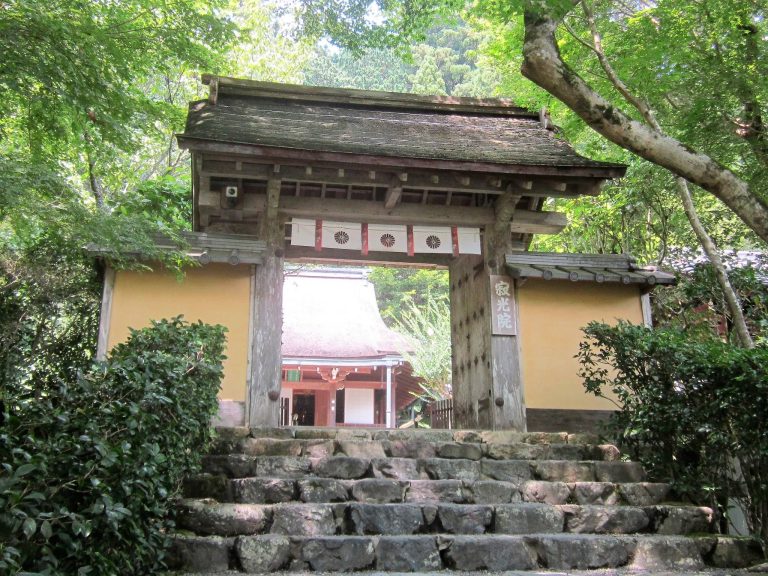
Hōsen-in’s grounds include kitchen quarters, a main gate, the shoin, a guest hall, three gardens, and the tea house Nisshin-an. The buildings and gardens are arranged as a connected temple complex, with the gardens providing distinct settings for the principal halls and entrance area.
Temple buildings and memorial features
Shoin
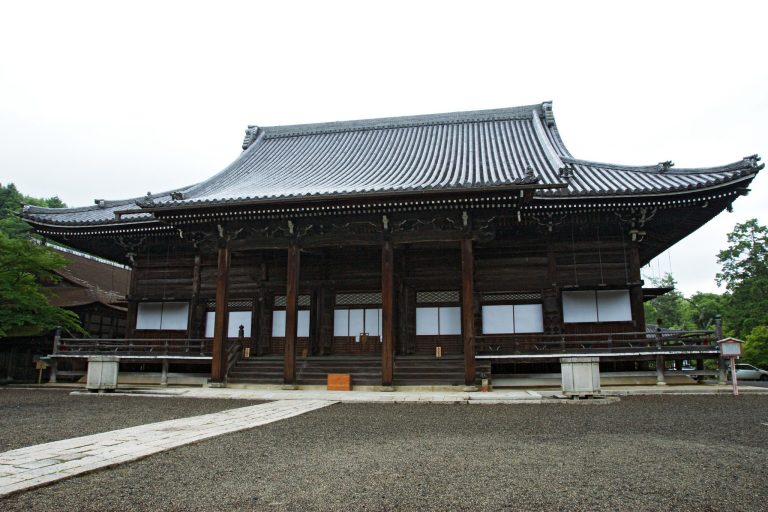
The shoin serves as Hōsen-in’s main hall. Its reconstruction has been dated either to 1502 or to the middle of the Edo period, the period of Tokugawa rule conventionally dated from 1603 to 1868. The difference between these dates remains unresolved. Its corridor has a ceiling known as the “blood ceiling,” formed from floorboards removed from Fushimi Castle.
Blood ceiling
The boards are said to retain the blood of Torii Mototada and several hundred other defenders who committed suicide during the 1600 defense of Fushimi Castle. Torii, a retainer of Tokugawa Ieyasu, commanded the castle against forces led by Ishida Mitsunari. The defense was a preliminary engagement of the Battle of Sekigahara, and the delay caused by the fighting gave Ieyasu additional time before that battle. The boards were installed at Hōsen-in as a memorial to the dead.
Richi-funi
Beside the guest hall is Richi-funi, a water-drop sound device made from sanukite, a hard volcanic stone. Its unusual two-part structure produces a sound said to convey an esoteric Buddhist teaching.
Gardens and cultivated features
Bankanen Garden
Bankanen is known as a “framed garden” because the shoin’s pillars and lintel are viewed as a picture frame around it. Its name expresses reluctance to leave. The temple’s five-needle pine grows on the garden’s southern side and is approximately 700 years old. It was registered as a Kyoto City natural monument in April 1991 because of its exceptional size and vigorous condition.
The pine is approximately 11 metres high, with branches extending about 11.5 metres from north to south and 14 metres from east to west. Its crown is roughly fan-shaped, and its roots have a circumference of 425 centimetres. The trunk divides at ground level and again about one metre above the ground. Of its three trunks, the central one is the largest and supports most of the crown. Tradition identifies the tree with Mount Mikami, known as Ōmi Fuji, and Takahama Kyoshi composed a poem about it.
Tsuru-Kame Garden
Tsuru-Kame Garden lies beside the left side of the entrance. It is a pond-style strolling garden dating from the middle of the Edo period. The pond is shaped as a crane, an old sasanqua tree represents Mount Hōrai, and an artificial hill represents a tortoise. A sala tree in the garden is estimated to be 300 years old.
Hōrakuen
Hōrakuen is a dry-landscape garden, a composition that represents natural scenery mainly through arranged stones, gravel, and limited planting rather than standing water. It was completed in March 2005 after being designed by the garden artist Enya. Approximately 300 tonnes of stone were brought from Yamagata and Nagano prefectures for its construction.
Other features
Nisshin-an
Nisshin-an is the complex’s tea house. Built in 1905, it was relocated to its present position in 2013.
Hōnen’s robe-hanging stone
A stone known as Hōnen’s robe-hanging stone stands within the temple grounds. It was moved to its present position at a later date.