Andon-yama Kofun: An Early Yamato Great-King Tomb in Japan


Site at a Glance
- Rating
- 4.2
- Popularity
- Low
- Country
- Japan
- Primary era
- Classical
- External website
- Open
- Eras represented
- Classical
- Civilizations
- Yamato
- Site type
- Burial
- Remains
- Burial Mound
On this page10 sections
History
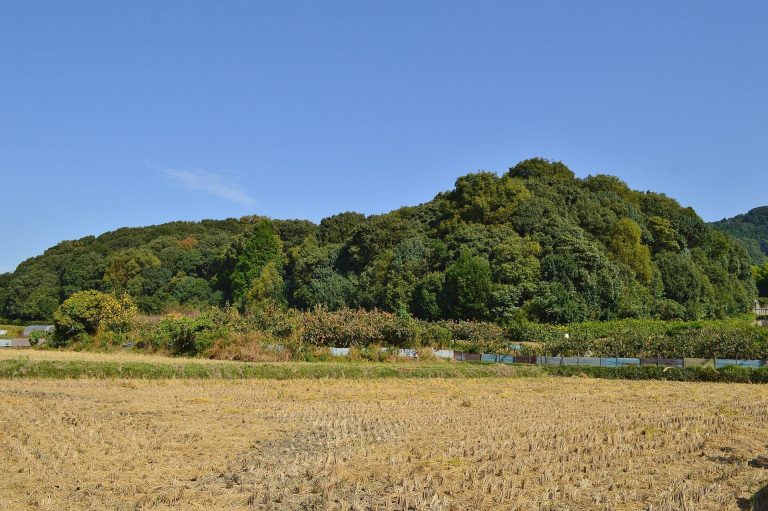
Andon-yama Kofun is a monumental Japanese burial mound in Tenri, Nara, Japan, built during the first half of the fourth century in the latter part of the early Kofun period. Its builders belonged to the society that created the large elite tombs of this era. The mound forms part of the Oyamato Kofun Group, specifically its Yanagimoto subgroup, and is regarded archaeologically, together with Shibutani Mukoyama Kofun, as a great-king tomb associated with the emerging early Yamato polity.
Construction in the Early Kofun Period
Andon-yama Kofun was probably constructed before Shibutani Mukoyama Kofun within the Yanagimoto group. The early Yamato polity was the developing centralized political authority that emerged in the Japanese archipelago during the Kofun period, broadly between the third and sixth centuries. The tomb’s scale and position within the Oyamato group place it among the major burial monuments connected with that political formation.
The person buried at Andon-yama Kofun cannot be identified with certainty. The Imperial Household Agency designates it as the mausoleum of Emperor Sujin, the traditionally counted tenth emperor of Japan, under the formal name Yamanobe no Michi no Magari no Oka no E no Misasagi. Ancient records place Sujin’s mausoleum in the Yamanobe area, but later tradition lost the precise location. A late-Edo interpretation first identified the mound as the tomb of Emperor Keiko. By the end of the Edo period, another interpretation had associated it with Emperor Sujin, and the imperial authorities adopted that identification in 1865. It has remained the official designation, rather than archaeological proof of the buried individual’s identity.
Restoration and Investigation
The Yanagimoto domain carried out restoration work between 1864 and 1865. This intervention altered parts of the surrounding moat and embankments, and a copper plate was found during the work. The Imperial Household Agency now manages the mound as an imperial mausoleum. Its Department of the Archives and Mausolea investigated the outer embankment, connecting embankments, and the foot of the rear mound in 1974 and 1975. Controlled-entry surveys by archaeological and historical researchers followed in 2017 and 2020.
Andon-yama Kofun is the sixteenth-largest kofun in Japan and the second-largest mound in the Yanagimoto subgroup. Shibutani Mukoyama Kofun, the largest in that subgroup, measures 300 meters. The formal mausoleum designation and associated subsidiary mounds are administered as one imperial mausoleum complex. Yamato Tenjinyama Kofun, located nearby, has also been interpreted as a possible subsidiary mound, although that relationship remains uncertain.
Remains
Main Burial Mound
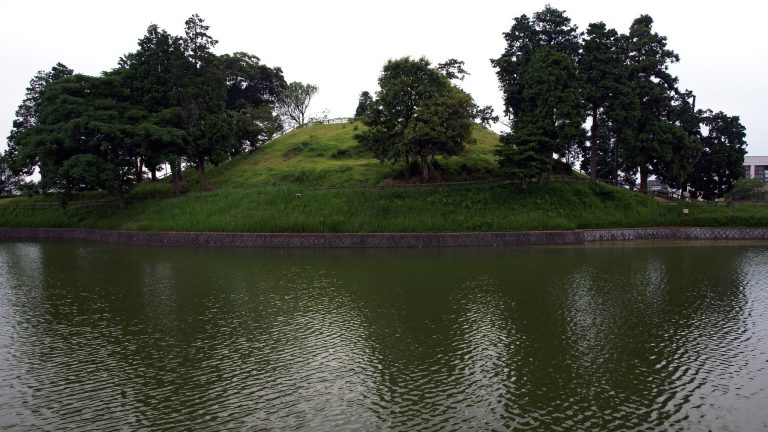
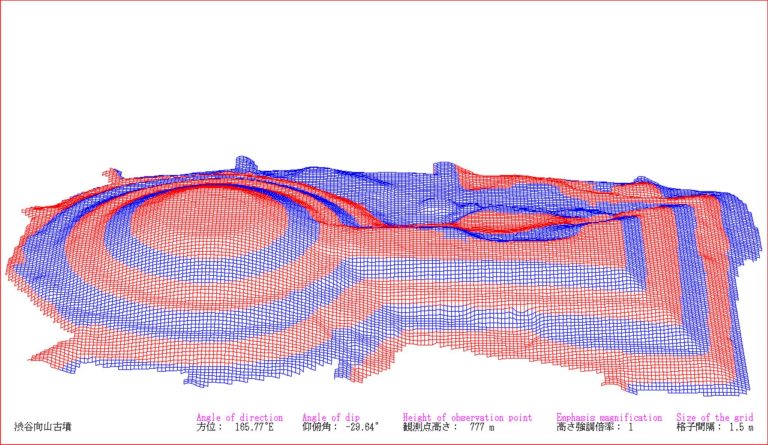
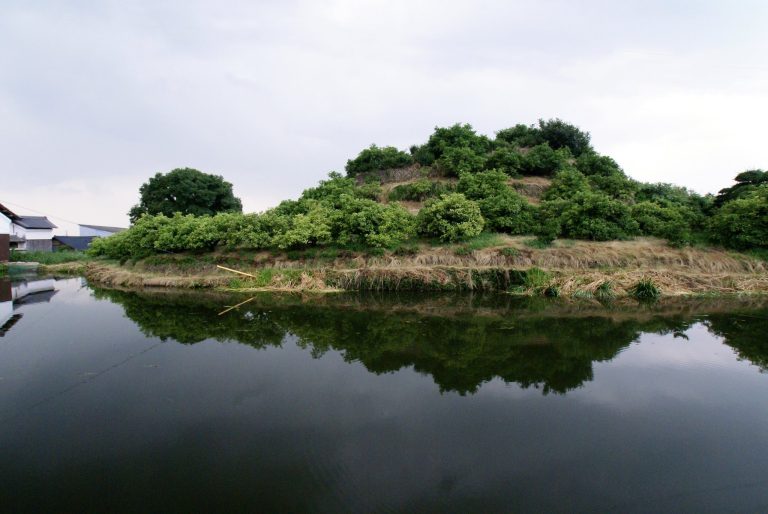
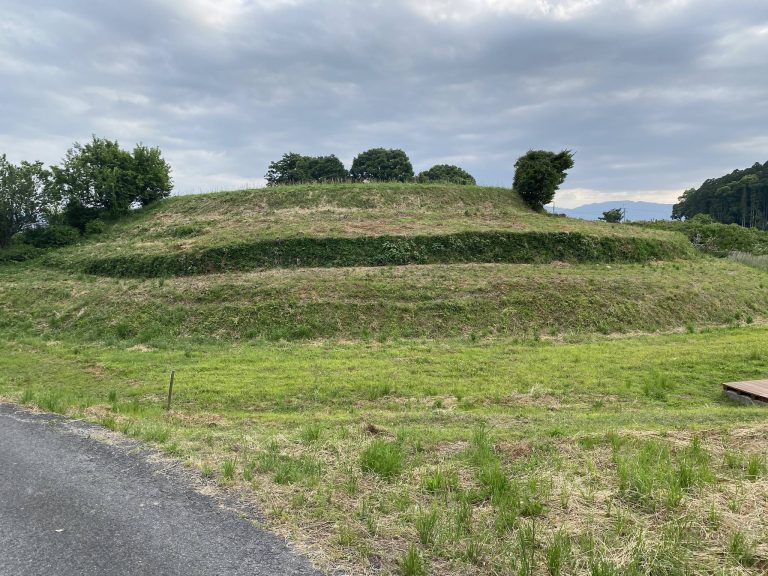
Andon-yama Kofun is a keyhole-shaped mound cut across the end of a hill on the eastern edge of the Nara Basin, with its rectangular front section pointing northwest. A keyhole-shaped kofun combines a circular rear mound with a projecting rectangular front. The mound has three stepped tiers and extends 242 meters. Its circular rear section is 158 meters in diameter and 31 meters high, while the rectangular front section is 100 meters wide and 13.6 meters high.
A shield-shaped moat surrounds the mound. Including the moat, the complex measures about 360 meters from end to end and reaches approximately 230 meters at its greatest width. Three connecting embankments divide the moat and allow water to be retained on the sloping ground. The sections south of the front mound and south, east, and north of the rear mound are considered to preserve the original arrangement. Other sections near the front were probably enlarged during the late-Edo restoration for use as agricultural reservoirs, leaving parts of the present moat modified from its earlier form.
Stone facing and clay figures were identified on the mound’s exterior. The burial facility in the rear section is presumed to have been a vertical stone chamber. Excavations by the Department of the Archives and Mausolea recovered cylindrical clay figures, Haji pottery, an unglazed ancient Japanese earthenware, and Sue pottery, a high-fired stoneware introduced during the Kofun period.
Objects and Burial Evidence
A rectangular copper plate was found in the southern part of the moat beside the rear section during the late-Edo restoration. The plate itself is now missing, but a rubbing survives. It measures 70 centimeters on its longer side and 53.8 centimeters on its shorter side. One face carries a design resembling a mirror with an inward-radiating floral pattern, while the other is covered with repeated square, grid-like motifs.
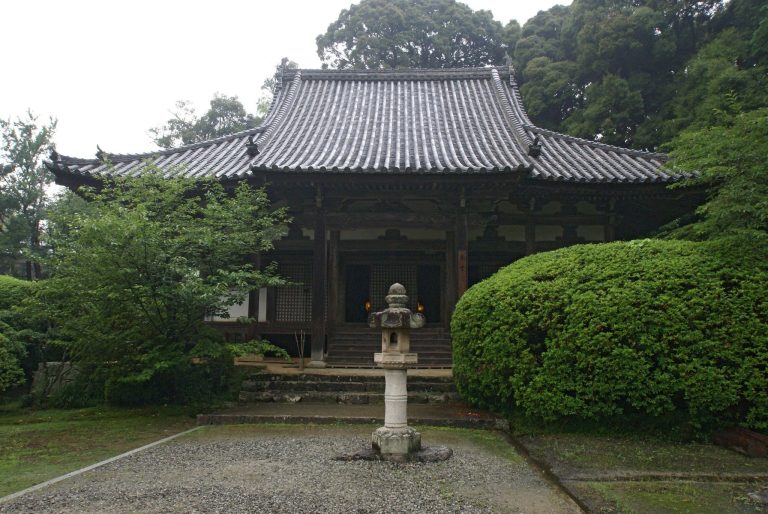
A stone coffin Buddha traditionally preserved at the nearby temple of Chogakuji has been proposed as a reused ceiling stone from the burial chamber. This identification remains a theory. The proposal nevertheless connects a later religious object with interpretations of the mound’s original burial structure.
Subsidiary Mounds
Internal Keyhole-Shaped Mound
One subsidiary mound lies within the controlled area, north of the mausoleum worship area. It is keyhole-shaped and about 120 meters long. Its burial facility is thought to have been a vertical stone chamber, and its construction is estimated to be contemporary with Andon-yama Kofun. The mound forms part of the wider complex administered with the imperial mausoleum.
Southern Detached Mound
A detached keyhole-shaped mound lies south of the mausoleum worship area. It measures about 65 meters in length, and its construction is also estimated to be contemporary with Andon-yama Kofun. Two further detached mounds occupy positions south of the rear section and south of the front section. Their status as subsidiary tombs is considered unlikely.
Yamato Tenjinyama Kofun
Yamato Tenjinyama Kofun lies west of Andon-yama Kofun and has been considered another possible subsidiary mound. It was a keyhole-shaped mound about 103 meters long, although its eastern half was removed when National Route 169 was built.
Excavation in 1960, before the road construction, revealed a vertical stone burial chamber containing numerous grave goods. These included 23 bronze mirrors and four mirrors with inward-radiating floral designs. The objects are designated Important Cultural Properties, and the finds are important for interpreting the date, status, and wider burial context of Andon-yama Kofun.