Moyry Castle: A Seventeenth-Century Stronghold Guarding Moyry Pass


Site at a Glance
- Rating
- 4.4
- Popularity
- Very Low
- Country
- United Kingdom
- Primary era
- Early Modern
- External website
- Open
- Eras represented
- Early Modern
- Civilizations
- English
- Site type
- Military
- Remains
- Castle
On this page6 sections
History
Moyry Castle is a small seventeenth-century castle in the United Kingdom, near Newry in Northern Ireland. Built in June 1601 under Lord Mountjoy, the title used by the English soldier and Crown official Charles Blount, it secured Moyry Pass during the later stages of the Nine Years’ War, a conflict in Ireland from 1594 to 1603 between forces associated with the English Crown and Irish confederates led principally by Hugh O’Neill and Hugh Roe O’Donnell. The pass, also called the Gap of the North, helped protect the route between the north and south.
Foundation and Early Administration
From 1601, the surrounding area was known as Ballinemoyree, meaning “Place of the Moyre.” Captain Anthony Smith became constable, the officer responsible for the castle, and guarded the pass with twelve men. In 1606, King James I assigned the towns of Dromintee, Carrickbroad, Dromad, Faughilotra, Faughart, Faughiletra, and part of Feede to support the maintenance and security of Moyry Castle, its fort, and its ward. Here, the ward was the defensive establishment charged with protecting the castle.
The castle made the passage through Moyry Pass relatively safer for travel between north and south. A long road crossed a great bog by means of a deep ditch and a small stone bridge, continuing toward the Four-mile House, later called the Half-way House. The bog was believed to be the Dun-a-ree bog, which is now thought to form part of a railway embankment.
Confederate and Williamite Occupations
Confederate forces garrisoned Moyry Castle in 1641. During the Williamite conflict, King William’s army, commanded by Schomberg, marched from Belfast through the pass toward Dundalk in August and September 1690 on its way to the Boyne.
Earlier in that campaign, on 23 June 1690, Laurence Dempsey’s force of forty dragoons and a company of infantry under Lieutenant Colonel Fitzgerald ambushed a Williamite detachment near the stone bridge at Jonesborough. The infantry was routed and prisoners were taken. Dempsey later died from his wounds at Oldbridge on the eve of the Battle of the Boyne.
Tradition and Preservation
A local tradition tells of a castle warder who shot a man reputed to be a wizard because he suspected him of spying. According to the story, the man’s enormous black cat then destroyed the garrison’s livestock and became known as the Cat of Moyry Castle. This is a traditional tale rather than a documented historical event.
Moyry Castle is a State Care Historic Monument in the townland of Carrickbroad, within the Newry, Mourne and Down District Council area. The designation places the ruin under the care of the relevant public authority as a protected historic site.
Remains
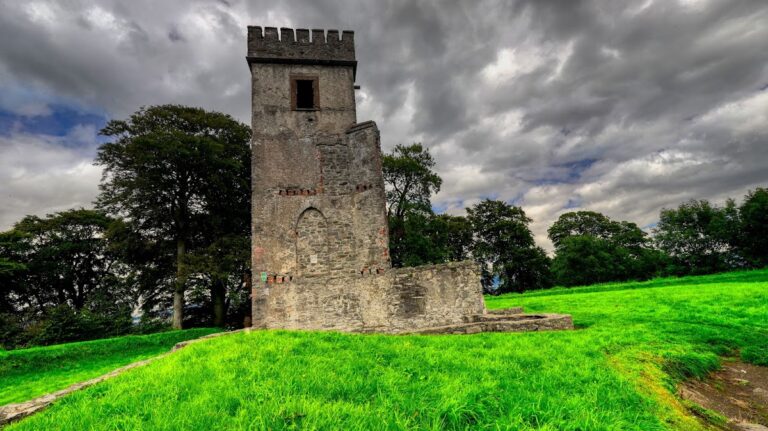
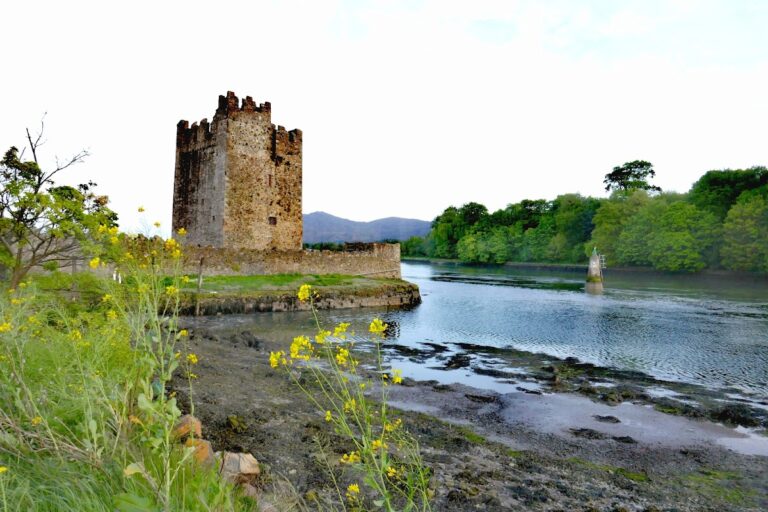
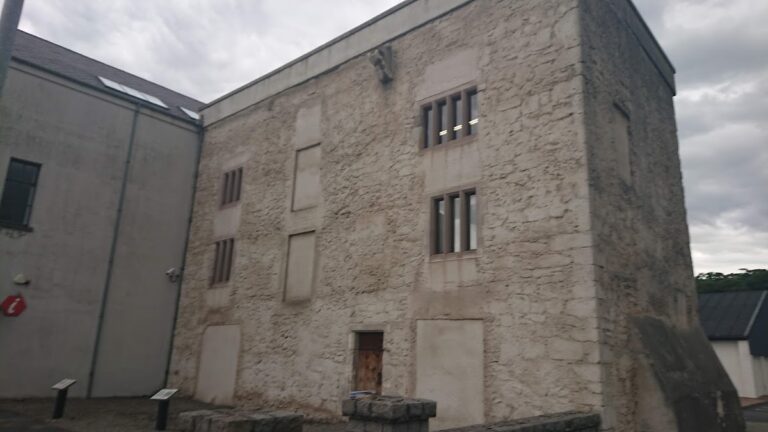
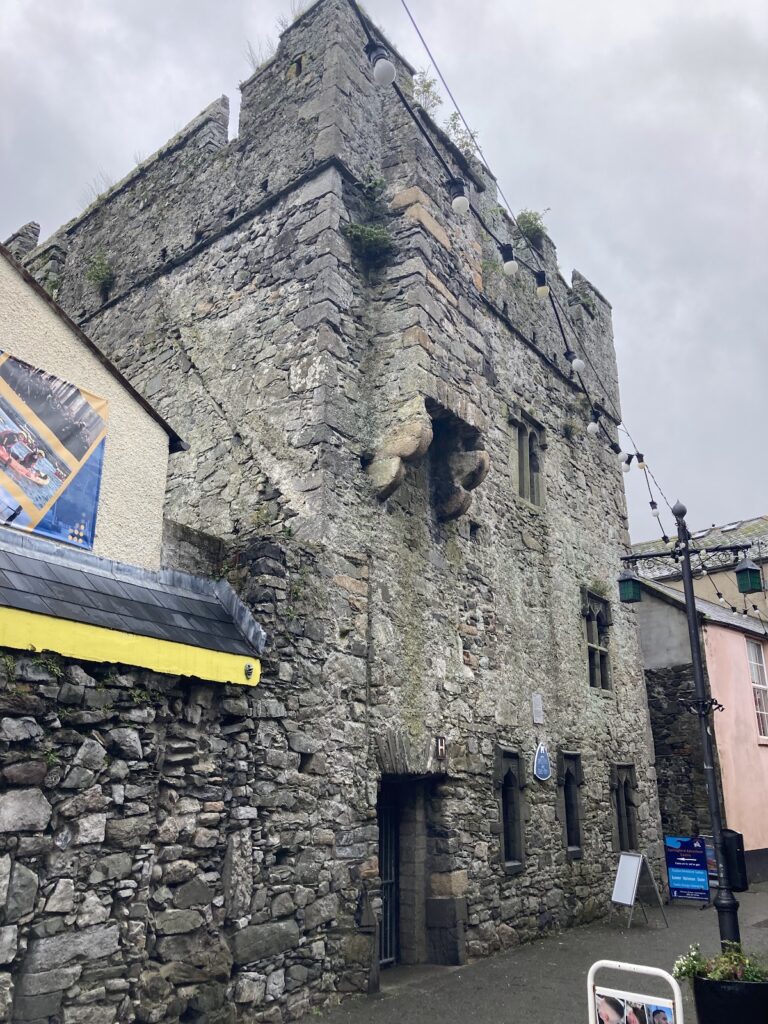
Moyry Castle survives as a ruin on solid rock at approximately 116 metres above sea level, at the corner of a small bawn, an enclosed defensive courtyard. The principal structure is a nearly square rectangular tower measuring about 8 metres on each side and rising through three storeys. Its position beside Moyry Pass reflects the castle’s defensive purpose and its relationship to the fortified enclosure.
Fortified Tower
Musketry loopholes, narrow openings through which firearms could be discharged, are present in every wall except the north-facing wall. The north wall contains fireplaces, and their external projections remain visible on the outside of the building. Together, the tower’s compact plan, height, loopholes, and fireplaces preserve the main physical features of the early seventeenth-century stronghold.