The Mint: A Fortified Tower House in Carlingford, Ireland


Site at a Glance
- Rating
- 4.4
- Popularity
- Very Low
- Country
- Ireland
- Primary era
- Medieval
- External website
- Open
- Eras represented
- Medieval, Early Modern
- Civilizations
- English
- Site type
- Domestic
- Remains
- Castle
On this page6 sections
History
The Mint is a fortified tower house in Ireland, standing in Carlingford, County Louth. Built probably during the fifteenth or sixteenth century, it is one of Carlingford’s three fortified structures, alongside King John’s Castle and Taaffe’s Castle, and is the smallest of them.
Origins and name
The building’s name is linked to Carlingford’s privilege to mint coins. Edward IV, who ruled England from 1461 to 1470 and again from 1471 to 1483, granted the relevant license in 1467. The present tower was constructed later, and no coin minted at Carlingford has been found.
The Mint is believed to have belonged to a wealthy Carlingford merchant family, possibly the Marmions. Its strong defenses and lack of a fireplace have also encouraged the interpretation that it may have functioned as a mint rather than chiefly as a residence. A local tradition holds that laws for the Pale, the area of Ireland under effective English administration during the medieval and early modern periods, were once enacted there.
Later use and preservation
The building was rebuilt during the nineteenth century and served as a prison during the eighteenth and nineteenth centuries. It is now owned by the state and designated a National Monument of Ireland.
Remains
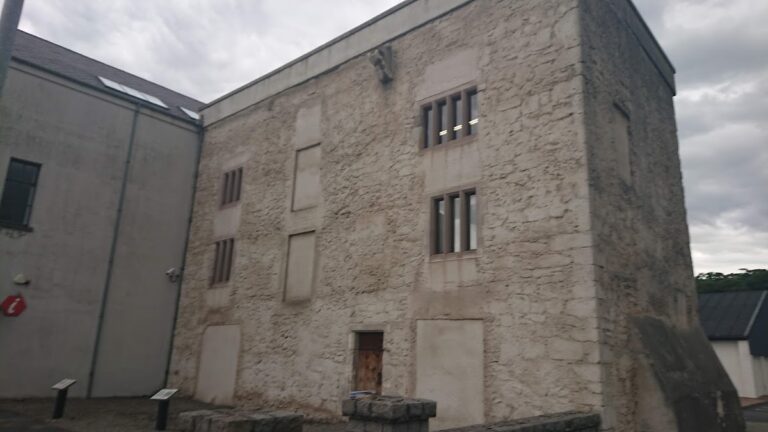
The Mint stands on Tholsel Street in southern Carlingford, about 120 metres southwest of Carlingford Lough. It is a three-storey structure built mainly from limestone, including roughly worked stone. Its defensive arrangement combines a battlemented roof wall-walk with a protected street entrance and decorated windows facing the street.
Structure and defenses
A wall-walk on the roof contains loopholes, narrow openings used for firing muskets. At roof level, a machicolation, a projecting defensive feature with openings for attacking people below, protects the entrance from the street. These elements give the building the character of a fortified residential tower, a form that combined domestic accommodation with defensive features.
Five windows on the ground and first floors face the street. They have hood mouldings, mullions, iron grilles, and carved ornament showing a horse, a man’s bust, a bird, a snake, and Celtic interlace. This decoration reflects the revival of interest in Celtic art during the fifteenth and sixteenth centuries.
Connection with the town gates
The Mint is connected with Carlingford’s surviving town gates, which are among the few historic town gates remaining in Ireland. Together, these surviving elements place the fortified house within the historic defensive fabric of the town.