Mount Nemrut: A Hellenistic Sanctuary and Royal Tomb in Turkey
Visitor Information
Google Rating: 4.7
Popularity: Medium
Country: Turkey
Civilization: Greek
Site type: Religious
Remains: Sanctuary
History
Mount Nemrut, Gülveren, Turkey, was created by the Hellenistic kingdom of Commagene under King Antiochus I. The site began as a hierothesion, a combined royal tomb and cult sanctuary, established by Antiochus in 62 BC to celebrate his rule and to fuse Persian and Greek religious traditions.
In the years around 62 BC Antiochus organized the sanctuary as the focal point of a deliberately blended faith. He presented himself as descended from both Achaemenid Persian and Seleucid Macedonian lines and promoted a ritual program that honored gods drawn from both cultures, while treating himself as a divine figure under the title Theos. Contemporary carved texts record the ceremonial calendar, scheduling festivals on his coronation and birthday, and lay down rules for priests and temple personnel. One carved scene known as the Lion Horoscope records a specific astronomical configuration tied to 7 July 62 BC, a date widely accepted as marking the monument’s foundation.
Construction proceeded on a grand scale, creating a raised stone mound and a complex of terraces and monumental sculpture intended to express the new cult. The project appears to have been left incomplete and did not achieve a stable ceremonial life after Antiochus’ death. Written regulations engraved on the backs of throne seats set out the Nomos, the cult law, which names Antiochus’ divine titles and includes protective curses against desecration. Archaeological campaigns beginning in the late nineteenth century and continuing through the twentieth century—conducted by researchers such as Karl Sester (1881), Otto Puchstein and Carl Humann (1882–83), Theresa Goell and Friedrich Karl Dörner (1950s–60s), and later international teams—have explored the summit and its monuments. In recognition of its historical and cultural importance the site was inscribed on the UNESCO World Heritage List in 1987 and was included in a national park established in 1988.
Remains
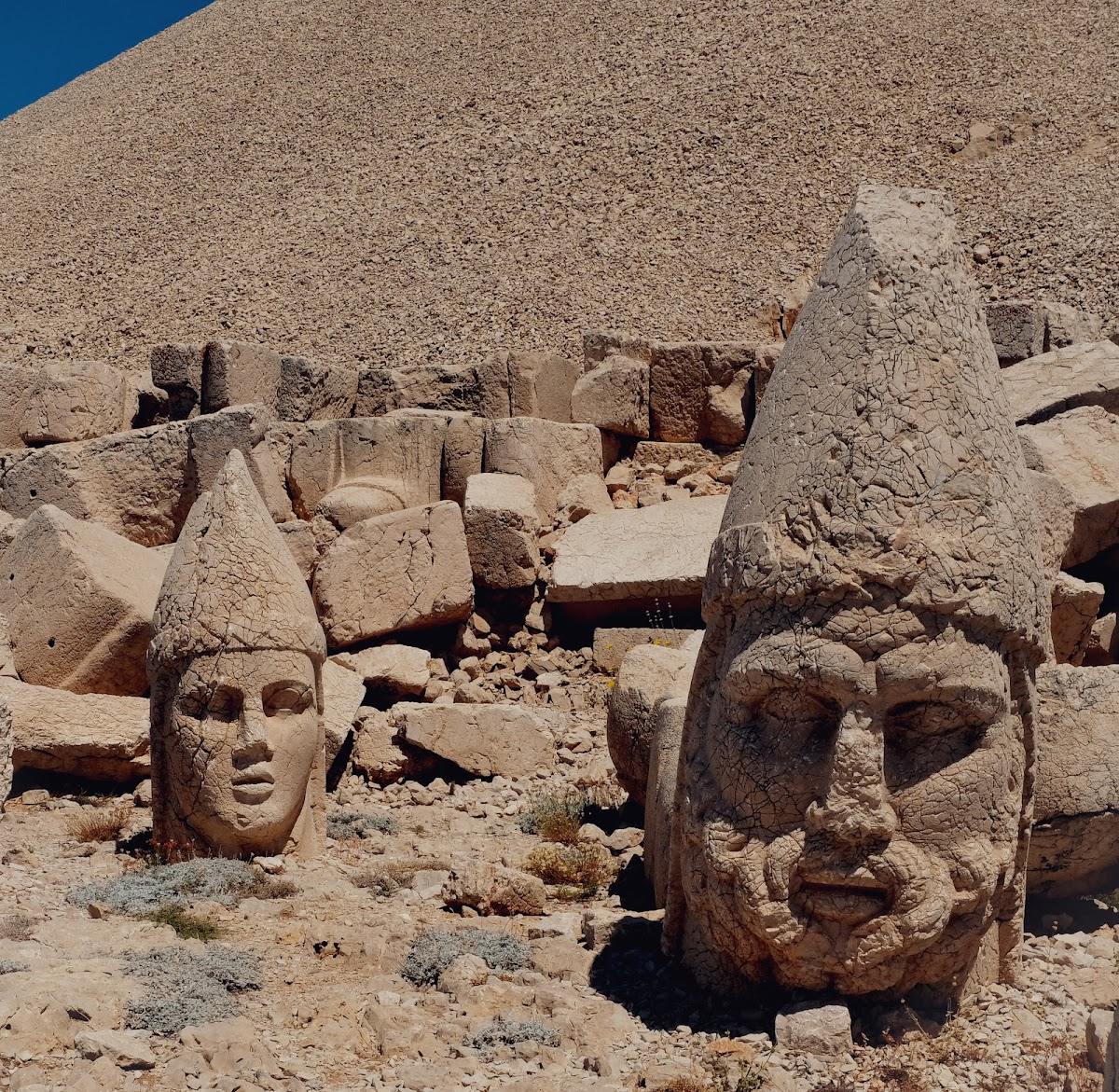
The summit ensemble is dominated by a great artificial burial mound set atop the limestone peak, surrounded by three purpose-built platforms. The mound itself, a tumulus (a burial mound), was formed of loose rock and shingle and rises as a broad, rounded mass roughly 150 meters across and some 45 meters high. It crowns the highest point and serves as the centerpiece around which the terraces and sculptural program were arranged. The builders moved large quantities of stone to assemble the mound and terraces, sourcing limestone from the slopes and a greenish sandstone from a nearby spring area.
Below the mound three terraces were laid out on the summit’s crest, each with its own orientation and role. The east terrace is roughly square in its overall footprint, containing a central open court of about 21 by 26 meters and space for the main sculptural group, while the west terrace, somewhat smaller, is partly backed by artificial support where the slope required it. The north terrace does not display the same monumental statuary as the others but includes a continuous line of stone bases that once supported upright slabs or relief panels, and it features a nearly one-meter-wide entrance with an adjoining ramp. The terraces were formed from quarried blocks and carefully leveled fills, creating formal platforms on an otherwise rugged summit.
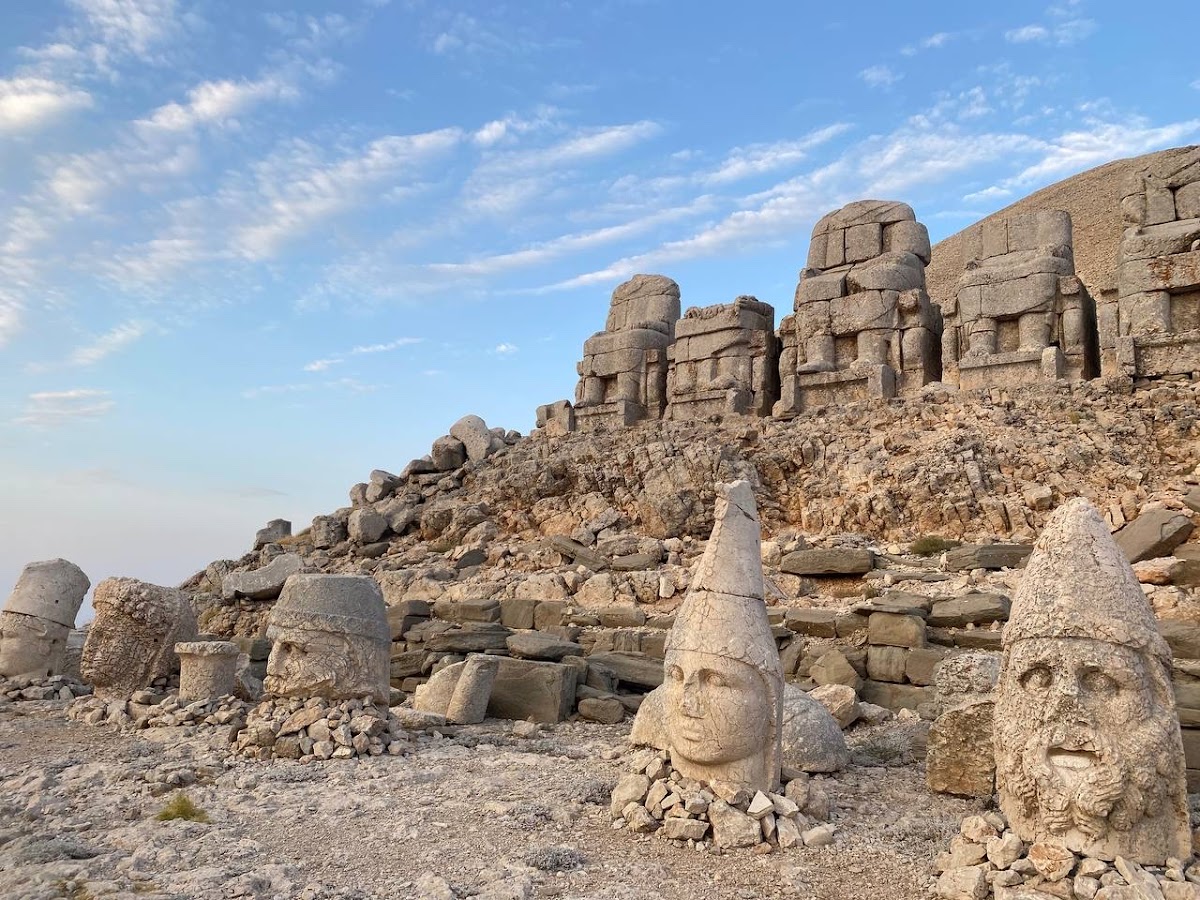
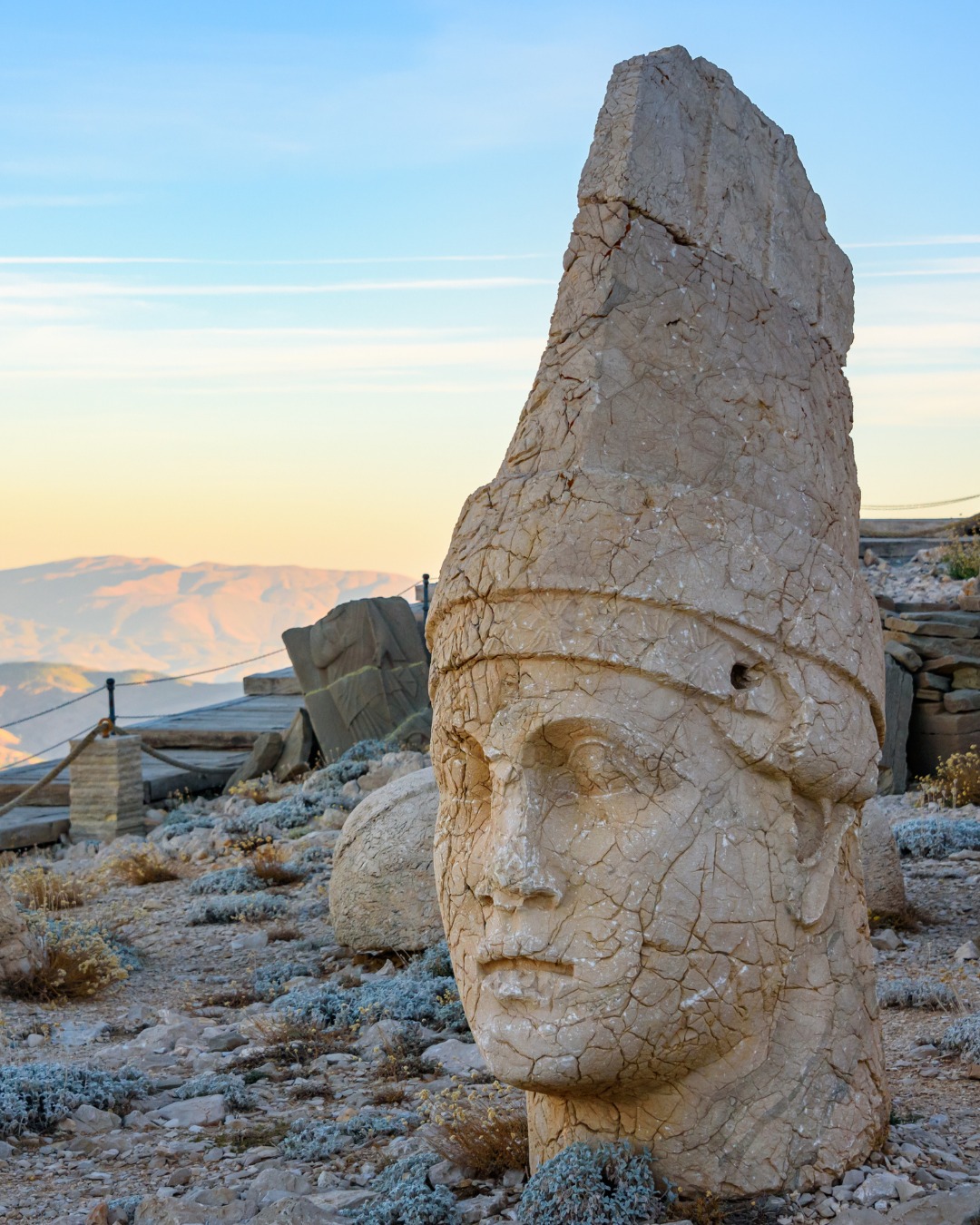
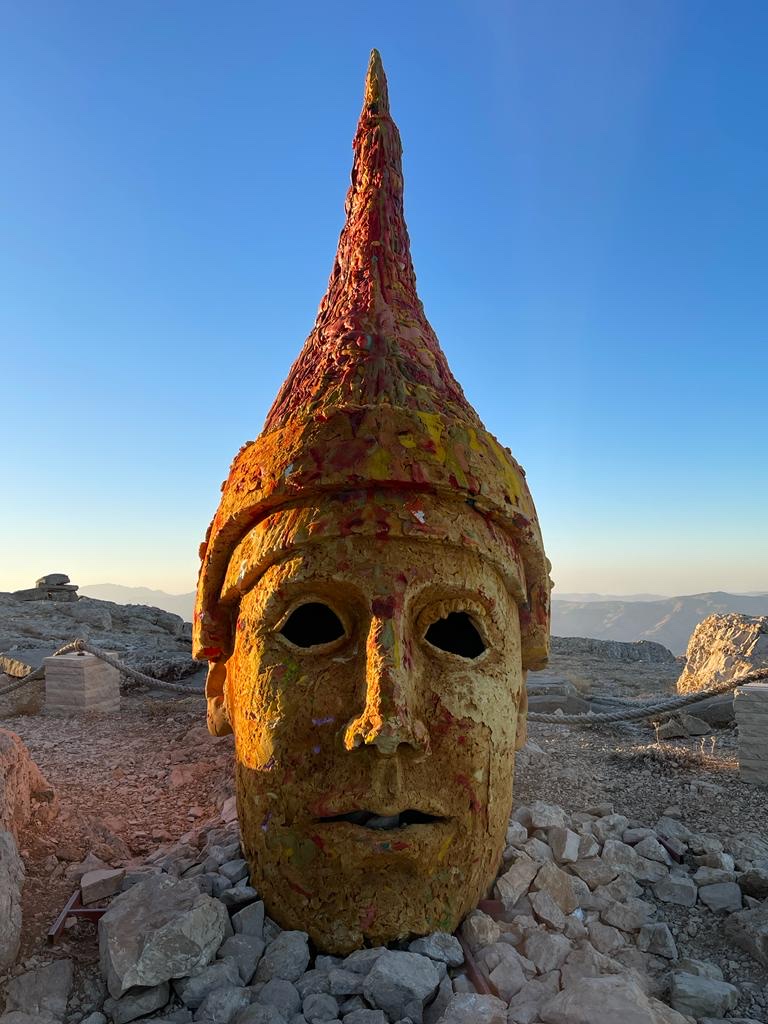
Seated colossi once faced out from the east and west terraces; these figures originally stood between eight and ten meters tall and combined royal and divine imagery. They included a representation of Antiochus, a female figure identified as the goddess Commagene, and composite gods that blend Greek and Iranian identities: Zeus-Oromasdes, Apollo-Mithras-Helios-Hermes, and Herakles-Artagnes-Ares. Lions and eagles accompanied the main figures as guardian animals. The statues were built from local limestone blocks placed in seven or eight horizontal layers, their shells forming hollow interiors that were later filled with rubble. The heavy heads were carved separately, each about two and a half to three meters in height; in today’s arrangement these head sculptures lie detached in front of the seated bodies. The heads show deliberate damage, especially to noses, and the surviving figures wear Persian-style dress and tiaras, with Antiochus distinguished by an Armenian-style crown bearing five pointed rays.
A rich program of carved reliefs and stelae lined the terraces, arranged in ordered rows and depicting members of Antiochus’ ancestry along paternal and maternal lines. The paternal group shows fifteen figures associated with Persian forebears, while the maternal group contains seventeen figures tied to Seleucid Greek descent. These portrait stelae are schematic in style and were given identifying inscriptions on their reverse faces, which name each ancestor and place them in the dynastic line. Other carved scenes include dexiosis panels, in which the king is shown clasping the hand of a deity (dexiosis denotes a ritual handshake), and an investiture image that may portray a royal reception of authority, perhaps for Antiochus or his successor.
Inscriptions are an integral component of the sculptural program. Shorter and longer texts appear carved on throne backs and other stone blocks; several of these inscriptions set out the Nomos, the legal framework for the cult, listing Antiochus’ divine epithets, the regulations for worship, and formal curses designed to deter desecration. The Lion Horoscope relief, a star-and-planet composition associated with a specific calendar date, serves as an explicit chronological marker tied to the monument’s foundation.
A stepped altar platform occupies the eastern terrace, built from sandstone blocks and reconstructed in places; the square platform measures about 13 by 13 meters and was likely intended as a fire altar area, flanked in the imagined scheme by lion and eagle figures. Two processional ways, known by their Greek name Propylaia Odos (processional approaches), and a third route ascend toward the summit, linking the sanctuary with other local centers such as Arsameia and structuring movement to the ceremonial core.
The scale of the enterprise is reflected in the logistics recorded by the stones themselves: roughly 300,000 cubic meters of material were moved to form the tumulus and terraces. Today the monumental sculptures and reliefs survive in a fragmentary state; seated bodies remain in place while the large carved heads stand before them, weathered and damaged, and many relief panels are broken or displaced. Architectural elements have been reassembled in places using sandstone and other recoveries, and the overall complex shows both careful original design and the effects of centuries of exposure and human intervention.