Cendere Bridge: A Roman Bridge in Türkiye




Site at a Glance
- Rating
- 4.7
- Popularity
- Medium
- Country
- Turkey
- Primary era
- Classical
- External website
- Open
- Eras represented
- Classical
- Civilizations
- Roman
- Site type
- Infrastructure
- Remains
- Bridge
On this page8 sections
History
Cendere Bridge is a Roman bridge in Türkiye, built under Emperor Lucius Septimius Severus around 200 CE as part of the Roman road network. It crosses the Cendere River, known in antiquity as the Chabinas, near ancient Arsameia in Adıyaman Province. The bridge was rebuilt during preparations for planned Roman military operations against Parthia, giving the crossing a practical role in the movement of troops and supplies.
Roman construction
The work probably replaced an earlier bridge traditionally associated with Emperor Vespasian, who ruled from 69 to 79 CE. The date and character of that predecessor remain uncertain. The later construction, dated to approximately 198 to 200 CE, was carried out under imperial authority by Legio XVI Flavia Firma, the Flavian Sixteenth Legion, which was stationed at Samosata. A Latin inscription names Lucius Marius Perpetuus as the legionary legate involved in the work and Alfenus Senecion as the provincial governor. It states that the crossing was rebuilt from its foundations and restored.
Four cities of the former Kingdom of Commagene contributed to the project. Commagene was a Hellenistic kingdom in southeastern Anatolia that entered the Roman imperial sphere during Vespasian’s reign. Samosata, its former capital and the legion’s base, joined Perre, an important crossroads, along with Doliche, now Dülük, and Germaniceia, now Kahramanmaraş. These cities also raised commemorative columns for the imperial family.
Imperial commemoration and later history
The columns honored Septimius Severus, his wife Julia Domna, and their sons Caracalla and Publius Septimius Geta. After Caracalla arranged Geta’s assassination in 211 CE, Geta’s column was removed and his name was erased under damnatio memoriae, the Roman practice of removing a condemned person from public memory.
Osman Hamdi Bey and Osgan Efendi described and sketched the bridge during their 1883 archaeological expedition to Mount Nemrut. They found the stone structure in good condition, although the paved surface and parapets were badly damaged. Louis Jalabert and René Mouterde first read and interpreted the inscriptions in 1929. Reconstruction or restoration followed in 1951 and 1997. After the later work, vehicle traffic was restricted and was eventually transferred to a new bridge about 500 to 600 metres east of the ancient crossing. The historic bridge now serves pedestrians.
Cendere Bridge lies within Nemrut Dağı National Park, an area containing important remains of Commagene civilization. Nemrut Dağı and its associated cultural remains were inscribed on the UNESCO World Heritage List in 1987.
Remains
Bridge structure
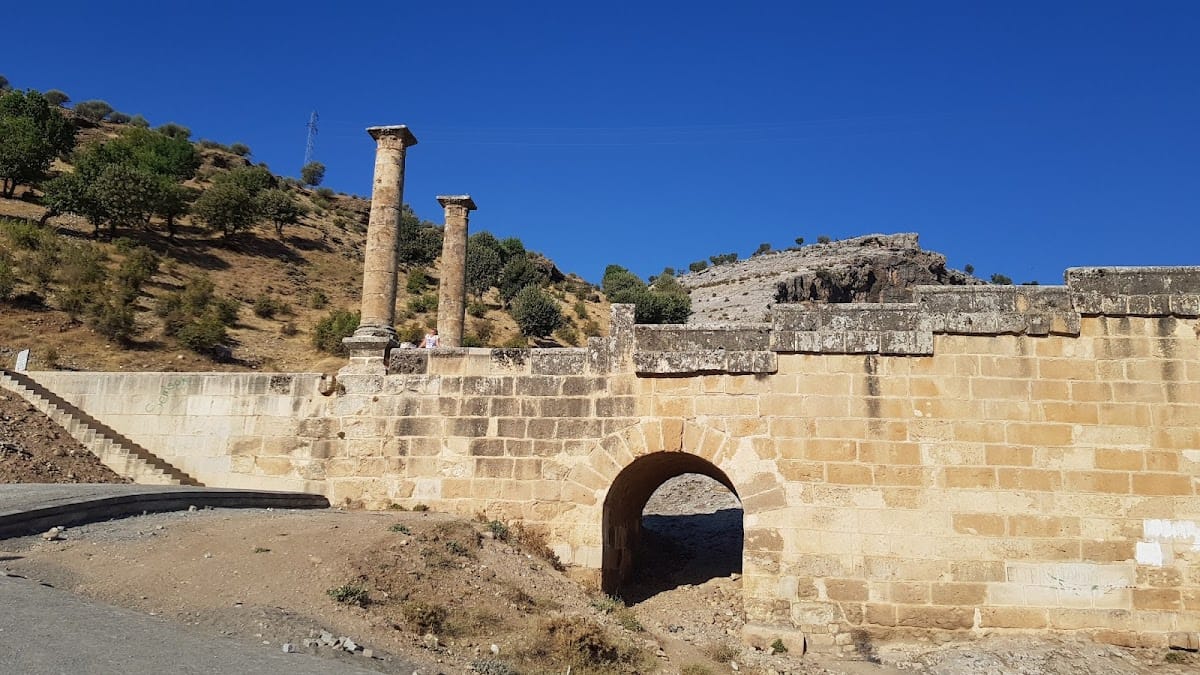
The bridge occupies the narrowest point of the Cendere River and rests on two rocky supports. It is approximately 120 metres long and 7 metres wide, with a principal clear span of 34.2 metres. Stone blocks laid without mortar form a simple single-arch structure with a wedge-shaped vault. A smaller additional opening also provides relief for floodwater. The bridge carried the historic route between Kahta and Sincik until that road function was diverted to the modern crossing farther east.
Commemorative features
Corinthian columns
Four Corinthian columns were erected on the bridge, using a classical style identified by capitals decorated with acanthus leaves. They originally stood about 9 to 10 metres high. Two remain on the Kahta side and commemorate Septimius Severus and Julia Domna. Two formerly stood on the Sincik side for Caracalla and Geta, but the column associated with Geta was removed after his death and official erasure. The surviving columns may have been transferred from the nearby Karakuş tumulus, although that attribution is uncertain.
Parapet inscriptions
Two stone stelae are set into the parapets on both sides of the bridge’s northern half. Their nearly identical Latin inscriptions name Septimius Severus, Caracalla, Geta, the imperial officials, and Legio XVI Flavia Firma. They also record the rebuilding of the crossing and connect the surviving structure with the Roman administration and military force that carried out the project.