Monastery in Lysá nad Labem: A Baroque Augustinian Complex


Site at a Glance
- Rating
- 4.8
- Popularity
- Very Low
- Country
- Czechia
- Primary era
- Early Modern
- Eras represented
- Early Modern
- Civilizations
- Habsburg, Holy Roman Empire, Kingdom of Bohemia
- Site type
- Religious
- Remains
- Monastery
On this page7 sections
History
The Monastery in Lysá nad Labem, Czechia, is a former Baroque Augustinian complex near the town castle. Its history reaches back to a chapel dedicated to St. Desiderius, recorded in 1244, and to the religious institutions that served the town and the surrounding Lysá estate.
Medieval Augustinian foundation
The chapel of St. Desiderius later became the parish church of Nová Lysá, a town founded in 1291 that belonged to the queens of Bohemia. In 1355, Queen Anna of Świdnica transferred the right of ecclesiastical patronage to her husband, Charles IV. He granted it to the Augustinian monastery at Prague-Karlov. Augustinian canons followed the religious rule associated with St. Augustine and commonly served in pastoral and ecclesiastical institutions. The Prague monastery established a community of five canons at Lysá, who may have rebuilt the earlier chapel as a Gothic church. An adjoining Augustinian provostry, a smaller religious house headed by a provost, was established beside it.
The medieval institution existed from 1355 until its destruction in 1421 during the Hussite Wars, the religious and political conflicts in Bohemia associated with the followers of Jan Hus. A manuscript of sermons, Sermones de sanctis, preserves the designation “canonici regulares Montis S. Desiderii in Lyssa,” connecting the community with Lysá.
Špork’s Baroque convent
Count František Antonín Špork founded a new convent dedicated to St. John Nepomuk and St. Desiderius near his castle, possibly on or close to the site of the medieval Augustinian house destroyed in 1421. He installed six Discalced, or barefoot, Augustinians, a stricter reform branch of the order. The new monastery was built to a design by B. Scotti, and its activities on the Lysá estate began in 1713.
From 1718, Špork also assigned the convent responsibility for the Church of the Virgin Mary at Vysoká near Suchdol, together with a farmstead and summer residence. The associated establishment became a small dependent monastery of the Lysá convent. Its barefoot Augustinians administered the local parish until 1746.
Churches and later transformation
Between 1739 and 1741, a church designed by A. Lurago was added to the complex. It was dedicated to the Nativity of the Virgin Mary, while the convent retained its dedications to St. John Nepomuk and St. Desiderius. A separate Loreto chapel, modeled on the Santa Casa traditionally associated with the Virgin Mary’s house at Loreto in Italy, had been built beside the Church of the Nativity in 1704 by Countess Františka Apollonie of Swéerts-Reist, Špork’s wife. The chapel was suppressed in 1782 and later disappeared with the church.
The Lysá monastery was dissolved in 1812, after which its building became a contribution granary. The granary survived into the twentieth century, but the monastery church was demolished in 1891. The former complex is protected as a cultural monument and now houses the Nymburk State District Archive, whose seat is in Lysá nad Labem.
Remains
The surviving site is a Baroque former monastery complex on Zámecká Street, near the town castle. Its preserved interior organization includes ground-floor corridors, further monastic corridors, a former refectory, a library, and archive storage areas. A former monastic interior is now used as a repository, reflecting the building’s later conversion to archival use.
Interior spaces and decoration
Frescoes survive in the former refectory, whose decorated ceiling is now part of a research room. Another fresco forms the ceiling of the library on the first floor. These surviving painted surfaces belong to the interior fabric of the former convent, while the corridors and storage rooms preserve the building’s institutional layout.
Associated complex at Vysoká
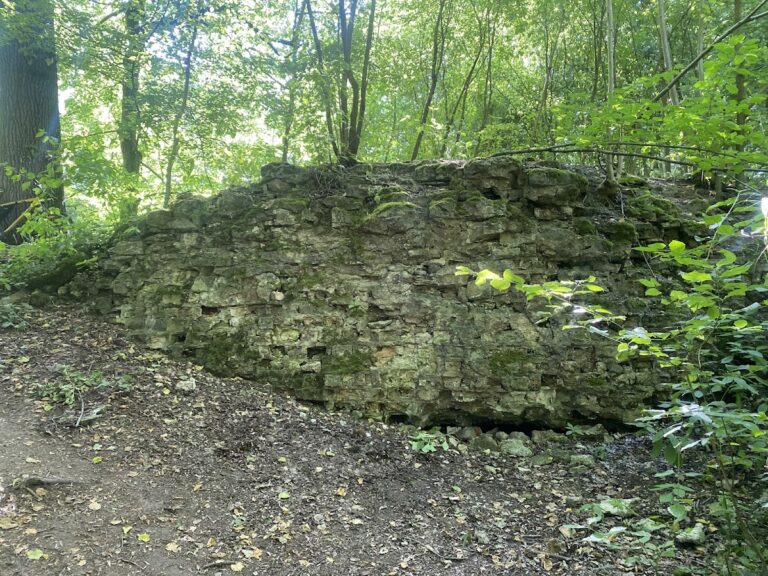
The dependent complex at Vysoká comprised the Church of the Virgin Mary, a farmstead, a summer residence, a small monastery, and hermitages. After a fire in 1834, the Chapel of St. John the Baptist and adjoining buildings were left in ruins. The site therefore survives through a combination of ruined structures and the historical relationship that linked the Vysoká establishment to the Lysá convent.