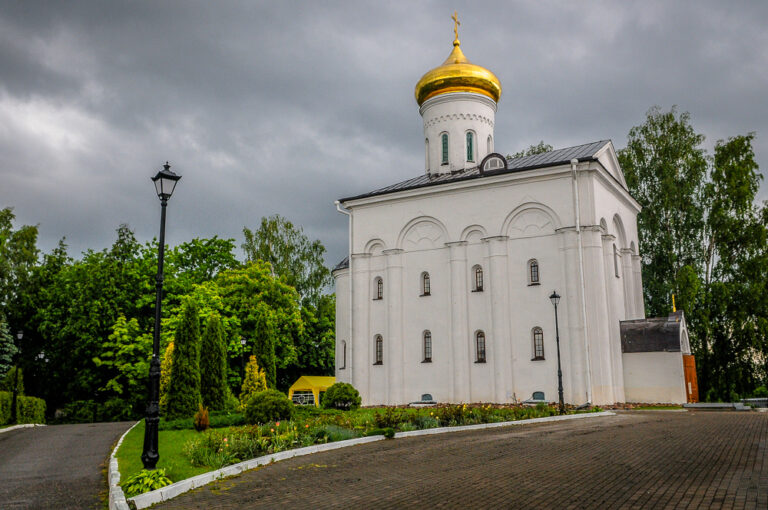
Convent of Saint Euphrosyne in Polack: An Orthodox Monastic Foundation in Belarus


Site at a Glance
- Rating
- 4.8
- Popularity
- Medium
- Country
- Belarus
- Primary era
- Medieval
- External website
- Open
- Eras represented
- Medieval, Modern
- Civilizations
- Russian
- Site type
- Religious
- Remains
- Monastery
On this page11 sections
History
The Convent of Saint Euphrosyne in Polack is an Orthodox women’s monastery in Belarus, founded in 1125 by Saint Euphrosyne of Polack beside an older wooden Church of the Transfiguration at Seltse. A twelfth-century monastic founder and Polack princess, Euphrosyne became the convent’s patron saint. Tradition attributes the establishment of the community to a divine revelation. The monastery later became one of the oldest and largest centers of Orthodoxy in Belarus.
Foundation and medieval development
Euphrosyne had taken up residence beside the earlier wooden church before founding the convent. Her sister, Eudoxia, and their cousin Eupraxia, the only daughter of Prince Boris Vseslavich of Polack, joined the community and took monastic vows there. In 1161 Euphrosyne commissioned a stone Church of the Transfiguration of the Savior, built by the master architect Johann. This church replaced the earlier wooden structure and established the principal medieval architectural legacy of the convent.
In the same year, Euphrosyne donated a gilded altar cross containing particles of relics from numerous saints and a fragment of the True Cross, traditionally identified in Christian belief as the cross on which Jesus was crucified. The local goldsmith Lazar Bogsha made the cross, which became the monastery’s principal object of veneration. It was removed from Polack in the thirteenth century and returned in 1563 by Ivan the Terrible after the siege and capture of the city.
Changes of religious control
Following King Stephen Báthory’s conquest of Polack in 1580, the monastery came into Jesuit possession. The Jesuits, a Catholic religious order particularly associated with education, held it until 1654, when it returned to Orthodox control. After the Truce of Andrusovo in 1667, the complex passed again to the Jesuits.
The Jesuits were expelled from Polack in 1820, after which the Piarists administered the complex until 1832. The Piarists were a Catholic order devoted especially to education. The monastery then passed to the imperial treasury and was transferred to ecclesiastical authorities in 1832. In 1840 it was restored as an Orthodox monastery, and the Euphrosyne Cross returned the following year.
Nineteenth-century expansion
During the 1840s the monastery became a first-class institution and housed a women’s theological school. Under Abbess Claudia, the Euphrosyne Refectory Church was built in the middle of the nineteenth century. When Tadulin Dormition Monastery became a women’s monastery in 1888, its nuns came under the administration of Euphrosyne Convent.
Under Abbess Eugenia Govorovich, the monumental Church of the Exaltation of the Cross was built in 1897. Ceremonies held from 19 April to 23 May 1910 marked the transfer of Euphrosyne’s relics from the Kyiv Cave Monastery in Kyiv, a major Orthodox monastic complex associated with monasticism and the veneration of saints’ relics, to Polack.
War, Soviet rule, and closure
The community was evacuated in 1915, taking Euphrosyne’s relics with it. The nuns returned to Polack in 1921 and brought the relics back, but Soviet authorities confiscated them in 1922 and placed them in the Archaeological Museum in Vitebsk, where they remained until 1940.
The Bolshevik authorities closed the monastery in 1921. Its community of 146 nuns was finally dissolved in 1924 or 1925. Some sisters continued living communally and operating an agricultural cooperative according to monastic rules until the cooperative was liquidated in 1928. The buildings were assigned to the army and state institutions, while valuable icons, icon coverings, and other church objects were confiscated.
The Euphrosyne Cross was confiscated, transferred to Minsk in 1928, and moved to Mogilev in 1929. It disappeared in 1941 during the Second World War and has not been found. During the German occupation of Polack, the nuns received permission to reorganize the monastery in part of the complex. The German command occupied one residential building, while the Church of the Exaltation of the Cross was used to hold Soviet prisoners of war. German authorities also permitted Euphrosyne’s relics to return to Polack in 1943.
Reactivation and present status
Soviet authorities closed the monastery again in 1960 and transferred the nuns to the male monastery at Zhirovichi. The Church of the Transfiguration continued to operate as a parish church and was the only functioning church in Polack. A proposal to convert it into a planetarium was considered between 1985 and 1989 but was abandoned.
On 6 July 1989, the Holy Synod of the Russian Orthodox Church decreed the monastery’s reactivation. The first nuns arrived in 1990, followed by restoration and conservation work on the churches and other buildings. The community comprised about 80 nuns in 2012. Since 2015, the convent has been under the direct jurisdiction of the Belarusian Exarch of the Russian Orthodox Church. It is a stavropegial convent of the Belarusian Orthodox Church, meaning that it is placed directly under a senior church authority rather than under the ordinary jurisdiction of a local diocesan bishop. The complex is recognized as protected historical and cultural property of Belarus.
Remains
The monastery complex contains churches representing the architectural traditions of the ancient Polack principality, Old Russian architecture, and Russian-Byzantine architecture. Its principal surviving buildings are the twelfth-century Church of the Transfiguration of the Savior, the nineteenth-century Euphrosyne Refectory Church, also called the warm Church of Saint Euphrosyne, and the Church of the Exaltation of the Cross. Restoration and conservation work after 1989 affected these churches and other monastery buildings.
Church of the Transfiguration of the Savior
The stone Church of the Transfiguration of the Savior was erected in 1161 on the site of the earlier wooden church. It is regarded as one of the best-preserved monuments of ancient Polack architecture and is among the city’s oldest churches. Its surviving fabric represents the medieval phase of the convent and the architectural traditions associated with the ancient Polack principality and Old Russian building.
Euphrosyne Refectory Church
The Euphrosyne Refectory Church was constructed in the middle of the nineteenth century under Abbess Claudia. It is also known as the warm Church of Saint Euphrosyne, a heated church intended for worship during the colder months. The laying of its foundation is dated to 23 May/4 June 1858, and the building forms part of the convent’s nineteenth-century architectural group.
Church of the Exaltation of the Cross
Built in 1897 according to designs by the architect V. F. Korchikov, the Church of the Exaltation of the Cross is a monumental five-domed building in the Neo-Byzantine style. Its form represents the late nineteenth-century expansion of the monastery. The church was used to hold Soviet prisoners of war during the German occupation of Polack.
Sacred objects
A recreated Euphrosyne Cross is listed among the convent’s sacred objects. The original was a gilded altar cross made by Lazar Bogsha in 1161, but it was lost after disappearing during the Second World War. The history of the original cross remains connected to the convent through its medieval donation, later return, confiscation, and eventual loss.