Mii-dera Temple: Head Temple of the Tendai Jimon Branch in Japan


Site at a Glance
- Rating
- 4.4
- Popularity
- Medium
- Country
- Japan
- Primary era
- Early Modern
- External website
- Open
- Eras represented
- Early Modern, Modern
- Civilizations
- Tokugawa, Toyotomi regime
- Site type
- Religious
- Remains
- Monastery
On this page27 sections
History
Mii-dera Temple is a Buddhist temple in Japan, located in Otsu near Lake Biwa, whose traditions trace its foundation to the political crisis surrounding the Jinshin War of 672. Formally called Nagara-san Onjo-ji, it is the head temple of the Jimon branch of Tendai Buddhism, a Japanese tradition derived from Chinese Tiantai teachings. The temple is traditionally associated with the Otomo clan and venerates a hidden image of Maitreya as its principal Buddha.
Foundation and early traditions
Mii-dera’s origins are linked to the succession struggle that followed the death of Emperor Tenji. One tradition says that Otomo Yota, the son of Prince Otomo, founded the temple to commemorate his father, using a Maitreya image formerly owned by Emperor Tenji. Another places the foundation around 672 and attributes it to the Otomo Muraji family. Roof tiles from the Asuka and early Nara periods, together with written evidence connecting the temple to the Otomo family, support a historical basis for these foundation traditions.
In 686, Emperor Tenmu, who succeeded Emperor Tenji after the Jinshin War, is said to have authorized the temple and granted it the name Onjo-ji. Tradition explains the name through Otomo Yota’s sacrifice of his estate and property for the temple’s establishment. The popular name Mii-dera means “Temple of the Three Wells.” It refers to a spring whose water was traditionally used in the ritual bathing of three imperial births, those of Emperors Tenji and Tenmu and Empress Jito, Tenmu’s successor.
Enchin and the formation of the Jimon tradition
The temple’s major revival began in 859 under Enchin, also known as Chisho Daishi. After six years of study and religious practice in Tang China, Enchin returned with scriptures, ritual implements, and religious images. At Qinglong Temple he had received esoteric Buddhist teachings from Faquan. Emperor Seiwa granted him an imperial residence called Jinju-den, which Enchin converted first into the Tang Quarters and later into the Tang Institute. The complex became a center for religious study and the transmission of ritual teachings.
Enchin established the Shinra sanctuary, reorganized Mii-dera as a place of religious training, and became its first senior cleric, a position known at the temple as chori. This title denoted the cleric who represented the entire Mii-dera institution. In 866, Mii-dera became a subsidiary temple of Enryaku-ji, and Enchin received official authorization for transmitting Buddhist teachings. Two years later he became head of the Tendai establishment, and the emperor granted Mii-dera to him personally. Enchin remained in this position until his death in 891.
Under Enchin, Mii-dera became one of Japan’s four great temples, alongside Todai-ji, Kofuku-ji, and Enryaku-ji. Its religious life combined exoteric Tendai Buddhism, esoteric practices, and mountain asceticism. Later connections with Shugendo, a tradition of mountain-based religious practice, were associated with Enchin’s own activities at Mount Omine and the Kumano shrines.
The Mountain Gate and Temple Gate struggle
After Enchin’s death, rivalry between his followers and those of Ennin intensified within the Tendai establishment. In 993, following attacks between the two factions, more than 1,000 monks belonging to Enchin’s lineage left Mount Hiei and moved to Mii-dera. They brought Enchin’s image with them and installed it in the Tang Institute. The division established the distinction between Enryaku-ji, called the Mountain Gate, and Mii-dera, called the Temple Gate. The resulting conflict became known as the Mountain Gate and Temple Gate struggle. The Enchin lineage later formed the Jimon branch, while the lineage associated with Ennin became the Sanmon branch.
Mii-dera repeatedly applied for permission to establish a Mahayana ordination platform, an institution for formally conferring Mahayana Buddhist precepts. Enryaku-ji opposed the project. Applications made in 1038 and later years failed, while permission briefly granted in January 1260 was withdrawn after renewed opposition. In 1264, Mii-dera attempted to establish the platform without authorization and was attacked and burned. A further unauthorized attempt in 1319 led to another attack, after which the temple abandoned the project.
From the late tenth century through the medieval period, disputes over appointments, institutional precedence, and religious legitimacy repeatedly drew in warrior monks. Enryaku-ji forces burned Mii-dera on many occasions. Seven large-scale total burnings had occurred by the end of the medieval period, while the traditional total of major and minor attacks is approximately fifty. Mii-dera also joined Enryaku-ji and Kofuku-ji in occasional joint actions against common opponents.
Imperial, aristocratic, and military patronage
During the Heian period, Mii-dera attracted the devotion of the imperial court and aristocracy. Among its patrons were Fujiwara no Michinaga and the retired Emperor Shirakawa. Their donations enabled the temple to control numerous estates and subordinate temples, including Zenko-ji in Shinano. Its institutional organization developed into three principal precinct groups, Central, Northern, and Southern, together with five important detached temples and the separate Nyoiji institution.
The temple also received sustained support from military families. Minamoto no Yoriyoshi prayed at Mii-dera for victory, and tradition says that his son Minamoto no Yoshimitsu underwent his coming-of-age ceremony before the Shinra sanctuary. During the Genpei War, the conflict that brought the Minamoto and Taira houses into armed struggle, Mii-dera sheltered Prince Mochihito after his flight from Taira forces and joined the Minamoto side.
In 1180, Mii-dera supported the uprising of Prince Mochihito and Minamoto no Yorimasa against the Taira, as well as Yamamoto Yoshitsune’s military uprising during the fighting in Omi. In December of that year, Taira no Shigehira and Taira no Tadanori attacked the temple and burned 637 buildings. Taira no Kiyomori consequently ordered the destruction of Mii-dera and other temples in Nara. In 1184, monks from Mii-dera also fought alongside Taira supporters against Minamoto no Yoshinaka.
After the Taira were expelled from Kyoto, Minamoto no Yoritomo began supporting Mii-dera. In 1184, he donated the Yokoyama Estate in Omi and the Tamaki Estate in Wakasa to assist reconstruction. After another destruction, Hojo Masako and Minamoto no Sanetomo ordered their retainers to rebuild the temple in 1215. The Kamakura shogunate later treated Mii-dera less favorably for a time because Kugyo, a son of Minamoto no Yoriie raised at Mii-dera, assassinated Sanetomo.
Ryuben, a former Mii-dera monk and religious attendant to the retired regent Hojo Tokiyori, helped secure the brief authorization for the Mahayana ordination platform in 1260. After the authorization was withdrawn, Ryuben later became Mii-dera’s senior cleric and helped restore relations between the temple and the Kamakura government.
Medieval expansion and Muromachi protection
By 1285, the Central precinct reportedly contained 74 subsidiary residences, the Northern precinct 124, and the Southern precinct 140. During the conflict between the Northern and Southern Courts, Mii-dera supported the Northern Court and the Ashikaga family. In 1336, its warrior monks joined Hosokawa Jozen in defending the temple against Southern Court forces, but they were defeated. Forces associated with Enryaku-ji then attacked, and the Main Hall burned. Ashikaga Takauji sponsored the rebuilding of the Main Hall and Shinra Sanctuary in 1347.
Mii-dera’s support for the Northern Court brought protection from the Muromachi shogunate. This patronage also helped check the power of Enryaku-ji. In 1481, the institution later known as Shoho-ji, now the Kannon Hall, was moved to its present location.
Sengoku destruction and early modern reconstruction
During the Sengoku period, Mii-dera sought military alliances with nearby powers for protection. In 1571, Oda Nobunaga used the temple as the headquarters for his attack on Mount Hiei and Enryaku-ji. Although Mii-dera had maintained good relations with Nobunaga, much of the temple was destroyed during the campaign.
In 1582, after Akechi Mitsuhide’s defeat and death at the Battle of Yamazaki, Toyotomi Hideyoshi used Mii-dera as his headquarters and is said to have inspected Mitsuhide’s severed head there. Despite initially favorable relations, Hideyoshi confiscated the temple in 1595, effectively reducing it to a ruined institution. The reason for his anger remains uncertain. Much historic material was removed or destroyed. The principal Maitreya image, images of Enchin, and the Yellow Fudo were evacuated to Shoko-in, while other statues and treasures were transferred elsewhere. Several buildings were demolished or moved, including the Main Hall, which was transferred to Enryaku-ji’s Western Pagoda precinct and survives there as the Shakado.
The former chief cleric Dōchō, together with Yamaoka Kagetomo and his brother, repeatedly petitioned for restoration. Shortly before Hideyoshi’s death, authorization for reconstruction was granted in 1598. Dōchō directed the revival, and the displaced sacred images were moved to the surviving Joko-in. The temple’s estate of 4,300 koku, a rice-based measure of land income, was also restored.
Reconstruction quickly reshaped the present complex. Kodai-in donated the rebuilt Main Hall in 1599. In 1600, Toyotomi Hideyori sponsored the Kangaku-in Guest Hall, with Mori Terumoto as donor. Yamaoka Kagetomo funded the Kojo-in Guest Hall in 1601. Tokugawa Ieyasu donated and relocated the Great Gate and Three-story Pagoda in the same year, while Mori Terumoto donated and moved the Sutra Repository in 1602. By the end of the Keicho era, the three precinct groups contained 49 subsidiary residences, and the five detached temples contained 25 sub-temples. The estate was confirmed at 4,619 koku during the Kan-ei era.
The Kannon Hall burned in 1686 and was rebuilt in 1689. Around the same period, Mii-dera brought the Seki Semimaru Shrine, associated with music and performing arts, under its influence. A register from the late seventeenth century also records Jodo and Ikko establishments within the wider complex, showing that its precincts included institutions belonging to more than one Buddhist tradition.
Modern institutional history
In 1873, the government requisitioned approximately 200,000 square meters covering most of the Northern precinct for military use. The area became the headquarters of the Ninth Infantry Regiment and a training ground, and many subsidiary temples disappeared. The Northern precinct was effectively abolished apart from the Shinra Sanctuary and Homyo-in. In 1876, the former Central, Northern, and Southern administrative divisions were merged into a single institutional unit.
In 1885, the American cultural figures Ernest Fenollosa and William Sturgis Bigelow received Buddhist precepts from the monk Keitoku of Homyo-in. Fenollosa later became closely associated with the appreciation and preservation of Japanese art. In 1941, the three Tendai branches temporarily united as a new Tendai organization. After the Second World War, the former Temple Gate branch became independent in 1946 as the Tendai Jimon school, with Mii-dera as its head temple.
Mii-dera was recognized in 2015 as part of the Japan Heritage story “Lake Biwa and Its Waterside Landscapes: Water Heritage of Prayer and Life.” It is also the fourteenth temple on the Saigoku Kannon pilgrimage, a historic circuit of thirty-three temples devoted to Kannon in western Japan, and is linked with several regional pilgrimage circuits. The temple’s identity is closely associated with the Yellow Fudo, the hidden Maitreya image, the Kannon pilgrimage, and the evening bell known as “The Evening Bell of Mii-dera.” Its reputation as the “Temple of the Phoenix” reflects its repeated recovery from fire, military attack, confiscation, and institutional decline.
An annual memorial service for Enchin is held on October 29, the anniversary of his death. Hidden images have been opened during major commemorative ceremonies and exhibitions, including events in 1989 and 1990, 2008 and 2009, 2014, and 2020. The temple’s buildings, gardens, images, bells, documents, and archaeological remains are protected through national, prefectural, and municipal cultural-property designations.
Remains
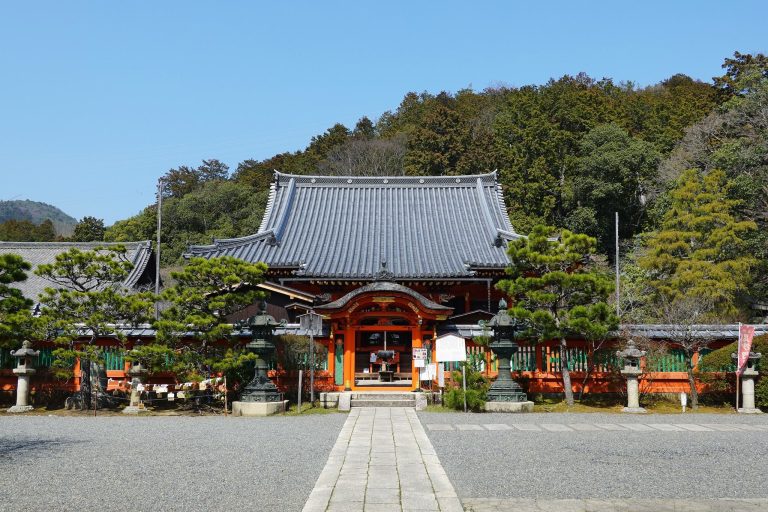
Mii-dera stands at the foot of Mount Hiei near Lake Biwa. Approximately forty named buildings are arranged through the Central, Northern, and Southern precincts, the five detached temples, and the former Nyoiji institution. The surviving complex combines temple halls, gates, guest residences, gardens, pilgrimage buildings, bells, and objects linked to the temple’s long history of reconstruction.
Central precinct
Tang Institute and Founder’s Hall
The Tang Institute occupies higher ground above the approach and is enclosed by walls. Its buildings follow an east-facing axis consisting of the Four-legged Gate, Consecration Hall, Tang Gate, Founder’s Hall, and Daily Fire Ritual Hall. The institute was moved to its present position during the rebuilding that followed Hideyoshi’s confiscation.
The Founder’s Hall, also called the Treasure Hall, is Enchin’s mausoleum. Rebuilt in 1598, it is a three-by-two-bay structure with a pyramidal roof covered in cypress bark. Inside are a wooden gilt standing Yellow Fudo and two wooden seated images of Enchin. The central Enchin image and the Bone Enchin image are National Treasures. The central image is opened annually on October 29, while the Bone Master image contains Enchin’s cremated remains and is thought to date from shortly after his death in the late ninth century.
Gates and ritual buildings
The Tang Gate was rebuilt in 1598 and serves as the principal entrance to the Founder’s Hall. The Consecration Hall is traditionally identified with the imperial residence donated by Emperor Seiwa. It is a five-by-five-bay, residence-like building with an irimoya roof, a form combining hipped and gabled sections, covered in cypress bark. Its interior is divided into front and rear rooms and is used for esoteric initiation ceremonies, rituals through which teachings and authority are transmitted from teacher to disciple.
The Daily Fire Ritual Hall was rebuilt in 1666 through a donation from the retired Emperor Go-Mizunoo. It is a three-by-three-bay, single-story building with a pyramidal tiled roof and houses an image of Fudo Myoo, a wrathful Buddhist guardian deity associated with protection and spiritual discipline. The Four-legged Gate, the entrance to the Tang Institute, was rebuilt in 1624 and altered in 1655 by the addition of secondary posts. It has a gabled roof covered in cypress bark.
Main Hall and Shinra Sanctuary
The Main Hall, or Kondo, is the principal building of Mii-dera. Rebuilt in 1599 after the earlier hall was destroyed in 1571, it houses the hidden Maitreya image traditionally regarded as a personal devotional image of Emperor Tenji and sometimes said to have come from Tang China. The hall also contains at least six Buddhist images and sacred possessions associated with Japanese emperors, including Emperor Tenji. A sacred spring is said to be housed within the hall.
The Shinra Sanctuary is a surviving historic building associated with Enchin’s revival of Mii-dera. It houses a hidden wooden seated image of Shinra Myojin, a deity said to have appeared to Enchin during his return voyage from China. The image was probably made in the eleventh century. Its unusual appearance includes a long beard, lowered outer eyes, and exceptionally long, thin fingers.
Guest halls and gardens
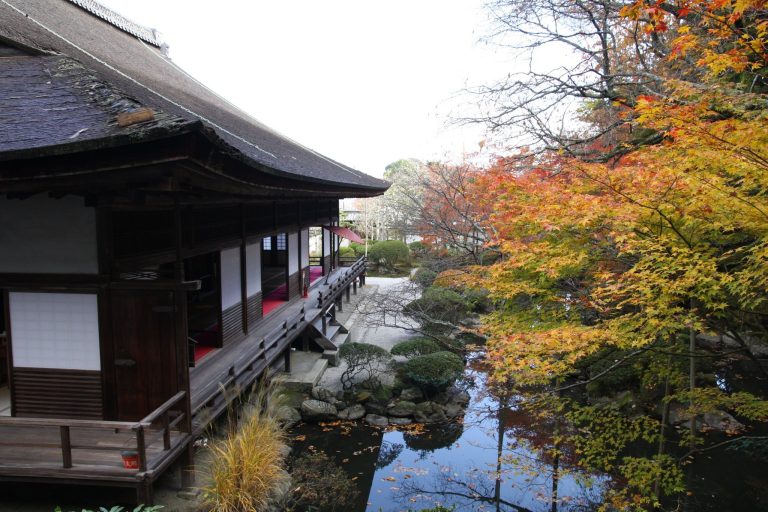
The Kangaku-in Guest Hall is a National Treasure built in 1600 under the patronage of Toyotomi Hideyori, with a donation from Mori Terumoto. The Kojo-in Guest Hall, completed in 1601, is also a National Treasure. It is a six-by-seven-bay building with a wooden-shingled irimoya roof and is regarded as a representative example of late Muromachi shoin-style architecture, an elite tradition centered on reception rooms, writing spaces, alcoves, tatami planning, and composed interior decoration.
The Kojo-in interior contains Kano-school paintings, including sliding-door paintings attributed to Kano Sanraku. These paintings became Important Cultural Properties in 1976. Its garden, designated a National Place of Scenic Beauty in 1934, has a large pond extending almost to the veranda, a central island, and stones arranged as a dry waterfall. The planting reflects the compositions of the interior paintings.
Relocated structures
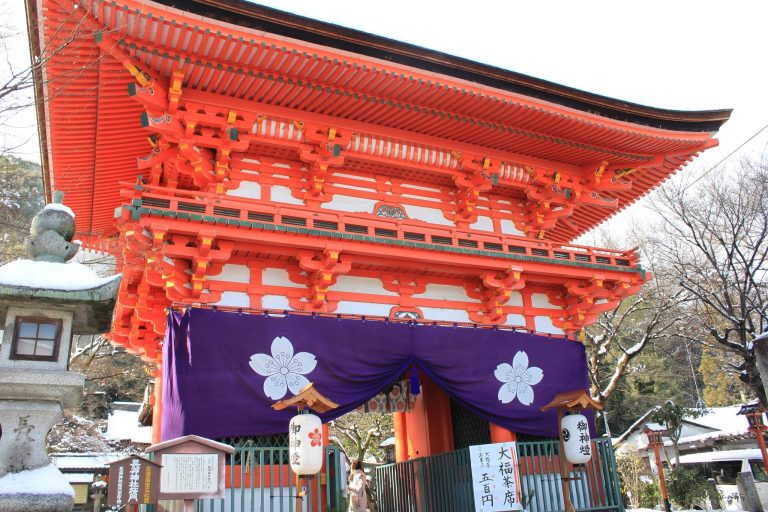
The Great Gate was formerly the gate of Joraku-ji in Omi before Tokugawa Ieyasu donated and moved it to Mii-dera in 1601. The Three-story Pagoda came from Hiso-ji in Yamato and was relocated in the same year through Ieyasu’s donation. The Sutra Repository came from Kokusei-ji in Suo and was donated and moved to Mii-dera by Mori Terumoto in 1602.
Southern precinct and pilgrimage buildings
Kannon Hall
The Kannon Hall stands on a hill in the Southern precinct overlooking Lake Biwa and forms the center of the pilgrimage compound. Founded in 1072 on the western mountain at Hananotani as a prayer for the recovery of Emperor Go-Sanjo, it was originally called Shogan-ji or Shoho-ji. The building moved to its present site in 1481, burned in 1686, and was rebuilt in 1689. Its structure comprises a main sanctuary, an intermediate section, and a worship hall. The nine-by-five-bay building has several levels and an irimoya roof covered with tiles.
The hall houses a wooden, lacquered, and gilded seated image of Nyoirin Kannon, traditionally attributed to Enchin. It is the principal image of the fourteenth temple on the Saigoku Kannon pilgrimage and is opened once every thirty-three years, with additional openings associated with the year after an imperial accession. Images of Aizen Myoo and Bishamonten are also housed there, together with votive paintings depicting the hall’s reconstruction.
Associated Southern precinct structures
The Southern precinct includes the Kannon Hall’s kitchen and study, a bell tower, the Hundred-Image Hall, the Moon-Viewing Stage, the Votive Tablet Hall, a water basin pavilion, the Otsu abacus memorial, a memorial to participants in the Satsuma Rebellion, and the Jizo Hall.
The study originally formed part of Murakumo Imperial Temple Zuiryu-ji, founded in 1596 by Nisshu-ni, the mother of Toyotomi Hidetsugu. After Zuiryu-ji moved from Kyoto to the former site of Hachiman Castle in Omihachiman in 1961, Mii-dera acquired the building and moved it to the temple in 1965. The present structure had been rebuilt in the nineteenth century.
The bell tower was rebuilt in 1814. Its present bell is a replica of the important Korean bell associated with Mii-dera. The original bell, known as the Bell of the Child’s Karma, was requisitioned during the Second World War under the metal collection order. The Hundred-Image Hall, built in 1753, contains one hundred images, including the central Nyoirin Kannon, models of the thirty-three Saigoku pilgrimage images, and models of the thirty-three Bando and thirty-four Chichibu pilgrimage images. A painting called “The Demon Performing the Nenbutsu” is displayed beside its entrance.
The Moon-Viewing Stage was built in 1849 as a projecting platform supported by a kake-zukuri structure. It provides views of Lake Biwa Canal, Otsu, and Lake Biwa. The Votive Tablet Hall, rebuilt in 1801, is an open-sided building with six exposed posts. The water basin pavilion was rebuilt in 1881. The Jizo Hall, rebuilt in 1819, houses the Heir-Appointing Jizo and stands along the stone steps rising from Nagara Shrine toward the Kannon Hall, giving it the name Middle-Slope Jizo.
Detached temples and sub-temples
Mimyo-ji and Suikan-ji
Mimyo-ji was founded in 994 by the monk Keisho southwest of present-day Nagara Park. Its Main Hall, rebuilt in 1776, was moved to the Central precinct in 1979. The hall’s principal image is an eleven-faced Kannon traditionally regarded as Emperor Tenji’s devotional image and formerly associated with Ozura-ji. It is preserved in the temple’s cultural-property repository and is linked with the name “Kannon of the Fallen Hat,” derived from the crowding of worshippers.
Suikan-ji was founded in 1040 by the abbot Myoson northeast of the former Great Gate. Its present Main Hall was rebuilt in 1655 and moved to its current position in 1988. Its principal image was originally Eleven-faced Kannon and became Yakushi Nyorai during the Edo period. The hall is the oldest of the five detached-temple main halls and is a Shiga Prefecture-designated cultural property.
Gonsho-ji and related traditions
Gonsho-ji was founded in 904 by the monk Annen in the eastern part of present-day Nagara Park. Its Main Hall, rebuilt in 1716, houses Senju Kannon. The adjacent Amida Hall, built in 1850, houses the image of the Zenko-ji Buddha. Gonsho-ji was associated with the Seki Semimaru Shrine, itinerant performers, and religious instructors. Its pilgrimage affiliations include the Kinki Saigoku Thirty-Three Kannon, Goshu Thirty-Three Kannon, and Lake Biwa 108 pilgrimages.
The five principal detached temples historically included Mimyō-ji, Suikan-ji, Gonsho-ji, Ozura-ji, and Jozaiji. Nyoiji was a former Mii-dera dependency around Mount Nyoigatake in eastern Kyoto. Its complex included a Main Hall, a Three-story Pagoda, and subsidiary residences along the Nyoigoe Pass. The institution was destroyed during the Onin War in 1468. A small hall was rebuilt near the foot of the mountain in the early Edo period, and its former principal image, a wooden standing Senju Kannon, is deposited at the Nara National Museum.
Enman-in
Enman-in is a Mii-dera sub-temple with an uncertain foundation history. It may have begun in 987 as a residence established by Prince Goen, son of Emperor Murakami, or may have been created with imperial support in 1040. It was moved into the Mii-dera precincts in the early Edo period.
Its main residence is in the shinden-zukuri style, an aristocratic residential form developed during the Heian period. Empress Meisho presented the building in 1647. It had originally been built in 1619 for Tokugawa Masako, daughter of Shogun Tokugawa Hidetada and wife of Emperor Go-Mizunoo. The plan has six rooms arranged in two north-to-south rows, with a throne used by Emperor Go-Mizunoo in the northwest room. Original Kano-school wall paintings are preserved at the Kyoto National Museum, while reproductions remain in the building.
The Enman-in garden is attributed to Soami and was designated a National Place of Scenic Beauty in 1934. The sub-temple is also associated with the Otsu-e Museum and its collection of votive prints.
Images, bells, and manuscripts
Yellow Fudo
The Yellow Fudo is a painted image of Fudo Myoo on silk, approximately 178 by 72 centimeters. It is conventionally dated to the ninth century, although a Tang-period origin has been proposed following recent restoration. The full-length figure appears against an unpainted background with wide-open eyes, a bare muscular upper body, no pedestal, and an unusual form of iconography without a queue hairstyle.
The image is hidden and is counted among Japan’s three celebrated Fudo images, together with the Red Fudo of Myoo-in on Mount Koya and the Blue Fudo of Shoren-in. Tradition says that it appeared to Enchin during ascetic practice in 838 and identified itself as the guardian of the monk who would transmit the essence of Buddhism. It was also said to appear during dangers in Enchin’s life, including his voyage to China. A wooden standing Yellow Fudo in the Tang Institute, painted with crystal-inlaid eyes, is an Important Cultural Property and is thought to have been carved during the Kamakura period by a leading sculptor of the Kei school.
Bells
Benkei’s Dragged Bell stands in the Bell Hall near the Main Hall. It is separate from the Evening Bell of Mii-dera. Tradition says that the Dragon King of Lake Biwa gave the bell to Tawara Toda, after which Benkei dragged it to Mount Hiei and threw it into a valley. Its historical association is instead with the seizure of the bell during the attack of 1264 and its later return under shogunal orders. The uninscribed bell probably dates from the Nara period and is 199.0 centimeters high. Scratches and cracks on its surface are traditionally attributed to the dragging.
The Korean bell is a Goryeo-period bell made in 1032 and measuring 77.2 centimeters in height. It served as the model for the bell now hanging in the Southern precinct bell tower.
Images and written treasures
Other important objects include the seated wooden image of Nyoirin Kannon in the Kannon Hall, the standing image of the temple’s protective deity in the Protective Deity Hall, the standing Eleven-faced Kannon from Nyoiji in the cultural-property repository, a seated Enchin, and a seated Fudo made in 1014 by the sculptor Moritada. The collections also include Karitei-mo, a gilt-bronze ritual percussion instrument with a peacock design, a Liao-period bell, manuscripts, an illustrated old plan of the temple precincts, and two measuring rulers associated with the Tang Institute.
The temple’s National Treasures include the Main Hall and its shrine, the Shinra Sanctuary and its altar and shrine, the Kangaku-in and Kojo-in Guest Halls, the Yellow Fudo painting, two seated images of Enchin, the seated image of Shinra Myojin, the illustrated ritual manuscripts called Five Sections of the Contemplation, and forty-six groups of documents and books associated with Enchin. These records include genealogical material, documents concerning his voyage to China, autograph writings, and scriptures brought from China.
The Five Sections of the Contemplation consists of two scrolls showing the deities of the Diamond Realm Mandala in monochrome ink. One scroll is a complete Tang-period work received by Enchin from Faquan. The other is an incomplete Japanese copy from the eleventh century, although another interpretation identifies the fragmentary scroll as the imported work.
Archaeological and garden remains
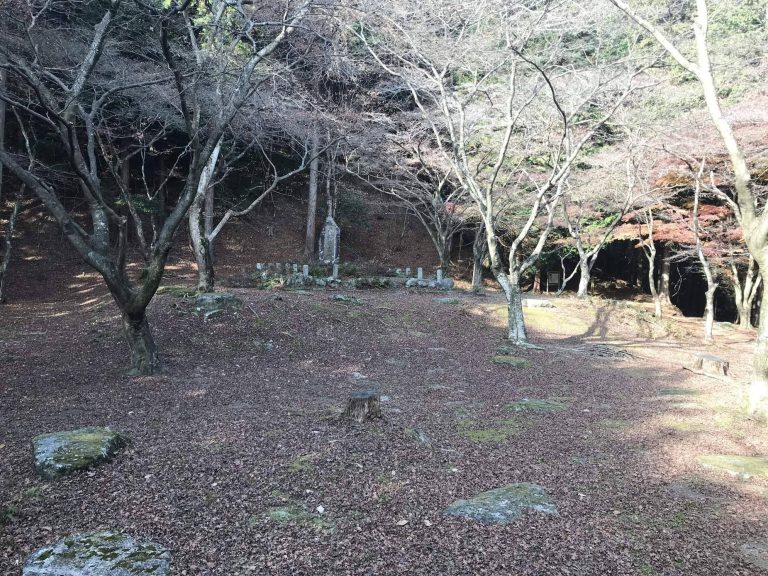
The Zenpo-in sub-temple once stood between the Three-story Pagoda and the Sutra Repository as a retreat for senior prelates. Its large garden received National Place of Scenic Beauty designation in 1934. After a landslide caused by heavy rain in 1941, rediscovered layout drawings and archaeological excavation revealed surviving pond edges and many garden stones. Reconstruction of the garden began in 2017.
Mii-dera’s surviving buildings and objects preserve evidence of its foundation traditions, its revival under Enchin, its institutional division from Enryaku-ji, and the repeated rebuilding that shaped its early modern appearance. The Kojo-in and Enman-in gardens are National Places of Scenic Beauty, while the temple’s historic structures, images, bells, documents, and archaeological remains are safeguarded through national, prefectural, and municipal cultural-property designations.