Gichū-ji Temple: A Buddhist Memorial Temple in Ōtsu, Japan


Site at a Glance
- Rating
- 4.2
- Popularity
- Low
- Country
- Japan
- Primary era
- Early Modern
- Eras represented
- Early Modern
- Civilizations
- Tokugawa
- Site type
- Religious
On this page12 sections
History
Gichū-ji Temple is a Tendai-related independent Buddhist temple in Japan, located in Ōtsu, Shiga Prefecture. Formally known as Asahiyama Gichū-ji, it venerates Shō-Kannon Bosatsu, but its foundation date and original name are unknown. The temple grew around the burial place of Kiso Yoshinaka, a late-Heian military leader whose death occurred during the Genpei War, the conflict that brought the Minamoto clan to power over the Taira.
Origins and the Yoshinaka tradition
Temple tradition attributes Gichū-ji’s beginnings to Tomoe Gozen, the celebrated female warrior associated with Yoshinaka in medieval Japanese tradition. After Yoshinaka was killed at the Battle of Awazu in Ōmi Province, she is said to have built a small hermitage near his burial place and performed memorial rites there each day. The hermitage became known as the “Hermitage of the Nameless Woman.”
The institution later circulated under several names, including Tomoe Temple, the Nameless Hermitage, Kiso Mound, Kiso Temple, and Gichū-ji. Records from the late Kamakura period already mention these names. The burial mound near the battlefield remained the focus of the developing temple, linking its religious identity to Yoshinaka’s memory and to the traditions surrounding Tomoe Gozen.
Medieval decline and early modern reconstruction
Gichū-ji declined during the Muromachi period. Around 1553, Rokkaku Yoshikata, the military governor of Ōmi Province, revived the temple, which became subordinate to Ishiyamadera around the same period.
A further reconstruction took place during the Jōkyō era, approximately 1684 to 1688, under the direction of the Jōdo priest Shōju. He established a new grave monument for Yoshinaka and built a small hermitage called Yoshinaka-an. The institution later became affiliated with Kōjōin, a subtemple of Onjōji, and its name was formally changed to Gichū-ji in 1692.
Bashō and the literary life of the temple
Matsuo Bashō, an influential Edo-period haiku poet, frequently stayed at Gichū-ji. Poetry gatherings took place at the Nameless Hermitage, giving the temple an important place in the activities of Bashō’s poetic circle. After Bashō died in Osaka, his wishes led to his burial beside Yoshinaka’s grave in October 1694. His adjoining tomb is commemorated by a verse from his disciple Shimazaki Yūgen, commonly rendered as “Coldness, back to back with Lord Kiso.”
In 1697, Onjōji appointed the Zen monk Taisō as abbot because Yoshinaka was regarded as a Zen adherent. The appointment provoked opposition within Onjōji because a Tendai-affiliated institution had appointed a Zen monk. Taisō was removed from the abbacy but continued to administer Gichū-ji as caretaker, while members of Bashō’s poetic circle helped sustain the temple.
Later revival and independence
Gichū-ji declined again during the Hōreki era, approximately 1751 to 1764. Its parent institution was temporarily changed from Kōjōin to Hōmyōin because Kōjōin faced financial hardship, and the affiliation later returned to Kōjōin. In 1769, the Kyoto haiku priest Chōmu completed a revival that had occupied several decades. A large memorial service marking Bashō’s centenary was held at the temple in 1793.
The Lake Biwa flood disaster of 1896 damaged the temple, and restoration began in 1900. Around this period, its parent institution became Enman-in, one of the three monzeki institutions of Onjōji. After the Pacific War, Gichū-ji faced severe decline and possible extinction. In 1965, a private benefactor provided funds to purchase the precinct land from Enman-in, enabling the temple to become independent and begin another revival. Further improvements to the precinct were also financed by the same benefactor.
The entire precinct was designated a National Historic Site of Japan in 1967. The graves of the restorer Miura Giichi and the literary critic Yasuda Yojūrō are also located within the precinct, linking the site’s modern history to the people associated with its recovery and literary importance.
Remains
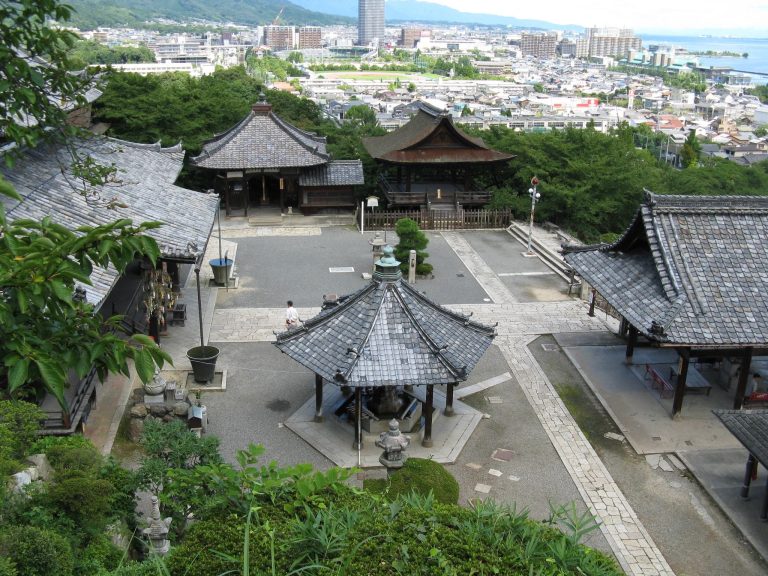
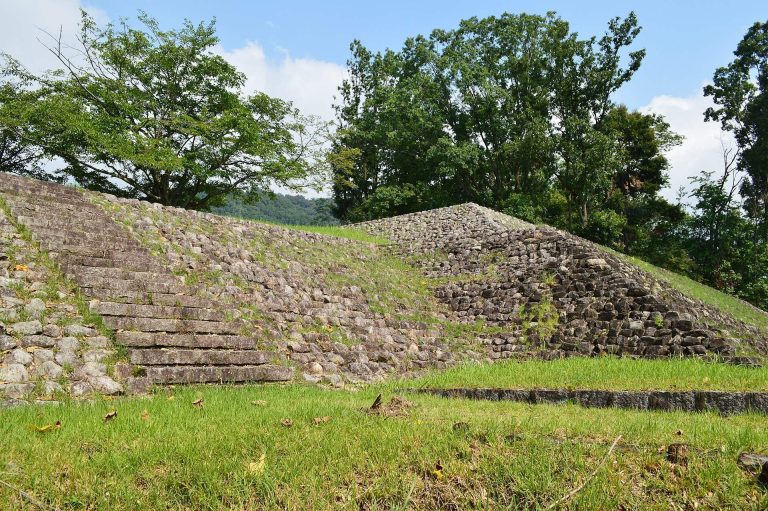
Gichū-ji’s surviving precinct brings together sacred images, memorial monuments, hermitage sites, graves, and a hall with painted ceiling panels. Its physical character reflects the temple’s long association with Yoshinaka, the literary gatherings connected with Bashō, and the rebuilding and preservation efforts of later periods.
Memorial monuments and graves
Yoshinaka’s burial place
Yoshinaka’s burial place is marked by a stone hōkyōintō, a Buddhist memorial tower traditionally associated with religious merit and commemoration of the dead. The burial tradition connects the original mound with a Japanese persimmon tree, while the later stone tower was erected for Yoshinaka’s grave. A wooden statue of Yoshinaka, shown in court robes and holding an arrow, is enshrined at the temple.
Bashō’s grave
Bashō’s grave stands beside Yoshinaka’s. Its position reflects the poet’s expressed wish to rest next to Yoshinaka and preserves the physical connection between the warrior’s memorial and the literary community that gathered at Gichū-ji in the Edo period.
Hermitages and painted hall
Nameless Hermitage and Yoshinaka-an
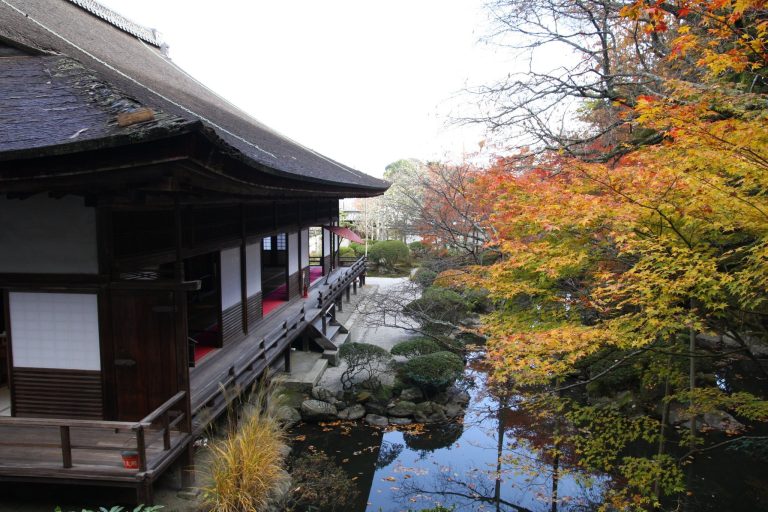
The Nameless Hermitage was the setting for poetry gatherings associated with Bashō and his circle. Yoshinaka-an, a small hermitage established during Shōju’s seventeenth-century reconstruction, belongs to the later phase of the precinct’s development and reflects the temple’s continuing focus on Yoshinaka’s memory.
Hall of the Old Man
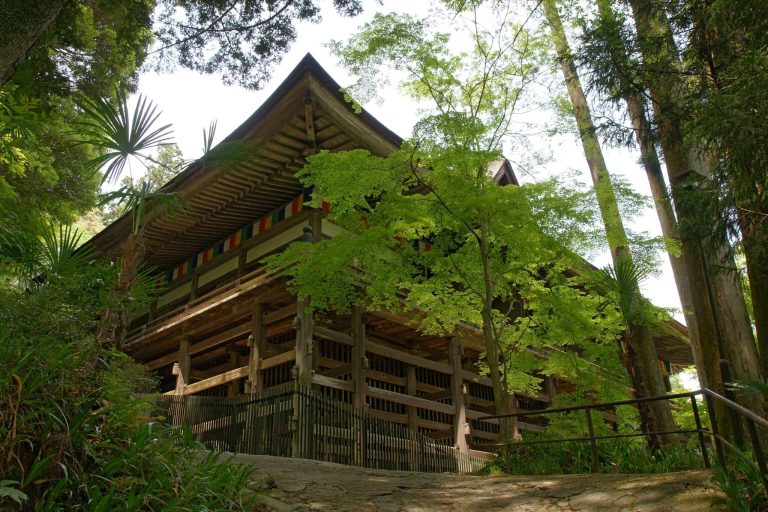
The Hall of the Old Man contains 15 ceiling panels with 12 types of ceiling paintings attributed to Itō Jakuchū. Their format suggests that they may once have formed a set with floral ceiling paintings now held at Shingyō-ji in Sakyo Ward, Kyoto. Both groups were originally made for the Kannondō of Sekihō-ji, which was dismantled in the late Edo period, after which the floral paintings passed outside the temple.
An inscription on the reverse of the hall’s ceiling states that the paintings were donated in June 1859 by a fishmonger from Sakaeya-chō in Ōtsu. The ceiling paintings currently open to the public are faithful digital reproductions. The precinct also contains the graves of Miura Giichi and Yasuda Yojūrō, whose connection with the temple belongs to its modern revival.