Bishamon-dō Temple: A Tendai Buddhist Monzeki Temple in Kyoto


Site at a Glance
- Rating
- 4.3
- Popularity
- Medium
- Country
- Japan
- Primary era
- Early Modern
- External website
- Open
- Eras represented
- Early Modern
- Civilizations
- Tokugawa
- Site type
- Religious
On this page12 sections
History
Bishamon-dō Temple is a Tendai Buddhist temple in Kyoto, Japan, whose present institutional history reaches back to the re-establishment of Izumoji in 1195. The temple is associated with Gohōzan, its mountain name, and formally with Gohōzan Ankoku-in Izumoji. Its principal image is Bishamonten, a Buddhist guardian deity associated with protection and warfare and counted among the Four Heavenly Kings.
Izumo-dera and the early tradition
Temple tradition identifies Izumo-dera as Bishamon-dō’s predecessor. It states that the monk Gyōki founded it in 703 at the devotional request of Emperor Monmu, an early-eighth-century Japanese sovereign. Early eighth-century roof tiles indicate that a temple existed in the area before the capital moved to Heian-kyō, although the tiles do not establish Gyōki’s role as founder.
The earlier Izumo-dera is thought to have stood north of the present Shōkoku-ji, near Kamigoryō Shrine, in an area still known as Izumoji. The temple had declined by the late Heian period, but during the medieval period the site was known as a celebrated place for viewing cherry blossoms.
The 1195 re-establishment
A testament attributed to Taira no Chikanori states that in 1195 he brought together three temples connected with the Taira family, Byōdō-ji, Sonchō-ji, and Gohō-ji. At Izumoji he built three five-bay halls, meaning halls whose principal fronts were divided into five structural bays between columns. The revived institution inherited the status of Izumo-dera and became known as Gohōzan Izumoji.
The three constituent temples each had their own history. Byōdō-ji, founded by Prince Kazurahara, a son of Emperor Kanmu and an ancestor of the Kanmu branch of the Taira family, stood in Uzumasa. Sonchō-ji had been founded by Taira no Chikazane at Gotsuji. Gohō-ji was founded in Fushimi by Taira no Norie, the father of Taira no Chikanori, moved to Kitaishikura in 1161, and burned in 1163.
According to tradition, only Gohō-ji’s Bishamonten image survived that fire. In 1195 it was taken to Raigō-in at Ōhara, where a temporary hall was built for it. The image then became the principal image of the re-established Izumoji. Another tradition attributes the statue to Saichō, founder of the Tendai school, who is said to have carved it in 795 from wood left over after making a Yakushi Nyorai, the Buddha of healing and medicine, for Enryaku-ji.
War, rebuilding, and relocation
The temple was burned during the Ōnin War, a fifteenth-century conflict that caused widespread destruction in Kyoto, in 1467. It was rebuilt in 1469 at the former Izumo-dera site at Tō-no-kaki, but burned again in 1571.
Restoration began during the Keichō era, from 1596 to 1615, under Tenkai, a Tendai monk and close associate of Tokugawa Ieyasu, founder of the Tokugawa shogunate. The shogunate granted Izumoji part of the estate of Anshō-ji, a ninth-century Shingon temple in Yamashina. This allowed the temple to move to its present location and to be revived there. After Tenkai’s death, his disciple continued the work, which was completed in 1665.
Imperial connections and later status
Because Izumoji enshrined Bishamonten, it came to be called Bishamondō. Prince Kōben, a son of Emperor Go-Sai, received his Buddhist precepts at the temple and later retired there. After Emperor Go-Sai’s death, Bishamondō received an imperial envoy gate, a spirit hall, and a ceremonial hall from the imperial palace in 1693. These buildings were transferred to the temple and became part of its complex.
From this period, Bishamondō was a monzeki temple, a high-status Buddhist institution traditionally headed by a member of the imperial family or aristocracy. It became one of the five Kyoto monzeki temples of the Tendai school, and its temple estate amounted to 1,700 koku. The Niōmon, main hall, and ceremonial hall are designated tangible cultural properties by Kyoto City. An associated important cultural property is a diary by Tōin Kinsada. A celadon flower vase with phoenix-shaped handles, formerly kept at Bishamon-dō and now held by the Kubo Sō Memorial Museum in Izumi, Osaka, is designated a National Treasure.
Remains
Layout and principal buildings
Three-hall arrangement
The 1195 re-establishment was organized around three five-bay Buddhist halls. Byōdō-ji stood to the west, Sonchō-ji to the east, and Gohō-ji at the center. Their arrangement was modeled on the placement of buildings around the main hall of Enryaku-ji, the principal monastery of the Tendai school. This plan preserves the institutional relationship between the three Taira-associated foundations and the revived Izumoji.
Temple buildings
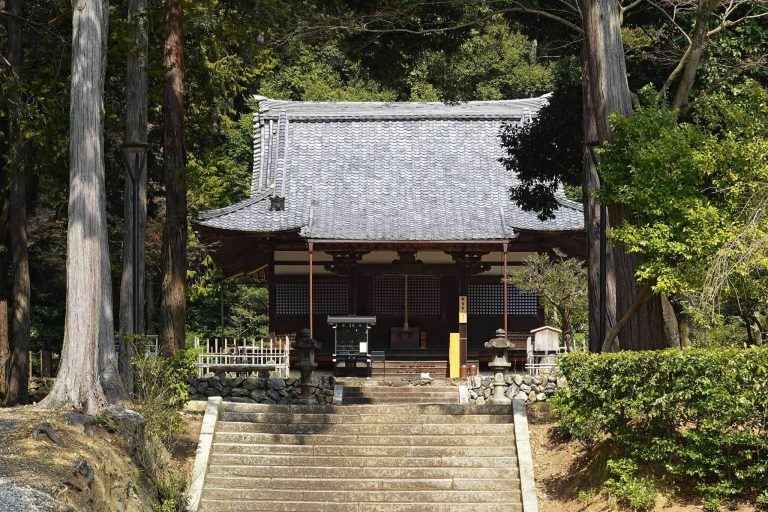
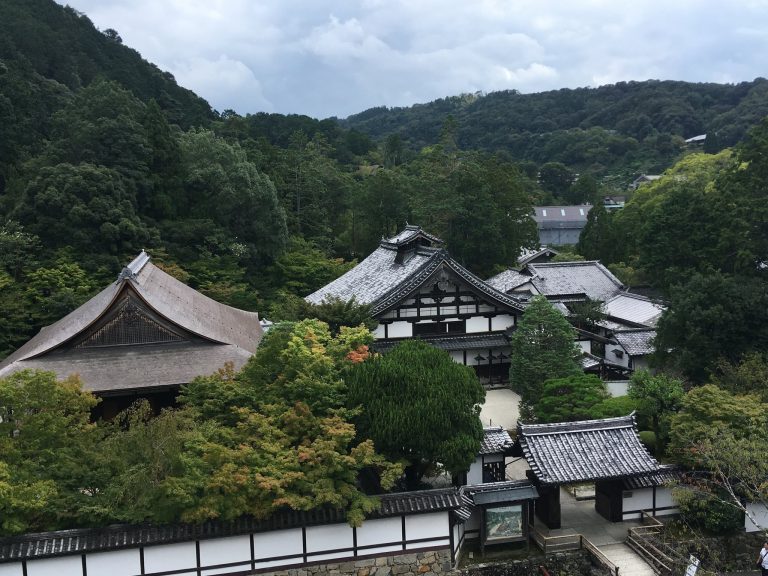
The present complex includes a Niōmon, a main hall, and a ceremonial hall. The ceremonial hall is a formal reception and ritual space used for religious and courtly functions. Together with an imperial envoy gate and a spirit hall, it was transferred from the imperial palace in 1693. The Niōmon, main hall, and ceremonial hall survive as the principal buildings identified among the temple’s protected architectural features.
Images and former temple objects
Bishamonten image
The principal image is a statue of Bishamonten, traditionally attributed to Saichō. Its history is linked to Gohō-ji, where it was said to have survived the temple’s destruction by fire in 1163. The statue was temporarily enshrined at Raigō-in in Ōhara before being installed as the principal image of the re-established Izumoji in 1195.
Celadon flower vase
Bishamon-dō formerly housed a celadon flower vase with handles shaped as phoenixes. The vase is now preserved at the Kubo Sō Memorial Museum in Izumi, Osaka, where it is held as a National Treasure.