Saidai-ji Temple: An Imperial Buddhist Temple and Head Temple of Shingon Ritsu


Site at a Glance
- Rating
- 4.1
- Popularity
- Medium
- Country
- Japan
- Primary era
- Early Modern
- External website
- Open
- Eras represented
- Medieval, Early Modern
- Civilizations
- Ashikaga shogunate, Tokugawa
- Site type
- Religious
- Remains
- Temple
On this page12 sections
History
Saidai-ji Temple is a Buddhist temple in Nara, Japan, founded in 765 as an imperial establishment for state-protective prayer. Created as a western counterpart to Tōdai-ji, it became one of the Seven Great Temples of Nara and is now the head temple of the Shingon Ritsu school.
Imperial foundation
The temple’s origins lay in the Fujiwara no Nakamaro Rebellion. In September 764, the retired Empress Kōken commissioned gilt-bronze images of the Four Heavenly Kings, Buddhist guardian deities traditionally placed around a sacred area, as prayers for the suppression of the uprising. She was enthroned again in October under the name Empress Shōtoku, and the images were completed in 765, the year Saidai-ji was founded. The monk Jōtō served as its founding abbot, and the new temple functioned as an imperial prayer establishment.
The foundation took place while the monk Dōkyō, an influential Buddhist monk and political figure at the imperial court, held considerable political power. His ideological influence on the project is considered probable. The installation of the Four Heavenly Kings for the protection of the state followed the Buddhist scripture known as the Golden Light Sutra.
Decline and Kamakura revival
Saidai-ji originally occupied a vast complex and possessed considerable political and religious importance. During the Heian period, however, its fortunes declined. Fires and typhoons destroyed many halls and pagodas, and control of the temple passed to Kōfuku-ji.
The monk Eison became the principal restorer of Saidai-ji during the Kamakura period. He first stayed there in 1235 and returned permanently in 1238, beginning more than fifty years of work to revive the institution. Eison promoted the renewal of Buddhist monastic discipline and organized relief for poor and sick people, making the temple a center of social-welfare activity. He dedicated the principal image of Shaka Nyorai in 1249, and Saidai-ji later became the head temple of the Shingon Ritsu tradition, which combines Shingon esoteric Buddhism with the Vinaya tradition of monastic discipline.
Eison’s restoration also produced many of the Buddhist images and craft objects associated with Saidai-ji today. The temple was connected with eminent monks such as Ninshō and helped revive ruined provincial kokubunji, the Buddhist temples established under the ancient Japanese state in the provinces. A register from the late fourteenth century lists affiliated temples in eight provinces, while other evidence indicates that the network extended across more than eight provinces.
Destruction, rebuilding, and modern status
An attack by Akazawa Tomotsune, a retainer of Hosokawa Masamoto, burned Saidai-ji in December 1499. The East Pagoda was destroyed by fire in 1502. During the Edo period, the Tokugawa shogunate granted the temple a fief of 300 koku, a rice-based measure of income, enabling reconstruction to begin. Every building now standing at Saidai-ji was rebuilt from the Edo period onward.
Saidai-ji became independent from the Shingon sect in June 1895 and organized the Shingon Ritsu school. It is also known as the Southern Capital Great Ritsu Temple. The precincts were designated a National Historic Site in 1965. The designation includes the present precincts, the Okunoin containing Eison’s tomb, and the site traditionally identified as Empress Shōtoku’s villa. The land north of the present precincts, where the main eighth-century complex stood, is now residential and lies outside the designated area.
The Great Tea Ceremony, or O-chamori, preserves a tradition associated with Eison’s restoration. In 1239, he offered tea to the Hachiman shrine and distributed the remaining tea to local people. The continuing ceremony uses a bowl more than 30 centimeters in diameter and weighing about 7 kilograms, which participants pass among themselves as an expression of communal harmony.
Remains
The original temple was arranged around the Yakushi Kondō and Miroku Kondō. The Small Pagoda Compound lay to their east, while the Dining Hall Compound stood farther north. To the west was the Storehouse Compound, with the Administrative Compound farther north. Two five-story pagodas were positioned south of the central halls, one east and one west. The Four Kings Compound stood east of the pagodas, and the Eleven-Headed Kannon Compound stood to their west; the Southeast Corner and Southwest Corner compounds lay farther south. The pagodas were first planned as octagonal buildings but were changed to square plans during construction.
Principal halls
Main Hall
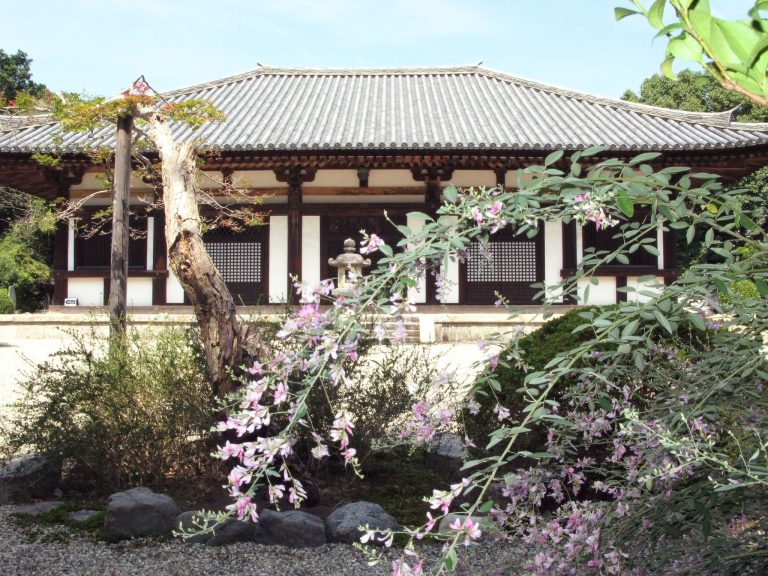
The Main Hall is a large Buddhist hall built in the early nineteenth century. Its hipped roof slopes on all four sides and is covered with traditional fired tiles. Construction began around 1798 and ended around 1808, replacing an earlier hall whose repair was considered impractical. The building uses no earthen walls and has restrained decoration. It is regarded as a representative large Buddhist hall of the late Edo period and continues the function of the Kamakura-period Kōmyō Shingon Hall.
Inside stands Saidai-ji’s principal image, a wooden Shaka Nyorai made in 1249 by the sculptor Zenkei. The standing figure follows the Seiryoji style, based on the celebrated Shaka image at Seiryoji in Kyoto, and contains numerous deposits placed inside the statue when it was made or consecrated. The hall also holds a group of five wooden figures representing Manjushri Bodhisattva, made in 1302. These figures likewise contain numerous deposited objects.
Aizen Hall
The Aizen Hall was transferred during the 1760s from the Konoe family’s administrative residence at the Kyoto Imperial Palace to the former site of Eison’s living quarters, known as the West Chamber. The transfer is dated to 1762, although 1767 is also given. A foundation tablet states that the Konoe family donated the hall for a daughter of Tokugawa Muneharu, who was also known as Reijuin.
The hall contains a small seated wooden image of Aizen Myōō, an esoteric Buddhist deity associated with transforming desire into spiritual awakening. Zenen made the image in 1247. Its original coloring and cut-gold decoration, a technique using thin strips or shapes of gold leaf on a painted surface, remain well preserved. Numerous objects were placed inside it. The image is kept hidden and opened for viewing around October and November. The hall also contains a seated wooden portrait of Eison made in 1280, when he was 80 years old. Installed in the left bay, the portrait contains deposited materials including the cremated remains of Eison’s parents.
Four Kings Hall and associated sculpture
Four Kings Hall
The Four Kings Hall, also called the Kannon Hall, was rebuilt in 1674. It contains a standing eleven-headed Kannon made in the late Heian period in the Hasedera style. The image was transferred in 1289 from the Eleven-Headed Kannon Hall of Hosshōji at Shirakawa in Kyoto.
Four standing images of the Four Heavenly Kings occupy the hall. Jikokuten, Zōchōten, and Kōmokuten are bronze and are attributed to the Kamakura period, while the wooden Tamonten is attributed to the Muromachi period. The demons beneath the figures’ feet are the only surviving parts of this group from the temple’s foundation period.
Gates, memorial buildings, and subsidiary temples
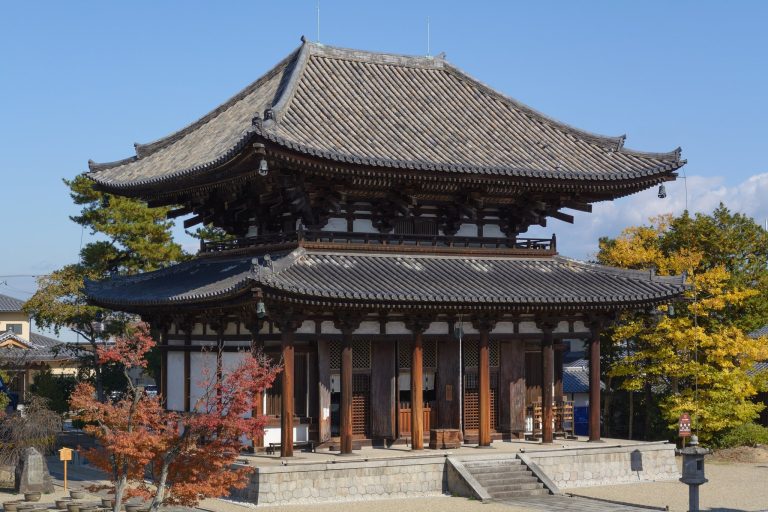
The South Gate is a Muromachi-period structure. Other buildings in the compound include a late-Kamakura-period five-ring pagoda, a funerary or memorial monument made from five symbolic geometric forms, an Edo-period Jizō Hall, and the Bone Hall, a Muromachi-period ossuary. Several subsidiary temples also form part of the compound. Two were revived in the early Shōwa period, while another burned in 1984 and was rebuilt the following year.
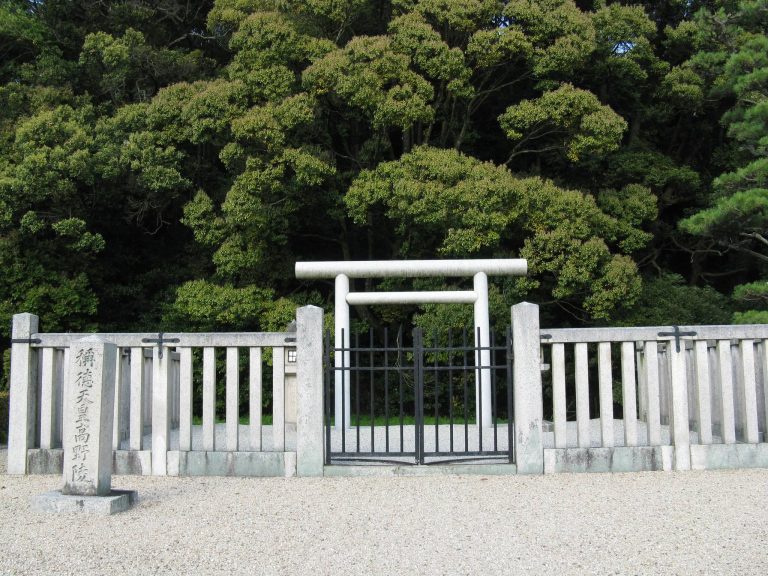
Two listed Amida halls were rebuilt in May 1656 by a senior monastic official; one is identified as the Amida Hall of Hōju-in. At the Okunoin in Saidaiji-Nogamicho, Eison’s tomb is marked by a five-ring pagoda. The area also contains a Jizō Hall, the Bone Hall, an Amida Hall, and the graves of successive senior abbots.
Earlier layout and preserved objects
The central halls of the original complex contained large groups of Buddhist images. The Yakushi Kondō held 21 images, including a Yakushi triad, in which Yakushi, the Buddha of healing, is accompanied by two attendants, and an image of Peacock Wisdom King. The Miroku Kondō held 77 images representing the Pure Land of Miroku in Tusita, the heaven associated with the future Buddha. Esoteric Buddhist images and numerous mirrors also adorned the halls.
Saidai-ji preserves paintings, ritual furnishings, manuscripts, metalwork, and other cultural-property holdings in addition to its sculptures. Among them is a complete set of twelve painted hanging scrolls of the Twelve Devas. Six of the scrolls are deposited at the Nara National Museum, while three are held by the Tokyo National Museum and three by the Kyoto National Museum.