Mibu-dera Temple: A Historic Risshū Buddhist Temple in Kyoto


Site at a Glance
- Rating
- 4.1
- Popularity
- Medium
- Country
- Japan
- Primary era
- Early Modern
- External website
- Open
- Eras represented
- Early Modern, Modern
- Civilizations
- Japanese
- Site type
- Religious
- Remains
- Temple
On this page18 sections
History
Mibu-dera Temple is a Buddhist temple in Kyoto, Japan, founded in 991 by Kaiken, a monk of Onjō-ji, as a foundation dedicated to his mother. It belongs to the Risshū school, a Japanese Buddhist tradition that emphasizes monastic discipline and religious precepts. Its original principal image was a Jizō statue attributed to Jōchō. Jizō is a bodhisattva associated with the protection of travelers, children, and the dead.
Foundation and Early Names
A memorial service held in 1005 took place when the temple was known as Komii-dera, meaning “Little Mii-dera,” a reference to Kaiken’s original temple. During an imperial visit traditionally dated between 1077 and 1080, Emperor Shirakawa is said to have granted the temple the title Jizō-in. Shirakawa later ruled as a retired emperor and exercised considerable political influence.
Mibu-dera also became connected with an annual Setsubun observance held in February. The temple lay in the direction regarded in Kyoto as the rear demon gate, and, at Emperor Shirakawa’s request, an exorcistic ceremony was associated with the site. Earlier names included Jizō-in and Shinjōkō-in, while the name Mibu-dera gradually developed from the surrounding place-name.
Relocation and Risshū Restoration
In 1213, a devotee moved the temple from the Gojōbōmon Mibu area, east of its present position, to its current location. A fire in February 1257 destroyed all the buildings. The complex was restored in 1259 by the devotee’s son and by Engaku, a Risshū monk connected with the Yuzu Nembutsu tradition, which centers on reciting the name of Amida Buddha.
After this restoration, the temple was renamed Hōdō Sanmai-dera and became a Risshū institution. Engaku is traditionally credited with establishing the Mibu Dai Nembutsu Kyōgen, a largely wordless masked theatrical tradition that presents Buddhist stories and moral themes during the Dai Nembutsu observance. The tradition is now recognized as an Important Intangible Folk Cultural Property.
Fire, Reconstruction, and Edo-Period Connections
In 1528, a fire damaged all the temple buildings except the main hall and south gate, and the damaged structures were soon restored. During the Edo period, Mibu-dera retained strong popular support and possessed numerous subsidiary establishments. They included Jizō-in, Nakano-bō, Minamino-bō, Takenobō, Nishinobō, Umeno-bō, Higashinobō, Anyō-in, Jakusei-an, Saigan-an, Hōzō-bō, and Fukujō-bō.
The entire complex was destroyed in the Great Tenmei Fire of January 1788. A new Dai Nembutsu-dō was built in 1789, and performances of Mibu Dai Nembutsu Kyōgen were subsequently held there rather than in the main hall. The main hall, which had previously faced south, was rebuilt facing east in 1811. Other buildings were restored gradually, including the front gate in 1799, the bell tower in 1851, and the Dai Nembutsu-dō in 1856.
At the end of the Edo period, the Tokugawa shogunate established the Mibu Rōshigumi at the nearby Yagi residence. This organization preceded the Shinsengumi, a special police and military force formed during the political conflicts before the Meiji Restoration. After the group moved its headquarters to Nishi Hongan-ji, Mibu-dera’s grounds continued to be used for military and martial-arts training.
Modern Destruction and Continuity
The temple’s association with the Shinsengumi is commemorated at Mibuzuka, a burial area connected with its members. A July 16 memorial service commemorates Shinsengumi members on the anniversary of the Ikedaya Incident and includes activities such as swordsmanship and poetry recitation. The temple’s subsidiary establishments declined during the Meiji-era suppression of Buddhism, and only Nakano-bō survived. It was later renamed Chūin.
The late-Kamakura-period seated Jizō known devotionally as Mibu Jizō or Enmei Jizō was destroyed by arson on July 25, 1962, together with the main hall, the Four Heavenly Kings statues, and a metal gong. A standing Jizō from the Risshū head temple, Tōshōdai-ji in Nara, was then installed as the new principal image. The main hall was rebuilt in 1970.
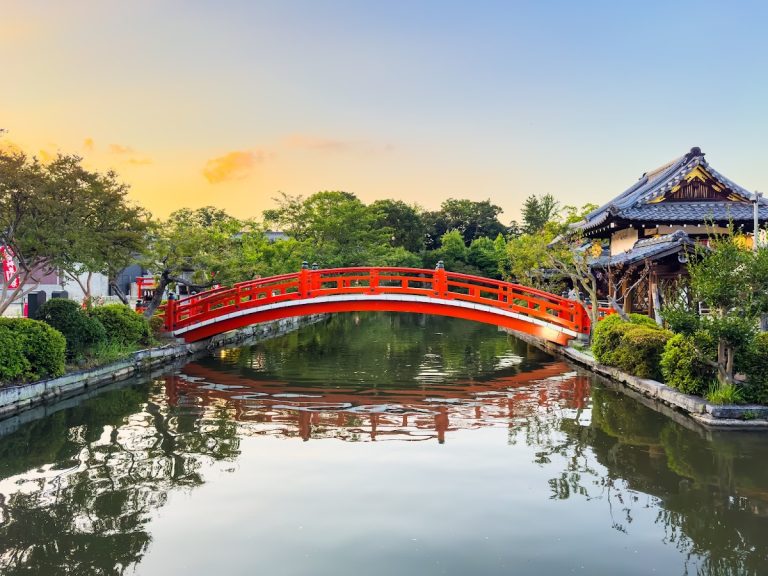
Mibu-dera remains associated with the February Setsubun observance and Mibu Dai Nembutsu Kyōgen. It is also connected with several pilgrimage traditions. Chūin is the twenty-eighth stop of the Rakuyō Thirty-Three Kannon Pilgrimage, the temple is the fourth stop of the Kyoto Twelve Yakushi Pilgrimage, and Ichiya Tenmangu is the fourth stop of the Rakuyō Twenty-Five Tenmangu Pilgrimage. The temple garden is designated a scenic place by Kyoto City. Its standing Jizō, Dai Nembutsu-dō, a Buddhist staff, and a screen painting by Hasegawa Tōhaku are designated cultural properties, while Kyoto Prefecture designates the six-volume Mibu-dera origin record. Mibu Dai Nembutsu Kyōgen and Mibu Rokusai Nembutsu dance are recognized as Important Intangible Folk Cultural Properties.
Remains
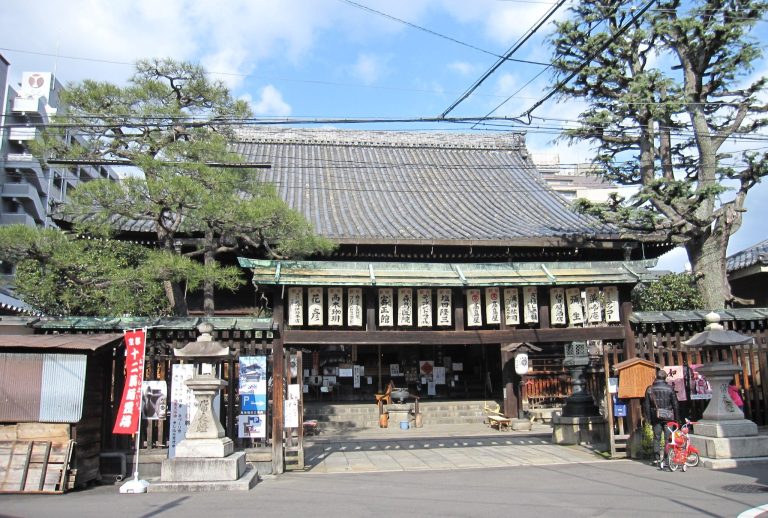
Mibu-dera is centered on its main hall and includes gates, subsidiary temples, halls, memorial areas, a garden, and other religious and administrative buildings. The precinct has no mountain name. Surviving structures represent repeated rebuilding after fires, while later additions preserve the temple’s religious, artistic, and Shinsengumi associations.
Main Buildings and Religious Features
Main Hall
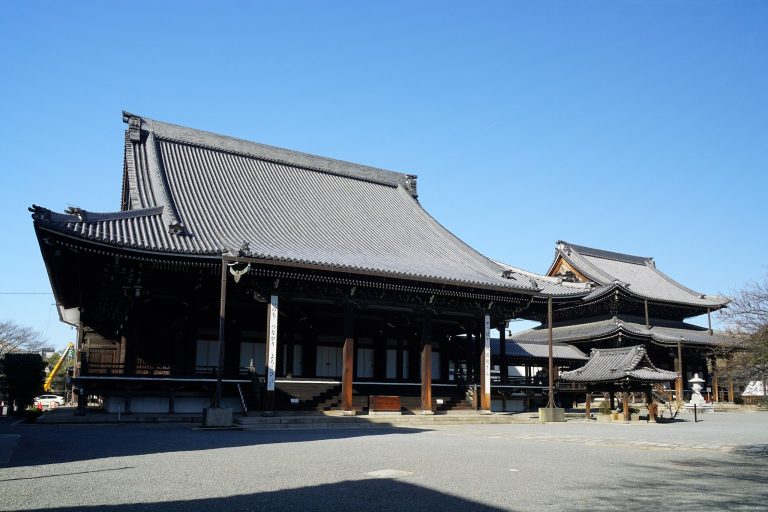
The present main hall was rebuilt in 1970 after the 1962 arson attack. It houses a standing wooden Jizō from the Heian period, formerly kept at Tōshōdai-ji, which replaced the late-Kamakura-period seated image destroyed in the fire. The hall’s plaque, reading “Jizō-son,” was written by Prince Komatsu Akihito.
A cultural-property exhibition room within the hall opens during special exhibitions. It displays a six-panel screen of Immortals by Hasegawa Tōhaku and the Muromachi-period Mibu Three-Faced work. The temple garden is another designated scenic feature of the precincts.
Gates and Bell Tower
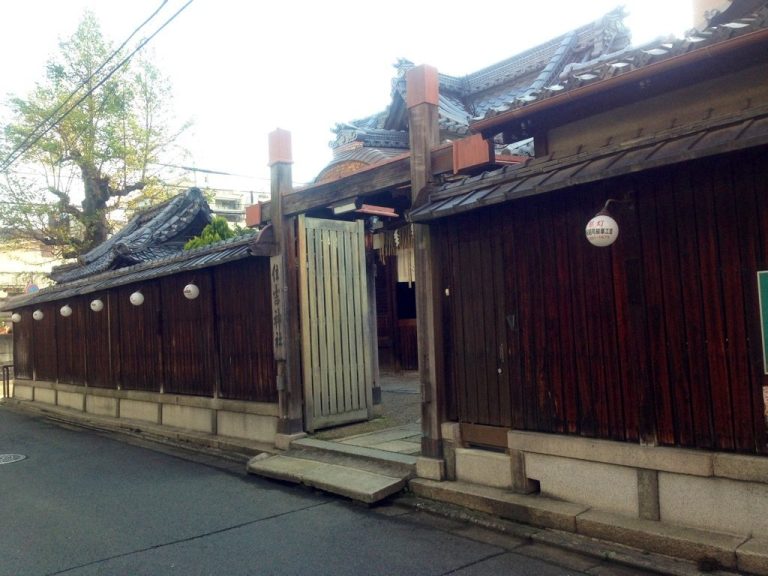
The front gate, rebuilt in 1799, is the oldest surviving building at Mibu-dera. The complex also has south, north, and east gates. Ichiya Tenjin-dō stands on the northern side inside the east gate. The bell tower was rebuilt in 1851, and its bell was cast in 1848.
Dai Nembutsu-dō
The Dai Nembutsu-dō was rebuilt in 1856. Its second floor contains the stage used for Mibu Kyōgen performances. The protected group associated with the building includes a tool storehouse, a side gate, two earthen walls, and two ridge tablets.
Subsidiary Temples and Halls
Chūin
Chūin was founded by the Risshū preceptor Honryō during the Kan’ei period, from 1624 to 1643, and rebuilt in 1829. Formerly called Nakano-bō, it acquired its present name after becoming a Risshū training center during the Meiji period. Its principal image is the Eleven-Headed Kannon, a form of the bodhisattva of compassion.
Ichiya Tenjin-dō
Ichiya Tenjin-dō, also called Ichiya Tenmangu, was rebuilt in 1852. It enshrines Sugawara no Michizane, six shrine deities, and Konpira Daigongen. Michizane was a Heian-period scholar and statesman later venerated as Tenjin, a deity associated especially with scholarship and learning. The hall’s name refers to the tradition that Michizane spent one night at Mibu while being exiled.
Benten-dō and Amida-dō
Benten-dō was rebuilt in 1894 and stands west of Amida-dō. Its hidden principal image of Benzaiten was transferred from Enmei-in at Kiyomizu-dera. Amida-dō was rebuilt in 2002 to a design by architect Ryōsuke Yamamoto using contemporary construction methods. It stands west of Ichiya Tenjin-dō, and its basement contains the Mibu-dera Historical Materials Room, a branch of the cultural-property exhibition room.
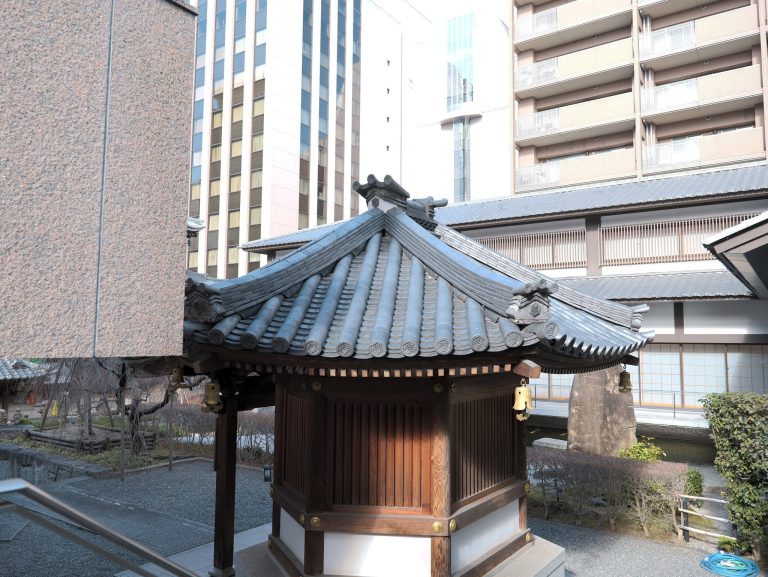
The Water-Pouring Jizō-dō stands west of Benten-dō. A Hōkyōintō, a Buddhist memorial pagoda associated with the Hōkyōin dharani, stands to the left of Ichiya Tenjin-dō.
Memorial and Commemorative Areas
Sentai Butto
South of the main hall stands the Sentai Butto, a pagoda-style stupa built in 1988. A stupa is a Buddhist reliquary or commemorative tower. This one houses exactly 1,000 stone Buddha images, including Muromachi-period figures of Amida and Jizō excavated during subway construction in Kyoto.
Mibuzuka
Mibuzuka contains Kondō Isami’s hair memorial pagoda and a bronze bust, along with a statue of Hijikata Toshizō erected in 2023. It also includes the graves of Serizawa Kamo and Hirayama Gorō, the grave of accountant Kawai Kichisaburō, and graves associated with Abiru Eizaburō, Tanaka Iori, Noguchi Kenji, Okusawa Eisuke, Andō Hayatarō, Nitta Kakuzaiemon, and Katsurayama Hachirō.
A grave identified with Kondō Isami is traditionally associated with him, although his actual resting place is believed to be elsewhere. Aizuwakamatsu and Mitaka have been proposed as possible locations. A monument commemorating the song “Ah Shinsengumi” was erected by volunteers in 1999. Its button plays the song through its third verse.
Other Precinct Buildings
The temple grounds include Sanpukugawa Inari Shrine, whose name derives from the place-name Mibugawa, as well as the temple office and main administrative compound, Mibu-dera Hall, and other gates and halls. A nursery was established in 1950, a special nursing home in 1981, and Grand Home Well Age Mibu opened in 1992.