Kannou-ji Temple: A Nichiren Buddhist Temple in Tokyo


Site at a Glance
- Rating
- 4.2
- Popularity
- Very Low
- Country
- Japan
- Primary era
- Modern
- External website
- Open
- Eras represented
- Early Modern, Modern
- Civilizations
- Japanese, Tokugawa
- Site type
- Religious
- Remains
- Temple
On this page11 sections
History
Kannou-ji Temple is a Nichiren Buddhist temple in Japan, in Edogawa City, Tokyo, founded in 1205 by the Shingon monk Kuunen. Formally called Kōkyūzan Kannou-ji and also known as Renkō-in, it began as a Shingon institution before becoming part of the Nichiren Buddhist tradition.
Foundation and Nichiren conversion
The temple is traditionally said to have changed from Shingon Buddhism to Nichiren Buddhism in 1288, following a doctrinal debate between its community and Nisshin. Shingon Buddhism is an esoteric tradition associated with ritual practice, mantras, mandalas, and the transmission of teachings through monastic lineages. Nisshin was a grand-disciple of Nichiren, the thirteenth-century monk who founded Nichiren Buddhism around devotion to the Lotus Sutra and the chanting of its title.
Nisshin later became the third head of Minobu Kuon-ji, the principal Nichiren Buddhist head temple at Minobu, in 1313. He promoted the development of Minobu, including the construction of temple buildings, while maintaining links with Nakayama Hokekyo-ji in Shimosa. His preaching also extended through the Kazusa and Shimosa regions, helping connect Kannou-ji with the wider organization of Nichiren Buddhism.
Edo-period lineages
During the Edo period, Kannou-ji became an intermediate head temple in the Nakayama lineage of Nichiren Buddhism and a subordinate temple of Hokekyo-ji. From about the middle of the Edo period, it belonged to the educational lineage of Konishi Danrin, one of three major Nichiren Buddhist scholarly academies in the Kanto region. A danrin was an academy where monks studied doctrine and trained within a particular sectarian lineage. Kannou-ji also belonged to the Hon’on-ji Dharma lineage and was regarded as one of that lineage’s four key temples.
The temple’s bell-making history reflects the support of its religious community. An attempt to produce a bell between 1655 and 1658 failed, but the eighteenth head, assisted by parishioners, succeeded in having one cast in 1698. Its maker was Ota Omi Daijo Fujiwara Masatsugu, a metalworker who later became the official kettle maker for the shogunal family during its visits.
Until the late Edo period, the precinct included the subsidiary temples Renmyobo and Zerinbo. Both collapsed in the Edo earthquake of 1855. A Seven-Faced Deity was once worshipped west of the main hall, and tradition held that a white snake lived in the temple pond. A late Edo-period geographical record also described a Nichiren image in the main hall that was said to have been made by Nisshin. That image no longer survives.
Rebuilding and wartime preservation
In 1935, the thirty-sixth head built a new main hall. Religious reorganization during the wartime period changed the institutional structure around the temple. The 1941 Religious Organizations Law dissolved the former hierarchy linking main temples and subordinate temples, after which Kannou-ji described itself as the former subordinate temple of Nakayama Hokekyo-ji.
The same period placed the temple’s bell at risk. The 1941 Metal Collection Ordinance required metal from temples to be requisitioned for wartime purposes. Through the efforts of the thirty-seventh head, the bell was exempted from special metal collection in 1943. It became the only bell in Edogawa Ward to escape wartime requisition.
Postwar change and recent development
Postwar agricultural reform, begun in 1947 under the guidance of GHQ, deprived temples of farmland and created financial hardship. Later population growth in Edogawa Ward expanded Kannou-ji’s parishioner base and supported reconstruction. The Hall of the Thirty Protective Deities stood east of the main hall until the 1960s or 1970s. Deterioration led to its demolition, and its sacred image was moved to the inner sanctuary of the main hall.
In 1971, the thirty-seventh head established priests’ quarters and a study hall with assistance from parishioners. The project commemorated the 750th anniversary of Nichiren’s birth in 1972, and the head died in the year after its completion. The temple’s bell was designated an Edogawa Ward Tangible Cultural Property in the craft category in 1982. In 1988, the teacher’s-pupils memorial mound associated with the priest Nichize was registered as an Edogawa Ward tangible cultural property and historical material.
Under the thirty-eighth head, the main hall, bell tower, guest hall, and residential quarters were rebuilt in 2008. In 2013, the temple established a columbarium, a building for storing cremated remains, as a form of perpetual memorial burial. This arrangement provided continuing memorial rites in response to difficulties surrounding the succession of family graves.
The thirty-eighth head also worked in offender rehabilitation and chaired the Edogawa Ward Volunteer Probation Officers’ Association for four years from 2008. He received a Justice Minister’s commendation in 2010 and the Order of the Sacred Treasure, Gold and Silver Rays, in 2015. In 2018, he was added to the succession of heads of Hon’on-ji, a Nichiren Buddhist head temple in Minobu. This retrospective succession recognizes a monk regarded as especially meritorious.
Remains
Rebuilt temple complex
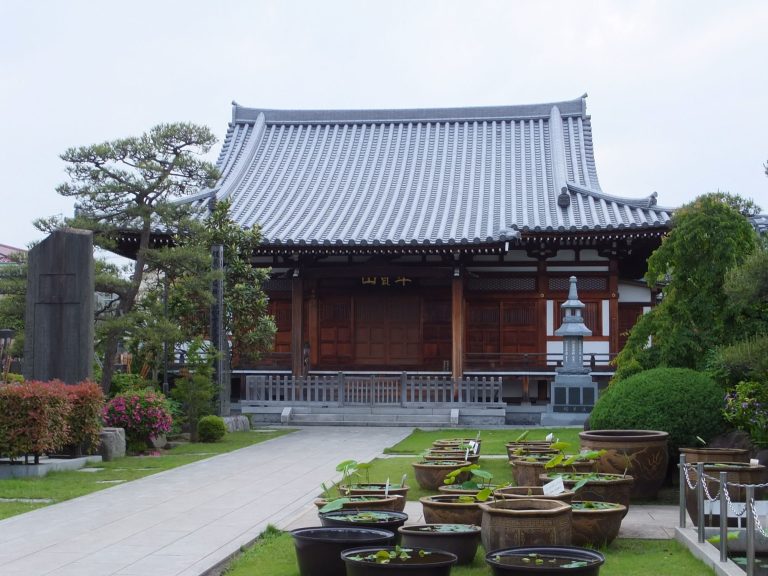
Kannou-ji’s present buildings reflect the reconstruction carried out in 2008. The main hall and bell tower are wooden structures, while the guest hall and residential quarters use reinforced-concrete wall construction. The earlier 1935 main hall was built of cypress, with a frontage of six ken and a depth of five and a half ken. The replacement is a timber building using zelkova and cypress and covered by a flat copper-sheet roof.
Bell tower and columbarium
The bell tower adjoining the perpetual memorial columbarium was erected in 2008 in a medieval eclectic style. It uses zelkova and Yoshino cypress, while the bell tower, columbarium, and residential quarters were designed by a construction company founded by the architect Shuzo Sato.
The columbarium, established in 2013, is an octagonal hall. Its curved roof is wooden, and the structure beneath the eaves is reinforced concrete. The exterior concrete walls incorporate details intended to recall traditional timber construction.
Kannou-ji Bell
Cast in 1698, the Kannou-ji Bell is 152 centimeters high and has a mouth diameter of 77 centimeters. Its striking beam is made of palm wood, traditionally regarded as especially suitable for this use. The bell survives as the oldest surviving bell in Edogawa Ward and is protected as an Edogawa Ward Tangible Cultural Property in the craft category.
Memorial mound and temple treasures
The memorial mound for the teacher Nichize is a stone monument connected with the temple’s former school. A temple school, or terakoya, was a local Edo-period institution that commonly taught children literacy and arithmetic. The mound’s right side carries the inscription “among the writing pupils,” while its left side bears the verse “In this dreamlike world, more than twenty years are dew beneath the moon.”
Kannou-ji holds a painted Nirvana image as a temple treasure. A Nirvana image portrays the Buddha Shakyamuni at the moment of death, surrounded by grieving disciples, deities, animals, and other figures. The hanging scroll measures 207.5 centimeters wide by 345.5 centimeters high. It was produced during the Genroku period under the sixteenth head and restored in 1826 and again in 2014.
Bronze image of Nichiren
A bronze statue of Nichiren was erected in the precinct in March 2018 through donations from parishioners. Approximately 1.8 meters high, it was reconstructed at close to life size from a roughly three-meter statue erected in 1923 at Asahigamori, on the grounds of Kiyosumi-dera in Kamogawa, Chiba. The earlier statue was made by the sculptor Watanabe Choan. The pedestal reproduces the inscription “Establish the Right Dharma and Secure the Peace of the Nation,” a Nichiren Buddhist formula expressing the belief that correct Buddhist teaching would bring social and political peace.