Kōshō-ji Temple: Head Temple of a Jōdo Shinshū Branch in Kyoto


Site at a Glance
- Rating
- 4.1
- Popularity
- Low
- Country
- Japan
- Primary era
- Modern
- External website
- Open
- Eras represented
- Early Modern, Modern
- Civilizations
- Japanese, Tokugawa
- Site type
- Religious
On this page18 sections
History
Kōshō-ji Temple is a head temple of the Kōshō-ji branch of Jōdo Shinshū Buddhism in Kyoto, Japan, immediately south of Nishi Hongan-ji. Jōdo Shinshū is a Japanese Buddhist tradition centered on reliance upon the vow of Amida Buddha and recitation of the nembutsu, traditionally expressed as “Namu Amida Butsu.” Kōshō-ji’s formal name is Entonzan Kaen-in Kōshō-ji, and its principal image is Amida Buddha.
Early foundations and medieval development
Temple tradition attributes the earliest foundation to Shinran, the thirteenth-century Buddhist teacher traditionally regarded as the founder of Jōdo Shinshū. In 1212, after returning from exile in Echigo, he is said to have established a small religious building at Yamashina, entrusted it to his disciple Shinbutsu, and left to spread devotion to Amida Buddha in the Kanto region. The Yamashina foundation is weakly supported, however, and the more widely accepted view holds that Shinran traveled directly from Echigo to the Kanto region.
Tradition also states that Emperor Juntoku granted the temple an imperial decree associated with Prince Shōtoku and the phrase “promoting and flourishing the true Dharma,” from which the name Kōshō-ji was derived. Another account connects the name with a passage attributed to Prince Shōtoku in the “Tomb Grotto Verse.” According to this tradition, Ryogen received approval for the name from Kakunyo, the third-generation head of Hongan-ji.
Ryogen, the seventh-generation leader, is generally regarded within the temple tradition as its effective founder. Around 1321, he is thought to have relocated Shinran’s former residence at Gojo-Nishinotoin and opened it as a temple. Around 1328, he moved the institution to Shitani, also called Shibutani, in eastern Kyoto near the present Kyoto National Museum. There he developed it as a base for missionary activity in western Japan, using luminous principal images, illustrated genealogical charts, and membership registers.
Names, affiliations, and conflict
Ryogen’s protection of Kakunyo’s disinherited eldest son, Zonkaku, led to a break with Kakunyo. A related tradition says that the institution’s name was then replaced by Bukkō-ji. The temple received the imperial title Bukkō-ji from Emperor Go-Daigo. An origin story links the title and the move from Yamashina to eastern Kyoto with the emperor’s dream of a beam of light from the southeast and the discovery of a stolen wooden image of Amida at the place where the light seemed to originate. The name Kōshō-ji was later revived when the institution returned to the Hongan-ji sphere.
The Bukkō-ji movement expanded as pressure from the Tendai establishment at Enryaku-ji increased. During the tenure of the thirteenth-generation leader, Kōkyō, the temple became involved in the Ōnin War, a fifteenth-century civil conflict that disrupted Kyoto and other parts of Japan, and its halls were burned.
In 1481, the fourteenth-generation leader Kyōgō joined the Hongan-ji movement led by Rennyo, a fifteenth-century leader whose missionary expansion greatly increased Hongan-ji influence. Kyōgō brought 42 of Bukkō-ji’s 48 influential affiliated temples with him, creating the group later known as the Kōshō-ji branch. Rennyo gave Kyōgō the name Renkyō, and Renkyō established a new Kōshō-ji south of Yamashina Hongan-ji as its subordinate temple. The six major temples that remained with Bukkō-ji selected Kyōgō’s brother, Kyōyo, as their fourteenth-generation leader.
Sixteenth-century rebuilding and movement
Kōshō-ji worked with Hongan-ji to spread the nembutsu teaching. In August 1532, it was burned during the destruction of Yamashina Hongan-ji in a war involving Hosokawa Harumoto, Rokkaku Sadayori, and followers of the Lotus school. After Hongan-ji established Osaka Hongan-ji as its headquarters in 1533, the fifteenth-generation leader, Renshū, moved to Osaka and entered quarters already built beside the headquarters.
Negotiations with Hosokawa Harumoto produced a peace settlement in late 1535, after which Renshū received the rank of ikkeshū, a senior family-related status within the Hongan-ji hierarchy. When Osaka Hongan-ji rebuilt its Amida Hall in 1542, Kōshō-ji undertook a full reconstruction of its own. The main hall was topped out on August 5, 1546. Renshū died in 1552, and his son Shōshū became the sixteenth-generation leader.
In December 1564, fire destroyed the Amida Hall and Founder’s Hall of Osaka Hongan-ji. Its head, Kennyo, stayed at Kōshō-ji for approximately four months because the temple had escaped the fire. Kennyo’s second son, Kenson, became Shōshū’s adopted son in 1567 and succeeded him as Kōshō-ji’s seventeenth-generation leader in 1568. Kenson received wakimonzeki status in 1569. A wakimonzeki was an affiliated institution holding a status related to the imperial or aristocratic house.
War, relocation, and institutional independence
Kōshō-ji fought alongside Hongan-ji against Oda Nobunaga during the Ishiyama War, a conflict over the fortified Osaka Hongan-ji complex and its political independence. After the settlement, Kennyo and Kenson left their respective temples in April 1580 and moved to Saginomori in Kii Province, where they established Saginomori Hongan-ji. After Nobunaga’s death in the Honnō-ji Incident, they moved to Kaizuka in July 1583 and established Kaizuka Hongan-ji.
In 1585, Hashiba Hideyoshi granted Kennyo land at Tenma, northwest of the former Osaka Hongan-ji, where Hongan-ji was rebuilt as Tenma Hongan-ji. Kōshō-ji was rebuilt there as well, and its main hall was topped out on August 19, 1586. In 1591, Hideyoshi granted Hongan-ji land at Rokujo-Horikawa in Kyoto. Hongan-ji moved there in August, and Kōshō-ji moved at the same time to its present location south of Hongan-ji, at Shichijo-Horikawa. The Tenma buildings remained as the temple’s Tenma branch temple.
Kōshō-ji generally remained subordinate to Hongan-ji, and later specifically to Nishi Hongan-ji, although a strong movement favored its independence as the head temple of its own branch. In 1876, the twenty-seventh-generation leader Honjaku established the Kōshō-ji branch of Jōdo Shinshū and separated it from the Hongan-ji branch. He also established the Ryozen Mausoleum in eastern Kyoto as Shinran’s burial and memorial site. Some affiliated temples remained with the Hongan-ji branch.
Modern reconstruction and preservation
A grand main hall known as Hitotsu Omidō was completed after a prolonged rebuilding process. It was celebrated together with the mausoleum of Nikkō Tōshōgū and the Sanmon of Chion-in as one of Japan’s three great buildings. On November 29, 1902, an accidental fire destroyed the main hall and all other buildings except the bell tower and sutra repository.
The twenty-eighth-generation leader Honjō immediately began reconstruction. The rebuilt complex adopted the standard two-hall arrangement of major Jōdo Shinshū head temples. The Founder’s Hall was completed in 1912, followed by the Amida Hall in 1915.
In 2018, the Northern Osaka Earthquake and successive typhoons, including Typhoon 21, caused collapses, structural damage, fallen trees, and other damage across the precincts. The Founder’s Hall developed structural distortion and was closed, while Shinran’s image and services such as the memorial hōonkō, an observance held in gratitude for Shinran, were temporarily moved to the Amida Hall. The earthquake also led to the decision to demolish the Kōshō Kaikan because of its seismic vulnerability. Repairs to the Founder’s Hall were completed in 2022, restoring its pre-earthquake arrangement. In April 2023, the first floor of the temple administration building became the site of Retelas, an education center.
Remains
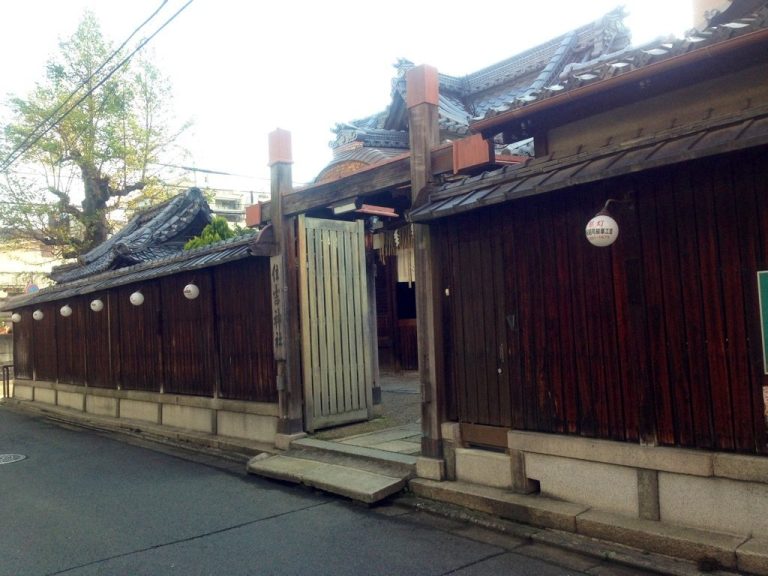
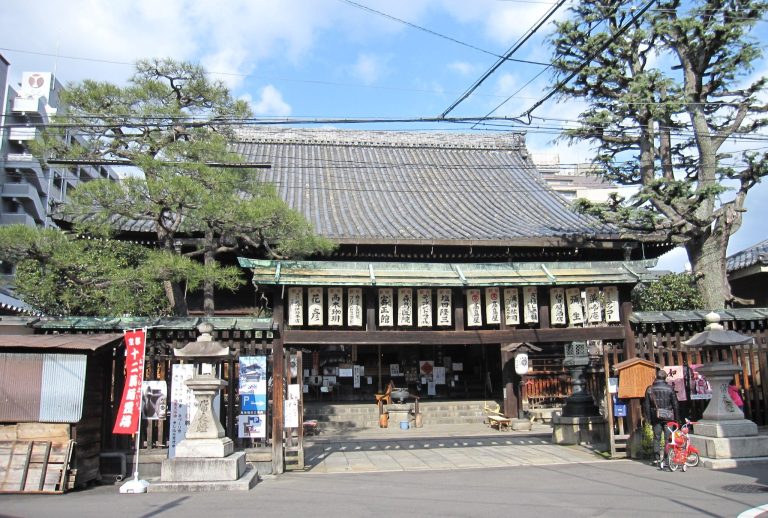
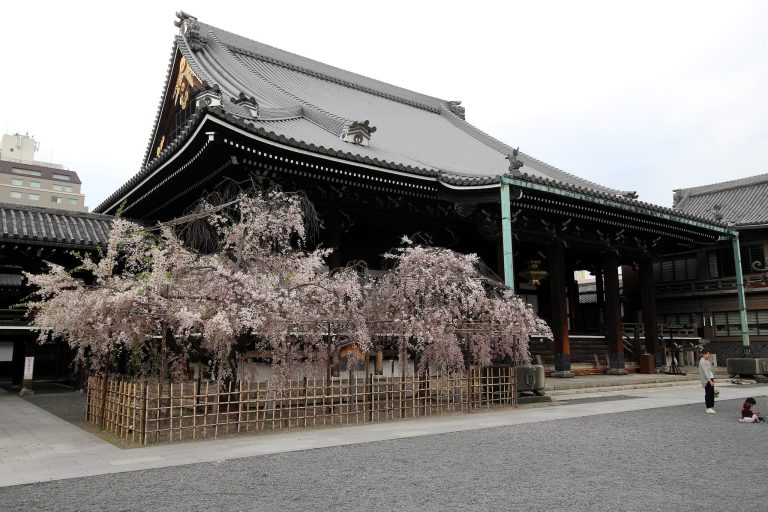
Kōshō-ji is a large temple precinct directly adjoining Nishi Hongan-ji to the south. Because the two complexes meet closely, their buildings can appear to form part of the neighboring temple grounds. The present layout is organized around the Amida Hall and Founder’s Hall, which are linked by a covered passage. Other principal elements include the Front Audience Hall, Rear Audience Hall, administration building, Sanmon, Amida Hall Gate, bell tower, and sutra repository.
Central halls
Amida Hall
The Amida Hall is the principal hall of the present complex. Rebuilt in 1915, it is centered on Amida Buddha and forms one half of the modern two-hall arrangement. The Amida Hall Gate, rebuilt in 1912, stands directly in front of it as the principal gate of Kōshō-ji.
Founder’s Hall
The Founder’s Hall was completed in 1912 and is the largest building at Kōshō-ji. It was the first Founder’s Hall constructed at the temple. The hall is dedicated to the image and memory of a Buddhist founder, and repairs completed in 2022 restored its pre-earthquake arrangement after structural distortion caused by the 2018 earthquake.
Gates and older buildings
Sanmon
The Sanmon, or gate tower, was built in 1912. It is the largest gate in the precinct, although it is not the main entrance.
Bell tower
The bell tower was rebuilt in 1774. Empress Dowager Kyōrei-mon’in, also known as Ichijō Tomiko, donated its bell in connection with the thirteenth memorial observance for Emperor Momozono.
Sutra repository
The sutra repository, also called the Hōbōzō, was built in 1848. Its imperial plaque, bearing the inscription “Hōbōzō,” was written by the Minister of the Right, Konoe Tadahiro, and bestowed by Emperor Kōmei.
Supporting buildings and surrounding features
Audience halls and administration building
The precinct includes a Front Audience Hall, a Rear Audience Hall, and an administration building. The first floor of the administration building contains the Retelas education center and is used for rest and events.
Former Kōshō Kaikan
The former Kōshō Kaikan stood within the precinct until it was demolished after the 2018 earthquake because of longstanding concerns about its seismic strength.
Hiunkaku
Across Kitakōji Street to the north stands Hiunkaku, a building belonging to Nishi Hongan-ji.