Hongan-ji Temple: The Institutional Center of Jōdo Shinshū Buddhism


Site at a Glance
- Rating
- 4.5
- Popularity
- Very Low
- Country
- Japan
- Primary era
- Early Modern
- External website
- Open
- Eras represented
- Medieval, Early Modern
- Civilizations
- Ashikaga shogunate, Toyotomi regime
- Site type
- Religious
- Remains
- Temple
On this page16 sections
History
Hongan-ji Temple in Japan, Kyoto, developed from the mausoleum of Shinran, the founder and religious patriarch of Jōdo Shinshū, a Japanese school of Pure Land Buddhism centered on devotion to Amida Buddha. Established as an independent temple in 1321, Hongan-ji became the institutional heart of a major religious movement whose history was shaped by missionary expansion, political conflict, repeated destruction, and the eventual formation of the Nishi and Higashi Hongan-ji branches.
From Shinran’s Mausoleum to Hongan-ji
Shinran died in Kyoto on January 16, 1263, although the year is also given as 1262 because the traditional calendar had not yet reached its new year. He was cremated at En’nin-ji in Toribeno, and his remains were buried at Otani. In the winter of 1272, his daughter Kakushinni, supported by disciples and followers from eastern Japan, moved the grave to a site north of Yoshimizu. There she established the hexagonal Otani Mausoleum and became its administrator and custodian in 1274.
Shinran’s grandson Nyoshin inherited the mausoleum’s religious lineage in 1280. He continued missionary work from a hermitage in Mutsu while delegating administration to Kakushinni and her son Kakue. After Kakushinni died in 1283, Kakue became custodian. A wooden image of Shinran was installed in 1295, and the mausoleum then also became known as the Otani Founder’s Hall.
A succession dispute between Kakue and his maternal half-brother Yuizen led to violence in 1309. After the Shōren-in adjudicated the succession in Kakue’s favor in 1309, Yuizen destroyed the mausoleum, seized the wooden image of Shinran and part of his remains, and fled to Kamakura. Kakunyo, Kakue’s eldest son, regained custodianship in 1310 with the support of eastern followers. He rebuilt the mausoleum and Shinran’s image for the founder’s fiftieth memorial observance in 1311.
Kakunyo repeatedly transferred and resumed the custodianship between 1310 and 1350. In 1312 he tried to turn the Founder’s Hall into a temple by displaying the name Senju-ji, but opposition from Enryaku-ji, the powerful Tendai Buddhist complex on Mount Hiei, forced the name’s removal. In 1321 he succeeded in establishing the mausoleum as an independent temple called Hongan-ji. The institution is also known as Otani Hongan-ji, distinguishing it from later establishments with the same name.
The temple’s original principal object of worship was a calligraphic sacred name associated with Amida. Kakunyo’s attempt to replace it with a wooden standing image of Amida was opposed by Takada followers, so the calligraphic object remained in use. Hongan-ji then worked to bring Shinran’s disciples and lay followers into a unified organization. In 1331, Kakunyo set out a succession based on both religious teaching and family descent, recognizing Shinran as the founder, Nyoshin as the second generation leader, and himself as the third.
Expansion in the Fourteenth and Fifteenth Centuries
During the fourteenth century, Hongan-ji was politically and economically weaker than established institutions such as Enryaku-ji. It experienced repeated suppression and was sometimes allowed to continue only under conditions that included loyalty to Enryaku-ji and restrictions on the recitation of the nenbutsu, the devotional invocation of Amida’s name. Another interpretation holds that the Shōren-in and Myōhō-in institutions protected Hongan-ji rather than exercising direct doctrinal control.
Hongan-ji’s growth was initially overshadowed by other Jōdo Shinshū lineages, including the Takada, Bukkō-ji, Kōshō-ji, Kinshōji, and Sanmon-to movements. From the late fourteenth century, however, its influence gradually spread through Ōmi and the Hokuriku region. Shakunyō became the fifth generation leader in 1390 and transferred much of the temple’s administration to his son Kōnyō. He also changed the main object of worship from the calligraphic sacred name to a wooden standing image of Amida. Kōnyō succeeded him in 1394, and the following leader, Zōnyō, extended the institution’s influence into Ōmi, Kaga, Noto, and Echizen.
Around 1438, during Zōnyō’s leadership, separate Amida and Founder’s halls were constructed. The expense placed Hongan-ji under severe financial strain, but the arrangement was intended to give separate settings to the Amida image and the image of Shinran. Rennyo, Zōnyō’s eldest son, was born in 1415 and became the eighth generation leader in 1457. At that time the temple was badly deteriorated and remained subordinate, or closely affiliated, to Shōren-in.
In 1465, warrior monks from Enryaku-ji’s Western Pagoda destroyed Otani Hongan-ji in the Kanshō persecution. The attack ended Hongan-ji’s residence at its original foundation site. Rennyo moved first to Ōmi and then, in 1471, to Yoshizaki in Echizen, where he founded Yoshizaki-gobō and began an energetic campaign of preaching and organization. He distributed devotional letters and handwritten sacred names, helping the movement spread from the Kinki region toward the Tōkai region. Rural communities, especially in Ōmi, became an important base of support.
Rennyo cooperated with Togashi Masachika during a 1474 conflict within the Togashi family of Kaga. The alliance was partly connected to the rival’s association with the Takada school. Tensions later arose as Masachika became concerned about the growing number of followers around Rennyo. Rennyo’s subordinate Shimotsuma Renshō also incited an uprising while falsely claiming Rennyo’s authority, although the extent of Rennyo’s knowledge remains disputed. Rennyo excommunicated Renshō and left Yoshizaki on August 21, 1475. After traveling through Wakasa, Tamba, Settsu, and Kawachi, he established a base at Deguchi and continued his missionary work.
Yamashina and the Growth of a Religious Community
Rennyo moved from Deguchi to Yamashina in 1478 and began building a new Hongan-ji there in 1479. The Yamashina temple was completed on August 22, 1483. A temple town grew around the complex, providing a settlement for pilgrims, residents, and people in many occupations. The community became exceptionally prosperous, and Hongan-ji’s following extended from northeastern Japan to Kyushu. Khitan people from northern continental Asia were also drawn to the temple’s following.
In 1481, Kyōgō, the former head of Bukkō-ji, joined Rennyo with 42 of that school’s 48 influential branch temples. Renamed Renkyō, he founded Kōshō-ji south of Yamashina Hongan-ji as a temple affiliated with Rennyo’s institution. In 1482, Zenchin, associated with the Izumoji and Yamamoto branches, likewise joined Rennyo with his followers.
The Kaga Ikkō uprising began in 1488 with Hongan-ji followers at its center. An ikkō-ikki was an armed league of Jōdo Shinshū followers and local allies, and such leagues became closely associated with Hongan-ji’s military and political power during the Sengoku period. Rennyo transferred leadership to his fifth son Jitsunyo in 1489 but retained religious influence. In 1496 he founded Ōsaka-gobō as a retirement residence. The place-name Ōsaka first appears in a surviving letter from 1498. Rennyo died at Yamashina Hongan-ji in 1499, aged 85.
Conflict and the Osaka Headquarters
Under Jitsunyo, Shōnyō, and Kennyo, Hongan-ji became one of Japan’s largest religious organizations and a major social and political power during the Sengoku period. Regional authorities sometimes prohibited or restricted Jōdo Shinshū practice. The Hōjō in Sagami, Nagao Tamekage in Echigo, and Tokugawa Ieyasu in his territories each imposed restrictions at different times. Ieyasu’s prohibition was lifted in 1583, while the Shimazu rulers of Satsuma continued to prohibit the school until the early Meiji period.
Political instability following the assassination of Hosokawa Masamoto caused Jitsunyo and Shinran’s image to move temporarily to Katata in Ōmi in 1507. Jitsunyo returned to Yamashina Hongan-ji in 1509. In 1516, Hongan-ji became an imperial prayer temple under Emperor Go-Kashiwabara.
In 1532, Shōnyō mobilized approximately 20,000 followers after receiving a request from Hosokawa Harumoto. They defeated allied Hatakeyama and Miyoshi forces and contributed to the destruction of the Sakai government. Later that year, Harumoto, the Nichiren Buddhist Hokke league, and Rokkaku Sadayori formed a coalition against Hongan-ji. Yamashina Hongan-ji fell and burned in August 1532.
Shōnyō had already escaped to Ōsaka-gobō. In 1533 the enlarged complex became the new headquarters, known as Osaka Hongan-ji, and it was surrounded by a temple town. Kennyo became the eleventh generation leader in 1554. In 1559 he was recognized as a monzeki, a high-ranking Buddhist abbot with recognized aristocratic or imperial connections. This elevation allowed Hongan-ji to become formally independent of the Shōren-in hierarchy. Related institutions in Mikawa, Harima, and Kawachi also received elevated status, while members of the Shimotsuma family served as temple officials.
In 1570, Oda Nobunaga ordered Hongan-ji to leave Osaka. The order began the approximately ten-year Ishiyama War, a prolonged conflict between Nobunaga and the fortified religious center. The war created a lasting division between Kennyo’s supporters, who favored negotiation, and the supporters of his eldest son Kyōnyo, who demanded continued resistance.
In March 1580, Kennyo accepted a peace settlement mediated by the imperial envoy Konoe Sakihisa. He and the moderate faction moved from Osaka Hongan-ji to Saginomori-gobō in Kii, which became Saginomori Hongan-ji. Kyōnyo refused to abandon the fortress, was disowned by Kennyo, and continued the resistance until Osaka Hongan-ji surrendered on August 2. The complex was then burned and reduced to ashes.
Relocation to Kyoto and the Two Hongan-ji Branches
After Nobunaga’s death in 1582, Kyōnyo was pardoned and reconciled with Kennyo. In 1583, Toyotomi Hideyoshi built Osaka Castle over the area that included the ruins of Osaka Hongan-ji. The institution moved with Shinran’s image to Kaizuka, where a former branch temple became Kaizuka Hongan-ji. Hideyoshi granted Hongan-ji land at Tenma in Osaka in 1585. Tenma Hongan-ji was established there, with an Amida Hall built in 1585 and a Founder’s Hall added in 1586.
In 1591, Hideyoshi granted Hongan-ji land at Horikawa and Rokujo in Kyoto. The Founder’s Hall was moved from Tenma in August, creating the temple now known as Nishi Hongan-ji. A new Amida Hall was built in 1592, completing the Kyoto complex. After Kennyo died that year, Kyōnyo initially succeeded him, but opposition led by Kennyo’s wife and supporters of the moderate faction persuaded Hideyoshi to install Kennyo’s third son Junnyo instead. Junnyo became the twelfth generation leader in 1593.
Kyōnyo was forced into retirement and lived in the northeastern part of the Hongan-ji compound under the title retired leader. He continued issuing documents, founding branch temples, and conducting missionary work in Hongan-ji’s name. After Hideyoshi’s death in 1598 and the Battle of Sekigahara in 1600, Kyōnyo drew closer to Tokugawa Ieyasu. In 1602, with imperial authorization, Ieyasu granted him a four-square-chō temple estate at Karasuma-Rokujo, immediately east of the existing Hongan-ji. Kyōnyo moved his halls there from his retirement residence.
This relocation produced the two major Hongan-ji organizations. Junnyo’s institution became the Jōdo Shinshū Honganji-ha, while Kyōnyo’s became the Shinshū Ōtani-ha. In 1603, a wooden image of Shinran was brought from Myōan-ji in Maebashi to Kyōnyo’s temple, which became known as Higashi Hongan-ji because it stood east of the older temple. Junnyo’s institution became Nishi Hongan-ji. The government recognized the two congregations separately in 1619, and the Otani branch became formally independent under Kyōnyo’s successor, Sennyo.
During the Meiji Restoration, new government rules for religious organizations placed Higashi Hongan-ji under the Otani-ha. In 1987, its religious corporation was dissolved and merged with the Shinshū Otani-ha. Its official name became Shinshū Honbyō, although it continued to be commonly called Higashi Hongan-ji. The buildings were not moved or altered because of this change, and the complex retained its cultural and religious significance.
Remains
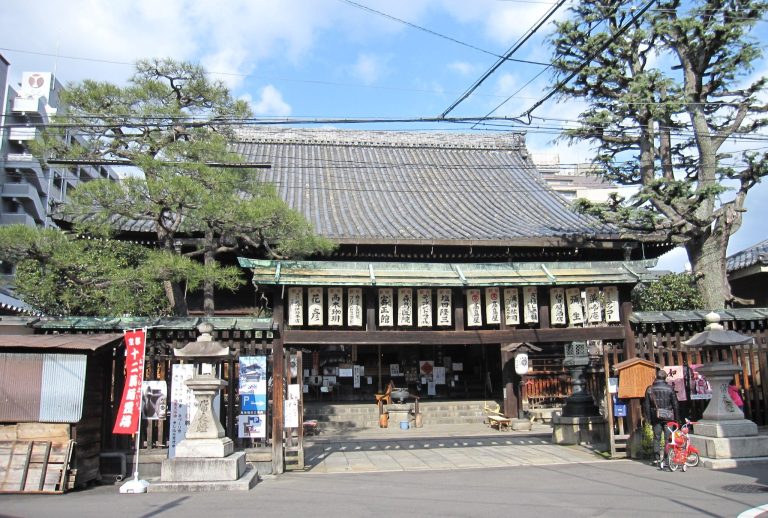
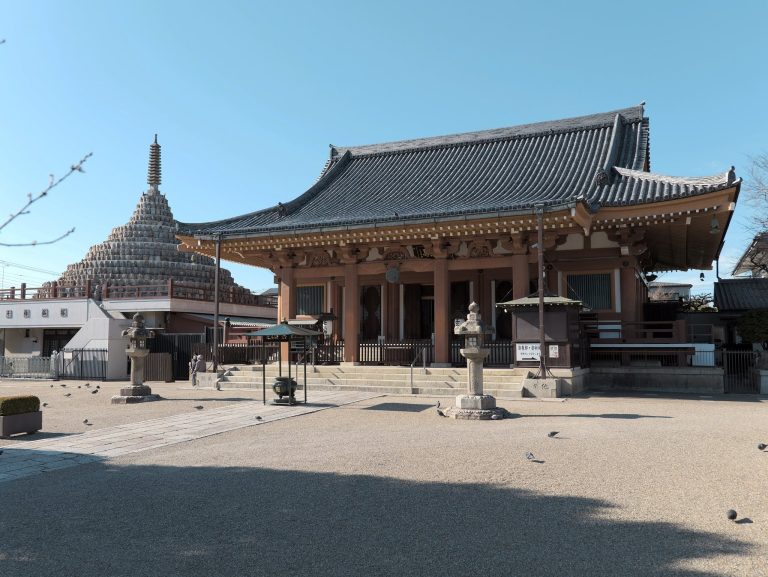
The surviving Hongan-ji tradition is represented by the Nishi Hongan-ji complex in Kyoto, the Higashi Hongan-ji complex, now officially Shinshū Honbyō, and Shinran’s mausoleum under the Otani-ha. Together, these places preserve the institutional division that followed the relocations and leadership dispute of the late sixteenth and early seventeenth centuries. Their principal spaces are organized around an Amida hall and a Founder’s Hall, reflecting the two central objects of devotion, Amida Buddha and the memory of Shinran.
Nishi Hongan-ji
Principal Halls and Study Rooms
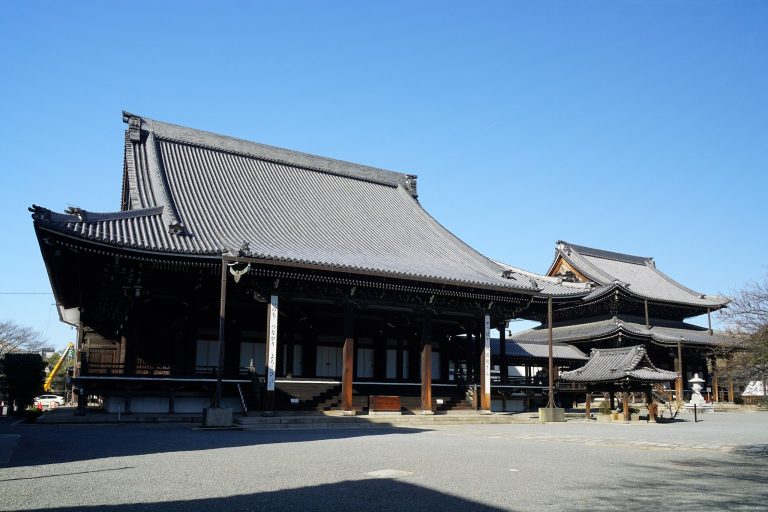
Nishi Hongan-ji contains a large Founder’s Hall and a smaller Amida Hall containing an image of Amida. The complex also includes a Founder’s Hall known as the Kaisan-do and a storehouse. Its study hall, or shoin, is divided into the White Study Hall and Black Study Hall. Much of the medieval shogunal complex was moved into the temple from other locations in Kyoto during the sixteenth century, while some medieval components later became independent institutions, including Ryukoku University and Kōshō-ji.
Gardens, Tea Pavilion, and Noh Stages
The Nishi Hongan-ji grounds include the Hiunkaku tea pavilion, four Noh stages, and the Kōkei-no-Niwa garden. One Noh stage is regarded as possibly the oldest surviving example, while another is described as the largest outdoor Noh stage. These features form part of the architectural and cultural complex created after Hongan-ji’s relocation to Horikawa-Rokujo in Kyoto.
Higashi Hongan-ji and Shinshu Honbyo
Founder’s Hall and Amida Hall
Higashi Hongan-ji, officially Shinshū Honbyō, contains a large Founder’s Hall, also called the Mie-do or Goei-do, and an Amida Hall. Its arrangement is nearly identical to that of Nishi Hongan-ji, although the Founder’s Hall is larger than the Amida Hall. The Founder’s Hall dates from 1895 and has been described as competing with other structures for recognition as the world’s largest wooden building.
Shosei-en Garden
The Shosei-en garden is owned by Higashi Hongan-ji and lies a short distance from its main grounds. Its design is traditionally associated with contributions by the poet-scholar Ishikawa Jozan and the landscape designer Kobori Enshu in the seventeenth century.
Shinran’s Mausoleum and Earlier Sites
Otani Mausoleum
The original Otani Mausoleum was a hexagonal hall with a circular plan, established over Shinran’s relocated grave in 1272. Yuizen destroyed it in 1309 and carried away the wooden image of Shinran and part of his remains to Kamakura. Kakunyo rebuilt both the mausoleum and the image in 1311. The mausoleum is now owned by the Otani-ha and remains the institutional core of Shinshū Honbyō.
Relocated Temple Complexes
Hongan-ji’s physical history includes successive sites at Otani, Yoshizaki, Yamashina, Osaka, Saginomori, Kaizuka, Tenma, and Horikawa-Rokujo. Yamashina Hongan-ji was accompanied by a temple town and was destroyed by fire when the complex fell in 1532. Osaka Hongan-ji developed from Rennyo’s small Ōsaka-gobō, founded in 1496, into a larger moat-enclosed and fortified urban religious center. It was burned in 1580 after the end of the Ishiyama War. The later Kyoto complexes preserve the institutional results of these movements and divisions rather than the buildings of the earlier sites.