Messina Palace: Historic Order of Saint John Residence and Cultural Headquarters


Site at a Glance
- Rating
- 4.7
- Popularity
- Very Low
- Country
- Malta
- Primary era
- Early Modern
- Eras represented
- Early Modern
- Civilizations
- Knights Hospitaller
- Site type
- Domestic
- Remains
- Elite Residence
On this page10 sections
History
Messina Palace, also known as Palazzo Messina, is a historic palace in Valletta, Malta, built toward the end of the sixteenth century under the Order of Saint John. Fra Pietro La Rocca, titular Prior of Santo Stefano, constructed it as part of a larger palace called Casa Rocca Grande. The building later became associated with the Italian Langue, the Order’s administrative division for members connected with the Italian states.
The Casa Rocca Grande period
After La Rocca’s death, Casa Rocca Grande passed to the Italian Langue. For more than 150 years, prominent members of the Order occupied the palace, including several admirals and commanders. Named residents included Fra Francesco Saccano, Prior of Santo Stefano, in 1614, and Commander Fra Gio. Batta Macedonio in 1643. During the late seventeenth century, Fra Carlo Spinelli, Bailiff of Armenia and Captain General of the Galleys, lived there, followed by Fra Mario Bichi and Bailiff Vincenzo Caravita, the Order’s admiral, in 1709.
In 1722 the property passed to Bailiff Fra Pietro Platamone, lieutenant to the admiral. Commander Fra Francesco Pappalettere and Commander Fra Giuseppe Provana da Colegno followed him, with Provana da Colegno remaining there until 1767. Fra Massimiliano Buzzacarini Gonzaga resided in the palace from 1773 and later leased it to Commander Fra Galgano Scozzini in 1783, Commander Fra Francesco Mazzei in 1785, and Commander Fra Michel’Angelo Arezzo in 1791.
Valuation, division, and the Messina family
Casa Rocca Grande was valued at 4,478 scudi in 1685. The scudo was a currency used in Malta and other territories governed by the Order of Saint John. A council decree of 16 July 1783 ordered the revaluation of properties belonging to the Italian Langue and increased the annual rent to 360 scudi. Following an appeal, the rent was reduced to 240 scudi on 3 June 1786.
Count Francesco Sant purchased the property from the French Republican Government on 21 August 1798. During the nineteenth century, Casa Rocca Grande was divided into the buildings later known as Palazzo Marina and Palazzo Messina. Count Rosario Messina, a wealthy merchant from Bagnara Calabra in Calabria, acquired the property sometime after 1850 and moved in with his wife and five children. From this period, the building became known as Palazzo Messina.
After Rosario Messina died in 1875, ownership passed to his son, Count Dr Giovanni Messina, and his brother Francesco. Giovanni was president of the Malta Chamber of Commerce from 1894 to 1911. Francesco, a lawyer, ran the family bank at 141A St Christopher Street. In 1911 the palace was bequeathed to Maria, Giovanni’s daughter, and to his nieces. Countess Lucia Messina, Francesco’s wife and beneficiary of the usufruct, the legal right to use property and benefit from it without owning it, left the palace in 1939 when the Second World War began.
Government use and the German-Maltese Circle
After Lucia’s departure, the Maltese government requisitioned the palace. It was first used as a school and later served for many years as a Ministry of Education building. The German-Maltese Circle leased the building from 1975 and purchased it in 1989 from the Stilon family, with financial assistance from the Federal Republic of Germany. It has retained the palace as its headquarters, where it supports German-Maltese cultural and educational activities.
Remains
Exterior and entrance spaces
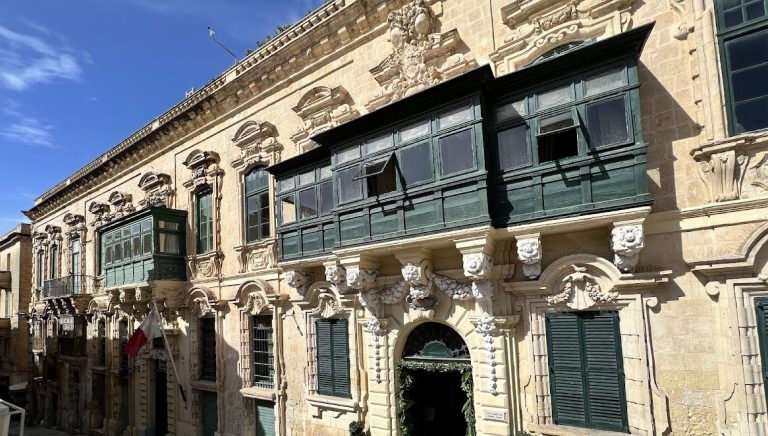
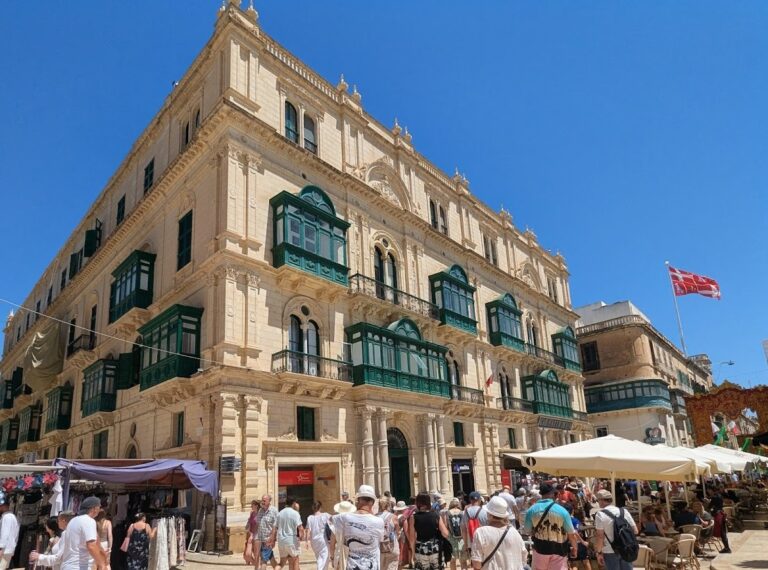
Messina Palace stands at the corner of St Christopher Street and Republic Street in Valletta. St Christopher Street was formerly called Strada della Fontana, a name referring to a spring that supplied the local population with drinking water. During the French occupation, the street was known as Rue des Droits de l’Homme.
The palace is constructed from grey stone. Its lower section is painted yellow, while black balcony balustrades rest on white brackets. The window bars are black, and the green door has a white frame. Inside, a vaulted vestibule leads to an arched courtyard, preserving the principal arrangement of the building’s entrance spaces.
Representative interiors
Main hall
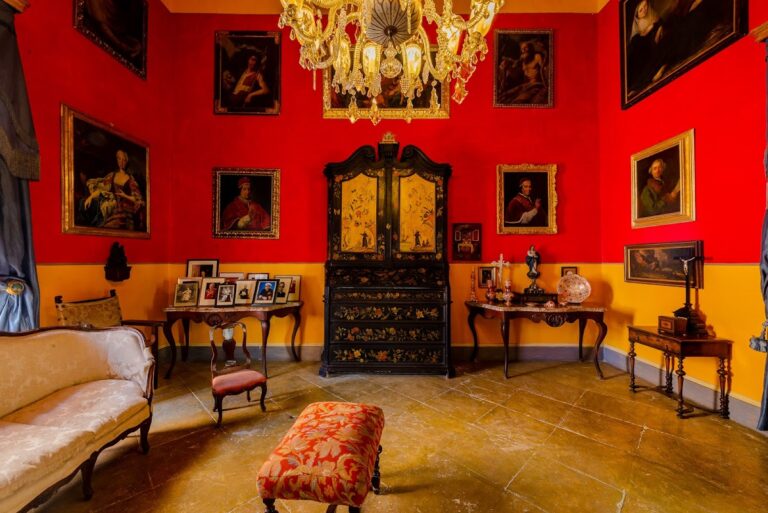
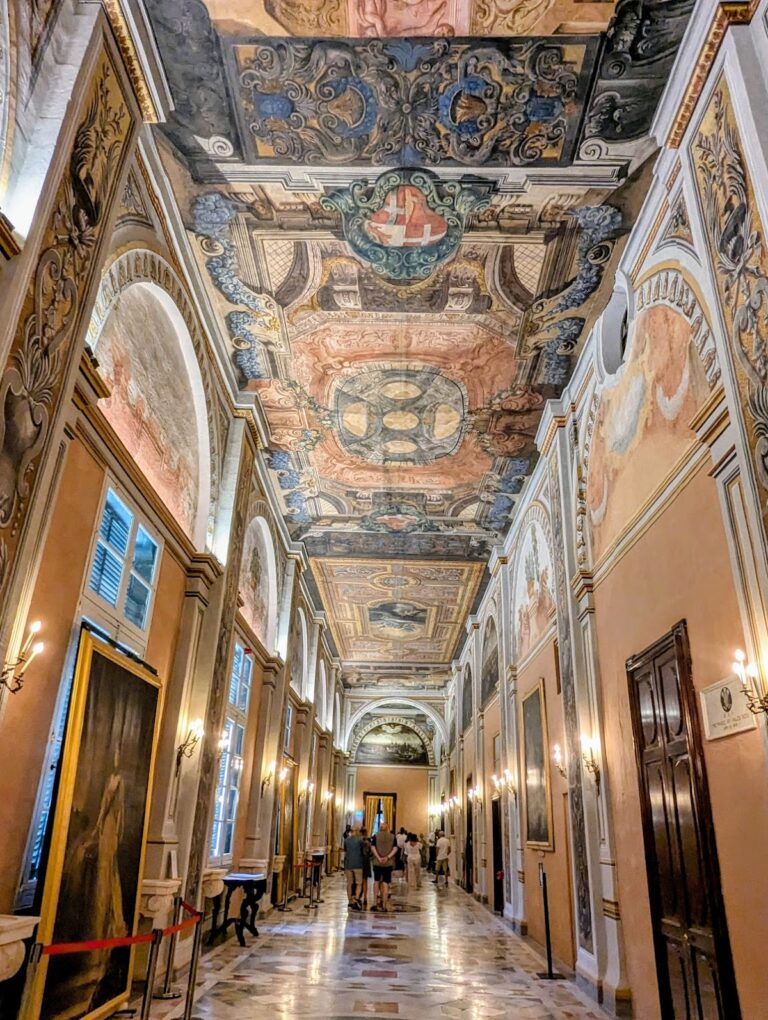
The representative main hall contains a grand staircase and marble furnishings. The Messina family coat of arms is inlaid in marble, and colourful frescoes border the ceiling. These features belong to the palace’s later identity as the residence of the Messina family.
Private chapel
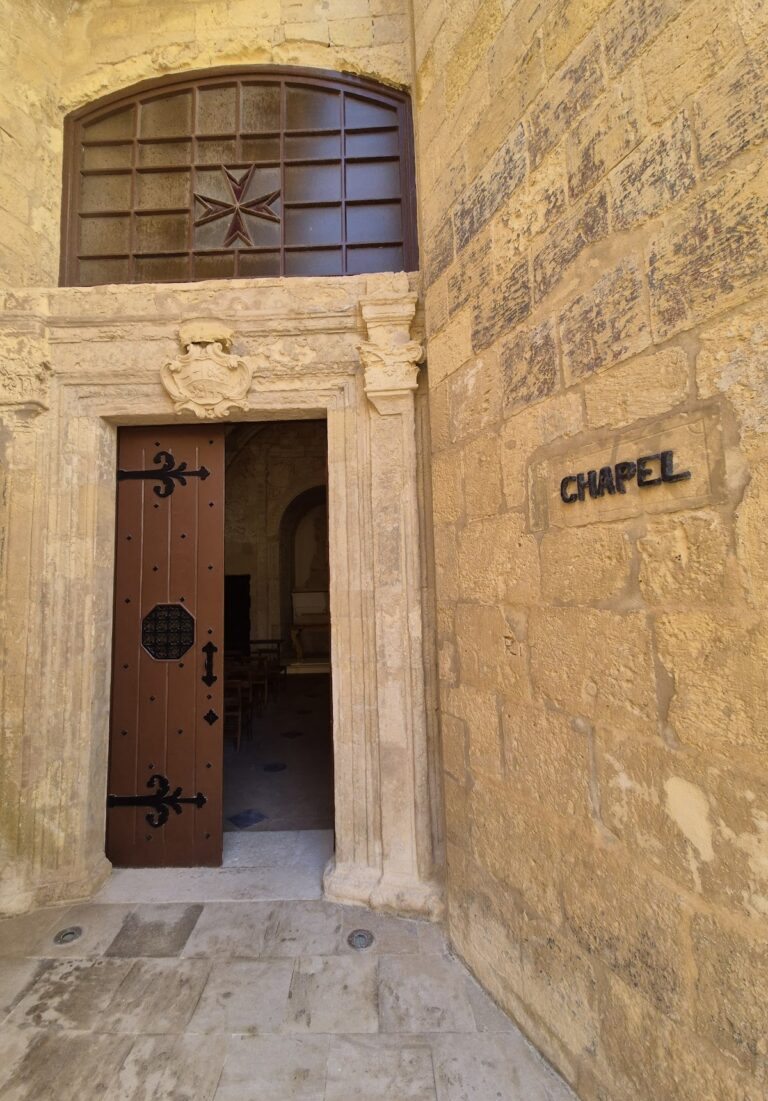
A private chapel contains a marble altar. The narrow room has a very high ceiling, tall glass doors, white-painted walls, and a floor of yellow-and-white chequered tiles.
Roof staircase and ground-floor spaces
A traditional Maltese spiral staircase connects the interior with the roof. Part of the ground floor contains a bar and coffee shop, while the palace continues to serve as the headquarters of the German-Maltese Circle.
Nearby sites