Basilica of Our Lady of Mount Carmel: A Carmelite Minor Basilica in Valletta
Site at a Glance
- Rating
- 4.7
- Popularity
- Medium
- Country
- Malta
- Primary era
- Modern
- External website
- Open
- Eras represented
- Early Modern, Modern
- Civilizations
- Unclassified
- Site type
- Religious
- Remains
- Basilica
On this page11 sections
History
The Basilica of Our Lady of Mount Carmel is a Roman Catholic Carmelite church in Valletta, Malta, built by the Carmelite Order during the city’s development under the Hospitaller knights. The first church was established in the late sixteenth century, and the present Neoclassical building was completed in 1981. The basilica remains an active church under the parish of St Dominic and the Archdiocese of Malta.
The first Carmelite foundation
The Carmelites, a Catholic religious order associated with Mount Carmel and Marian devotion, had been present in Malta since at least 1418. After Valletta was founded in 1566, the order established a church and convent in the new city. Hospitaller Grand Master Pierre de Monte transferred land to the Carmelites on 27 July 1570. Although the property was initially valued at 66 scudi, two decrees issued in April 1571 granted it to the order without charge.
Carmelite vicar Ġwann Vella commissioned the Maltese architect Girolamo Cassar to design the church and priory. While construction continued, Mass was celebrated in a small temporary chapel dedicated to the Annunciation. Inquisitor Pietro Dusina visited the chapel in February 1575 and recorded its contents. The chapel became Valletta’s first parish church before being absorbed into the parish of St Paul’s Shipwreck.
Cassar’s church was completed in either 1591 or 1608. Between the sixteenth and eighteenth centuries, Hospitaller knights gave the Carmelites money, property, and artworks. Girolamo de Fosses financed a chapel dedicated to Our Lady of Pilar. Knights of the German langue, a territorial division of the Order of St John representing members from German-speaking territories, also particularly supported the church because their nearby Auberge d’Allemagne had no dedicated church.
Nineteenth-century changes and papal recognition
Giuseppe Bonavia designed a new façade in 1852, and the work was accompanied by changes to the interior. Bishop Carmelo Scicluna crowned the church’s altarpiece on 15 July 1881. This followed Pope Leo XIII’s decree of 19 June 1880 authorizing the canonical coronation of the revered Marian image, a Catholic rite in which a crown is formally placed on an image of the Virgin Mary. Apostolic Administrator Antonio Maria Buhagiar consecrated the church on 6 April 1886.
Pope Leo XIII granted the church the status of a minor basilica on 13 May 1895. A minor basilica is a church given special papal recognition of its religious and ecclesiastical importance. The title is distinct from that of a cathedral, which is the principal church of a diocese.
Wartime destruction and rebuilding
Bombing on 4 March 1942, during the Second World War, seriously damaged the church. The Carmelites later demolished the ruins and replaced the building. This caused the loss of some artistic and historic objects, although many contents of the earlier church survived and were incorporated into the new one.
Ġużè Damato designed the present church. Construction began on 30 April 1958, when the Prior General blessed the foundation stone, and it was completed on 15 June 1981. Prior Provincial Manwel Gatt later blessed the completed building. Joseph Damato sculpted the interior over a period of 19 years.
The basilica forms part of the UNESCO World Heritage Site covering the city of Valletta and is listed in the National Inventory of the Cultural Property of the Maltese Islands. Its continuing status as a minor basilica reflects its ecclesiastical role, while its history preserves the connection between the Carmelite community and Valletta since the city’s early development.
Remains
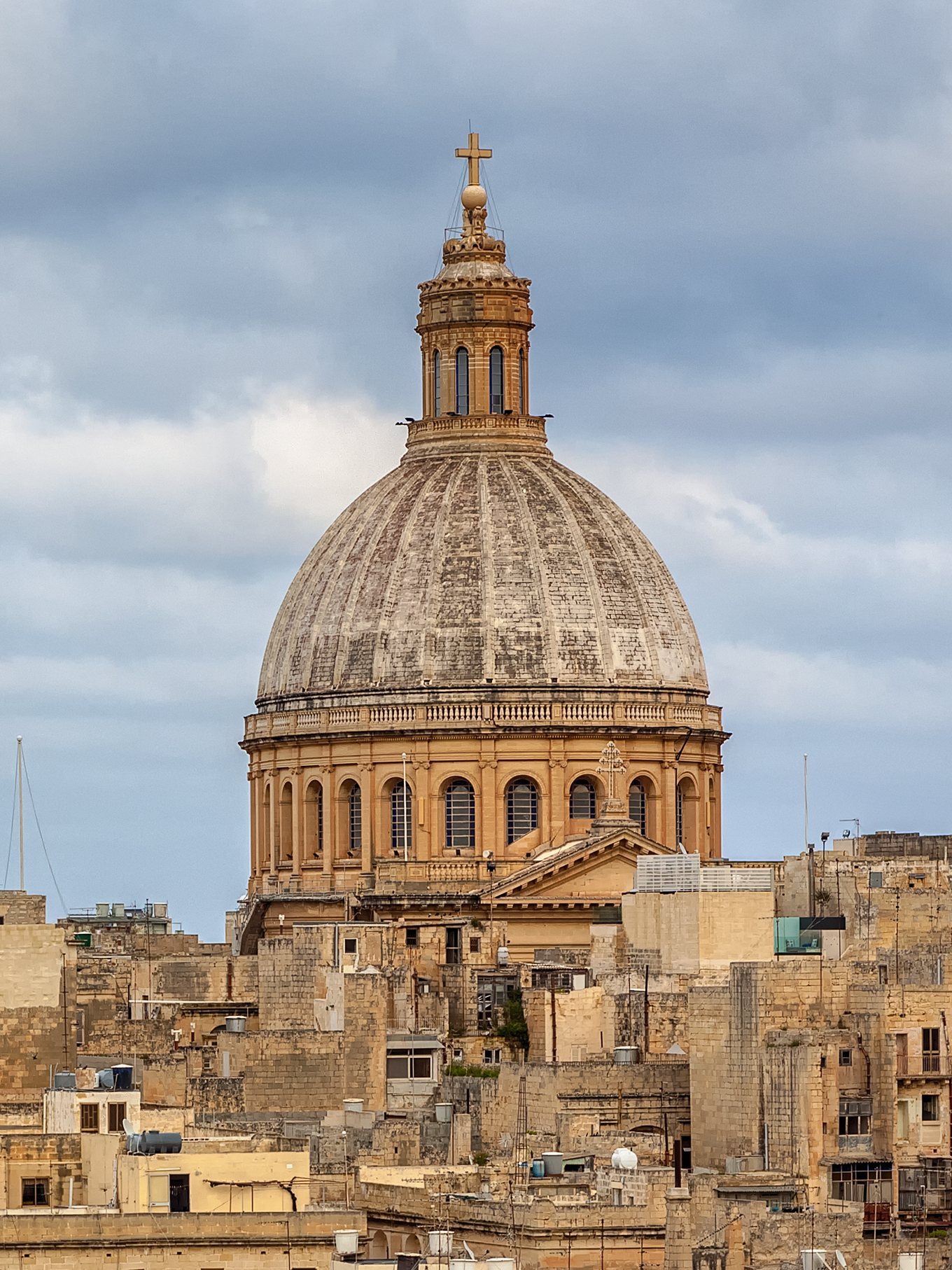
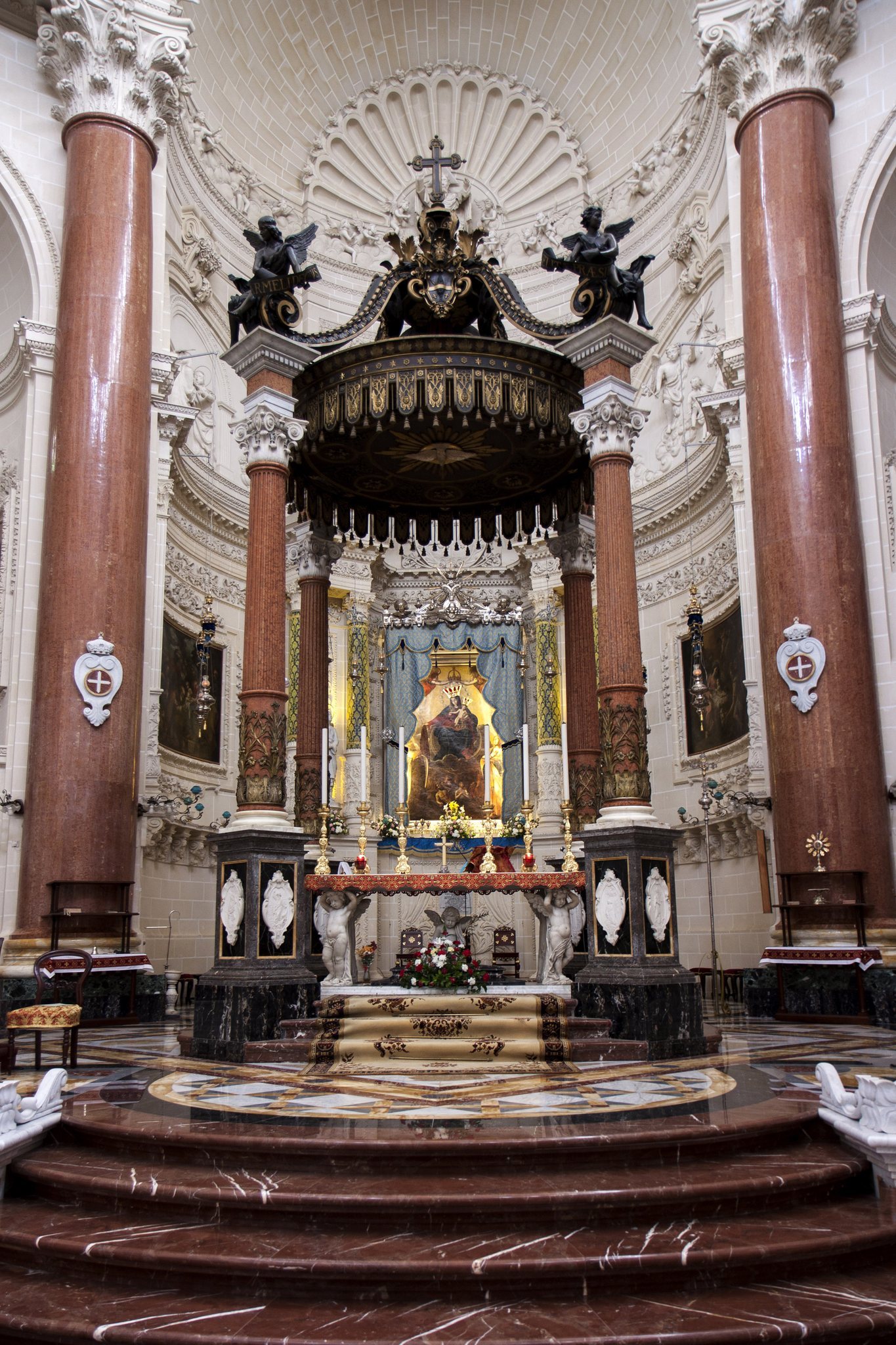
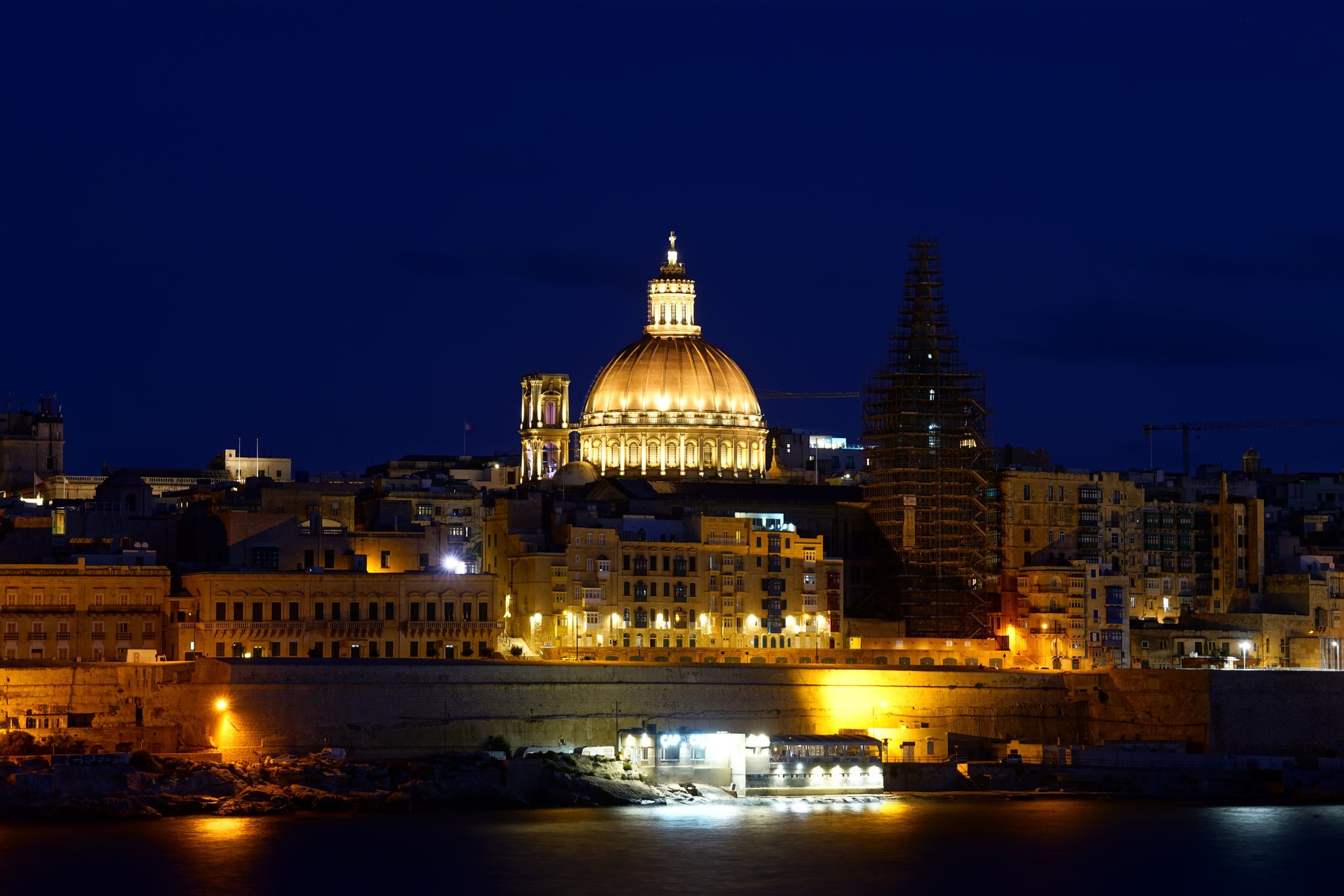
The surviving basilica is a large limestone Neoclassical building, using architectural forms derived from ancient Greek and Roman traditions and characterized here by monumental proportions, symmetry, and columns. Its oval dome rises 42 metres above the church and forms a prominent part of Valletta’s skyline facing Marsamxett. It is slightly higher than the bell tower of the nearby Anglican St Paul’s Pro-Cathedral, and may have been deliberately designed to compete with that tower. Red-marble columns are among the interior features.
Earlier church and surviving memorials
Cassar’s church
The first church designed by Girolamo Cassar measured approximately 150 feet, or 46 metres, in length and 50 feet, or 15 metres, in width. Its layout included a broad nave, lateral chapels, ten altars, a low dome, and a bell tower. Painted frescoes decorated the interior. After the wartime destruction and demolition of the ruins, elements and contents of the earlier church were incorporated into the replacement building.
Burial monuments
People buried in the church included Hospitaller knights, Caterina Scappi, and Caterina Vitale. The Baroque marble tombstones of Scappi and Vitale survived the Second World War and were attached to the walls of the new church, preserving their memorial presence within the rebuilt interior.
Images and artworks
Altarpiece
The altarpiece shows the Virgin Mary holding the infant Jesus, with Saint Simon Stock and Saint Agatha of Sicily beside her. Saint Simon Stock was a medieval Carmelite associated with the order’s Marian devotion, while Saint Agatha was an early Christian martyr venerated as a patron saint in Sicily. The artist and provenance of the painting are unknown. It is believed to date from at least the late sixteenth or early seventeenth century and may be by Filippo Paladini. The Carmelites may have acquired it from Sicily while the first church was being built.
Paul Cuschieri restored the painting in 1856, Samwel Bugeja worked on it in 1978, and Godwin Cutajar restored it in the twenty-first century. The altarpiece was crowned in 1881 during the ceremony associated with the church’s Marian devotion.
Statues and painted works
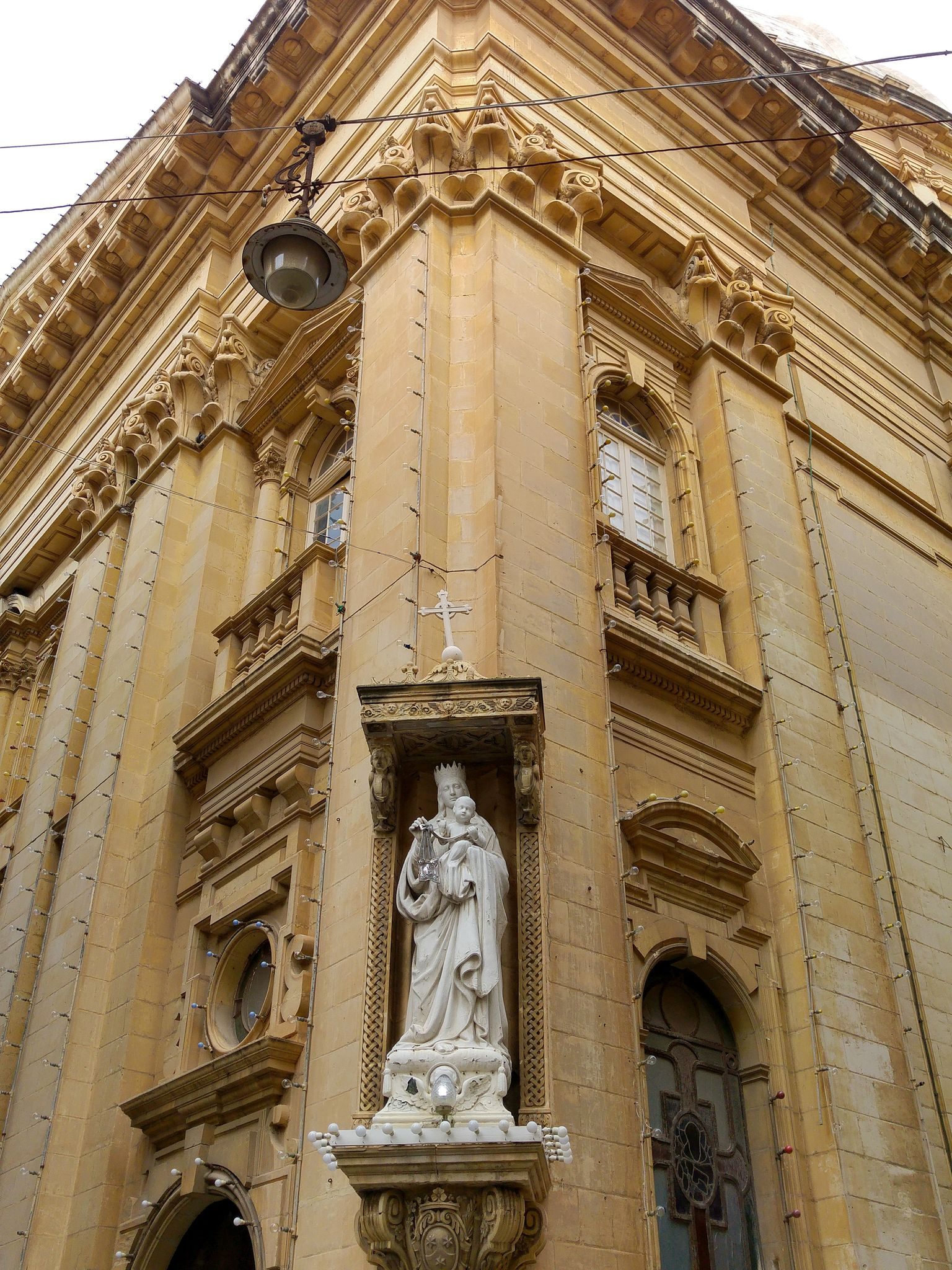
A niche at the exterior corner of Old Theatre Street and Old Mint Street contains a statue of Our Lady of Mount Carmel sculpted by Salvatore Dimech in 1855. Inside the church, a wooden statue of Our Lady of Mount Carmel, carved in Naples in 1781, stands on a silver pedestal designed by Abram Gatt. Publius Magro restored the statue in the twenty-first century.
The church also contains Beato Franco, a work by Maria de Dominici dating from the 1670s. Together with the older altarpiece and the surviving devotional statue, it forms part of the artistic inheritance retained within the rebuilt basilica.