Church of the Jesuits: A Baroque Catholic Church in Valletta, Malta
Site at a Glance
- Rating
- 4.6
- Popularity
- Very Low
- Country
- Malta
- Primary era
- Early Modern
- Eras represented
- Early Modern
- Civilizations
- Knights Hospitaller
- Site type
- Religious
- Remains
- Church
On this page17 sections
History
The Church of the Jesuits, formally the Church of the Circumcision of Our Lord, is a Roman Catholic church in Valletta, Malta, built by the Society of Jesus in the late sixteenth and early seventeenth centuries. Designed in the Baroque tradition and linked to the Jesuit college known as the Collegium Melitense, it formed part of a complex that occupied an entire city block and introduced advanced philosophical and theological education to Malta.
Foundation of the Jesuit college
Ignatius Loyola had considered establishing a Jesuit college in Malta from 1553. Pope Clement VIII promoted the project in a letter of 28 March 1592 to Bishop Tomás Gargallo and Grand Master Hugues Loubenx de Verdalle. The college was formally created by a notarial act on 12 November 1592, mainly to prepare candidates for the clergy. Its programme also introduced higher studies in philosophy and theology to Malta.
The cathedral granted land for the complex, whose foundation stone was laid by Grand Master Martin Garzes on 4 September 1595. The college was completed in 1602. The church itself had begun in 1593 and was completed in 1609. Its original design is attributed to the Jesuit architect Giuseppe Valeriano. The building followed the Church of the Gesù in Rome and became Malta’s first church with a Latin-cross plan.
Reconstruction after the seventeenth-century explosion
On 12 September 1634, an explosion at a nearby gunpowder factory seriously damaged the church and the college. Most of the church, including its façade, was rebuilt during the seventeenth century. Reconstruction began in 1647 and was principally associated with Francesco Buonamici, a Luccan architect and military engineer. Buonamici left Malta in 1659, while the façade remained unfinished.
The church was damaged again by the 1693 Sicily earthquake. Its formal consecration eventually took place on 16 December 1731, when Bishop Paul Alphéran de Bussan solemnly consecrated the building. The present church therefore combines the foundation of the early Jesuit period with the form produced by its later rebuilding.
From Jesuit college to university church
The Jesuits continued teaching philosophy and theology at the college until their expulsion from Malta in 1768, an action associated with Grand Master Manuel Pinto da Fonseca. In 1769, the former college became the seat of the University of Malta, making the Collegium Melitense the institutional predecessor of the university. The church remained in use after the Jesuits’ departure and became closely connected with university life.
University degree ceremonies were held in the church until the university moved to a new campus in the 1960s. The building continues to host master’s and doctoral graduation ceremonies. Its historical association with education therefore survived the departure of the Jesuit order and the transformation of the adjoining college.
Congregations, restoration and protection
The Oratory of the Assumption of the Virgin was founded in 1600 by knights of the Order of Saint John, the Catholic military and religious order that governed Malta during the church’s foundation. Its congregation consisted of prominent and educated residents of Valletta. Members first met in the Jesuit college chapel before moving to an oratory built during the period of Grand Master Nicolas Cotoner. The congregation ceased activity after the Order of Saint John’s departure and was revived in 1813.
A second oratory was dedicated to the Immaculate Conception of the Virgin Mary and housed the Congregation of the Segreta. Other congregations associated with the church included those dedicated to the Precious Blood of Jesus, the Immaculate Conception, Saint Raphael the Archangel and the Sacred Heart of Mary.
The church and its adjoining complex underwent major restoration between 1996 and 2002. A further campaign from 2016 to 2018 repaired the dome and roof, restored damaged parts and renewed the façades facing Merchants Street and Archbishop Street. Four statues at the corners of the old university and church complex were also restored. The church is listed in the National Inventory of the Cultural Property of the Maltese Islands under number 00577. The adjoining Onorati Oratory and the statues of Saint Francis Borgia and the Virgin Mary also have national monument or inventory protection.
Remains
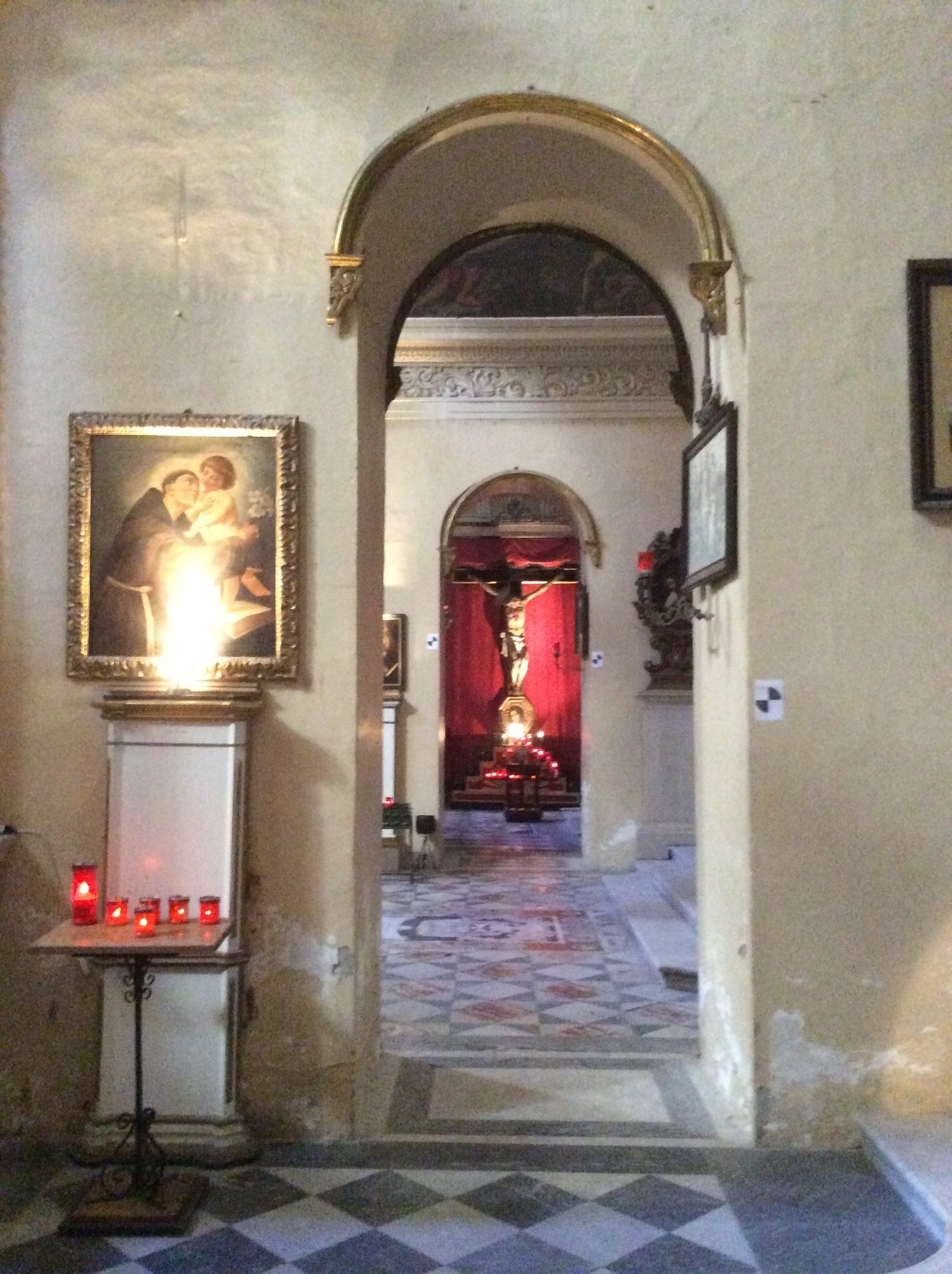
The church is a Baroque limestone building occupying part of the block bounded by Merchants Street, St Christopher Street, St Paul Street and Archbishop Street. Its plan has three aisles, a four-bay nave, a crosswise transept, a raised presbytery with a choir and two apses, seven principal side chapels, additional chapels in the transept, ten altars and nine domes. A passage beside the nave links the church with a side exit on Archbishop Street and gives access to two oratories.
Façade and principal structure
Exterior façade
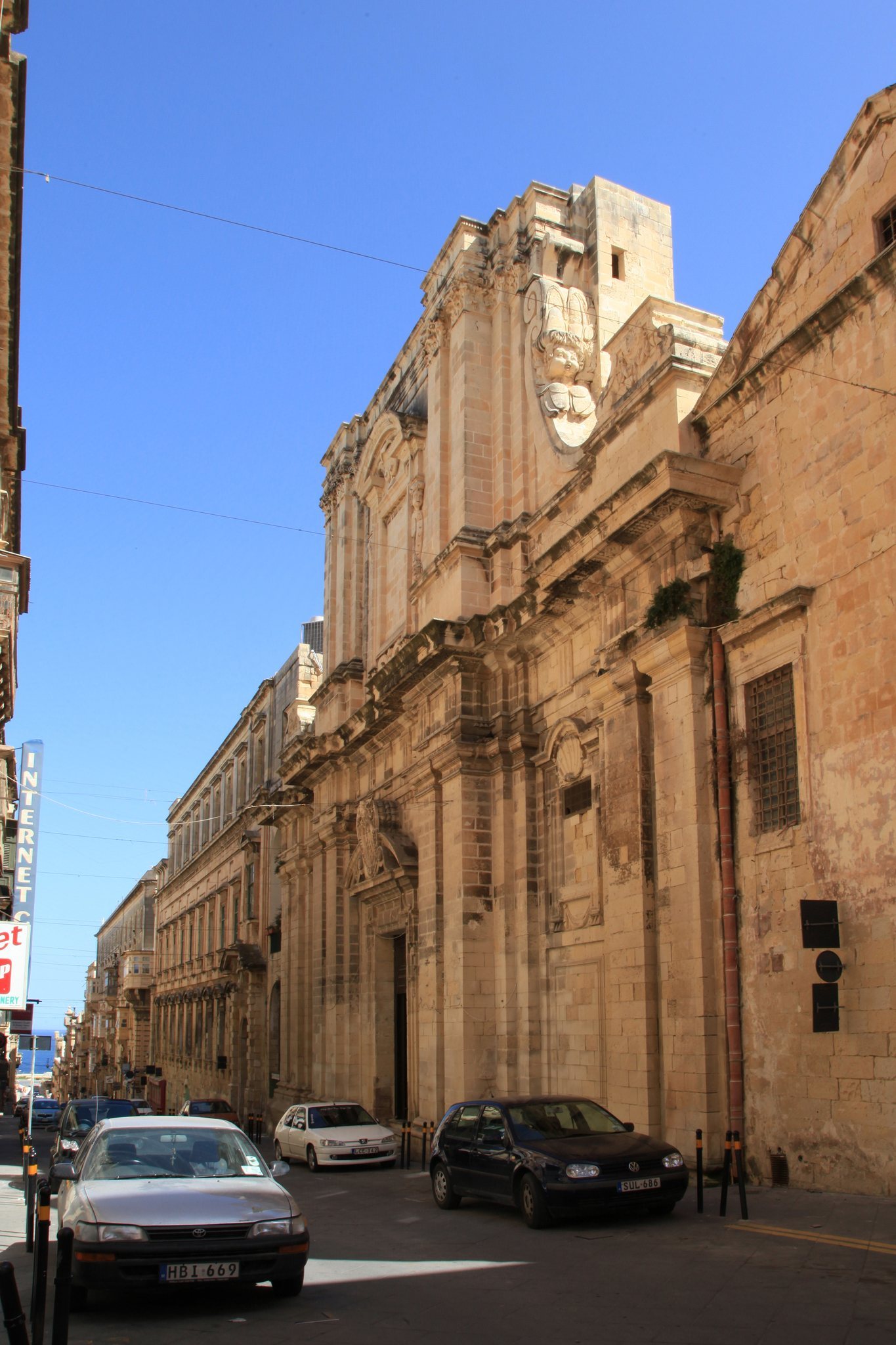
The limestone façade is arranged in two levels. The lower level has three bays, while the central bay is repeated above. Volute scrolls connect the upper central bay with the lower side bays. Paired monumental Doric pilasters support a continuous entablature with triglyphs, metopes and a modillion cornice.
The central rectangular portal has a stone frame, a semicircular pediment and a medallion bearing the Jesuit Christogram. The side windows have Greek-omega-shaped hoods containing scallop shells. Angel heads and floral decoration appear on the volutes, while paired statues flank a blind upper window. Saint Francis Borgia stands on a high pedestal at the south-western corner of the façade, and a statue of the Virgin is set into the exterior wall to the right of the church.
Nave, crossing and presbytery
The nave is approximately 46.6 metres long and 7.9 metres wide. The transept measures approximately 23.5 metres across, and the side aisles are approximately 7.8 metres wide. The nave is covered by a plain barrel vault with lunettes. Buonamici raised the vault and added a continuous cornice, while windows above the side chapels increase the light entering the church.
The dome rises above the square crossing of the nave and transept. It rests on a drum carried by pendentives, curved triangular transitions that support a dome over a square space, and four substantial corner groups of pilasters. Semicircular arches connect the groups. The interior follows the Doric order, with paired free-standing columns beside the nave pilasters supporting semicircular arches. Serliana columns have tightly spiralling shafts over much of their height, while the lower sections have more complex geometric carving. Floral decoration covers the undersides of the nave arches.
The presbytery projects from the main rectangular mass and forms part of the wider complex. Its marble high altar was installed in November 1730, replacing an earlier altar. The main altarpiece depicts the Circumcision of Jesus and was painted by Filippo Paladini. It was restored in the early twentieth century. Large oval paintings of Saint John the Baptist and Saint Anne by Giuseppe D’Arena are also located in the presbytery, whose balustrade displays local craftsmanship. Several burial places beneath the nave floor are marked by marble slabs.
Side chapels and transept
Left nave chapels
Four chapels line the left side of the nave. The first was entrusted in 1654 to the Dicos, Sagnani and Dorell families. Its gilded wooden altar contains relics, and Stefano Erardi’s paintings include Saint Charles Borromeo and the Plague-Stricken, Saint Charles Borromeo with the Sick and Saint Francis Xavier Helping the Poor. A large wooden Crucifix by Alessandro Farrugia stands on the left wall, near the tomb slab of Joannes Sagnani and Don Giovanni Battista Sagnani.
The second chapel was entrusted in 1662 to Pietro Rosselli and Aloisia Massa. Its marble, sarcophagus-shaped altar bears the families’ coats of arms. Mattia Preti painted Saint Peter Released from Prison, the Martyrdom of Saint Peter and Saints Peter and Paul Led to Execution. Other paintings show Saint John the Baptist, Saint John Nepomuk and Saint Paul, while the founders are buried beneath the floor.
The third chapel was entrusted in 1625 to Paolina di Napoli. Its principal painting, the Return of the Holy Family from the Flight into Egypt, is attributed to Battistello Caracciolo and was restored after the war. The lunettes show episodes from the life of Saint Joseph, and a side-wall painting represents Saint Benedict Joseph Labre. Don Giovanni Domenico Felix, secretary to Grand Master Antoine de Paule, is buried beneath the chapel.
The fourth chapel was assigned in 1633 to the Xara and Bonici families. A marble altar donated in 1911 by Father P. P. Sceberras supports a richly framed wooden Crucifix. Gio Nicola Buhagiar painted the Adoration of the Magi and the Presentation of Jesus in the Temple. Members of the Xara and Bonici families are buried in the chapel.
Right nave chapels
The first chapel on the right is dedicated to Saint Anne. Entrusted in 1653 to Vincenza Xara, it has a gilded wooden altar bearing the Xara arms. Its painting of Saint Joachim, Saint Anne and the Blessed Virgin is by Nicolò Lozeta of the Flemish school. A historic marble statue of Our Lady of the Missions stands in a wall niche.
The second right chapel is dedicated to Saints Agatha and Lucy. Matteo Filiberto di Lucia was entrusted with it in 1633 and financed its completion. The white-marble altar carries a painting of the two saints by Joannes de la Preite of the Lombard school. Giuseppe D’Arena painted the scenes of their martyrdom in the lunettes. The chapel also contains a painting of Saint Liberius and Giuseppe Calì’s copy of the Madonna of Pompeii. Its feast is celebrated on 8 May.
The third right chapel is dedicated to the Guardian Angel. Mariano and Mariana Sueyda built it and received responsibility for it in 1627. Its wooden altar bears their coats of arms, and the titular painting is attributed either to Louis Finson or to an artist of the school of Luca Giordano. The lunettes depict the Souls in Purgatory. A life-sized statue of the Dead Christ lies beneath the altar for Good Friday rites, while paintings of the Archangels Gabriel and Raphael are by Raffaele Caruana. The Sueyda family tomb lies in the nave before the chapel.
Transept chapels
Bishop Tomás Gargallo initiated the chapel in the left transept. Its altar painting by Giuseppe D’Arena shows the Virgin and Child surrounded by angels. Saint Francis Xavier was added to the composition in 1647 and Saint Francis Borgia in 1700. Other works depict the Eternal Father, Saint John the Evangelist, Saint Rosalia and the Martyrs of Nagasaki. Gargallo was buried in the chapel, where a decorated epitaph commemorates him.
The large chapel at the right end of the transept is dedicated to the Holy Trinity and Saint Ignatius. Assigned in 1633 to the Abela and Testaferrata families, it contains Giovanni Francesco Romanelli’s painting of the Holy Trinity and Saint Ignatius. The families’ coats of arms and an epitaph to Giacomo Testaferrata de Robertis are also present.
Oratories and associated interiors
Onorati Oratory
The Onorati Oratory adjoins the church on Archbishop Street. Its austere exterior has two large upper-level windows, a triangular pediment, a monumental pilaster decorated with panels and a statue of Saint Francis Borgia. The side elevation contains blocked window openings and three semicircular clerestory windows, which are upper windows that illuminate an interior. A small statue of the Virgin stands on the central blocked window.
Inside, the oratory has three bays, reliefs and sculptures set in niches, fluted Corinthian pilasters, large paintings in stone frames and a principal altar framed by colossal fluted Corinthian columns on double bases. A flat coffered ceiling and marble floor complete the interior. Paintings by Stefano Erardi and Alessio Erardi include scenes from the life of the Virgin and Christ.
Oratory of the Immaculate Conception
The Oratory of the Immaculate Conception contains a titular painting by Stefano Erardi and other works by Alessio Erardi. Its collection also includes Saint Philip Neri by Giuseppe Hyzler, a small Madonna of Mount Carmel by Salvatore Barbara and a painting of Vincent de Paul by Falson.
Old sacristy
The old sacristy preserves paintings formerly located in the church or college. They depict Saint Stanislaus Kostka, Saint Francis de Sales, Saint Francis Xavier, Saint Francis Regis, Saint Lucy, the Guardian Angel, Saint Rosalia, Saint Francis Borgia, Saint John the Baptist and Saint Agnes. Across the church and its associated spaces, the paintings range from the late sixteenth to the late eighteenth century and include works by Baldassarre Peruzzi, Stefano Erardi, Niccolò de Simone and Mattia Preti.