Konzō-ji Temple: A Tendai Buddhist Temple and Shikoku Pilgrimage Site in Japan


Site at a Glance
- Rating
- 4.1
- Popularity
- Low
- Country
- Japan
- Primary era
- Early Modern
- External website
- Open
- Eras represented
- Early Modern, Modern
- Civilizations
- Japanese, Tokugawa
- Site type
- Religious
- Remains
- Monastery
On this page24 sections
History
Konzō-ji Temple is a Buddhist temple in Japan, located in Zentsuji, Kagawa, whose foundation tradition dates to 774. It belongs to the Jimon branch of Tendai Buddhism, a major Japanese Buddhist tradition founded by Saichō, and is the 76th temple on the Shikoku pilgrimage. Formally known as Keisokuzan Hōdōin Konzō-ji, it developed from a small hall into an important Tendai religious center associated with the monk Enchin.
Foundation and Early Development
Tradition places the beginning of the temple in 774, when Wake Dōzen built a hall called Jizaidō and enshrined Nyoirin Kannon there. Dōzen was an ancestor and grandfather of Enchin. In 851, at the request of Dōzen’s son, the institution became a state temple and received the name Dōzen-ji.
Enchin returned from China in 858 and expanded his home temple into a larger religious complex. He based its arrangement on Qinglong Temple in Chang’an and carved a statue of Yakushi Nyorai, the Buddha associated with healing and medicine, as its principal image. Construction was completed in 861, and Enchin returned to take part in the dedication ceremony.
In 928, an imperial order renamed the temple Konzō-ji. The new name came from the surrounding Kanakura district. Its mountain name, Keisokuzan, refers to the mountain associated with Kasyapa, one of the Buddha’s ten principal disciples.
Enchin and the Jimon Tradition
Enchin, later honored by the posthumous title Chishō Daishi, is central to Konzō-ji’s religious identity. He was a ninth-century monk who studied in China, became the fifth chief abbot of Enryaku-ji in 868, and is regarded as the founder of the Jimon branch of Tendai Buddhism. At Konzō-ji, his return from China led to the temple’s transformation into a major center of that tradition.
The temple is also connected with Kūkai, the monk who founded the Shingon school of Japanese Buddhism and became the central figure of the Shikoku pilgrimage. Konzō-ji preserves a tradition that Enchin was Kūkai’s nephew. This association places the temple within both the local history of Enchin and the wider devotional landscape of the pilgrimage.
Destruction, Abandonment, and Revival
After a period of prosperity, Konzō-ji suffered repeated damage and destruction through fires and warfare. Most of its buildings and treasures were lost, although an important portrait of Enchin and the principal image survived. The temple was subsequently abandoned for nearly a century.
By 1606, no resident clergy remained. With assistance from a nearby Shingon temple, Konzō-ji temporarily became affiliated with Shingon Buddhism. Matsudaira Yorishige, the lord of the Takamatsu domain, later supported its revival and its return to Tendai Buddhism. In 1651, the Founder’s Hall, additional halls, guest quarters, and the residential and service buildings used by the monks were rebuilt.
Religious and Social Life
Konzō-ji continues to serve as a place of worship and as a pilgrimage temple. Its historical observances include the Enchin and Nogi Festival, the annual festival of Kariteimo, and ascetic entry into the mountains at Ishitsuchi. The temple also remains associated with the practices of the Shikoku pilgrimage.
The precinct has hosted events beyond regular religious observance. In 1925, an increasingly intense dispute between landowners and tenant farmers over the auction of farmland seized by a landowner brought the parties and police into the temple grounds, where mediation took place.
The temple also preserves memories of General Nogi Maresuke, who lived in its guest hall for approximately three years from 1898. Its position between his military camp at Marugame and his headquarters on Shikoku led to his stay there. Objects associated with him include his military cap and letters from his wife.
Cultural Properties and Living Traditions
Konzō-ji is associated with several designated cultural properties. A silk painting of Enchin with an inscription was designated in 1901, while a silk painting of the Two-World Mandala, a diagrammatic Buddhist image representing sacred relationships and cosmology, was designated in 1987. The Shikashika dance, preserved by a dedicated association, received designation in 1973.
Remains
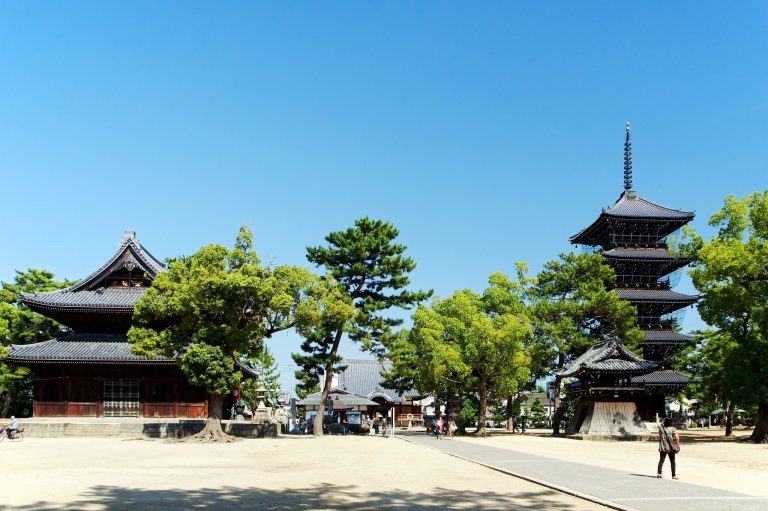
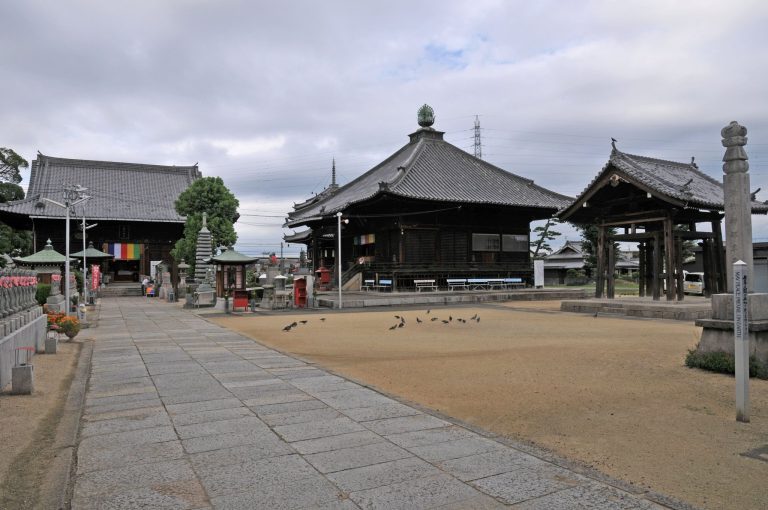
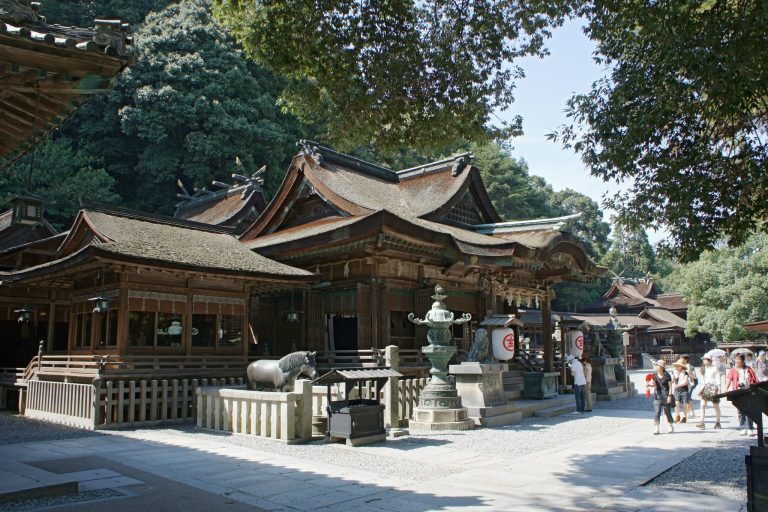
The precinct is entered from the south through a Niō Gate, a temple entrance flanked by guardian figures. The approach continues toward the Main Hall, with the bell tower on the left and the pilgrimage-registration office to the right of the hall. The Founder’s Hall stands farther to the left. Other halls, shrines, monuments, and pilgrimage features occupy the grounds, while the Enchin First-Bath Well lies approximately 3 kilometers east of the main precinct.
Main Buildings
Main Hall
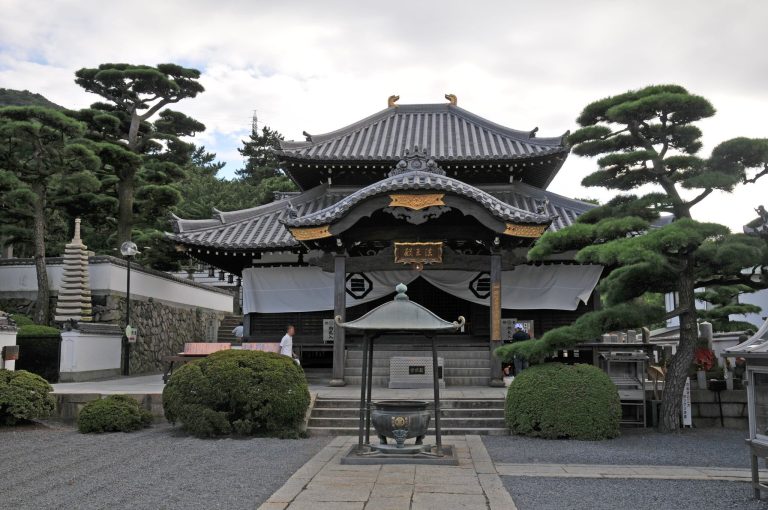
The Main Hall was rebuilt in November 1983, using Saimyō-ji as its architectural model. It enshrines Yakushi Nyorai, Fudō Myōō, and Amida Nyorai. The hall forms the principal destination of the southern approach through the Niō Gate.
Founder’s Hall
The Founder’s Hall, also called the Daishidō, is a former Main Hall built in 1651 and later relocated. A statue of Enchin occupies the central position. Kūkai stands on the right and En no Gyōja on the left. The Tiantai Great Master and Dengyō Daishi are enshrined beside Enchin in a large shrine structure, while the same three principal figures also appear in the inner hall behind it. Among the temples on the 88-temple pilgrimage, Konzō-ji is identified as the only one whose Founder’s Hall places a figure other than Kūkai at the center.
Kariteimo Hall
The Kariteimo Hall consists of an inner hall built in 1716 and a worship hall added in 1881. It enshrines Kariteimo, also known as Kishimojin, a Buddhist protective deity associated especially with children and childbirth. Tradition says that the deity appeared to the five-year-old Enchin, so the hall is regarded as the place of Kariteimo’s first appearance in Japan. It is associated with prayers for conception and safe childbirth.
Kannon Hall
The Kannon Hall enshrines a hidden Eleven-Headed Kannon image. Kannon is a bodhisattva associated with compassion. The image’s associated mantra is given as “On rokeijibarikiriku.”
Smaller Shrines and Sacred Features
Great Ārya Nandikeśvara Hall
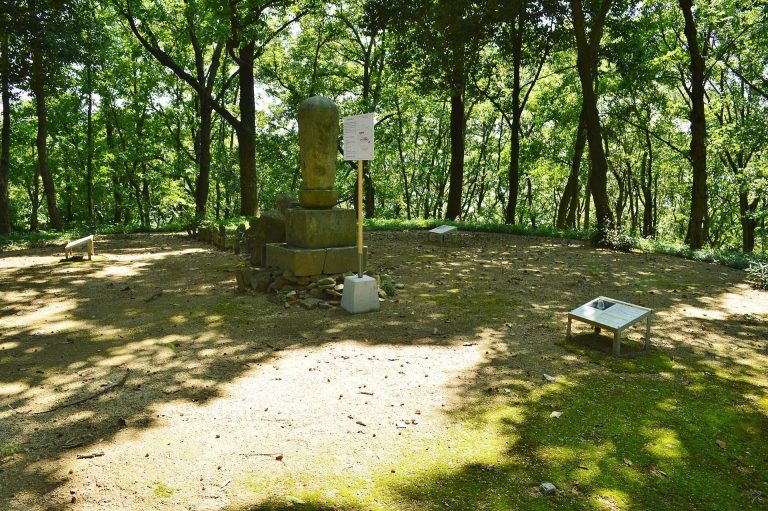
A small Great Ārya Nandikeśvara Hall contains a stone image whose facial features have been lost. Its modest scale and separate position distinguish it from the principal halls of the temple precinct.
Benzaiten and Tenmangu Shrines
The grounds contain a Benzaiten shrine set within decorated surroundings and a Tenmangu shrine. A pond lies in front of the Benzaiten shrine, with a poem monument nearby.
Chukonsha Shrine and Nogi’s Wife-Returning Pine
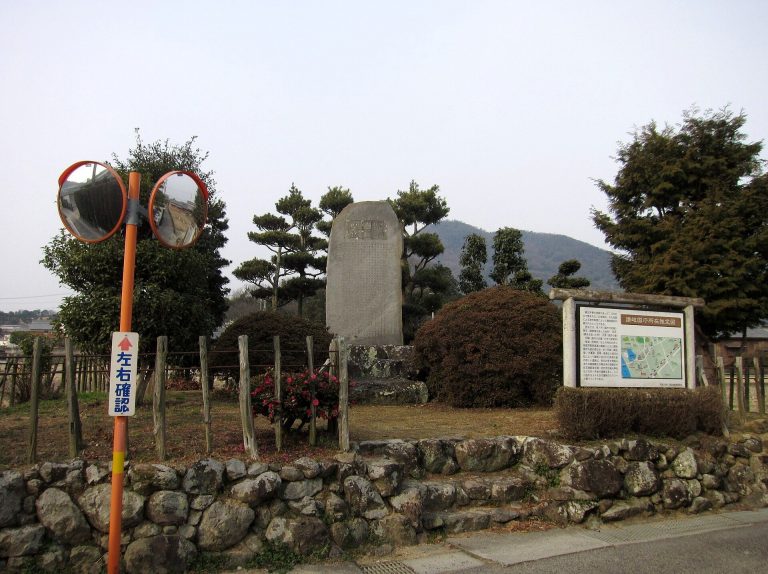
The Chukonsha shrine is dedicated to the war dead and was moved to its present position in August 1947. The precinct also contains a second-generation pine known as Nogi’s Wife-Returning Pine, a feature recalled by a poem monument to the left of the bell tower.
Shinra Shrine
The Shinra Shrine stands immediately west of the temple gate. Before the modern separation of Buddhism and Shinto, it was known as the Shinra Myōjin Shrine. Its earlier religious setting included the old man identified with Shinra Myōjin, who was said to have guided Enchin to Onjō-ji, and the Sannō Gongen associated with encouraging his journey to China. The separation policy required Buddhist and Shinto institutions and images to be distinguished, and the shrine now enshrines Susanoo.
Enchin First-Bath Well
The Enchin First-Bath Well lies about 3 kilometers east of the main precinct, outside the temple grounds. Tradition identifies it as the sacred spring used for Enchin’s first bathing.
Pilgrimage Features and Monuments
Seven Lucky Gods and Stone Ox
Seven stone images of the Seven Lucky Gods are distributed around the grounds, creating a pilgrimage route within the precinct. A stone ox image recalls the area’s former prosperity as a cattle market.
Sand-Treading Pilgrimage Hall
Near the parking area, a sand-treading pilgrimage hall contains hanging paintings of the principal images of the 88 pilgrimage temples, together with an image of Kūkai. The feature provides a physical expression of Konzō-ji’s place within the wider Shikoku pilgrimage.
Bell Tower and Poem Monuments
The bell tower has twelve pillars, a feature described as expressing its formal rank. Several poem and song monuments stand around the precinct. One refers to the Wife-Returning Pine, another quotes Bashō’s verse about the full moon and the tide entering at the gate, and a further monument stands near the pond before the Benzaiten shrine.
Guest Hall
The guest hall includes the room formerly occupied by Nogi and a display of objects associated with him. The surviving material connects the building with his residence at Konzō-ji from 1898 and with the temple’s role in the history of the local area.
Paintings and Images
The temple’s associated cultural properties include a Kamakura-period silk painting of Enchin. It is a colored hanging scroll on silk bearing an inscription and is identified as an Important Cultural Property of Japan. Together with the surviving principal image and the portrait of Enchin, it forms part of the material record of the temple’s religious history.