Kannonshō-ji Temple: A Buddhist Pilgrimage Temple on Mount Kinugasa


Site at a Glance
- Rating
- 4.2
- Popularity
- Medium
- Country
- Japan
- Primary era
- Modern
- External website
- Open
- Eras represented
- Early Modern, Modern
- Civilizations
- Japanese, Tokugawa
- Site type
- Religious
- Remains
- Temple
On this page11 sections
History
Kannonshō-ji Temple is a Tendai-affiliated Buddhist temple in Omihachiman, Japan, traditionally founded by Prince Shōtoku in 605 during the reign of Empress Suiko. Its formal name is Kinugasa-san Kannonshō-ji, and its principal deity is Senjū Kannon, the Buddhist bodhisattva Kannon represented with a thousand arms. The temple’s actual foundation date is unknown, but it was established by the eleventh century during the Heian period and later became part of the history of Kannonji Castle.
Foundation Traditions
One foundation legend tells of a mermaid who appeared to Prince Shōtoku in reed-filled waters near Kanzaki. She said that she had previously been a fisherman from Katata and had become a mermaid through the karmic consequences of repeatedly taking life. She asked Shōtoku to enshrine a Senjū Kannon so that her soul could be released from suffering. According to the tradition, he founded the temple and carved its principal image. A related story says that the mermaid later attained Buddhahood and that her body, recovered after appearing to Shōtoku in a dream, was deposited at the temple.
A second tradition places the foundation on Mount Kinugasa. Shōtoku is said to have seen a heavenly being dancing on a huge rock, which he named Tenrakuishi. He carved five Buddhist figures there, including Myōken, a deity associated with the Pole Star and the Big Dipper. After revelations linked with Amaterasu and Kasuga Myōjin, he used spring water from the mountain to grind ink and paint an image of Senjū Kannon. Shaka Nyorai, the historical Buddha, and Dainichi Nyorai, the cosmic Buddha of Esoteric Buddhism, then instructed him to carve another Kannon from sacred wood. The tradition identifies Tenrakuishi as the temple’s inner sanctuary.
Imperial and Medieval Connections
Kannonshō-ji was associated with the political and military history of Mount Kinugasa from the Kamakura period onward. A tradition holds that in 1333 it sheltered Emperor Kōgon, the retired Emperor Go-Fushimi, and the retired Emperor Hanazono. They were supposedly staying at a residence on the site of the present main hall when Hōjō Nakatoki, the Northern Rokuhara Tandai, attempted to flee eastward after an attack by Ashikaga Takauji. Nakatoki was a military-administrative official of the Kamakura shogunate, while Takauji led the movement that opposed the Kamakura regime and later founded the Ashikaga shogunate.
Mount Kinugasa became the stronghold of the Rokkaku, a warrior family that controlled southern Ōmi Province. Kannonshō-ji prospered under their protection, and temple tradition states that it once possessed 72 subtemples and three affiliated cloisters, or alternatively 33 branch temples. Under Rokkaku Takayori, and especially during Rokkaku Yoshikata’s expansion of Kannonji Castle in the Eiroku era from 1558 to 1570, much of the mountaintop precinct was absorbed into the castle. The temple was moved to Kannon Valley at the foot of the mountain.
The relocated temple was burned during the disorder surrounding the Battle of Kannonji Castle on September 12, 1568. Rokkaku Yoshikata and his son Yoshiharu were defeated by Oda Nobunaga, a military leader whose campaigns brought much of central Japan under his control, and withdrew to Kōka District. After Kannonji Castle fell into ruin, Kannonshō-ji began rebuilding near its former mountaintop location in 1597. The former approach was filled to enlarge the precinct, and a main hall was rebuilt in 1606 on the site now occupied by the monks’ quarters.
Pilgrimage and Modern Reconstruction
During the Edo period, Kannonshō-ji flourished as a station on the Saigoku Kannon Pilgrimage, a circuit of thirty-three temples devoted to Kannon in western Japan. In 1841, ten subtemple residences were recorded. All but one had disappeared by the Meiji period, and the remaining residence later became independent. The temple is the thirty-second stop on the Saigoku circuit and is also linked with the Ōmi Saigoku Thirty-Three Temples, the Gōshū Thirty-Three Kannon pilgrimage, the 108 Biwa Lake Sacred Sites, and the Pilgrimage Route of Shinto and Buddhist Sites.
The main hall was rebuilt in 1880. Its predecessor was dismantled and moved to Nenshō-ji in Kōra, Shiga, where it became that temple’s main hall. In 1882, Kannonshō-ji acquired the Zelkova Palace from Hikone Castle and moved it into the precinct for use as a new main hall. That building was destroyed by an accidental fire in 1993. The mountain setting made firefighting difficult, and the blaze also destroyed the former principal image, a standing Senjū Kannon with an inscription dated 1497, and the object traditionally identified as the mermaid’s mummy.
The present main hall and a new seated Senjū Kannon were completed in 2004. The auxiliary image of the principal deity, a separate standing statue, was later designated a secret Buddha, meaning a sacred image normally concealed and revealed only on appointed occasions. It was displayed publicly in 2022 and is scheduled to be shown every 33 years thereafter. Kannonshō-ji stands on the site of Kannonji Castle, designated a National Historic Site, while the Goma-dō, Jizō-dō, and Shōin are among the temple buildings registered as Nationally Registered Tangible Cultural Properties.
Remains
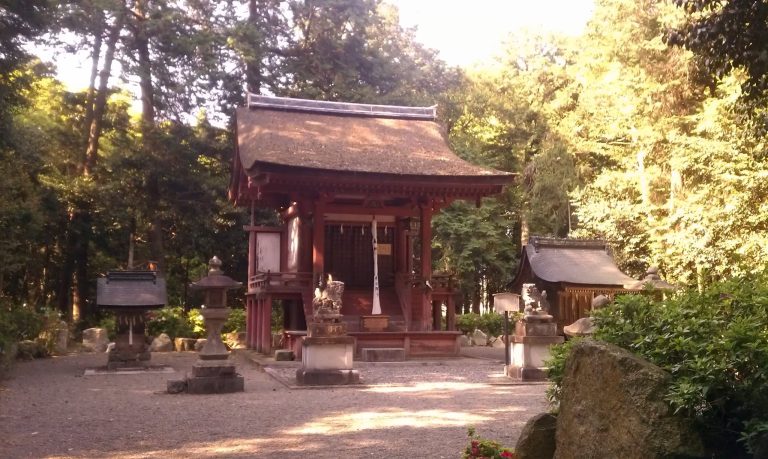
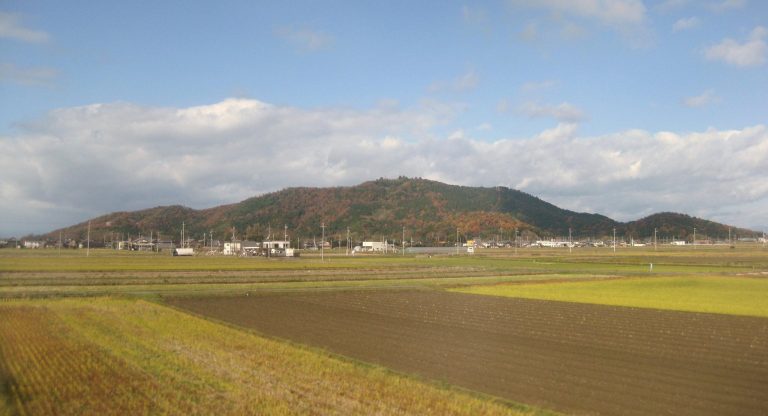
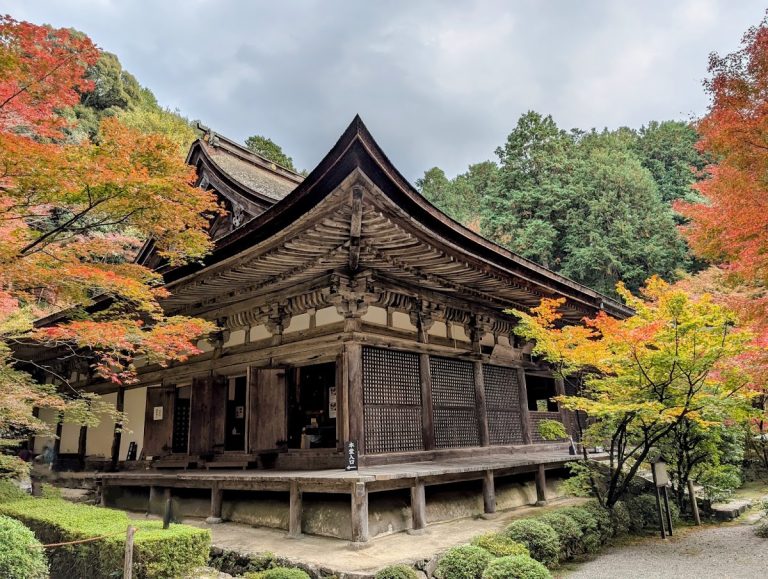
Kannonshō-ji occupies the southern side of the summit area of Mount Kinugasa on the eastern shore of Lake Biwa. The mountain rises to approximately 433 meters, while the temple precinct lies at about 370 meters above sea level. Its surviving buildings occupy a mountain temple complex shaped by repeated rebuilding, relocation, and fire. The present main hall is a wooden structure with an irimoya roof, a form combining a central gabled roof with hipped sections on its sides.
Main Hall and Sacred Images
The present main hall was rebuilt in 2004 and houses a seated Senjū Kannon carved by the Buddhist sculptor Myōkei Matsumoto. Completed in the same year, the image measures 3.56 meters in height and reaches 6.3 meters including its halo. It was carved from approximately 23 tons of sandalwood imported from India. The wood had previously been prohibited for export, and the temple’s chief priest obtained special permission after repeated negotiations and more than twenty visits to India.
The auxiliary principal image is a separate standing Senjū Kannon from the statue destroyed in the 1993 fire. Its status as a secret image shaped its public presentation, including the display held in 2022. The earlier main hall that stood at Kannonshō-ji before the 1880 rebuilding survives at Nenshō-ji in Kōra, where it was moved and reused as that temple’s main hall. The Zelkova Palace from Hikone Castle served as Kannonshō-ji’s main hall from 1882 until the fire of 1993.
Historic Auxiliary Buildings
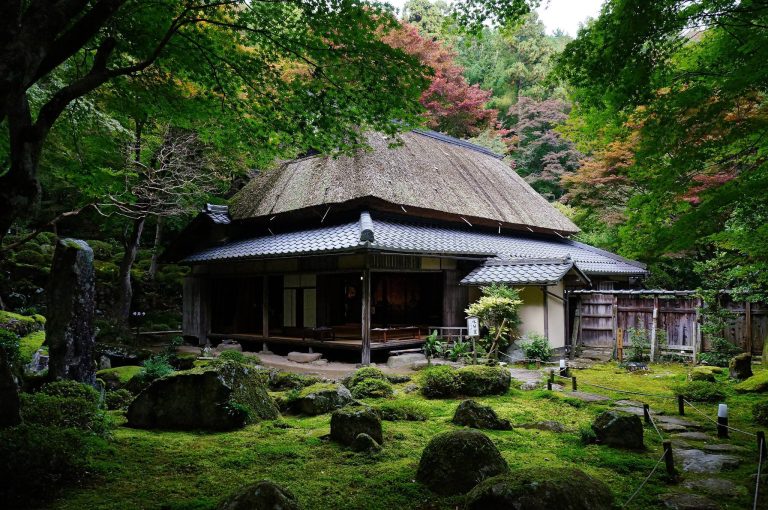
Shōin and Garden Gate
The Shōin dates to the Edo period, with a stated date of 1796. Its garden gate dates to 1844 and opens onto the western side of the earthen wall enclosing the garden north of the building. The gate is a one-bay, single-door structure with a gabled, shingle-tiled roof and one rafter. Square main and supporting posts frame a double-leaf wooden door across the opening.
Jizō-dō
The Jizō-dō dates to 1881, during the Meiji period. It forms part of the group of historic temple buildings that reflects the complex’s continued reconstruction after the relocation and destruction of earlier structures.
Ritual and Service Buildings
The Goma-dō, Fuda-dō, Shōrō, and Chōzuya date to 1928, during the Shōwa period. The Goma-dō is associated with goma fire rites, Buddhist ceremonies in which offerings and prayer materials are burned before a sacred fire. The Shōrō is a bell tower, while the Chōzuya is a pavilion for water purification.
Former Precinct and Tenrakuishi
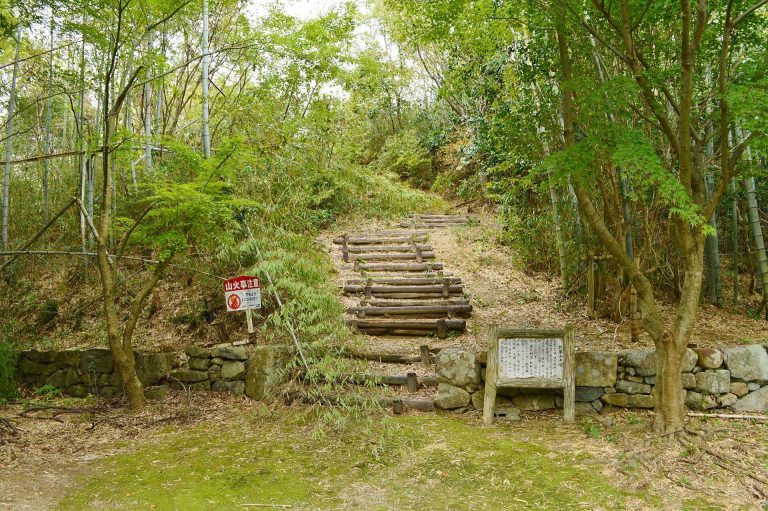
The earlier mountaintop precinct is thought to have followed the Hon’tani approach. Its course included a stone stairway near the traditionally identified site of the Gotō residence and extended toward the traditionally identified site of the western Mitsui residence. A former main hall was thought to have stood near the summit. The approach was later filled as the grounds were enlarged, and the former precinct became incorporated into the area associated with Kannonji Castle.
Tenrakuishi, a huge rock on Mount Kinugasa, remains central to the temple’s foundation tradition. The story associates it with the five Buddhist figures carved by Prince Shōtoku, including Myōken, and identifies the rock as the temple’s inner sanctuary. The object traditionally identified as the mermaid’s mummy was formerly kept at Kannonshō-ji and was destroyed in the 1993 fire.