Matsusaka Castle: A Japanese Castle and Administrative Center
Site at a Glance
- Country
- Japan
- Primary era
- Early Modern
- Eras represented
- Early Modern, Modern
- Civilizations
- Japanese, Tokugawa, Toyotomi regime
- Site type
- Military
- Remains
- Castle
On this page11 sections
History
Matsusaka Castle is a fortress in Japan, completed in 1588 by the daimyō, a powerful territorial lord, Gamō Ujisato. Built as his inland seat in Ise Province, it accompanied the creation of a new castle town and commercial district.
Before the castle
People lived in the area by the late Jomon period, a prehistoric era associated with cord-marked pottery. Pottery from the later Yayoi period, associated with the spread of wet-rice agriculture, is more abundant among finds from the castle site. Before Matsusaka Castle was built, a retainer of the Kitabatake family had established a fortification on the same hill. The Kitabatake, a medieval warrior clan, held power in the area during the Muromachi period. In the later Sengoku period, an era when regional lords competed for power, Oda Nobunaga defeated the family and installed his son Oda Nobukatsu as governor of Ise. Nobukatsu first lived at Tamaru Castle, then moved to coastal Matsugashima Castle.
Foundation under Gamō Ujisato
In 1584, Ujisato was transferred from a domain in Omi assessed at 60,000 koku, a measure of a domain’s rice yield, to one in Ise assessed at 123,000 koku. He initially took up residence at Matsugashima. Four years later, he moved his seat inland because the coastal castle’s cramped site limited the growth of its town, was difficult to defend, and suffered from salt damage. Matsusaka Castle was completed rapidly in 1588.
Construction reused stone taken from local temples and an ancient burial mound. Residents of Matsugashima were forcibly resettled in the new castle town. Ujisato also invited merchants from his former domain in Omi to establish a commercial district and brought a wealthy merchant family from an Ise port to the town’s port district. These measures helped establish Matsusaka’s commercial base.
Changes in lordship
In 1590, after the military siege of Odawara, Ujisato was transferred to Aizu-Wakamatsu with a domain assessed at 600,000 koku. Hattori Kazutada, a retainer of Toyotomi Hideyoshi, took over at Matsusaka. In 1595, Hideyoshi reprimanded Kazutada for his involvement in the affair concerning his nephew Toyotomi Hidetsugu, who had been designated as his successor for a time. Kazutada then died by suicide, and Furuta Shigekatsu received the domain, assessed at 34,000 koku.
Shortly before the 1600 Battle of Sekigahara, a conflict that helped establish Tokugawa rule, forces led by Ishida Mitsunari attacked the castle, which survived. Shigekatsu died that year. Because his eldest son was still a child, Shigekatsu’s younger brother succeeded him. After the battle, Tokugawa Ieyasu confirmed the Furuta family’s holdings and raised their assessed revenues to 54,000 koku.
Tokugawa administration and decline
In 1619, the Furuta family was transferred to Hamada in Iwami Province, and Matsusaka Domain was abolished. The territory became part of the holdings of the Kishu-Tokugawa clan, based in Wakayama. Although a policy restricted castles to one per province, Matsusaka’s fortifications remained as an administrative center for the clan’s holdings in southern Ise, assessed at 179,000 koku. The clan held the territory until the Meiji Restoration, the political transition that ended the domain system.
A typhoon brought down the keep in 1644, and it was not rebuilt, though other castle buildings remained standing. In 1794, a fortified administrative residence was constructed in the second bailey, an enclosed ward within the castle. Matsusaka Castle was abolished in 1871 as part of the end of the domain system. A fire destroyed the residence in 1877; by 1881, most of the other castle buildings had also been demolished, with a rice warehouse the stated exception. Development of the third bailey began in the Meiji period.
Preservation and historical recognition
A proposal to reconstruct the keep was abandoned in 1982 after local opposition. Major repairs to the moats and stonework followed. The ruins were selected for Japan’s “100 Fine Castles” list in 2006. In 2011, about 4.7 hectares were designated a National Historic Site for their value in understanding early-modern politics and military affairs.
Remains
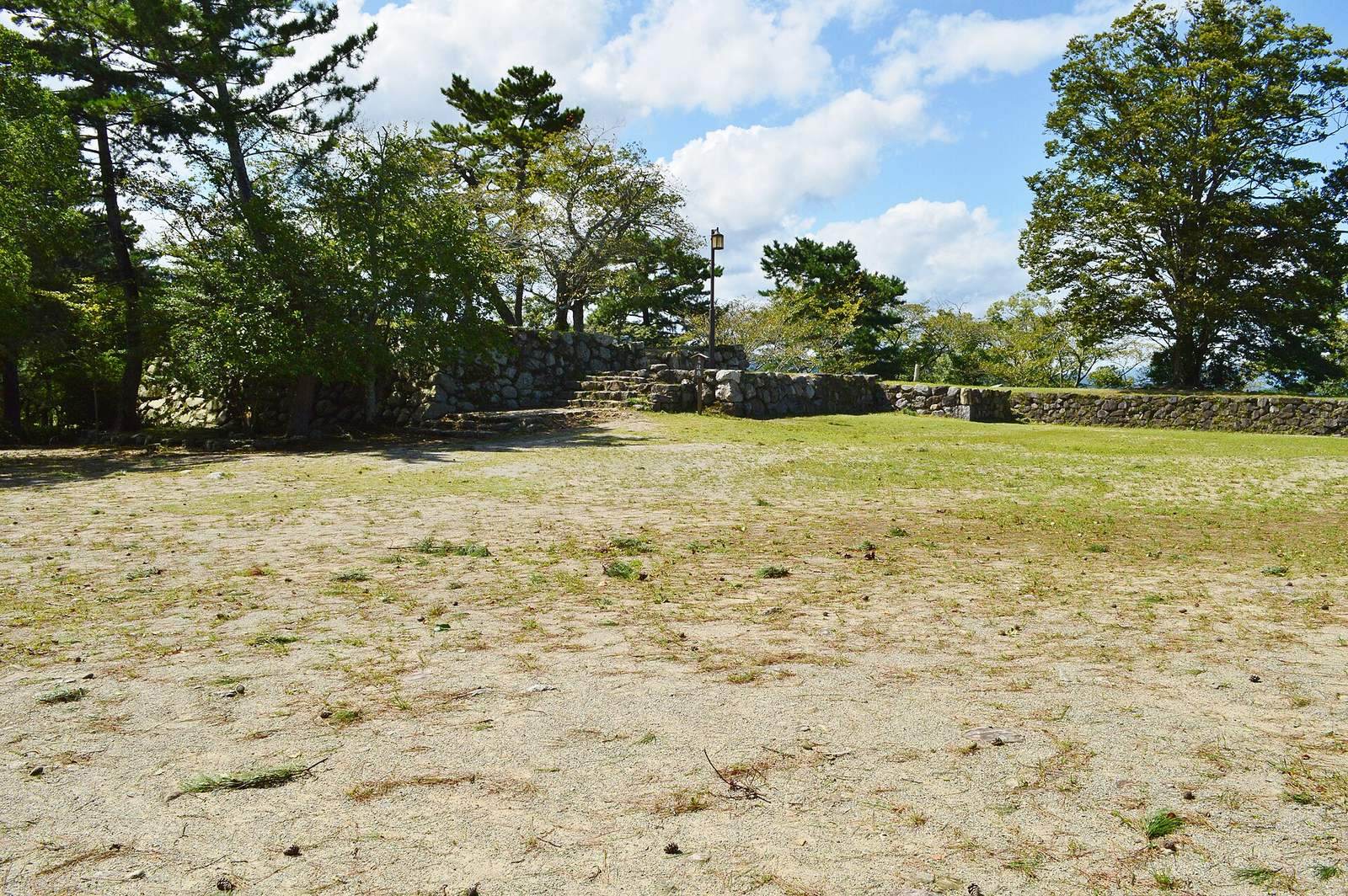
The castle occupied a wedge-shaped hill facing east, with defenses arranged across three levels of terraces. The central area measured roughly 200 metres square. The central bailey stood at the hilltop, the second bailey lay to its south, and the lowest defensive level was divided into smaller enclosures. The main gate was on the east and the rear gate on the south. Two moats surrounded the fortifications, including a deep moat through paddy fields and a water-filled moat; the river to the north provided a natural defensive boundary.
Central bailey
Keep and towers
The central bailey was square. Its five-storey keep, with three tiers of roofs and gold roof tiles, stood on the western side, while a watchtower occupied the eastern side. A larger watchtower in the middle enclosure overlooked the lower defenses.
Stone walls
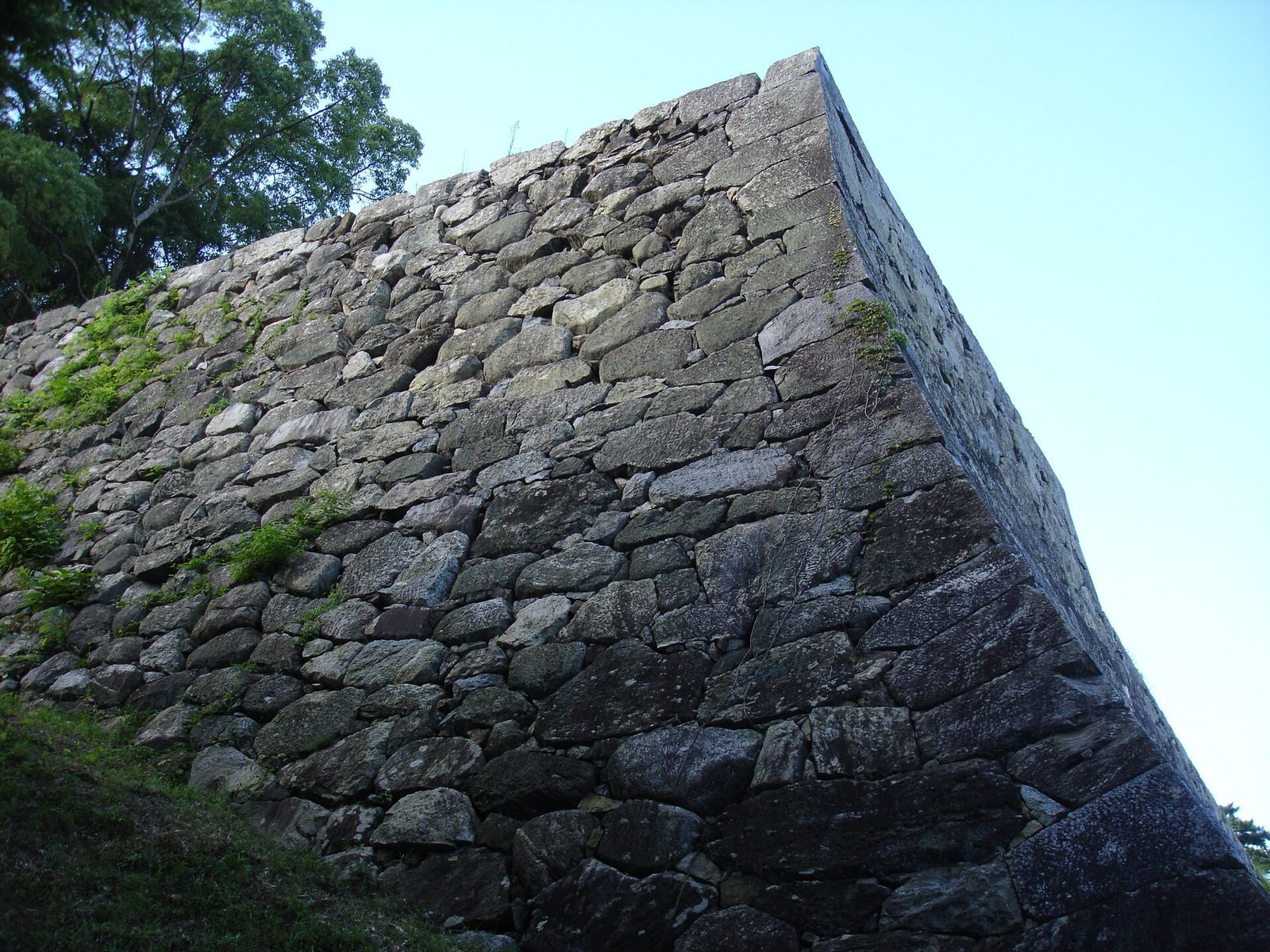
Stone walls survive across the enclosures. Most were built from rough, uncut stones, while corners used carefully cut and fitted blocks, including stones laid in alternating long and short orientations. Much of the stone came from nearby riverbeds. Lids from stone coffins in an ancient burial mound were used at the keep platform. Ujisato had taken part in the construction of Azuchi Castle, an important development in Japanese castle building, and methods associated with that project were used at Matsusaka. Repairs revealed that some stones in the second bailey bear chisel marks unlike those from Ujisato’s building phase, while much of the third bailey’s rough-stone masonry dates to the Kishu-Tokugawa period.
Present-day grounds
The castle is now a park, with its stone walls and other ruins as its principal remains. A literary monument in the second bailey commemorates writer Motojirō Kajii and his short story In a Town with a Castle; it was erected in August 1974. The third-bailey site has been developed for public and educational uses, including a city hospital and schools. The castle grounds and their immediate surroundings also include the city hall, a local history museum, and the Motoori Norinaga Memorial Hall.