Nobono Ōtsuka Kofun: A Keyhole-Shaped Burial Mound in Japan
Site at a Glance
- Rating
- 4.3
- Popularity
- Low
- Country
- Japan
- Primary era
- Classical
- External website
- Open
- Eras represented
- Classical
- Civilizations
- Yamato
- Site type
- Burial
- Remains
- Burial Mound
On this page9 sections
History
Origins in the Middle Kofun period
Nobono Ōtsuka Kofun is a monumental burial mound in Kameyama, Mie, Japan, built in the late fourth century during the transition into the Middle Kofun period. It forms part of the Nobono Kofun Group, which contains more than ten tombs in northern Mie Prefecture. The mound is approximately 90 metres long, making it the largest kofun in the northern Ise region. Together with the approximately 60-metre-long Nagoshi Kofun, it represents the earliest known construction of keyhole-shaped tombs in the Suzuka River basin.
A kofun is a Japanese burial mound, especially one built between about the third and seventh centuries. Its keyhole-shaped plan combines a circular rear mound with a projecting front section. Nobono Ōtsuka Kofun represents a change from the early Kofun-period form, sometimes described as mirror-handle-shaped, toward the developing designs of the Middle Kofun period. Analysis of haniwa collected from the mound also places its construction in the latter half of the fourth century.
Yamatotakeru and the imperial mausoleum tradition
The identity of the person buried in Nobono Ōtsuka Kofun is archaeologically unknown. The Imperial Household Agency designates it as Nobono Grave, identified with the tomb of Yamatotakeru, a legendary prince and heroic warrior presented in early Japanese tradition as a son of Emperor Keiko. This identification rests on traditions preserved in the Chronicles of Japan and the Records of Ancient Matters.
According to these traditions, Yamatotakeru died at Nobono and was buried there by imperial order. The accounts further say that he became a white bird and flew to two other places, where additional tombs were constructed. Together, the three monuments were called the White Bird Tombs and were associated with his clothing and headgear. The Records of Ancient Matters likewise describes a tomb built at Nobono by his wife and children after his death.
Yamatotakeru is generally understood as a legendary figure whose stories bring together traditions from different regions. One interpretation proposes that the mound may have held a royal figure involved in the Yamato court’s eastward expansion, later becoming one of the models for the Yamatotakeru legend. Another theory links the designation of these royal tombs to the compilation of the early chronicles and to the creation of tomb guardianship during the reign of Emperor Jitō, a ruler of the late seventh century.
Imperial administration and medieval observance
The ninth-century Engishiki lists Nobono Grave in Suzuka District of Ise Province. It assigns the tomb a precinct measuring two cho from east to west and two cho from north to south, and provides three households to guard it. The classification as a remote tomb identifies it as the only imperial or royal tomb of that category in Ise Province.
A record from 702 states that an envoy was sent to perform rites at Yamatotakeru’s tomb after a disturbance shook it, interpreted either as lightning or an earthquake. Regulations from the early eighth century also mention three households assigned to tomb guarding in Ise Province. These arrangements show that the grave was then administered by the office responsible for imperial mausolea. Its management and ritual observance continued until at least the first half of the tenth century.
Early-modern debate and modern designation
The mound was formerly called Chojizuka, a name associated with the resemblance of its keyhole-shaped outline to a sake flask. Early-modern studies, including a 1788 examination of the Nobono mausoleum, preserved drawings and descriptions of Chojizuka. During the early modern period, debate over Yamatotakeru’s tomb focused on three principal candidates: the White Bird Tomb, Takebizuka, and Futagozuka. The shogunate appears to have favoured the White Bird Tomb, while the Takebizuka interpretation developed between 1716 and 1735 and the Futagozuka interpretation gained support during the Meiji period.
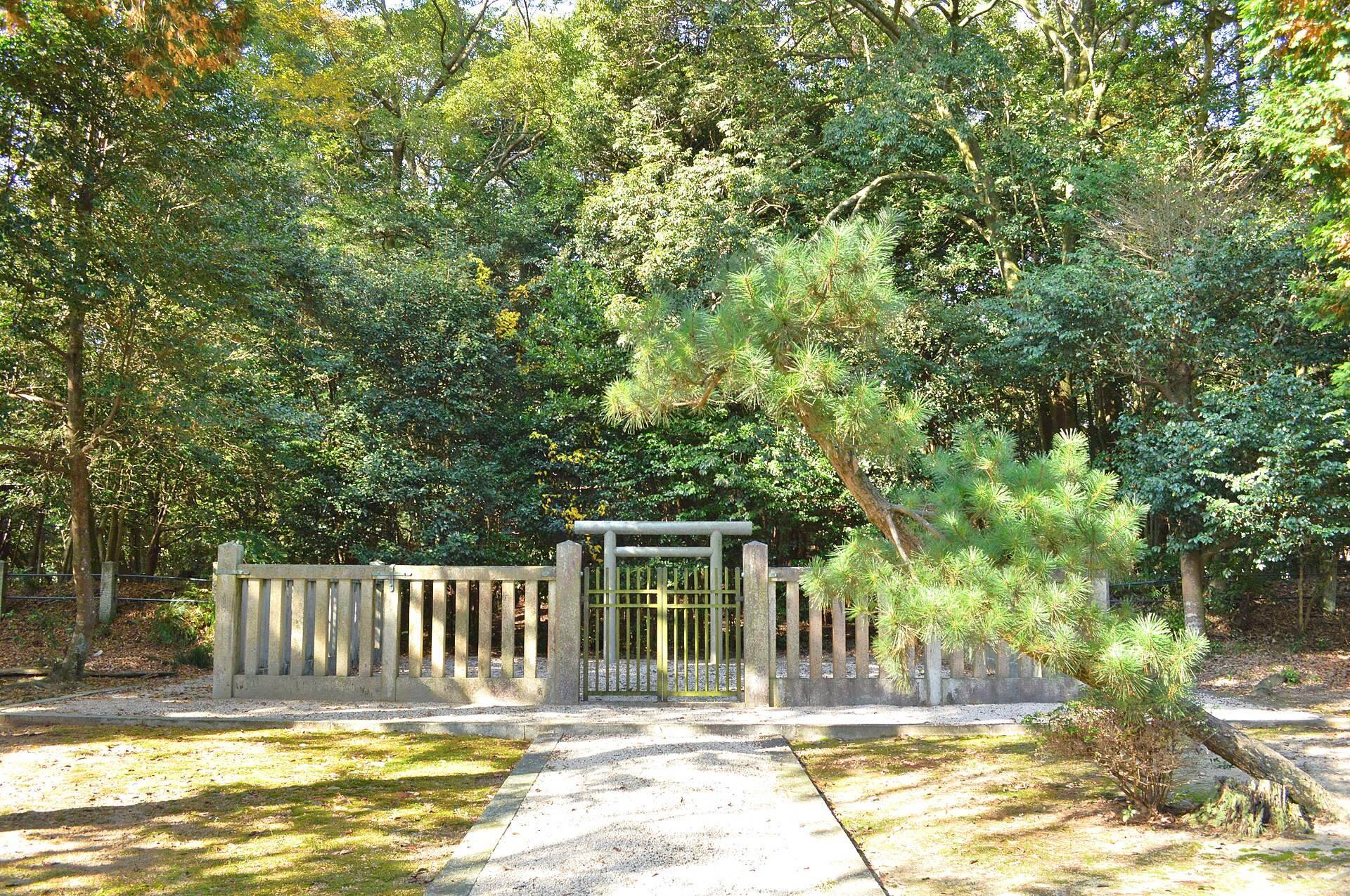
In 1871, the Kobe and Kameyama domains submitted different candidates to the government. The Ministry of Religion selected the White Bird Tomb in 1876, but the Imperial Household Ministry designated Chojizuka as Yamatotakeru’s tomb in 1879. The mound’s exceptional size in the northern Ise region appears to have influenced that decision. Between 1880 and 1885, the ministry established the tomb precinct and repaired its surrounding embankment. The site has remained under Imperial Household Agency management.
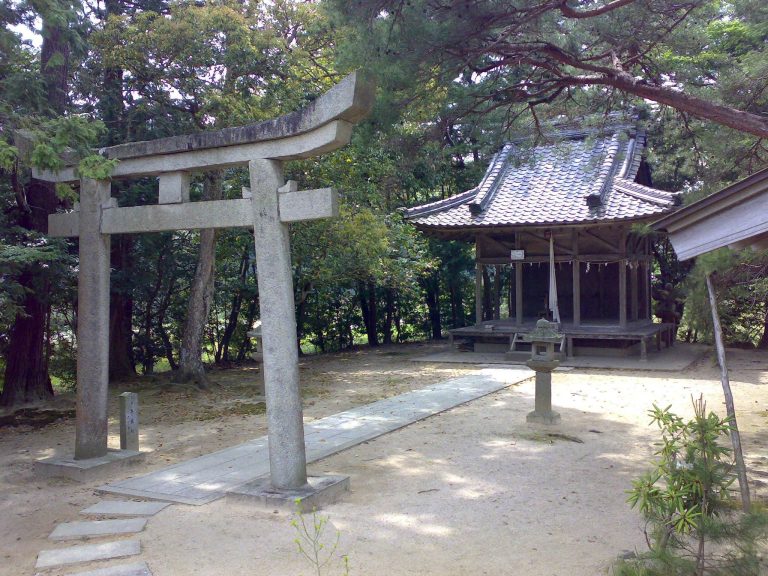
Nobono Shrine, dedicated to Yamatotakeru, was founded beside the kofun in 1895 after local residents had planned a shrine at the site in 1883. A survey by the Imperial Household Forestry Bureau followed in 1929. In fiscal year 2013, the Imperial Household Agency’s Archives and Mausolea Department conducted a topographic survey of the mound and trial excavations at surrounding tombs before site-improvement work. Representatives of sixteen archaeological and historical societies carried out an on-site investigation on 9 January 2020.
The area was also later associated with the establishment of the provincial government of Ise during the Nara period, at the Chojayashiki remains in present-day Suzuka.
Remains
The keyhole-shaped mound
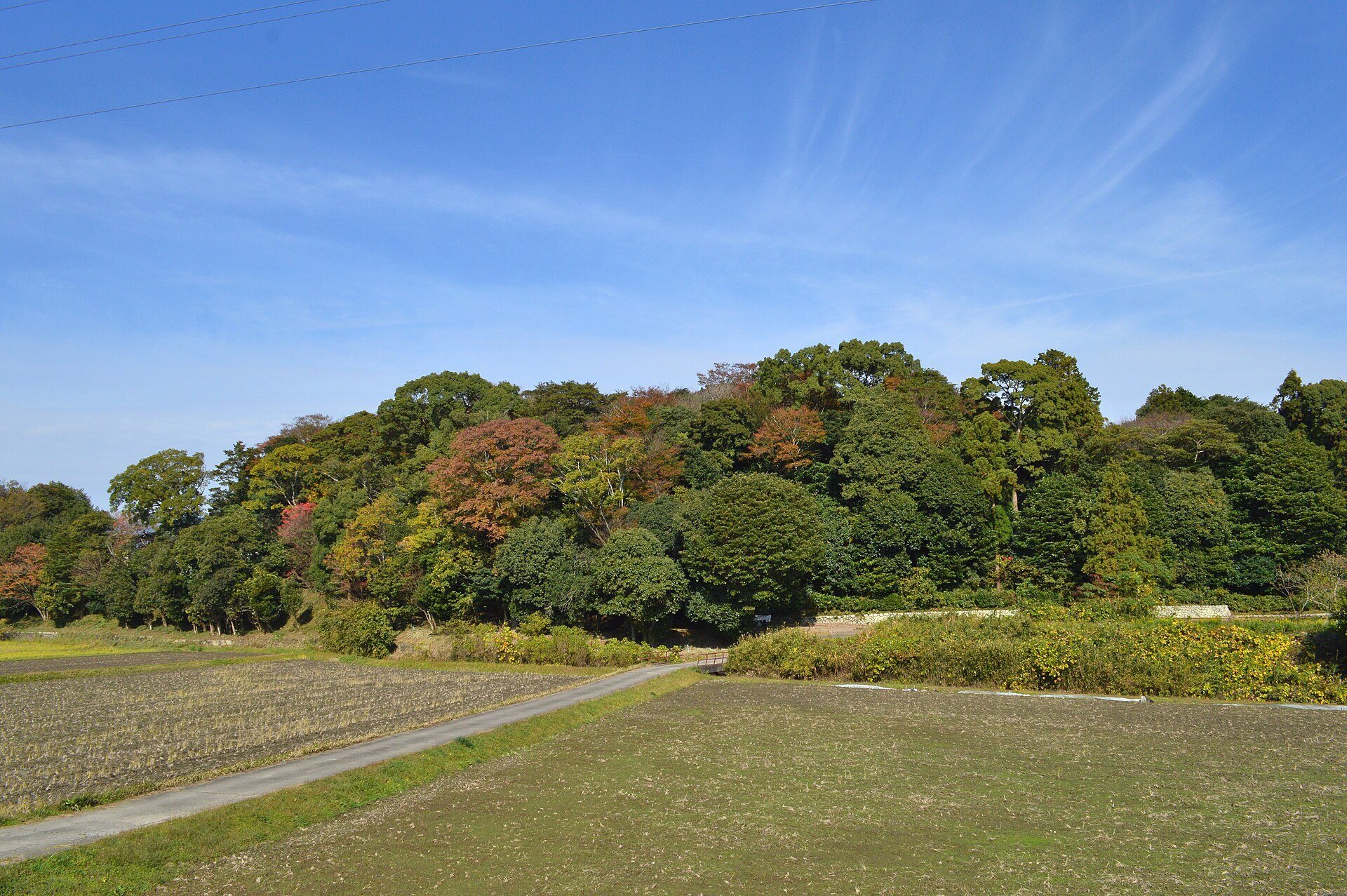
Nobono Ōtsuka Kofun stands at the western edge of a plateau on the north bank east of the meeting point of the Miegawa and Anraku Rivers, tributaries of the Suzuka River. Its projecting front section points southeast. The mound consists of a circular rear section and a forward projection, forming the keyhole plan associated with many large Kofun-period tombs.
The rear circular section measures approximately 54 metres across and rises about 8.5 metres. Its form appears to comprise two or three stepped tiers. The front section is approximately 40 metres long, 40 metres wide, and 5.5 metres high, with evidence for a single construction tier. An outer ditch and embankment surround the mound, although the features visible today were newly established in 1880, leaving the original arrangement open to reconstruction through archaeological study.
The burial arrangement remains uncertain. Tradition holds that, before the mound received its mausoleum designation, a large robbers’ pit occupied the summit and was spacious enough for several people to enter. This has prompted the possibility that the original burial used a vertical stone chamber, a shaft-like facility cut into or beneath the mound.
Haniwa and archaeological evidence
Several dozen haniwa fragments have been collected from the mound. Haniwa are clay funerary objects placed on or around burial mounds. The assemblage includes finned cylindrical haniwa, among them examples with morning-glory-shaped rims, as well as equipment haniwa representing implements or other objects. Finned cylindrical haniwa are a specialized form with projecting side elements.
The development of this finned cylindrical type has been used to propose a movement of techniques and forms from the Iga region through northern Ise and western Mino toward Owari. A parallel route has also been proposed from Iga through central Ise. Some of the haniwa, including equipment haniwa once kept at Nobono Shrine, are now deposited with the Kameyama History Museum.
The surrounding Nobono tombs
More than ten additional circular and square kofun are distributed around the main mound. The Imperial Household Agency officially treats fourteen of these as satellite tombs of Nobono Grave, including five detached examples and nine within the designated precinct. Archaeological interpretation generally places most of them in the Late Kofun period, later than the main mound, rather than treating them as contemporaneous satellite tombs.
Trial excavations in fiscal year 2011 identified Tomb 15, corresponding to detached satellite tomb Ha, and Tomb 16, corresponding to detached satellite tomb Ro. Both are circular tombs approximately 18 metres in diameter. Two further small circular-tomb remains were identified nearby, indicating that the Nobono Kofun Group may have contained more tombs than previously recognized. Excavations in fiscal year 2013 examined seven satellite tombs within the precinct and two detached examples, and confirmed a horizontal stone burial chamber in in-precinct satellite tomb Ri. A horizontal chamber is entered from the side through a passage and is characteristic of many later kofun.