Hakumai Castle: A Kitabatake Mountain Fortification in Japan


Site at a Glance
- Rating
- 4.6
- Popularity
- Very Low
- Country
- Japan
- Primary era
- Medieval
- Eras represented
- Medieval
- Civilizations
- Ashikaga shogunate
- Site type
- Military
- Remains
- Castle
On this page10 sections
History
Hakumai Castle is a medieval mountain fortification in Japan, located in present-day Matsusaka, Mie. Built in the former Ise Province by or for the Kitabatake clan, it formed the southern part of the stronghold historically known as Azaka Castle, whose northern fortification was later called Shiinogi Castle. The castle’s origins are traditionally associated with Kitabatake Chikafusa or Kitabatake Mitsumasa, and its earliest documentary reference dates to 1352.
Kitabatake stronghold in the Nanboku-chō period
The Kitabatake clan had developed from provincial governors of Ise into regional daimyo, or warrior lords, during the Sengoku period of intense competition among military families. Its earlier history was linked to the Nanboku-chō period, the era from 1336 to 1392 when rival Southern and Northern imperial courts contested authority. One tradition places the castle’s establishment among the fortifications built after Chikafusa entered Ise in 1335 with his sons Akiie, Akinobu, and Akiyoshi.
Historical records use names corresponding to both Asaka Castle and Azaka Castle. Over time, the two principal fortified areas became known as Hakumai Castle in the south and Shiinogi Castle in the north. In 1478, Kitabatake Norichika supported the founding of Jōganji Temple at the foot of Mount Masugata as the Kitabatake family’s mortuary temple. The temple served as the family’s residential base, while the mountain castle provided its fortified stronghold, creating a root-and-branch arrangement that joined a settlement below with a defensive site above.
The siege of 1415
In spring 1415, Kitabatake Mitsumasa raised an army at the castle after Emperor Shōkō’s accession was treated as a violation of an agreement calling for alternating succession between rival imperial lines. Warriors from former Southern Court territories in Yamato, Kii, and Kawachi supported him. The Ashikaga shogunate, Japan’s medieval military government, responded with an army commanded by Isshiki Yoshitsura and supported by the Toki and Kyogoku clans.
The Kitabatake forces were besieged, and the castle fell on June 21, 1415. The siege is associated with the Hakumai, or “white rice,” tradition. After the besieging army cut the defenders’ supply routes and the water supply was nearly exhausted, the defenders allegedly poured white rice over a horse’s back to suggest that water remained plentiful. The besiegers supposedly abandoned their effort to cut the water supply and lifted the siege, although the castle was ultimately lost. Mitsumasa later reached a settlement with the shogunate through mediation. The story appears in the early Edo-period war chronicle Ounki, whose military-narrative style makes some details difficult to establish as certain history.
Renewed military importance and abandonment
Direct records concerning the castle resume in 1565 and 1580, when Omiya Nyūdō Ganrinsai is identified as its lord. In 1567, the castle repelled repeated attacks by Takigawa Kazumasu, a retainer of Oda Nobunaga, and became known for its strength.
In September 1569, Nobunaga’s army besieged the castle. Ganrinsai rejected a demand to surrender, but a stratagem by Kinoshita Tokichirō, the future Toyotomi Hideyoshi, induced the garrison to open the castle. It was then abandoned. The attack formed a preliminary operation for the Battle of Okawachijō and gave Hideyoshi an opportunity to gain a military achievement before he had won major distinction. During the fighting, a warrior of the Omiya family shot at him with a powerful bow. Hideyoshi is said to have received the only combat wound of his life, described as an injury to his left armpit or left thigh.
Preservation and interpretation
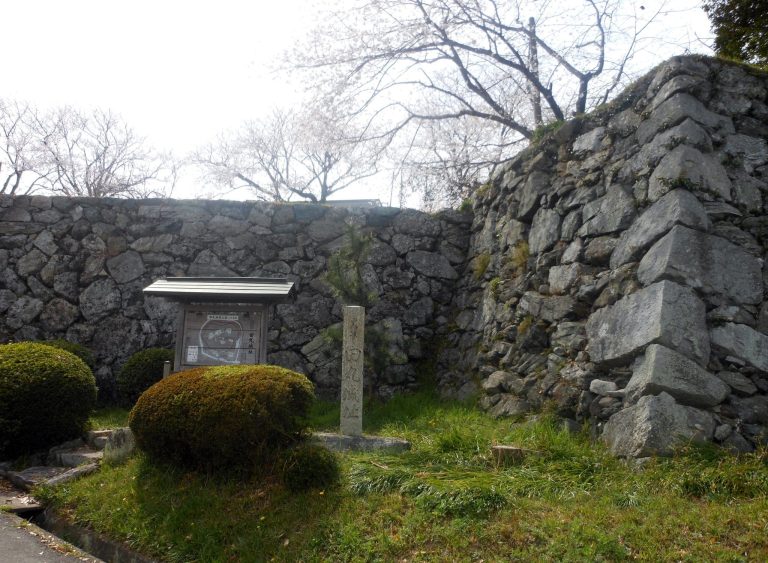
The ruins of Hakumai Castle, together with Taka Castle and Karatachi Castle, became a National Historic Site of Japan on April 7, 1982. Residents of Oazaka began continuous grass cutting and maintenance in the year before the designation. Since 2017, the Matsusaka Yamashiro Association has conducted smoke-signal experiments at the ruins to examine the visible range of signals from the site.
Remains
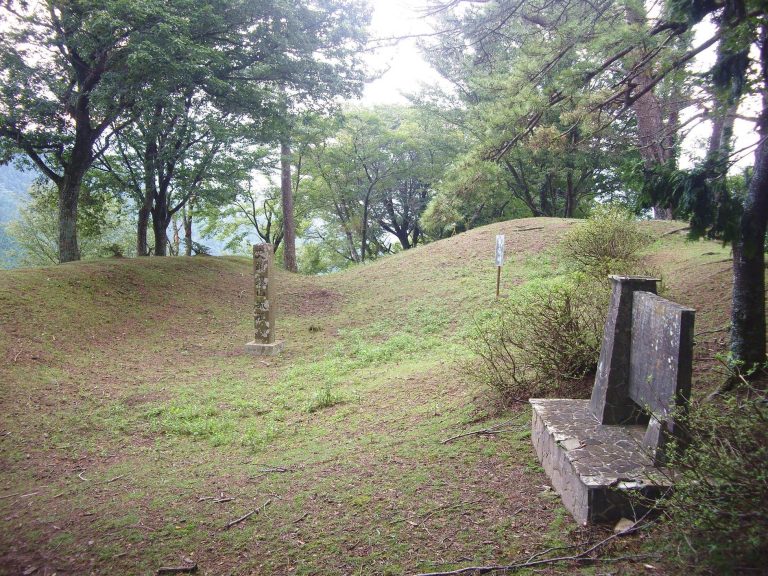
The castle occupies a mountain summit about 312 meters above sea level west of Oazaka. The wider ruins extend approximately 180 meters from east to west and 330 meters from north to south, although another historical measurement gives a smaller area of about 40 to 70 meters east to west by 150 meters north to south. The surviving layout consists of two fortified plateaus about 250 meters apart. Sections of dry moats, defensive ditches without standing water, and earthen ramparts, or raised banks of compacted earth, remain among levelled castle features. A stone monument stands in the southern enclosure.
Southern and northern fortified plateaus
Hakumai Castle
The southern Hakumai enclosure covers approximately 25 by 30 meters and forms a platform about 12 meters high. Its lower enclosure is trapezoidal, measuring about 45 by 60 meters, while the upper platform is a flat oval approximately 20 by 35 meters. Small platforms occupy its four corners. Hakumai stands at a higher elevation than Shiinogi and is visible from Matsusaka city.
Dry moats and small platforms were arranged along the ridges east, north, and west of Hakumai Castle. Two parallel dry moats follow the northwestern ridge. The summit of Mount Masugata included a dry moat, an open ditch, and a platform for signal fires, linking the mountain’s defensive landscape with the castle complex.
Shiinogi Castle
The northern Shiinogi enclosure is larger, covering about 70 by 70 meters, and appears to be later than Hakumai Castle. Its complex arrangement of dry moats and earthen ramparts suggests that it was the principal fortification. Two narrow plateaus form its core, with moats between them and at both ends. Two vertical defensive ditches survive on the lower western slope on the northern side.
Detached fortifications
Taka Castle and Karatachi Castle were detached fortifications near the main site. Taka Castle, apparently built by the Kitabatake vassal clan Omiya, retains an entrance structure and features associated with Sengoku-period castle construction. Karatachi Castle preserves characteristics of the Nanboku-chō period.
The surviving remains give only an indistinct impression of the stronghold’s former appearance. Levelled enclosures, sections of dry moats, earthen ramparts, defensive ditches, and the surviving platforms preserve the main physical evidence of the paired mountain fortifications.