Tsu Kannon Temple: A Shingon Buddhist Head Temple in Japan


Site at a Glance
- Rating
- 4
- Popularity
- Low
- Country
- Japan
- Primary era
- Early Modern
- External website
- Open
- Eras represented
- Early Modern, Modern
- Civilizations
- Tokugawa
- Site type
- Religious
- Remains
- Temple
On this page17 sections
History
Tsu Kannon Temple is a Shingon Buddhist temple in Tsu, Japan, formally known as Enichizan Kannonji Daihoin. It belongs to the Daigo-ha branch of Shingon Buddhism, an esoteric Japanese Buddhist tradition, and holds the status of a special head temple. Its principal image is the Holy Kannon Bodhisattva, a form of Avalokiteshvara associated with compassion. Tsu Kannon is traditionally counted among Japan’s Three Great Kannon temples, alongside Asakusa Kannon and Osu Kannon.
Foundation and medieval development
Temple tradition places the foundation of Kannonji in 709. In that year, a standing image of Holy Kannon was said to have been caught in a fisherman’s net at Ako-ga-ura in Ise and then enshrined as the temple’s principal image. The history of the institution between this foundation tradition and the medieval period is unclear, possibly because repeated disasters destroyed earlier records.
The earliest clear surviving record dates from 1430. Acting under an imperial order, Ashikaga Yoshinori, the sixth shogun of the Ashikaga shogunate, established a three-story pagoda and Eon-in within the Kannonji grounds and granted the temple land. Kannonji then stood at Yanagiyama, in the area of present-day Tsu. A directive issued in 1455 by Nagano Yamato-no-kami Noritaka placed the temple under special protection during the development of Tsu. Medieval references name Kannonji, Eon-in, Fudo-in, the three-story pagoda, and Rokudai-in, the institution later known as Daihoin.
Rokudai-in was founded at Kubota in present-day Tsu in 1444 under the name Horaisan Rokudai-in. Its founder, Choen, was a senior Buddhist monk and an adopted heir of the Tobojo family. He received an imperial prayer mandate from Emperor Go-Hanazono, reflecting the temple’s connection with the imperial court. Another adopted heir, Chokei, received a handwritten imperial plaque from Emperor Go-Nara in 1519. The abbots of Rokudai-in thereafter continued hereditary adopted-heir relationships with the Tobojo family, while the temple supplied prayer texts and tea to the court.
Documents from Emperors Go-Kashiwabara and Go-Nara reached the temple in 1521 and 1534. Emperor Go-Nara also granted a document concerning the abbot’s titles and ecclesiastical ranks. These court relationships accompanied the growth of Rokudai-in into a substantial religious institution. The temple was destroyed by fire in 1565 during the conflict between the Oda and Kitabatake families.
Religious activity and relocation
Around 1490, Shinsei, founder of the Tendai Shinsei tradition and of Sairai-ji in Tsu, stayed at Fudo-in while conducting religious activities in Ise. He encouraged people to recite the nenbutsu, the devotional recitation of Amida Buddha’s name, at the Kannon Hall. A wooden image of Shinsei was later placed beside the principal image of Fudo Myoo, a protective Buddhist deity, in Fudo-in’s main hall. The hall was eventually destroyed, but the custom of Sairai-ji’s incoming abbot entering Fudo-in before proceeding to Sairai-ji continued until recent times.
A major earthquake struck the Tsu area in 1498, when seawater submerged the entire region. Kannonji and nearby houses were subsequently moved from Yanagiyama to the present Daimon district. This relocation placed the temple within the developing urban center that grew around its grounds.
In 1568, Oda Nobukane, the brother of Oda Nobunaga and later lord of Tsu Castle, exchanged an oath document at Kannonji at the request of Hosono Fujinori, lord of Tsu Castle. After Nobukane became lord of the castle, he rebuilt the temple complex in 1580. The abandoned Rokudai-in and three other temples were moved into the Kannonji grounds and re-established alongside Fudo-in and Eon-in.
The Kō Amida and the early modern temple
During this re-establishment, a seated Amida Buddha from Kō in present-day Suzuka and its two attendant figures were transferred to Rokudai-in. The resulting triad became known as the Kō Amida. Amida is the Buddha associated with the Pure Land tradition. At Tsu Kannon, the triad was revered as the original Buddhist manifestation of Amaterasu, the principal sun kami of the imperial and Ise religious tradition. This association expressed Buddhist-Shinto syncretism, the historical practice of understanding Buddhist deities and Shinto kami as related manifestations.
The Kō Amida became especially well known during the Edo period, when it was taken to Edo for traveling public displays. As pilgrimages to Ise increased, travelers commonly stopped at Kannonji. A saying held that visiting Ise without visiting Tsu made the pilgrimage incomplete. Pilgrims forced to end their journey early reportedly worshipped the Kō Amida and faced toward Ise before returning home.
The ninth abbot of Daihoin, Chogyo, was a noted calligrapher who had taught Toyotomi Hideyoshi handwriting and learning. Hideyoshi rewarded him with a red-seal document granting Rokudai-in 100 koku of temple land. A koku was a historical measure of rice-based land revenue, so the grant represented substantial economic support. Because Chogyo’s courtesy name was Daihobo, Rokudai-in thereafter became known as Daihoin.
In 1600, forces supporting Ishida Mitsunari attacked Tsu Castle, and the entire temple complex burned. Its halls and monastic buildings were destroyed. When Todo Takatora became lord of Tsu in 1608 after his transfer from Iyo, he strongly supported reconstruction. Kannonji occupied the northeast, or “demon gate,” direction in relation to Tsu Castle, which was considered vulnerable. The Kannon Hall was rebuilt in 1613, followed by the bell and belfry in 1617 and the Niomon gate in 1629. Prayers were offered for the recovery of Tokugawa Iemitsu when the gate was completed.
The Todo family also donated an Amida Hall, a goma hall for esoteric Buddhist fire rituals, other buildings, temple land, and ritual implements. Daihoin retained its 100-koku grant under the Tokugawa shogunate. Tokugawa Hidetada and Tokugawa Iemitsu confirmed the grant, and successive shoguns continued it until the shogunate ended. Kannonji later received 50 koku in prayer support from the lord of Tsu and 10 koku from the lord of Hisai. Daihoin therefore remained the senior temple within the complex, distinct from Kannonji’s six subsidiary temples.
Civic life, destruction, and reconstruction
During the Edo period, Kannonji served as a cultural and civic center as well as a place of worship. A large poetry gathering for Motoori Norinaga, an eighteenth-century scholar of classical Japanese learning, took place at Fudo-in in 1790. In 1853, Hongan-in hosted a lecture meeting on Kyoto Ishimon Shingaku. The adjoining Daimon temple town also contained Shubunkan, the first school in the Tsu castle town intended for ordinary townspeople.
An illustrated guide published in 1797 shows the Kannonji grounds together with the Oni-oshi festival held at Setsubun. By the end of the Edo period, the complex included Kannon Hall, Daihoin, Eon-in, Fudo-in, Chion-ji, Daigan-ji, Senno-in, the belfry, and Hongan-in. The subsidiary institutions had been founded or moved into the grounds at different times between 1444 and about 1618.
After the Meiji Restoration, Kannonji lost the protection formerly provided by the shogunate and the domain lords and returned to its role as a popular place of prayer. As Tsu expanded, its grounds also became part of public and civic life. They accommodated a branch of Yosei Elementary School, an ordinary elementary school, the Tsu administrative district office, the Tsu Chamber of Commerce, a bank assembly hall, and the Akebonoza entertainment theater.
On the night of July 28, 1945, incendiary bombs dropped by American forces caused the temple buildings to burn along with most of Tsu’s urban buildings. Seven subsidiary temples and 41 buildings were destroyed, including the former National Treasure Kannonji main hall and Daihoin main hall. The burned area covered approximately 900 tsubo. In March 1949, the main hall of Anyo-ji in Kubota, Kawage District, was moved to the site and opened as a temporary Kannon Hall.
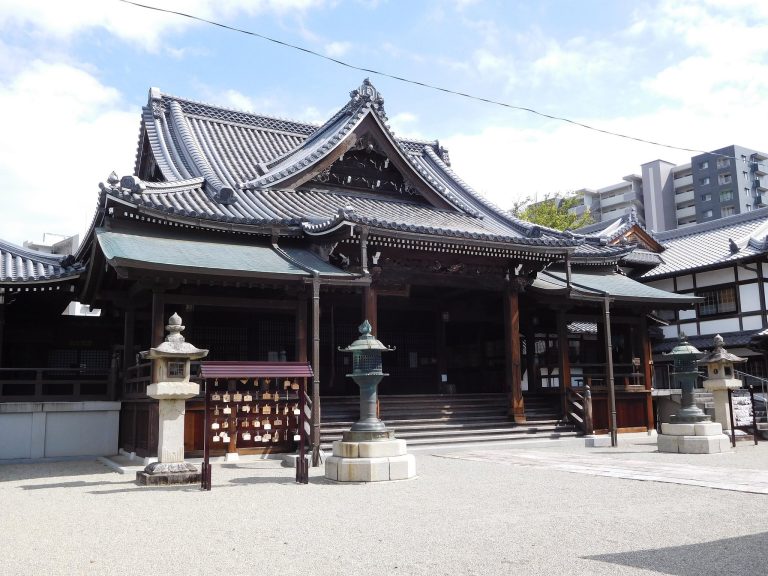
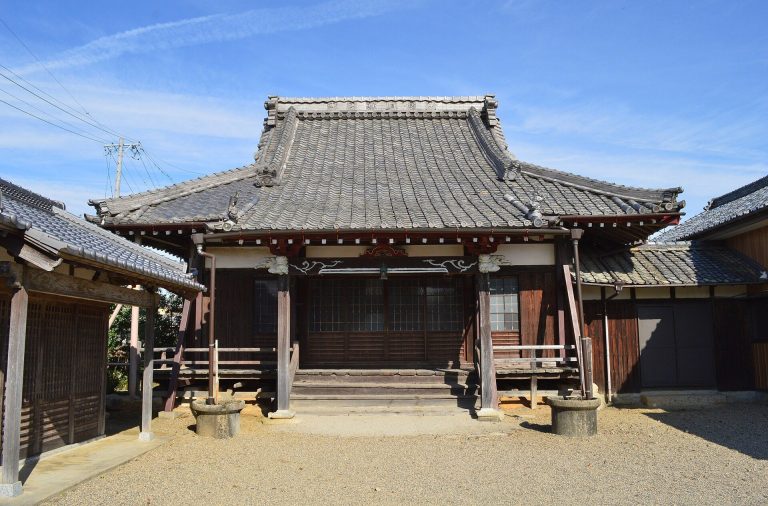
A replacement Kannon Hall, modeled on the former war-destroyed building, was completed in 1968 under the direction of Murata Jiro, a modern architectural historian. A full reconstruction program began in 1980. The Niomon was completed that year, followed by the belfry in 1984, the ablution pavilion in 1986, the collection storehouse in 1989, and the goma hall in 1994. The Tsu Kannon museum and a wooden five-story pagoda were completed in 2001. The pagoda was the first wooden five-story pagoda built in Mie Prefecture.
The Kannon Hall was registered as a Registered Tangible Cultural Property on June 29, 2022, following a registration recommendation issued on March 18 of the same year. Tsu Kannon is also stop 67 on the Mie Shikoku 88-temple pilgrimage, stop 14 on the Ise Saigoku 33 Kannon pilgrimage, stop 15 on the Shinsei Shonin 25 Sacred Sites pilgrimage, and the first stop on the Ise Tsu Seven Lucky Gods pilgrimage.
The Oni-oshi tradition
The Oni-oshi Setsubun ceremony preserves elements of an older rite. Its legend says that demons tried to seize the Kannon image when it was caught in the fishing net. Townsmen dressed as warriors drove them away with swords and other weapons, and successful expulsion was believed to bring a good fishing year.
The event became so violent that people were killed or injured. It was temporarily suspended toward the end of the Edo period and abolished in 1871. Bean throwing associated with Oni-oshi resumed in the 1950s, and the wider event was revived in 1997. Bamboo representing a sacred sword is now used in the ceremony.
Remains
The present Tsu Kannon complex combines reconstructed buildings with religious objects and artworks associated with the temple’s long history. Its architectural composition includes the Kannon Hall, the senior Daihoin institution, the Niomon entrance gate, the belfry, the ablution pavilion, the goma hall, the collection storehouse, the museum, and a wooden five-story pagoda. The site’s historical form also included Eon-in, Fudo-in, Chion-ji, Daigan-ji, Senno-in, and Hongan-in as temples founded or relocated within the larger grounds.
Principal buildings
Kannon Hall
The Kannon Hall houses the temple’s principal sacred focus, the standing Holy Kannon Bodhisattva. The present building was completed in 1968 as a reproduction of the design of the former Kannonji main hall, which was destroyed in the 1945 air raid. It therefore preserves the architectural appearance of the earlier hall while belonging to the postwar reconstruction of the complex.
Niomon and belfry
The Niomon, a gate guarded by two Buddhist guardian figures, was completed in 1980. The belfry, a structure for housing the temple bell, was completed in 1984. Both belong to the reconstruction program that reshaped the complex after the wartime destruction.
Other reconstructed facilities
An ablution pavilion was completed in 1986, a collection storehouse in 1989, and a goma hall in 1994. The museum and wooden five-story pagoda were completed in 2001. The pagoda introduced a five-story wooden tower to the reconstructed site and was the first building of that type in Mie Prefecture.
Associated temples and sacred images
Daihoin
Daihoin developed from Rokudai-in, which was founded at Kubota in 1444 and later moved into the Kannonji grounds. It functioned as the senior temple within the complex and occupied a distinct institutional position outside Kannonji’s six subsidiary temples. Its former main hall was destroyed in the 1945 fire.
Fudo-in
Fudo-in was associated with a main hall whose principal image was Fudo Myoo. A wooden image of Shinsei stood on a side altar beside it. The hall was later destroyed, but its connection with Shinsei’s religious activity remains part of the temple’s history.
The Kō Amida
The Kō Amida consists of a seated Amida Buddha transferred from Kō in Suzuka and two attendant figures. The triad is treated as a secret image, meaning that it is not continuously open for viewing, but it is displayed on occasions that include the eighteenth day of each month. Its association with Amaterasu expresses the complex’s Buddhist-Shinto religious tradition.
Artistic and documentary collections
The temple’s associated collection includes Buddhist paintings, illustrated and calligraphic sutras, and Buddhist sculpture from the Heian, Northern and Southern Courts, Azuchi-Momoyama, and Edo periods. Among the identified works is a late-Heian Thousand-Armed, Thousand-Eyed Dharani Sutra written alternately in gold and silver on dark blue paper, together with its sutra box.
Other works include a Heian-period wooden seated Amida Buddha and a Northern and Southern Courts-period painting of Shaka and the Sixteen Benevolent Deities. Edo-period paintings include a White-Robed Kannon attributed to Kano Tanyu. The manuscripts and paintings use silk or paper supports, with colored decoration, gold, or silver writing where specified.
Daimon temple town
The surrounding Daimon district developed from the settlement in front of the temple into a commercial and entertainment quarter. Its growth was tied to the presence of the temple complex within Tsu and to the civic functions that occupied or adjoined its grounds over time.