Ruins of Saikū: Palace and Administrative Complex of the Saiō


Site at a Glance
- Rating
- 4.1
- Popularity
- Low
- Country
- Japan
- Primary era
- Medieval
- External website
- Open
- Eras represented
- Medieval
- Civilizations
- Japanese
- Site type
- City
On this page10 sections
History
The Ruins of Saikū in Japan preserve a palace and administrative complex established during the Nara period for a Saiō, an unmarried imperial princess appointed to serve at Ise Shrine on behalf of the emperor. Located about 10 kilometres northwest of Ise Shrine, Saikū developed as the center of the Saiō institution, a major religious and administrative office associated with the imperial court.
Foundation and development
The Nara period, conventionally dated from 710 to 794, was an era of centralized imperial government. Saikū continued to develop into the late Nara and early Heian periods, reaching its greatest extent and influence during the early Heian period after 794. The tenth-century Engishiki, a compilation of court regulations, administrative procedures, and ritual provisions, records that the Saiō’s staff numbered more than 500 people, including approximately 120 officials.
This large staff made Saikū much bigger than most regional government complexes. It is often described as Japan’s second-largest provincial settlement after Dazaifu, the imperial government’s principal administrative and military center in Kyushu. Saikū therefore functioned as a substantial settlement as well as a residence and administrative center for the Saiō and her household.
Destruction and rediscovery
The Saiō system eventually collapsed, and the settlement reverted to a rice-farming village. The precise location of Saikū was then forgotten. During the fourteenth-century Nanboku-chō period, an era of conflict between rival Northern and Southern imperial courts, the site was destroyed.
Saikū was rediscovered in 1970, when foundation work for a housing development uncovered a large horse haniwa, a hollow clay object associated with ancient Japanese burial mounds. Construction stopped, and archaeological excavation confirmed that the area contained the ancient city of Saikū. The site became a National Historic Site in 1979. Excavation has continued annually on a relatively small scale, with particular attention given to the early Heian period, when Saikū was at its largest and most influential. Because the settlement covers a broad area, much of it remains unexcavated, and researchers must compare several generations of building foundations created as the city was repeatedly rebuilt.
The Saikū Historical Museum stands in the area where the site was rediscovered and presents exhibits and films about the Saiō and her life. Saikū is also known as the Bamboo Palace, Saigū, Itsuki no Miya, Iwai no Miya, and Imimiya.
Remains
The settlement occupied the right bank of the Kushida River and its tributary, the Harai River, which flows into Ise Bay. Its planned area extended approximately 2 kilometres from east to west and 700 metres from north to south, covering about 137 hectares. The layout followed Chinese planning traditions and consisted of numerous large building blocks.
Planned blocks and timber buildings
Enclosed building blocks
Each block measured approximately 120 metres in length and was enclosed by high wooden walls. More than 100 buildings of different sizes and functions stood within each block. Some blocks included small wells for drawing water, while others contained shrines or buildings used to store food.
Raised residences
The buildings followed the shinden-zukuri style, an aristocratic residential form based on timber buildings arranged around open spaces and linked by covered passageways. They were rectangular and stood on posts set into the ground, with floors raised as much as 1 metre above ground level. Japanese cypress was joined through interlocking wooden members, allowing the structures to stand without nails. The original buildings have disappeared, but their foundations reveal successive phases of construction and rebuilding.
Excavated evidence and reconstruction
Archaeological finds
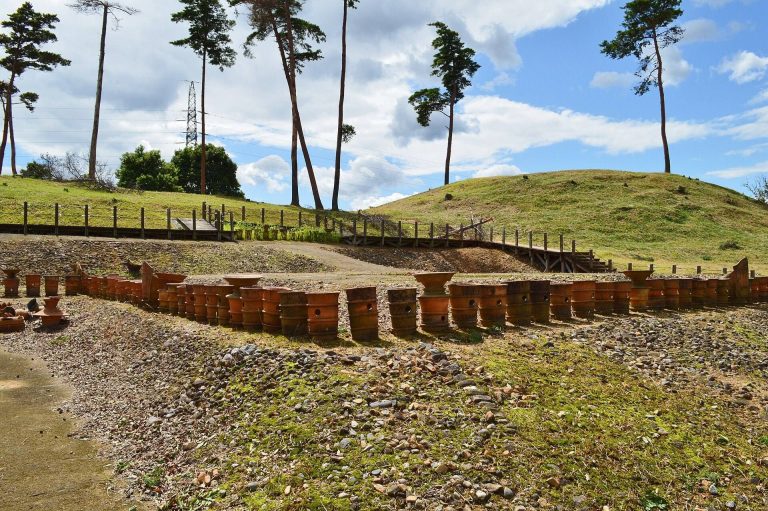
Excavation has exposed the foundations of numerous structures and recovered large quantities of fragments from earthenware vessels, green-glazed pottery, and circular inkstones. Together with the surviving foundations, these finds help clarify the functions and changing arrangement of the settlement.
Itsukinomiya Historical Experience Hall
Beside Saikū Station, the Itsukinomiya Historical Experience Hall presents a reconstructed Heian-period residence. The building is not a restoration of a particular former structure at Saikū. Instead, it is based on existing shinden-zukuri buildings elsewhere in Japan and provides a reconstruction of the architectural form associated with the settlement’s Heian-period phase.