Mariyatsu Castle: A Medieval Hilltop Stronghold in Japan
Site at a Glance
- Popularity
- Medium
- Country
- Japan
- Primary era
- Medieval
- Eras represented
- Medieval
- Civilizations
- Unclassified
- Site type
- Military
- Remains
- Castle
On this page10 sections
History
Mariyatsu Castle is a hilltop stronghold in Japan’s Boso Hills, traditionally dated to 1456 and attributed to Takeda Nobunaga. It became a political and military center of the Kazusa Takeda, a warrior clan whose influence grew across Kazusa, the historical province on the Boso Peninsula.
Foundation and rise of the Kazusa Takeda
Kazusa was then regarded as being under the control of Uesugi Masanori. Ashikaga Shigeuji, a prince associated with the Koga Kubo, a regional Ashikaga office, opposed the Uesugi and directed Nobunaga to enter the province. Nobunaga established Mariyatsu and Chonan castles as footholds, from which the Kazusa Takeda extended their power.
The clan developed a chain of subsidiary castles to defend its territory and control routes through the region. Shiizu and Saze guarded against incursions from Shimosa, while Nakao, Sasago, and Kururi helped control the Obitsu River basin. Sanuki and Tsukuriumi faced the Satomi to the south.
Nobunaga’s grandson, Takeda Nobuoki, made Mariyatsu his base and adopted the surname Mariyatsu. The clan reached its height under Nobuoki and the succeeding leaders Nobukatsu and Nobukiyo. During Nobukiyo’s leadership, the Mariyatsu captured Oyumi Castle from the Hara clan and received Ashikaga Yoshiaki, associated with the Oyumi Kubo, another regional Ashikaga office. Nobukiyo styled himself the deputy of Boso, asserting authority across the region.
Succession conflict and loss of power
After Nobukiyo’s death, his sons Nobutaka and Nobumasa contested leadership. Nobutaka, born to a secondary wife, initially inherited the headship. Nobumasa was born soon afterward to Nobukiyo’s principal wife, and his supporters regarded him as the rightful heir. Backed by Ashikaga Yoshiaki and the influential Mariyatsu clan member Zenpo, Nobumasa’s faction took control of the headship and entered the castle. Nobutaka fled to Shiizu Castle under the protection of Hojo Ujitsuna, then travelled to Kanazawa in Musashi.
In 1538, the Oyumi Kubo faction was defeated at the First Battle of Konodai, and Nobutaka regained leadership of the clan. The internal struggle continued, however. The Mariyatsu came under the power of the Go-Hojo, lost their hold over Kazusa, and shifted their principal base from Mariyatsu Castle to Shiizu Castle. Nobumasa’s continued presence at Mariyatsu and Shiizu’s easier communication with the Hojo have been cited as reasons for the move. Mariyatsu thereafter served as a subsidiary stronghold. The Go-Hojo and the Satomi continued to compete for control of Kazusa.
The castle’s inland position has also been interpreted in light of the Kazusa Takeda’s need, as newcomers, to guard against both outside forces and local lords. Rather than choose a transport junction that an enemy could also exploit, they established their base in defensible terrain from which they could move toward productive river valleys and coordinate with other strongholds.
Abandonment and disputed identification
In the conventional chronology, Toyotomi forces captured the castle during the 1590 Odawara Campaign, after which it was abandoned. Another interpretation places its abandonment around 1552. The castle’s identity is also debated. One view identifies it as a new stronghold established by Nobutaka’s faction during the succession conflict, with nearby Yōgai Castle, closer to the Obitsu River, serving as the earlier Takeda base. In this interpretation, the present castle was built with Hojo support and abandoned when Nobutaka went into exile.
Remains
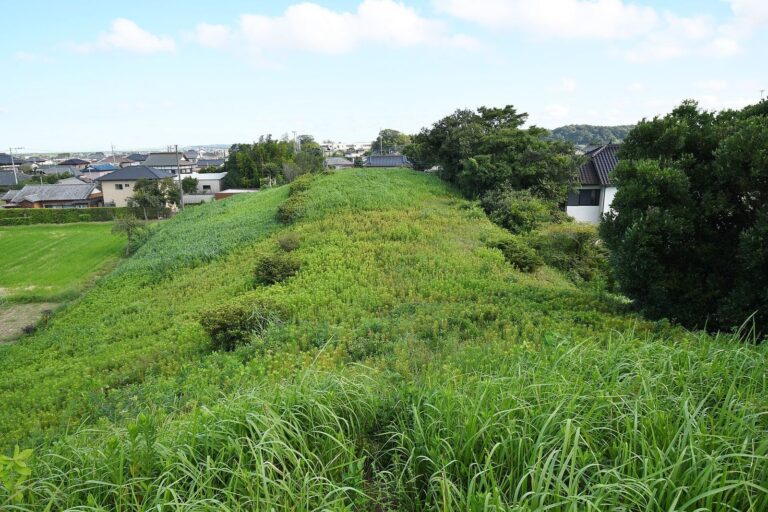
The castle occupies a ridge in the Boso Hills at an elevation of 161 metres, above the surrounding peaks. It lies in the upper Takeda River valley, a tributary of the Obitsu, between the Obitsu and Yoro river basins. The site is about 3 kilometres from the Obitsu and 4.4 kilometres from the Yoro; Chonan Castle is about 12 kilometres away. Its irregular plan extends roughly 400 metres east to west and 700 metres north to south, with the main enclosure at the southern end and three further baileys (enclosed defensive areas) running northwest along the ridge. The layout belongs to an older castle tradition, built amid Kanto conflicts before the Sengoku period, an era of warfare among competing regional powers. Ceramics from the site point to brief use in the first half of the sixteenth century, with very few pieces dating to the fifteenth century or to after the mid-sixteenth century.
Enclosures and ridge defenses
Main enclosure
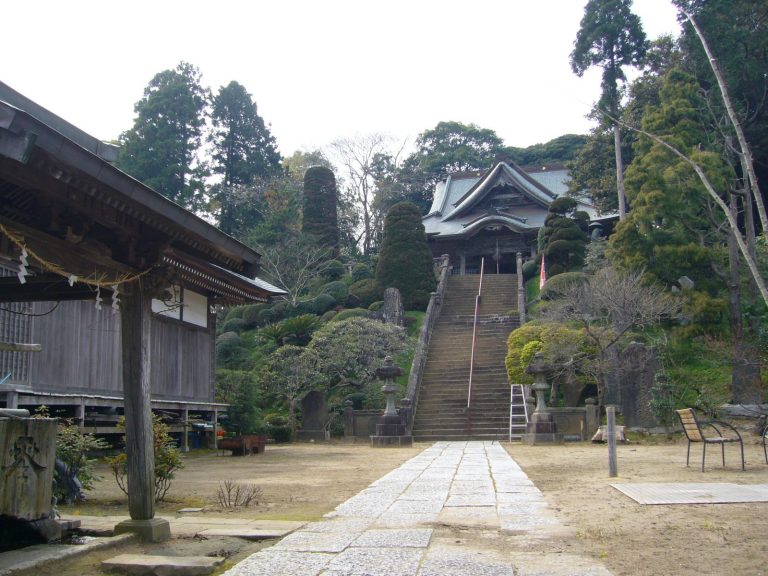
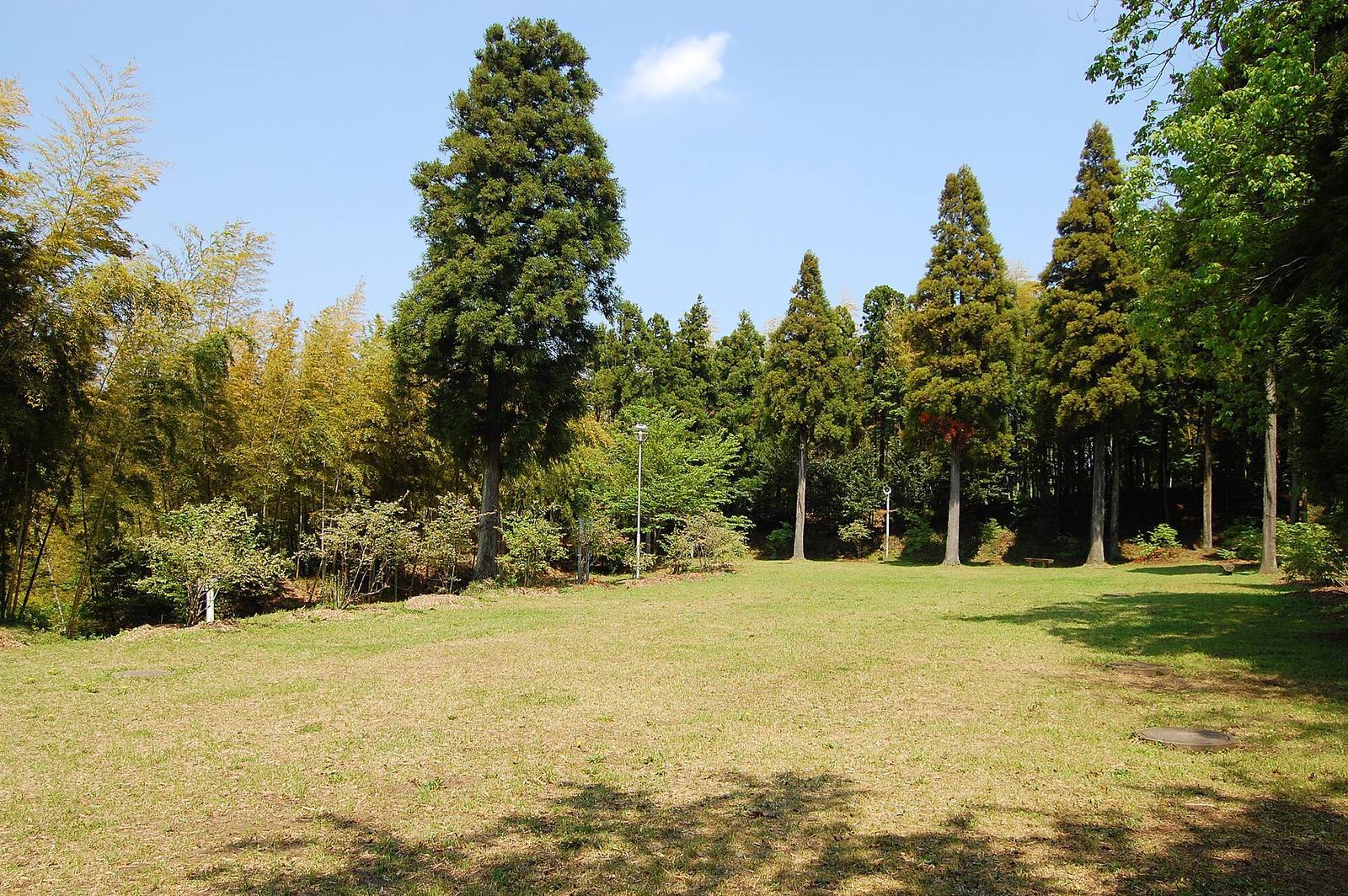
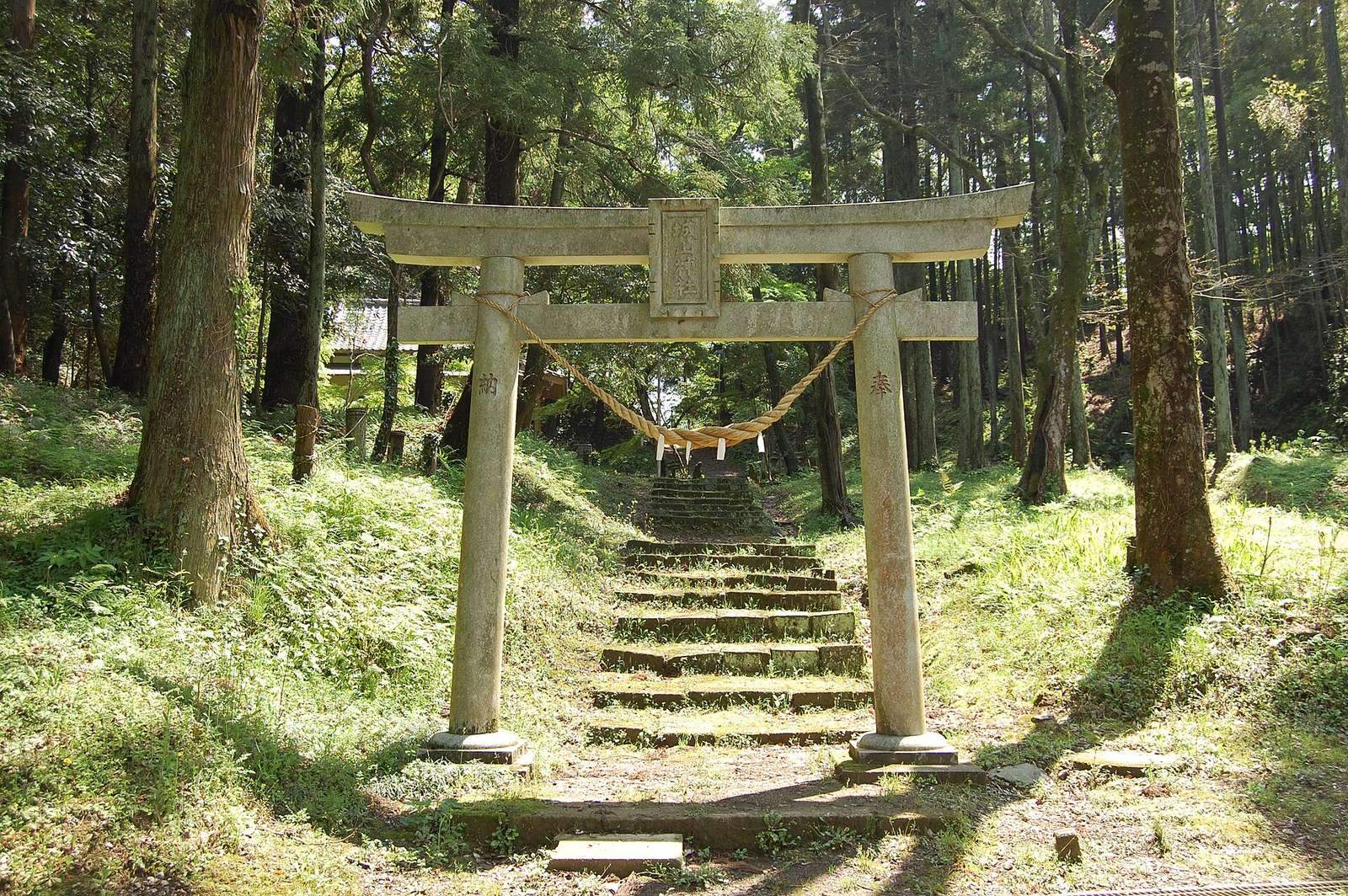
The main enclosure includes the area commonly called the Thousand-Mat Terrace, the grounds of Shiroyama Shrine, and lower defensive areas around them. The terrace is a level rectangle about 50 metres east to west and 70 metres north to south, enclosed by earthen ramparts. Its eastern rampart rises about 7 metres. Shiroyama Shrine stands below the enclosure’s northern rampart.
Second bailey
The second bailey occupies a spur extending southwest from the main ridge. A large ridge-cut ditch, a defensive trench cut across a ridge, separates it from the main enclosure, and another such ditch divides the bailey into northeastern and southwestern parts. The bottom of the latter trench is thought to have served as a path linking the third bailey with the larger ditch. A gate is also thought to have guarded the approach before entry to the main enclosure.
Third bailey
The third bailey lies on a spur projecting west-southwest from the main ridge. Ravines separate it from the second and fourth baileys. Its position helped defend the principal approach road, which climbs through the ravine between the third and fourth baileys.
Fourth bailey
At the northern end of the castle, the fourth bailey is interpreted as an outwork, a defensive position outside the main enclosure.