Dravograd Castle: A Medieval Hilltop Fortress in Slovenia

Site at a Glance
- Rating
- 4.6
- Popularity
- Very Low
- Country
- Slovenia
- Primary era
- Medieval
- Eras represented
- Medieval
- Civilizations
- Holy Roman Empire
- Site type
- Military
- Remains
- Castle
On this page12 sections
History
Dravograd Castle is a medieval hilltop castle ruin above Dravograd in Slovenia, built around 1150 as a fortified residence and defensive complex. It controlled medieval movement and trade along the Drava and Meža rivers, as well as the ford across the Drava.
Foundation and dispute with St. Paul Abbey
Cholo I of Trixen, a Styrian ministerial, ordered the castle’s construction before 1161. A ministerial was a member of the medieval service nobility who held office or land for a ruler or high noble. A document from around 1161 names Ortolfus senior de Traberch, while the earliest written evidence for the castle dates to 9 August 1177.
In that year, the abbot of St. Paul Abbey in the Lavant Valley complained to Pope Alexander III that the castle, then called castrum Trahburck, had been unlawfully built on monastery land. St. Paul Abbey was a Benedictine monastery whose superior authority covered the land. Alexander commissioned Salzburg Archbishop Konrad III of Wittelsbach and Bishop Roman of Leibnitz of Gurk to destroy the castle. The order was not carried out, partly because Alexander’s conflict with Holy Roman Emperor Frederick Barbarossa affected its enforcement and because Salzburg faced a disputed succession.
Since Cholo could not be expelled, St. Paul Abbey reached an agreement with him and his brother Heinrich I of Trixen between 1180 and 1190. The abbey retained superior authority over the territory, while the Trixen family held the castle and surrounding area as a fief, meaning a lordship held in return for service within a feudal relationship. The castle grew in importance, and in 1208 Otto I of Trixen adopted the name Otto of Traberch. His descendants later used the same designation.
Changes of lordship
The Trixen line ended in 1261, or possibly in 1278. Count Heinrich of Pfannberg then received Dravograd Castle as a fief of St. Paul Abbey in exchange for money. After Heinrich died in 1282, the castle passed to his eldest son Hermann, who died in 1286 or 1287. Hermann’s widow, Elisabeth of Heunburg, was the daughter of Ulrich II of Heunburg, who became the castle’s owner in 1286 or 1287.
Elisabeth married Heinrich of Hohenlohe in 1303 and brought the lordship of Dravograd into the marriage as her dowry. In 1304 Duke Heinrich of Carinthia recognized St. Paul Abbey’s earlier feudal rights over the castle and lordship. Soon afterward, his successor Otto III, Duke of Carinthia and Carniola, acquired both from Abbot Weriand, temporarily ending the abbey’s connection with Dravograd. Otto III then pledged the castle to his ministerial Konrad III of Auffenstein.
Konrad remodeled the castle by 1328. Under Duke Heinrich IV of Carinthia, the costs were credited against the pledge. Konrad died in 1368 at the Battle of Bleiburg while taking part in an uprising against the Habsburg dukes Albrecht III and Leopold III.
Habsburg, Cilli, and ecclesiastical rule
The Habsburgs acquired the castle in 1368 and granted the lordship to the Stubenberg family. In 1375 it passed to Johann of Liechtenstein, and in 1387 to Count Hermann II of Cilli. The Counts of Cilli were a powerful late-medieval noble family. They held the castle and territory until the death of the last count, Ulrich II of Cilli, on 9 November 1456. Under an inheritance agreement, the castle and lordship then returned to the Habsburgs, who retained them until 1613.
In 1613 Prince-Bishop Georg III of Lavant acquired the castle and lordship for his diocese. St. Paul Abbey recovered them on 8 June 1629, when Abbot Hieronymus Marchstaller bought the castle and lordship for 20,000 gulden.
Fire, dissolution, and decline
A fire destroyed large parts of the castle during the second half of the eighteenth century. The damaged sections were rebuilt immediately afterward. On 10 April 1787, Emperor Joseph II’s Josephinian church reforms dissolved St. Paul Abbey and transferred its properties for sale. Count Alois of Kuenburg acquired the territory.
The Kuenburg family sold the castle to David Dumreicher in 1838. Dumreicher abandoned it in 1846, after which it fell into decay. The castle has been legally protected as a monument since 6 December 1996. By 2020, trees and other vegetation covered the entire grounds and were regarded as a threat to the surviving remains.
Names and historical position
The castle and settlement appeared under several names, including castrum Trahburck, Traburg, Untertraburg, Buchenstein, Tráberk, and Dravograd. Unterdrauburg became the predominant name because the castle marked the lower end of the Drava in the Duchy of Carinthia, in contrast with Oberdrauburg, where the river entered Carinthia. The Slovene name Tráberk remained in use until 1945. Dravograd was introduced from 1945, following a 1948 law requiring the renaming of religious and German place, square, and street names.
Remains
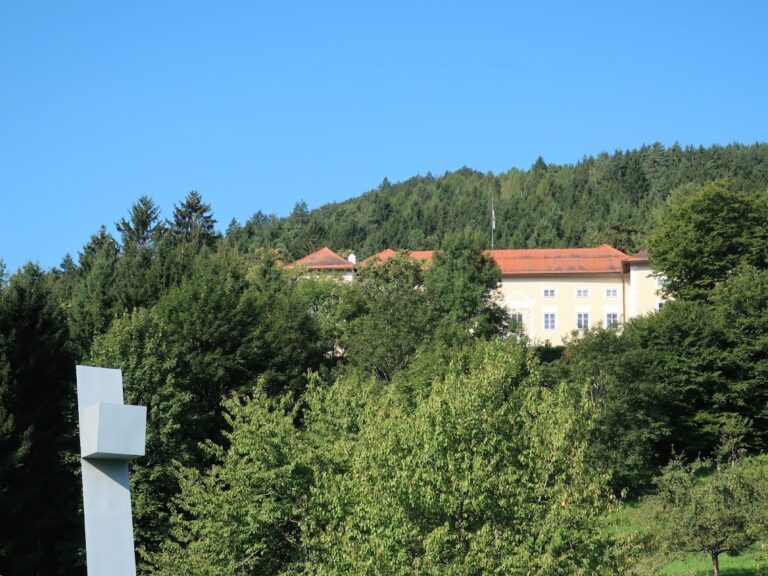
Dravograd Castle occupies Castle Hill at about 475 metres above sea level, on the edge of Dravograd beside the northern bank of the Drava. The hill rises about 85 metres above the town and overlooks the Drava and Meža valleys. Oriented from northwest to southeast, the complex measured approximately 66 metres in length and 18 metres in width. Its walls were built from local stone, both roughly broken and dressed, laid with mortar.
Inner castle
Keep
The former square keep, the principal fortified tower of a castle, stood within the inner castle. Its exterior sides measured about 7 metres, and its foundation walls survive.
Residential tower
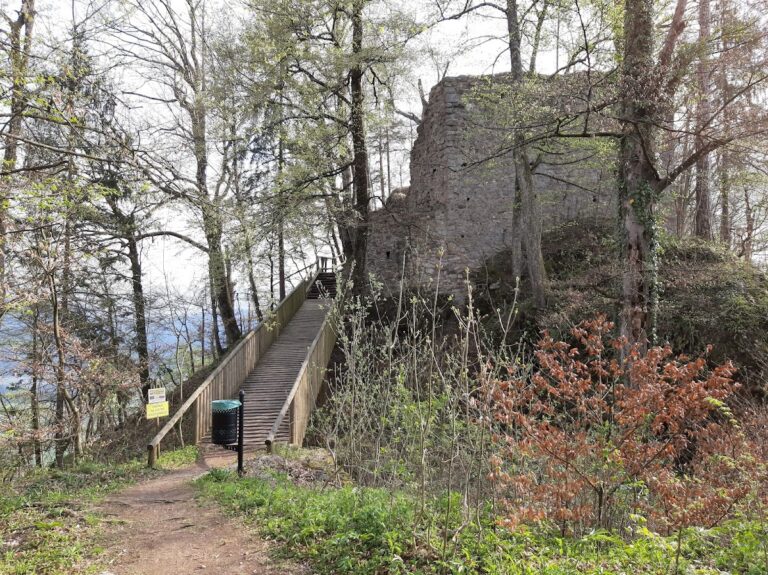
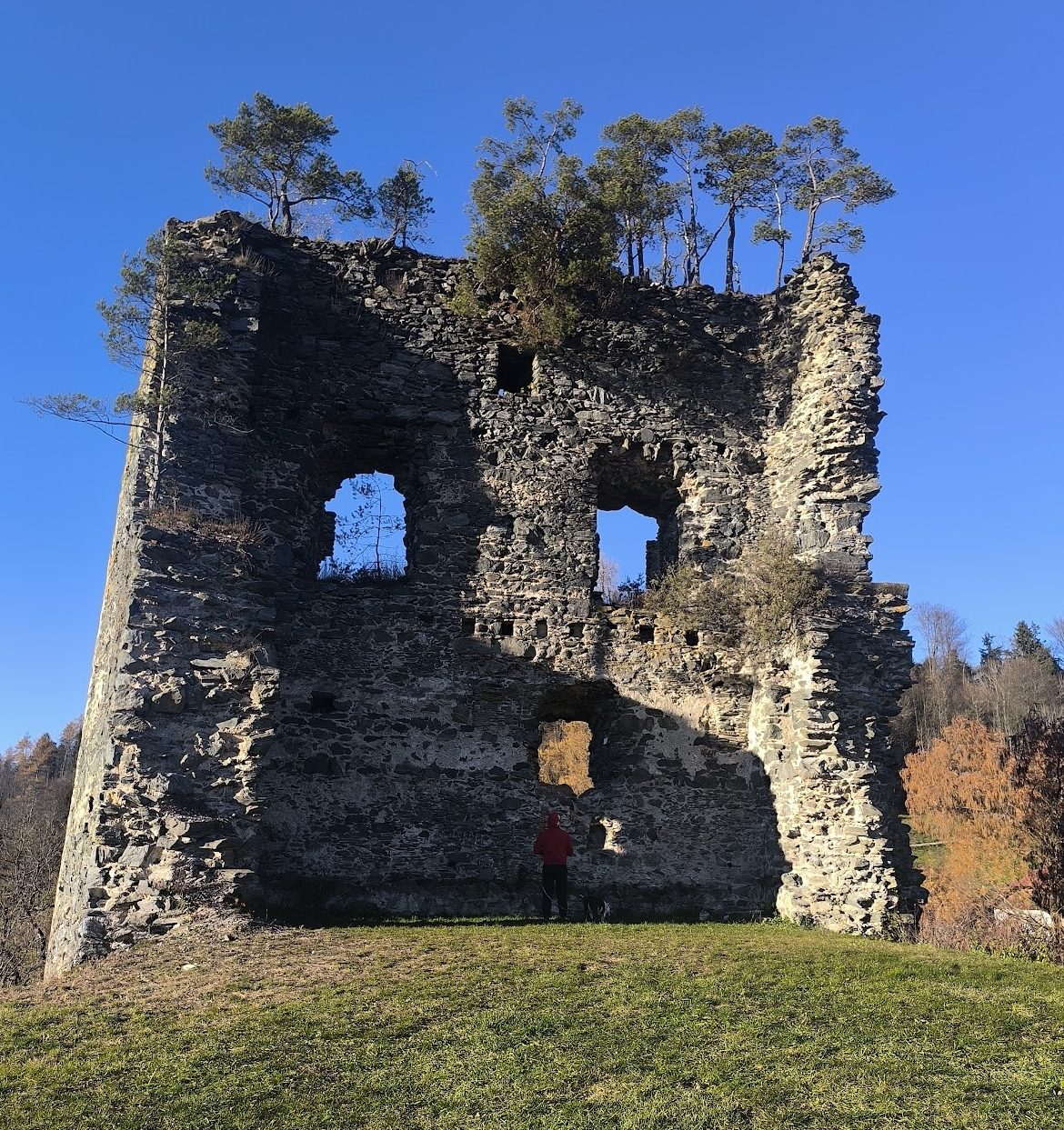
The residential tower was a fortified tower designed partly or primarily for habitation. It measured approximately 9 by 12.5 metres externally. Three exterior walls remain, while the inner wall facing the castle courtyard has collapsed. From the main tower of the inner castle, it was possible to see the confluence of the Meža and Drava, the settlement beside the river, and the bridge across the Drava.
Southeastern bailey
A bailey, the outer enclosed part of a castle complex, extended southeast of the main castle. It measured approximately 40 by 20 metres. Sections of its southern wall remain, linking the outer enclosure to the larger castle layout.
Current condition
Trees and other vegetation now cover the castle grounds. This overgrowth threatens the preservation of the stone walls and foundations that survive across the hilltop complex.
Nearby sites