Lviv High Castle: A Medieval Fortress and Royal Residence in Ukraine

Site at a Glance
- Rating
- 4.7
- Popularity
- Medium
- Country
- Ukraine
- Primary era
- Medieval
- Eras represented
- Medieval
- Civilizations
- Kingdom of Poland
- Site type
- Military
- Remains
- Castle
On this page10 sections
History
Lviv High Castle is a medieval fortification and royal residence in Ukraine, built on Castle Hill under Leo I of Halych during the thirteenth-century Kingdom of Rus. Its earliest defenses consisted of wooden and earthen works. Earlier defensive structures may have stood on the hill, but their form and exact position are unknown. During the Kingdom of Rus, the castle also housed the state treasury, including crowns and thrones, precious crosses, and fragments associated with the True Cross.
Kingdom of Rus and early destruction
The first fortifications were dismantled in 1259 at the demand of Boroldai, a Mongol military commander who intervened in the affairs of the Rus principalities. They were rebuilt by 1270. The Lviv historian Bartolomej Zymorovych later treated that year as the date of the fortifications’ original construction, although the nature of the construction material referred to in his account remains uncertain. By 1287, when Khan Telebuga besieged Lviv, the city’s defenses had been restored and were apparently in good condition.
In 1340, Casimir III of Poland captured Lviv and the wooden castle was burned. Lithuanian forces led by Prince Liubartas burned Lviv in 1351 and destroyed the hastily rebuilt castle again in 1353. Around 1362, after the consolidation of Polish rule in the region, Casimir III ordered the construction of a new castle in stone and brick. Between 1379 and 1387, a Hungarian garrison occupied the fortress before Lviv returned to Polish control.
Royal administration and military defense
Under the Polish Crown, the castle became the residence of the royal starost, a Crown-appointed administrator who governed for the monarch, together with his garrison. It also served as a prison. Prisoners included Teutonic knights captured at the Battle of Grunwald in 1410 and, at a later date, Princess Halszka Ostrozka. Starosts directed the castle on behalf of the monarch, while burgraves, their deputies, supervised parts of its administration and defense.
In the fifteenth century, Lviv High Castle was regarded as one of the strongest fortifications in the Ruthenian lands. Its military value grew as Tatar raids increased, and repairs were undertaken during the reign of Casimir IV Jagiellon, the Polish king and grand duke of Lithuania. Moldavian forces and their Ottoman allies besieged the castle in 1498 and 1509, but it resisted both attacks. A major fire that devastated Lviv in 1527 damaged the principal tower. In 1537, the castle witnessed the Chicken War, a rebellion against King Sigismund I the Old and Queen Bona Sforza.
Capture, decline, and dismantling
The fortification continued to be extended and repaired, but its military history became increasingly troubled. During the Khmelnytsky Uprising, a Cossack revolt against Polish rule, forces commanded by Colonel Maksym Kryvonis captured the castle on 15 October 1648. Ottoman or Turkish forces occupied it in 1672, reportedly without a fight. After the Cossack capture, the garrison had been withdrawn, leaving the fortress in a weakened condition.
Swedish forces occupied Lviv in 1704 and heavily damaged the already weakened castle. It then lost much of its strategic importance. From the second half of the eighteenth century, its towers and walls were gradually dismantled for building material. After 1772, Austrian authorities began dismantling Lviv’s fortifications, and work around the city started in 1777. Most of the castle was taken apart during the nineteenth century, while stone from the hill and the fortress foundations was reused in buildings, including the house at 3 Lychakivska Street.
Transformation into a historic site
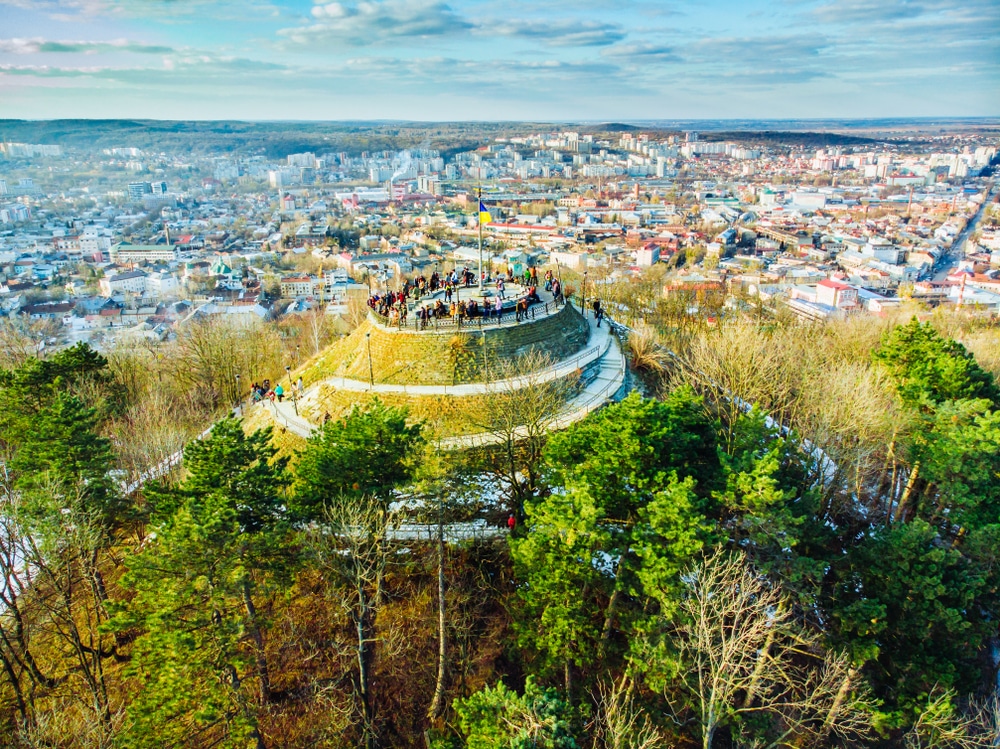
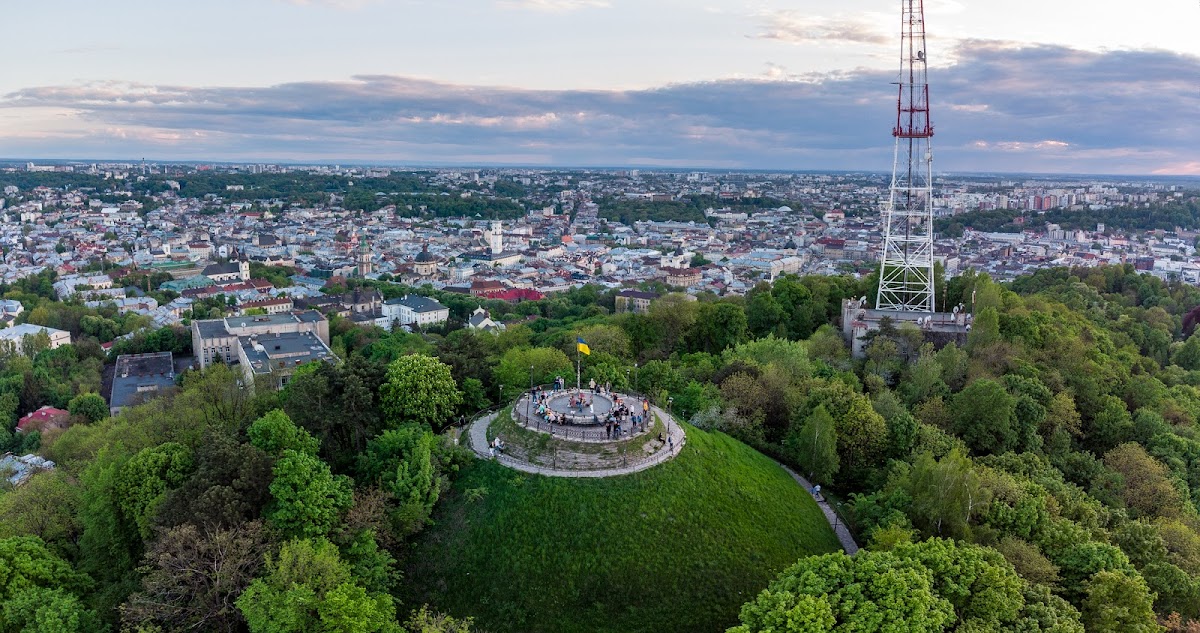
A park had been established on the hill in 1835, with trees planted on its slopes. In 1868 and 1869, the remaining walls were almost entirely destroyed during construction of the Union of Lublin Mound, which commemorates the three-hundredth anniversary of the Union of Lublin. Proposals to reconstruct a stone castle on Castle Hill were debated in 2004 and 2005, attracting both support and opposition, but no reconstruction followed. Lviv High Castle is now a ruin and is recognized as a Ukrainian cultural-heritage monument of national significance.
Remains
Castle Hill, also known as Knyazha or Bidel Hill, occupies the summit of the site near Lviv’s historic centre. Rising to 413 metres above sea level, it forms part of the Podolian Upland and the Rastochie range. The earliest defenses were built from wood and earth. Archaeological work has identified remains of a circular thirteenth-century tower, while substantial deposits of stone lie within the hill.
Masonry castle
The later castle in stone and brick followed the outline of the hill in an elongated rectangular plan with four corner towers. Its western tower was the tallest and functioned as a watchtower. Inside, a princely palace divided the fortress into two courtyards. Barracks, ammunition stores, towers, arcaded masonry galleries, and a deep well cut into the rock formed part of the complex.
A description from 1562 presents the castle in good condition. It contained a chapel with its furnishings, vaulted rooms for guards, ten cannon, equipment for breaking walls, large stores of cannonballs, and substantial supplies of gunpowder. The account also describes an elaborate royal residence, reflecting the castle’s combined military and residential functions under the Polish Crown.
Surviving wall and later structures
Southern outer wall
The principal surviving fragment is part of the southern stone wall of the outer courtyard, or forecourt. It stands between the principal outer and inner gates and includes loopholes. The wall once enclosed the entrance to the castle grounds and is the clearest remaining section of the masonry fortification.
Union of Lublin Mound
The Union of Lublin Mound occupies the former castle site. An observation platform stands at its summit, while a 141-metre television tower was erected on a ridge of the hill in 1957. These later structures form part of the present physical character of Castle Hill, whose castle walls, towers, foundations, and stone outcrops were progressively dismantled or destroyed during the eighteenth and nineteenth centuries.