Lubomirski Palace: A Baroque Residence and Cultural House in Lviv


Site at a Glance
- Rating
- 4.7
- Popularity
- Very Low
- Country
- Ukraine
- Primary era
- Early Modern
- Eras represented
- Medieval, Early Modern
- Civilizations
- Polish–Lithuanian Commonwealth
- Site type
- Domestic
- Remains
- Palace
On this page7 sections
History
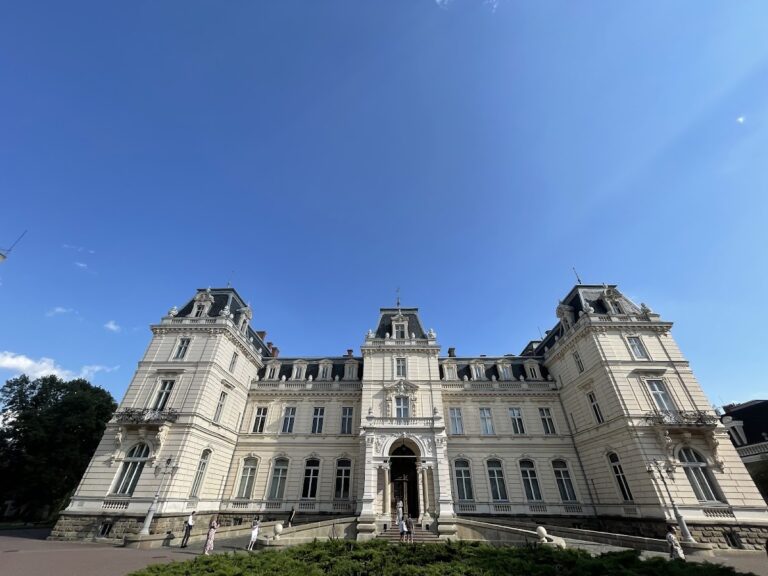
Lubomirski Palace is a Baroque palace in Lviv, Ukraine, whose present form emerged from rebuilding begun in 1744 and continued during the 1760s. It stands on a corner site between Rynok Square, Ruska Street, and Fedorova Street, occupying the position of seven earlier town houses. The palace became the residence of Stanisław Lubomirski, the Bracław voivode, a high-ranking territorial governor, and took its name from him.
From town houses to palace
The earlier properties included two houses on Rynok Square associated with the Shymonovych and Torosevych families, three on Ruska Street, and two on Fedorova Street. One of the Rynok Square houses belonged to Shimon Shymonovych, a Latin-language poet of Lviv. Gothic foundations and cellars survived beneath the later building, including cellars connected with Prince Sapieha. Bernard Meretyn consolidated the properties in 1744. After Stanisław Lubomirski acquired the site in 1760, Jan de Witte directed further rebuilding, with additional work and decoration by Marcin Urbanik and the sculptors Sebastian Fesinger and Kostecki.
Governmental and cultural uses
From 1772 to 1821, the palace housed the administration of the Austrian governors of Galicia. Galicia was a historical region governed by the Habsburg monarchy after the partitions of the Polish-Lithuanian Commonwealth, with its Austrian administration based in Lviv. Count Pergen was among the governors associated with the building.
The Prosvita Society acquired the palace in 1895, after which it became known as the Prosvita House. Ukrainian cultural and educational organizations used the building, including the editorial office of the newspaper Dilo, a bookstore belonging to the Shevchenko Scientific Society, and the editorial office of the journal Hromadsky Holos. Ivan Franko, Lesya Ukrainka, Ethel Voynich, and Vasyl Stefanyk also visited the building. In 1941, Yaroslav Stetsko proclaimed the Act of Restoration of the Ukrainian State from its balcony.
Museum use and restoration
Since 1975, Lubomirski Palace has housed the open collections of the Museum of Ethnography and Artistic Crafts, associated with the Institute of Ethnology of the National Academy of Sciences of Ukraine. During the Soviet period, the building held collections of the Lviv branch of the Institute of Art Studies, Folklore, and Ethnography. Restoration of the main facade and roof began in 2011. The work uncovered an older inscription reading “Prosvita House” beneath the plaster and fragments of earlier advertisements on the Ruska Street facade.
Remains
Palace exterior
Lubomirski Palace is a three-storey brick building covered with plaster and topped by a decorative attic. Its elongated rectangular plan runs from west to east and includes a small internal courtyard. Three facades are exposed: the elaborate principal facade faces Rynok Square, while simpler side and rear facades face Ruska Street and Fedorova Street. Pilasters, shallow wall projections resembling columns, and flat wall strips organize the elevations. Broad cornices divide the first storey from the upper sections, while stucco garlands decorate the pilaster capitals and relief surrounds frame the windows.
The main and rear entrances have semicircular tops. A carved cartouche, an ornamental framed panel, on the Fedorova Street portal bears the date 1695. Gothic pointed vaults in the cellars preserve evidence of the earlier foundations beneath the palace. Balconies with openwork metal railings rest on shaped brackets. Oval openings and sculpture pattern the attic, and the rounded corner carries military and knightly emblems, including armor motifs. The sculptural decoration is attributed to Sebastian Fesinger and was executed by Kostecki, forming a military-themed program across the attic and corner. Inside, stucco fireplaces were made by Jan Obrocki.
Museum interiors and collections
The palace displays European and Ukrainian antique furniture, ironwork, porcelain, earthenware, and other objects dating from the sixteenth to the twentieth century. Twelve ground-floor rooms contain furniture associated with Italian Renaissance households, including cassoni chests. The first floor presents mainly Western European ceramics from the eighteenth to the early twentieth century, with examples from Meissen, Vienna, Berlin, and Copenhagen, alongside objects from China and Japan. The second floor contains ironwork collections and Galician tiles.