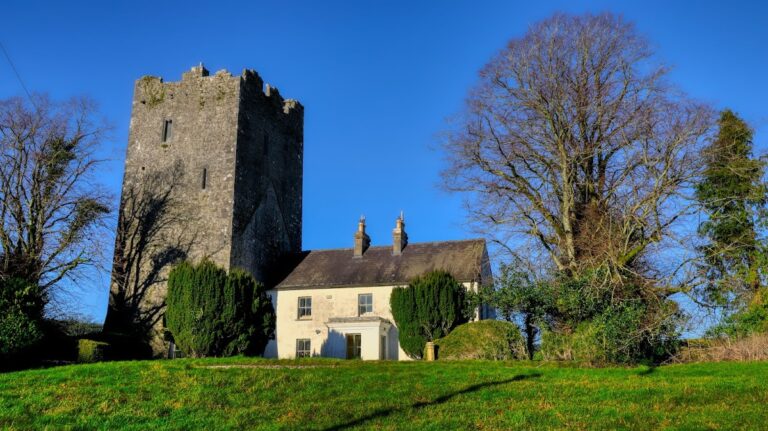
Loughmoe Castle: Ancestral Castle of the Purcell Barons


Site at a Glance
- Rating
- 4.4
- Popularity
- Very Low
- Country
- Ireland
- Primary era
- Medieval
- Eras represented
- Medieval, Early Modern
- Civilizations
- English
- Site type
- Military
- Remains
- Castle
On this page7 sections
History
Loughmoe Castle is a ruined medieval castle in Ireland, located at Tinvoher in County Tipperary. It was the ancestral home of the Purcell family and the Barons of Loughmoe, within the historic barony of Eliogarty near Loughmore village and Templemore. The date of its foundation and initial construction remains uncertain, although the castle’s history is associated with the medieval Purcell lordship and later seventeenth-century enlargement.
The Purcell Lordship
The land was said to have been granted to Sir Hugh Purcell in 1204 as a dowry from Theobald FitzWalter. Construction of the castle is also associated with 1328, when Richard Purcell received the title of Baron of Loughmoe from James Butler, the first Earl of Ormond. A barony was a hereditary or honorific territorial lordship. The English Crown did not recognize the Loughmoe barony at that time.
The recorded succession of Loughmoe lords and barons begins with Richard Purcell in 1328 and includes Phillip Purcell; Geoffrey Rothe Purcell, from about 1397; Thomas Purcell, from about 1430; Peter Purcell; James Purcell, from about 1456; John Purcell, from about 1466; Thomas Purcell, from about 1518; Patrick Purcell, from about 1534; Thomas Purcell, who died on 3 August 1607; Ralph Purcell; Richard Purcell; Theobald Purcell; James Purcell, who died on 13 September 1652; and Nicholas Purcell, who died in 1722. Peter Purcell received charters and titles from King Edward IV on 13 August 1461.
Conflict and Decline
James Purcell of Loughmoe, associated in contemporary poems and legends with opposition to the Irish O’Kennedy clan, is dated to about 1456. Richard Purcell of Loughmoe was tried in 1607 and convicted of murdering his brother Adam Tobin, who had been the last High Sheriff of County Tipperary in 1606. Richard was married to Maria Plunket of Kilhair.
Theobald Purcell, born in 1595, represented Tipperary in Parliament in 1634 and was known as the “Irish Papist.” He took part in the 1641 rebellion for Irish independence. The title of Baron of Loughmoe was confirmed in 1690 by James II, the Stuart king deposed in 1688 who continued to claim the throne and fought in Ireland during the following conflict. The Purcell family occupied the castle until about 1760, after which it fell into decline. The Loughmoe barony ended with the death of Nicholas Purcell of Loughmoe on 4 March 1722.
Name and Tradition
The name Luach Magh is translated as “Valley of Reward.” The alternative form Loughmore, meaning “Great Lake,” is attributed to an error by English cartographers. Local tradition tells of a king who lived at an earlier castle and offered his daughter and the surrounding land to whoever killed a wild boar and sow that were damaging crops and terrorizing the district. A young Purcell supposedly killed the animals with a bow and arrow and received the promised reward. The story is reflected in the Purcell family arms, which display four boar heads, but it has no confirmed historical basis. Another tradition claims that the Purcells descended from Charlemagne, a claim regarded as doubtful.
Remains
Castle Structure
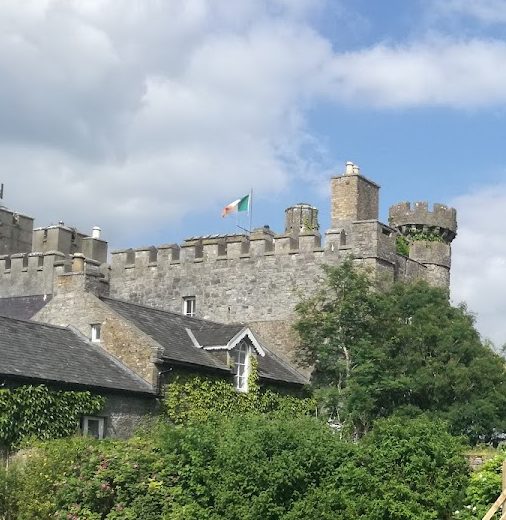
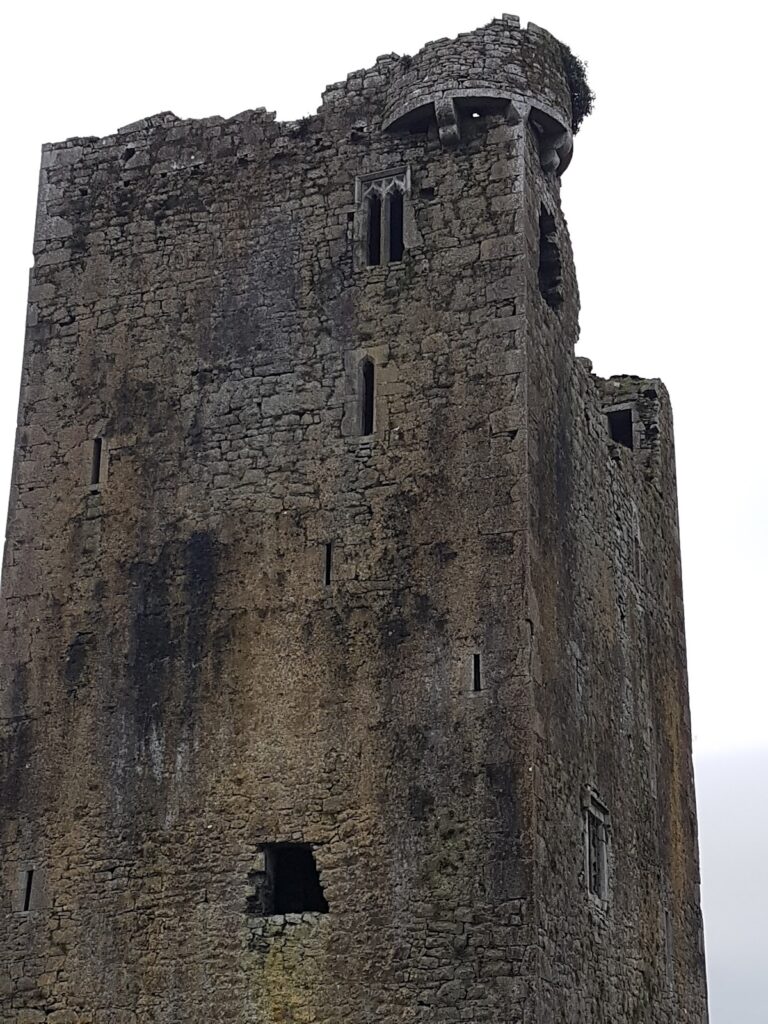
Loughmoe Castle is a ruined lowland castle built of rubble stone on flat ground between the River Suir and the Cork-Dublin railway line. Its principal surviving element is a four-storey tower house, a fortified residential building arranged vertically with living and defensive spaces over several floors. The date of the tower house is uncertain, and its surviving fabric represents more than one building phase.
Later Additions and Setting
The Purcell family enlarged the original tower house during the seventeenth century. A mill was erected near the castle during its initial development. The ruin stands close to the River Suir, a railway bridge, and the Cork-Dublin railway line, and is now preserved as a ruin.
Nearby sites