Lindekemale Mill: A Historic Watermill in Belgium


Site at a Glance
- Rating
- 4.7
- Popularity
- Very Low
- Country
- Belgium
- Primary era
- Medieval
- Eras represented
- Medieval
- Civilizations
- Duchy of Brabant, Holy Roman Empire
- Site type
- Economic
- Remains
- Watermill
On this page7 sections
History
Lindekemale Mill is a historic watermill in Woluwe-Saint-Lambert, Belgium, built for the medieval grain-milling economy along the Woluwe River. First documented in 1129, it is regarded as the oldest surviving watermill in the Brussels-Capital Region and one of only two surviving examples among the approximately 87 watermills that existed in the region in the mid-nineteenth century.
Medieval Ownership and Local Use
In 1129, Étienne de Wezembeek donated the mill to the Norbertine Abbey of Parc near Leuven. The Norbertines were members of the Premonstratensian order, a Catholic religious order founded in the twelfth century. The abbey held about 15 hectares along the Woluwe, including Lindekemale Mill and the Hof ten Berg estate, making the mill part of its landed economic holdings.
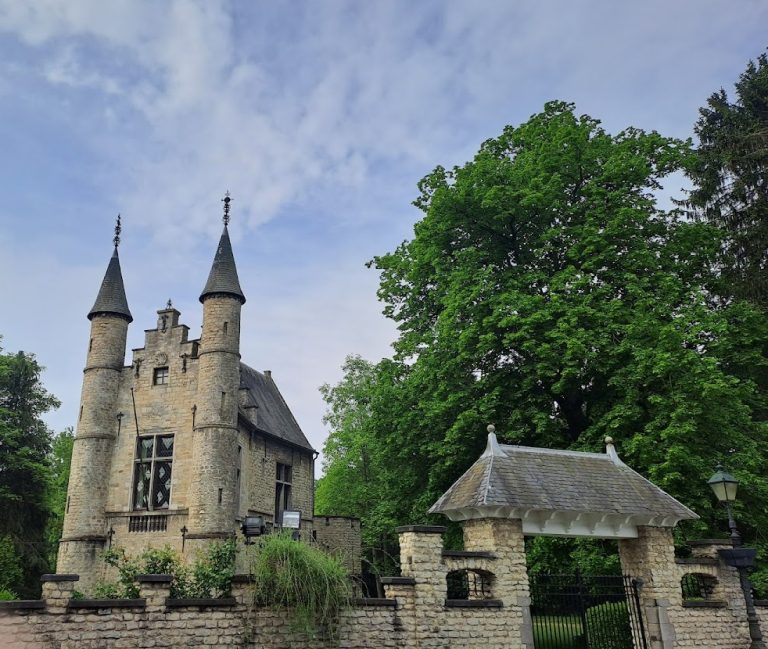
The mill probably served as the customary mill for the neighbouring seigneurial domain. A customary mill was one that local tenants were traditionally required to use. The domain included a castle now called the Slot, a farm that later disappeared, and the Chapel of Marie the Miserable. Lindekemale Mill also stood beside Het Lindeken brewery, described as the municipality’s principal brewery.
Industrial Change and Later Ownership
Grain milling continued until at least 1611. Part of the complex was later adapted for paper production, with 1686 given as the date of that conversion. By the early twentieth century, industrial flour mills had made flour production unviable at Lindekemale. The mill then processed locally cultivated chicory and snuff tobacco.
By the late nineteenth century, the mill belonged to Jean Devis, who was mayor of Woluwe-Saint-Lambert from 1819 to 1860 and became the municipality’s longest-serving mayor. The residential section was later converted into a café-dairy and altered with picturesque details. A fire in 1928 destroyed the industrial south wing, which was subsequently rebuilt.
Municipal Care and Recent History
Although the mill was privately owned, Woluwe-Saint-Lambert paid for the replacement of its badly deteriorated waterwheel in 1933. The municipality acquired the property in 1955. It was first used as a café and later became a restaurant during the latter half of the twentieth century.
Lindekemale Mill received legal protection as a heritage monument in 1989. Major restoration of the mill and its waterwheel followed in 1997, while the wheel was also restored or replaced in 1994 and 2008. The Woluwe was later restored as an open watercourse, and a promenade was created along its banks. Restoration of the mill’s supply channel allowed the wheel to operate again. After the intervention dated to 2008, however, the mechanism became blocked and the wheel deteriorated. The mill has been offered for sale since 2022 and had not found a buyer at the latest reported status.
Remains
Lindekemale Mill stands on the northern edge of Malou Park beside the Woluwe River. The water-powered complex is built of calcareous sandstone, a sandstone containing a substantial amount of calcium carbonate. It was probably originally covered with thatch, while a brick upper storey was added later. The surviving complex retains both a residential section and an industrial south wing rebuilt after the 1928 fire.
Mill Building
The former residential section preserves the picturesque appearance created when it became a café-dairy. Stepped gables, shutters, and a rustic sign form part of those later alterations. The industrial south wing represents the rebuilt portion of the complex after the fire. Together, these sections reflect the mill’s change from a working agricultural installation to a building adapted for hospitality and restaurant use.
Waterwheel and Supply Channel
The mill’s overshot waterwheel, driven by water delivered from above, has a diameter of 2.30 metres. A replacement wheel inaugurated on 11 May 1994 weighed 2,800 kilograms. The supply channel was restored so that water could reach the wheel and set it in motion again. The wheel has been repaired or replaced several times, most recently in 2008, after which its mechanism became blocked and the wheel deteriorated.