San Marco in Sylvis, Afragola: A Historic Roman Catholic Church


Site at a Glance
- Rating
- 4.8
- Popularity
- Very Low
- Country
- Italy
- Primary era
- Medieval
- Eras represented
- Medieval, Early Modern, Modern
- Civilizations
- Italian, Kingdom of Naples, Spanish
- Site type
- Religious
- Remains
- Church
On this page11 sections
History
San Marco in Sylvis, also called San Marco della Selvatella, is a Roman Catholic church in Afragola, Italy, dedicated to Saint Mark the Evangelist and belonging to the Archdiocese of Naples. Tradition attributes its foundation to William II, the Norman king of Sicily who ruled from 1166 to 1189, on 10 April 1179, for families of veterans who had fought with his grandfather, Roger I of Sicily. A church at the site is documented in 1179, although another chronological tradition places the building’s construction between the mid-fourteenth and early fifteenth centuries.
Medieval foundation and ownership
The church stood beside the public road corresponding to the present Via San Marco by 5 December 1258, when it was mentioned in a document belonging to the monastery of San Sebastiano. A document from the monastery of Santa Patrizia in Naples, dated 9 March 1309, also refers to rural lands beside the church. The name Selvatella, or in Sylvis, means “in the woods” and has been connected with the area’s wooded character and with soil layers containing traces of very rich horizons.
A 1390 account, first published in 1581 and attributed to the Dominican friar Domenico De Stelleopardis of Afragola, describes a miraculous episode in the church’s history. According to the account, angels carried the building during the night to a place containing a martyrium, a shrine associated with the relics or burial place of saints from Nola. The narrative also describes an apparition of the saints’ souls to pious men.
The church was historically owned by the nuns of the monastery of Saints Marcellinus and Desiderius in Naples, who held the right to choose its rector. On 18 September 1356, the Neapolitan archiepiscopal court restored that right to the nuns, subject to the consent of the inhabitants of Casavico and the Archdiocese of Naples. The church’s consecration is dated to 1356.
Later changes in devotion and fabric
Parish priest Francesco Antonio Castaldo stated in his report for the 1749 pastoral visitation that the church had been completed on 10 April 1179, during the twelfth indiction. An indiction was a fifteen-year cycle once used for dating documents. This statement preserves the older foundation tradition alongside the later chronology assigned to the building itself.
The church probably fell into disuse around the seventeenth century, as local devotion to Saint Mark was superseded by devotion to Saint Anthony of Padua from 1633. Cardinal Giuseppe Spinelli organized a solemn procession in 1742 to revive devotion to Saint Mark. The building had already undergone several reconstructions, including a major refurbishment in 1563, and its architectural character came to combine Romanesque, Renaissance, and Baroque elements.
Parts of the church were renovated around 1733 and again around 1868 by the priest Giuseppe Rocco. These works included opening the apsidal window and raising the floor by nearly half a metre. In 1897, the parish priest and historian Luigi M. Jazzetta moved the Stone of Saint Mark to the area behind the church and commissioned a shrine-like structure around it. The church was later filmed in a scene of the 1965 film Colpo grosso ma non troppo, directed by Gérard Oury.
Remains
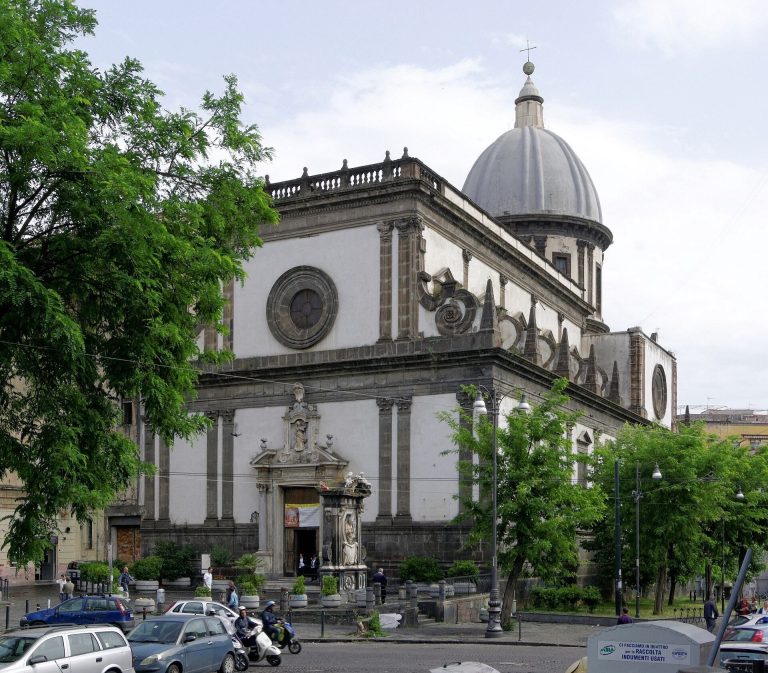
San Marco in Sylvis has a single nave in a basilical arrangement, a longitudinal church layout centered on the main nave, with side chapels and a terminating apse. The apse has a rectangular plan, and the church has no transept. Frescoes decorate the side chapels, while the surviving fabric brings together Romanesque, Renaissance, and Baroque elements.
Exterior and bell tower
Facade
The facade is organized in three levels. A small staircase rises to the entrance portal at the lowest level. The portal has a shaped, lowered limestone arch dating from the late nineteenth century. Two small buttresses extend from the base to a horizontal string course, while pilasters mark the outer edges of the facade.
The middle level contains a niche with a lowered arch and jambs. Its fresco of the Madonna and Child has been lost. Above it, the gabled upper facade has internal roof trusses, an iron cross, and single-light windows with pointed arches.
Bell tower
The bell tower dates from the fourteenth or fifteenth century. It is divided into four levels and crowned by an octagonal pinnacle, forming a distinct vertical element beside the church.
Stone of Saint Mark
The Stone of Saint Mark is a large limestone block incorporated into the apse wall of the bell tower. Tradition holds that Saint Mark sat on it before reaching Rome and that Saint Januarius, the patron saint of Naples and a Christian martyr, sat on it during his fourth-century transfer from Nola to Pozzuoli. The stone is venerated for supposedly miraculous healing powers. A shrine-like structure added in 1897 surrounds it and includes a fresco of Saint Mark and Saint Januarius.
Interior features
Chapels and frescoes
The side chapels contain a sixteenth-century fresco cycle, with some paintings dated to 1521. The church contained three altars: two dedicated to Saint Mary of Grace, also known as the De Jorio and d’Alfieri altars after the families who owned them, and a third dedicated to Saint John.
Burials and furnishings
The interior also included several burials, a wooden pulpit, and two fixed confessionals. These features formed part of the church’s furnishings and devotional arrangement alongside its chapels and altars.