Château of Val Duchesse: Priory Estate and Diplomatic Meeting Place



Site at a Glance
- Rating
- 4.4
- Popularity
- Low
- Country
- Belgium
- Primary era
- Early Modern
- External website
- Open
- Eras represented
- Medieval, Early Modern
- Civilizations
- Habsburg, Spanish
- Site type
- Domestic
- Remains
- Elite Residence
On this page7 sections
History
The Château of Val Duchesse is a historic estate in Auderghem, Belgium, developed from a women’s Dominican priory founded in 1262 in the Woluwe valley. Adelaide of Burgundy, Duchess of Brabant and widow of Henry III, Duke of Brabant, established the priory as the first women’s religious house in the Low Countries to follow the rule of Saint Dominic, the religious rule of the Order of Preachers.
Foundation and religious community
Adelaide’s foundation was associated with Saint Thomas Aquinas, who tradition holds stayed at Val Duchesse. At her request, her heart was buried in a mausoleum at the priory. That mausoleum no longer survives. Gifts from royal and noble families increased the priory’s wealth, while its buildings suffered severe damage during the sixteenth-century Wars of Religion, a period of conflicts driven partly by divisions between Catholicism and Protestantism.
In 1760, during the reign of Maria Theresa of Austria, the complex was enlarged with a prioress’s quarter in the Louis XVI style. Religious women continued to live there until the French occupation of the Low Countries. The property was then sold as confiscated property and passed through numerous owners.
Private ownership and reconstruction
Baron Eugène Amour de Cartier acquired the property in 1850. After his daughter Anne-Marie died without issue in 1871, the estate was purchased by the banker A. Franck-Morel and later by Baron Charles Dietrich. Dietrich acquired it in 1903, when the priory itself had ceased to exist and only part of the complex remained.
Dietrich restored and enlarged the estate, including a reconstruction of its surviving historic elements. In 1915, he commissioned the architect Albert Roosenboom to rebuild the former farm and stables and to reconstruct the priory complex more broadly. A charity event organised by the Spanish ambassador for Belgian and French war orphans took place at the estate on 8 September 1917. Dietrich donated Val Duchesse to the Belgian Royal Trust in 1930. The estate is managed by the Protocol and Security Directorate of Belgium’s Federal Public Service Foreign Affairs.
European and Belgian political meetings
After the Second World War, the château became a setting for national and international meetings. From 26 June 1956 to 24 March 1957, Paul-Henri Spaak chaired the intergovernmental conference on the Common Market and Euratom held there. These negotiations prepared the Treaties of Rome, signed in 1957, which led to the European Economic Community and Euratom in 1958. The Treaties of Rome were important predecessors of the European Union.
On 16 January 1958, the château hosted the first formal meeting of the Hallstein Commission, the first European Commission of the European Communities, chaired by Walter Hallstein. During the 1960s, negotiations involving the Belgian government of Théo Lefèvre and Paul-Henri Spaak produced the 1963 language laws. These laws regulated language use in public administration and established the administrative division of the Brussels arrondissement.
Val Duchesse has also been used for confidential negotiations on the formation of Belgian federal governments and for resolving conflicts between Belgium’s linguistic communities. Prime Minister Jean-Luc Dehaene held many negotiations there during the 1990s. From 1992, he used the nearby Saint Anne’s Priory for the weekly Friday meeting of the Council of Ministers.
From 23 to 25 April 1990, the château hosted a Western European Union conference that agreed the sequence for the accession of Eastern European countries formerly belonging to the Warsaw Pact to European structures. The Western European Union was a Cold War European defence and security organisation, while the Warsaw Pact was the Soviet-led military alliance of Eastern European communist states. Val Duchesse later hosted the Belgo-British Conference in 2002 and 2006, and an international Bilderberg Group meeting on 12 November 2009, where Herman Van Rompuy presented his vision of Europe.
The estate forms part of the Belgian Royal Trust and lies within the Sonian Forest landscape and the Woluwe valley. It is included in a Natura 2000 area protected under the Habitats Directive, a European framework for conserving important habitats and species.
Remains
The Château of Val Duchesse is an estate of buildings and adjoining gardens at the edge of the Sonian Forest, extending across the boundary between Auderghem and Woluwe-Saint-Pierre. Its surviving complex combines the prioress’s residence, reconstructed agricultural buildings, an enclosing wall, and the Saint Anne Chapel.
Château and agricultural buildings
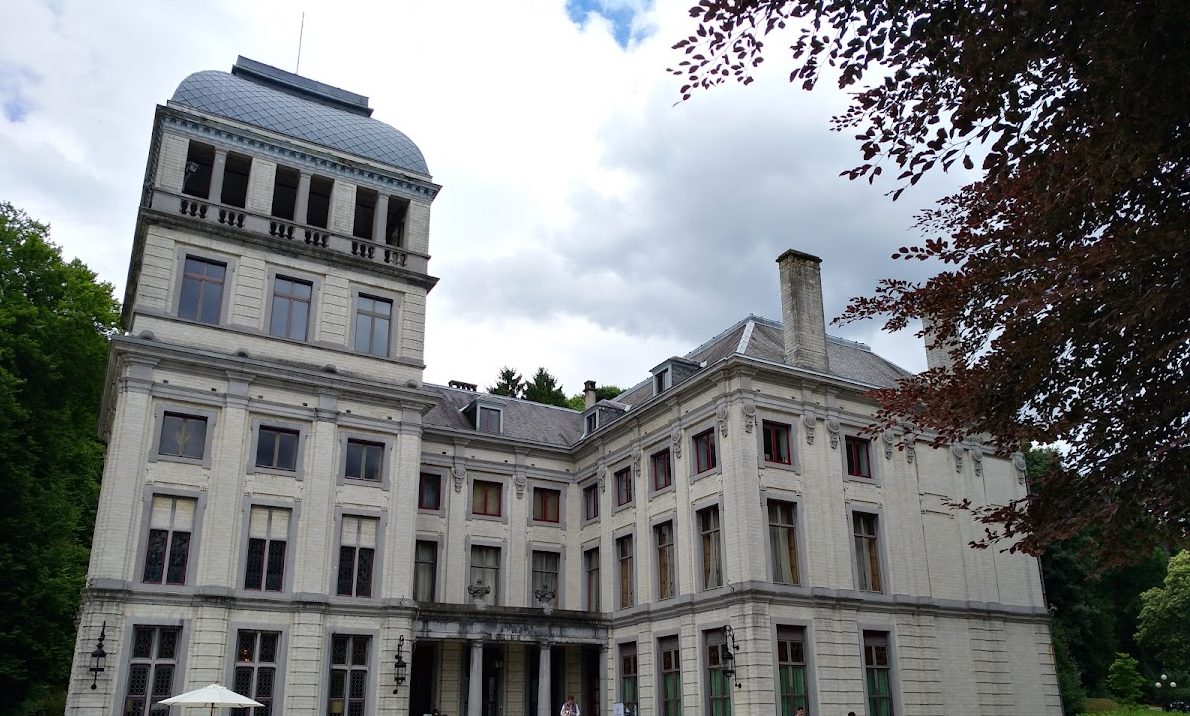
The present château was built in 1780 as a residence for the prioress. Its architecture is described as Neoclassical and, in another characterization, eclectic. By 1903, the surviving remains consisted of one wing of the château, part of the enclosing wall, and several rural buildings.
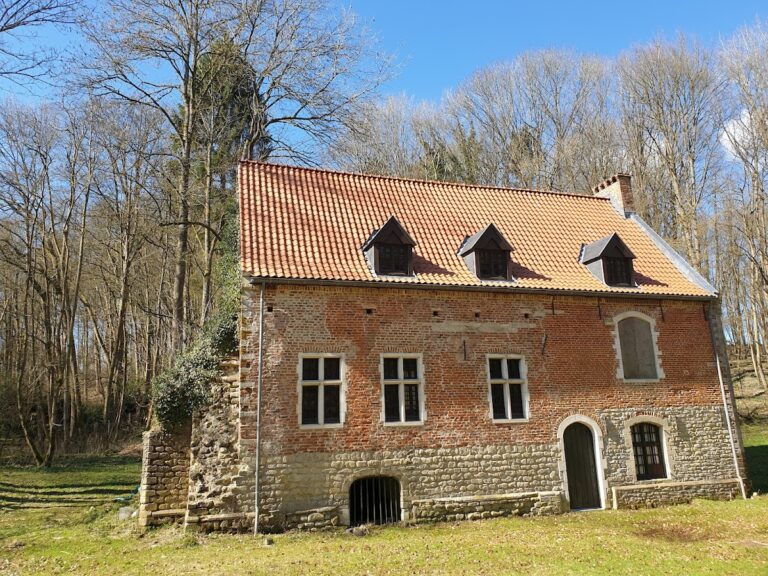
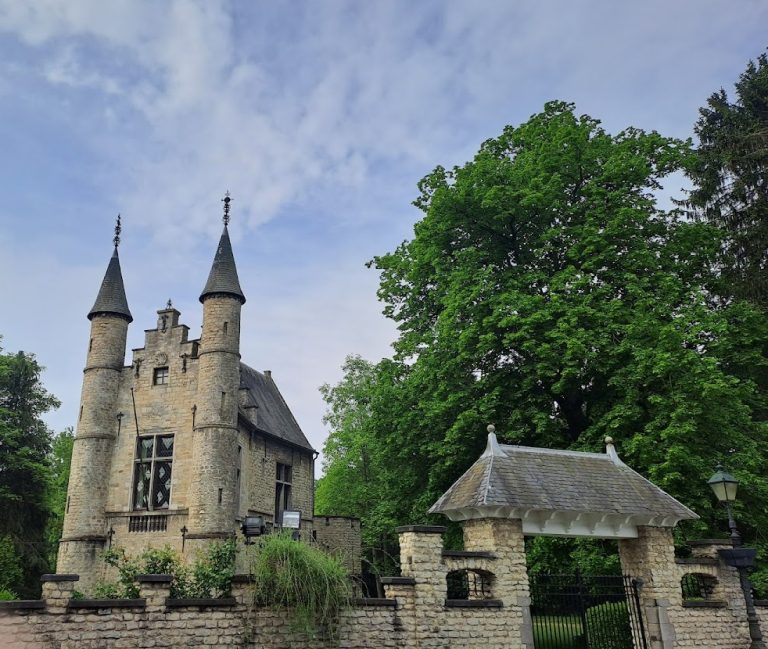
The former farm and stables were rebuilt in 1915 under Albert Roosenboom’s direction, as part of the wider reconstruction of the priory complex. This building is sometimes incorrectly identified as the former priory or as a beguinage, a community of religious women, but it resulted from the rebuilding of earlier agricultural buildings.
Chapel, wall, and former mausoleum
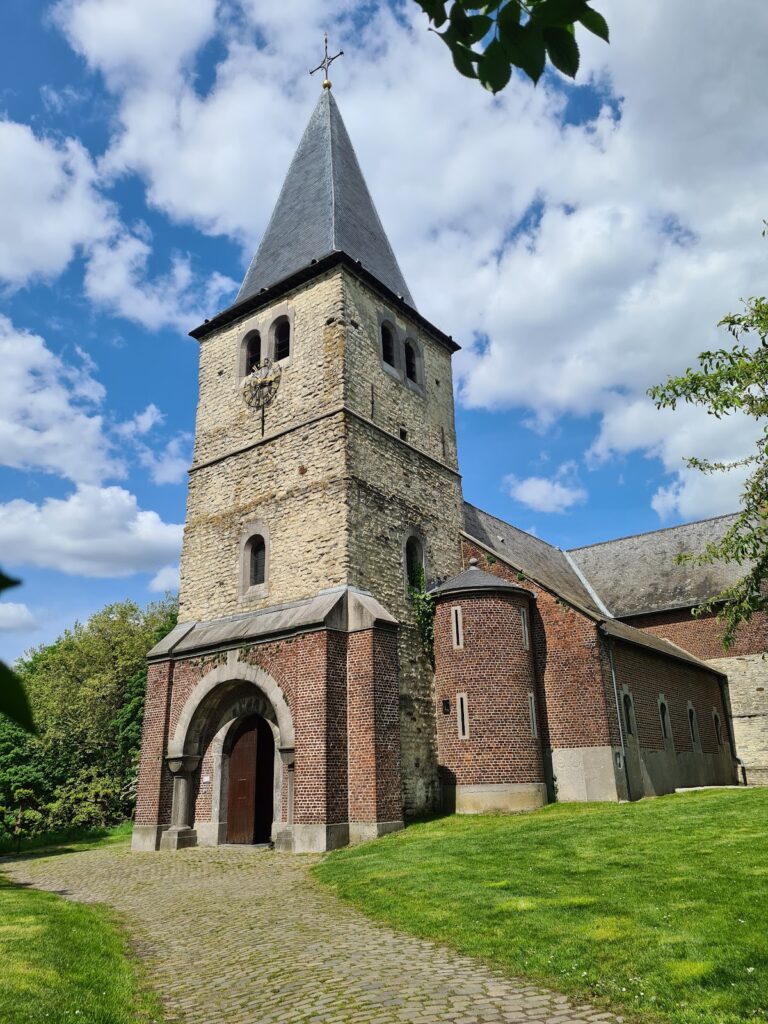
The Saint Anne Chapel stands on a hill within the estate. It is described as one of the few Romanesque buildings in Belgium to have retained its original appearance. An enclosing wall was erected in 1650 to protect the priory’s various buildings.
The mausoleum associated with Adelaide of Burgundy’s heart burial once stood at the priory, but it has disappeared. Its former presence remains connected with the early religious history of the estate.
Nearby sites