Castro de Leceia: A Prehistoric Fortified Settlement in Portugal
Site at a Glance
- Rating
- 3.7
- Popularity
- Very Low
- Country
- Portugal
- Primary era
- Stone Age
- External website
- Open
- Eras represented
- Stone Age
- Civilizations
- Unclassified
- Site type
- Military
- Remains
- Fortified Town
On this page9 sections
History
Castro de Leceia is a prehistoric settlement in Portugal, at Barcarena in Oeiras Municipality, occupied by communities associated with the Castro culture from the Late Neolithic through the Chalcolithic, or Copper Age. The site was used for approximately 1,000 years and was abandoned around the transition to the Bronze Age. Its history combines an early sedentary community, the later construction of substantial fortifications, and a successful agro-pastoral economy.
Late Neolithic beginnings
The earliest occupation belongs to the Late Neolithic, a prehistoric period associated with settled communities, farming, animal husbandry, and widespread use of polished stone tools. People first established themselves in the Carrascal Caves, and their strong sedentary way of life appears to have been present from the beginning. The settlement at this stage consisted of circular houses without additional defensive structures.
Animal remains indicate that swine were the most frequent ungulates during the Neolithic, followed by cattle and caprines, meaning sheep and goats. Cattle probably supplied the largest share of dietary protein, while hare and deer made only a small contribution. The community also occupied a landscape connected with the Ribeira de Barcarena, which was then a river and provided shellfish.
Fortification and the Early Chalcolithic
During the Early Chalcolithic, migrants associated with the Castro culture arrived at Leceia. After a brief abandonment, probably lasting no more than several decades, the first defensive construction was carried out around 2900–2800 BCE. The fortified settlement supported a population of approximately 200–300 people and developed an agro-pastoral economy that combined crop cultivation with animal husbandry.
The new community continued to exploit local river resources while reorganizing life within a defended settlement. Caprines became predominant among the animal remains, reflecting increasing reliance on milk and wool as well as meat. Swine replaced cattle as the main source of protein. Equus was present in small numbers, but these animals were undomesticated.
Middle and Upper Chalcolithic
During the Middle Chalcolithic, copper metallurgy became widespread and economic activity flourished. Copper-working remains, tools, and ingots show the spread of metal production at the settlement, while cheese molds and weaving-related ceramics point to the development of food processing and textile manufacture. The community’s agro-pastoral economy remained highly successful throughout the Chalcolithic, even as the population and defensive system later declined.
Leceia was contemporary with the Bell Beaker culture, a prehistoric tradition identified partly through distinctive bell-shaped pottery and related material practices. This association places the settlement within wider Chalcolithic cultural networks. During the later phases, new ellipsoidal houses increased the density of construction inside the fortified area, and Bell Beakers were found in two of these houses.
Abandonment and archaeological investigation
By the end of the Chalcolithic and the beginning of the Bronze Age, Castro de Leceia was abandoned. Some structures were dismantled or destroyed, although houses continued to be built against the defensive walls during the final phase. The site therefore preserves evidence of both the weakening of its defensive system and the continued use of its enclosed space before occupation ended.
Carlos Ribeiro, a nineteenth-century Portuguese geologist and archaeologist, first excavated and reported Leceia in 1878, presenting his results to the Lisbon Academy of Sciences. His work is regarded as the first monograph devoted to a prehistoric Portuguese settlement. Leite de Vasconcellos, a Portuguese archaeologist and ethnographer, excavated the site in 1914. Further archaeological interventions continued through 2003, including a major campaign conducted from 1983 to 2002.
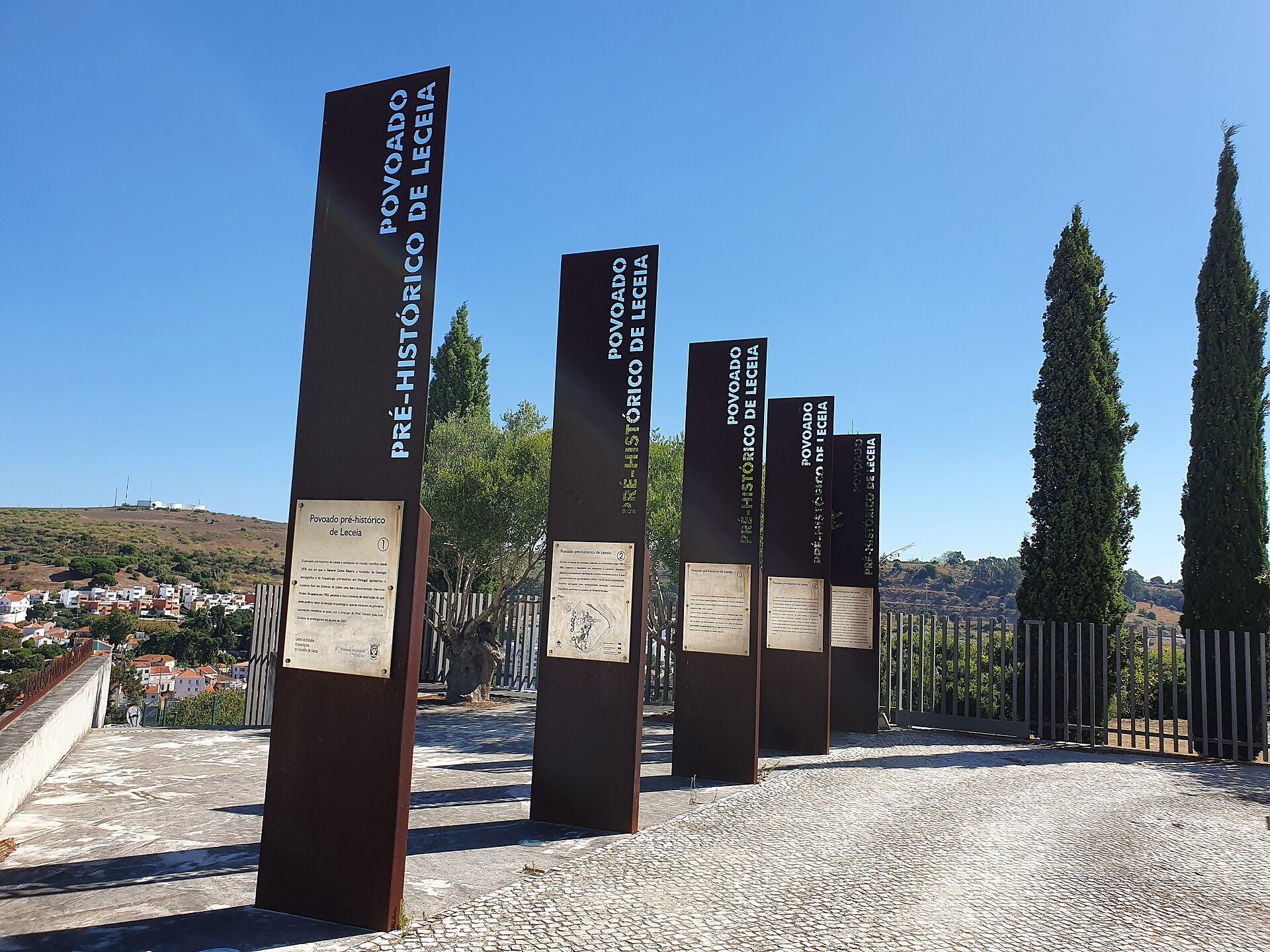
Castro de Leceia has been classified as a Property of Public Interest since 1963 and is regarded as an important archaeological station in Portugal. A permanent exhibition at the Fábrica da Pólvora de Barcarena, approximately two kilometres away, presents a model of the settlement and objects recovered from it.
Remains
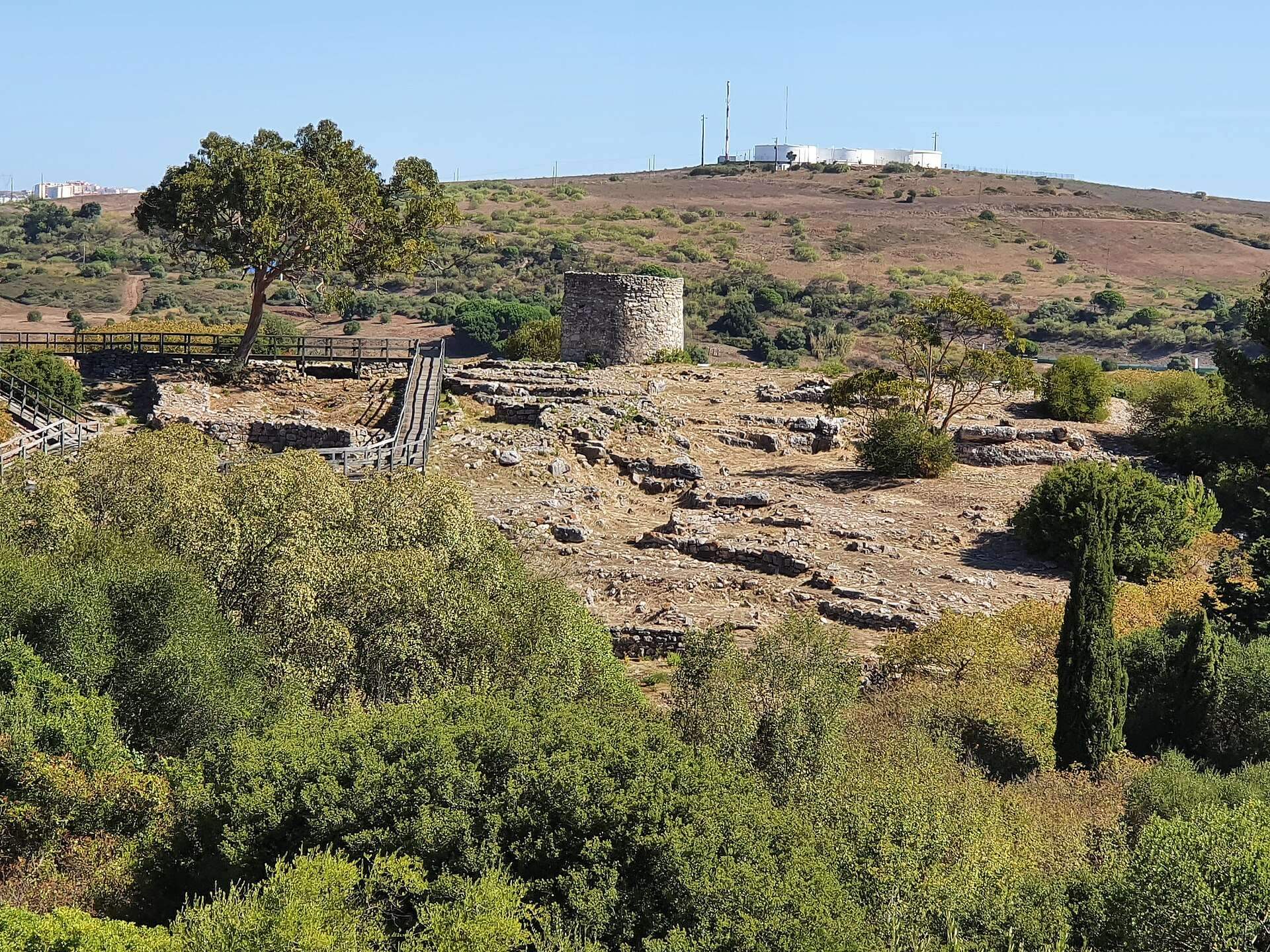
The surviving archaeological area combines an earlier cave occupation with a fortified settlement built from local limestone. The constructed area of the settlement covered approximately 10,000 square metres, while its defensive works occupied about 11,000 square metres. The site has a view toward the Ribeira de Barcarena, whose former river environment contributed to the community’s subsistence.
Early houses and the Carrascal Caves
The earliest settlement included circular houses without defensive structures. The Carrascal Caves formed part of this Neolithic occupation and represent the first known setting used by the community. Later Chalcolithic construction introduced ellipsoidal houses, increasing the density of buildings within the fortified area. Some of these later houses contained Bell Beakers decorated with acacia-leaf motifs.
Fortified settlement
The defensive system was built rapidly from blocks of local limestone during the Early Chalcolithic. It initially consisted of three lines of walls and three entrances protected by towers. The walls were reinforced during the Middle Chalcolithic, when the entrances were narrowed, and were strengthened again during the Upper Chalcolithic.
Excavations have revealed both domestic and defensive structures. During the final phase, some houses were built directly against the defensive walls, joining residential construction to the existing enclosure. The arrangement preserves the changing relationship between household buildings and the fortifications over the course of the Chalcolithic.
Tools, production, and daily activities
The excavated objects reflect farming, fishing, textile production, food processing, and metalworking. Flint arrowheads, sickle blades, blades, scrapers, axes, adzes, chisels, hammerstones, and millstones represent a range of agricultural, woodworking, hunting, and domestic activities. Loom weights and ceramics associated with weaving point to textile production, while cheese molds belong to the Middle Chalcolithic evidence for dairy processing.
Fishing and river-based activities are represented by copper fishhooks. Other finds include bone beads and pins, copper ingots, and a copper axe. Ceramic vessels belong to styles characteristic of the Estremadurean Early and Middle Chalcolithic, cultural sequences associated with the Estremadura region of Portugal. Many excavated objects are displayed at the National Museum of Archaeology and the Geological Museum of the National Energy and Geology Laboratory. The exhibition at the Fábrica da Pólvora de Barcarena also presents objects from the settlement and a model reconstructing its houses, organization, cults, and rituals.