Lighthouse of Alexandria: A Ptolemaic Harbor Beacon
Site at a Glance
- Popularity
- Very High
- Country
- Egypt
- Primary era
- Classical
- Eras represented
- Classical, Medieval
- Civilizations
- Ptolemaic
- Site type
- Infrastructure
- Remains
- Lighthouse
On this page17 sections
History
The Lighthouse of Alexandria was a Ptolemaic-period beacon on Pharos at the entrance to Alexandria’s harbor in Egypt. Ptolemy I Soter, ruler of the Ptolemaic Kingdom, commissioned it after becoming king in 305 BCE. Construction began during his reign, with proposed starting dates ranging from about 299 to 285 BCE, and the work was completed under his son Ptolemy II Philadelphus. Building took about twelve years and cost the royal treasury around 800 talents of silver, approximately 23 metric tonnes.
Alexandria and the lighthouse’s purpose
Alexander the Great founded Alexandria in 332 BCE on an isthmus opposite Pharos, seeking to establish a major port connecting Mediterranean shipping with traffic on the Nile. A causeway and harbor barrier, the Heptastadion, later joined the island to the mainland. Its name means “seven stadia,” with a stadion measuring about 180 metres. More than 1,200 metres long, it divided the Great Harbour to the east from the port of Eunostos to the west.
The lighthouse helped ships find their way into the strategically important harbor and served as a landmark on Egypt’s flat coast. Its elevated position also allowed observation of the sea, where Alexandria’s principal military threat was expected to approach. The building presented the city’s grandeur as well as serving practical purposes. A story that Pharos’s inhabitants lured ships to wreck was also given as a reason for its construction.
Sostratus of Cnidus is traditionally named as the architect, although the attribution is disputed; he may instead have commissioned a statue for the building. Strabo mentions a dedication to the “Savior Gods.” These have been identified either as the Dioscuri, the twin gods Castor and Pollux associated with sailors, or as Ptolemy I, whose name Soter means “Savior.” Lucian recounts a tale in which Sostratus carved his own name into the stone and covered it with plaster bearing the king’s name.
Military and religious associations
Control of Pharos also mattered during military conflict. In 48 BCE, amid Julius Caesar’s struggle with Ptolemy XIII, Caesar seized the island and stationed troops there. Holding it secured a sea route through which supplies and reinforcements could reach Alexandria.
Pharos also held a place in the religious life of Alexandria’s Jewish community. An annual festival there honored the Greek translation of the Jewish Scriptures, traditionally believed to have been completed on the island under Ptolemy II. Philo of Alexandria described the observance as commemorating the place where the translation’s light first appeared.
Earthquakes, decline, and reuse
The lighthouse remained in use for nearly seventeen centuries, into the fourteenth century, but a series of earthquakes damaged it. Events in 796 and 951 were followed by a major earthquake in 956, which brought down the upper part of the structure and its summit statue. Repairs included the addition of a dome of Islamic design. Further severe damage followed later earthquakes, especially the Crete earthquake of 1303, which was also associated with a tsunami. Another damaging earthquake struck in 1323.
When the Moroccan traveler Ibn Battuta visited in 1326, one side had fallen into ruin, though he could still enter. By his return in 1349, the damage had made entry impossible. Sultan An-Nasir Muhammad planned to build a replacement nearby, but the project did not proceed after his death in 1341. A different explanation for the lighthouse’s destruction appears in a story recorded by the tenth-century historian al-Masudi. He blamed it on a Byzantine agent who, during the rule of the Umayyad caliph Abd al-Malik ibn Marwan (705–715), supposedly obtained permission to search for treasure and weakened the structure before escaping by ship.
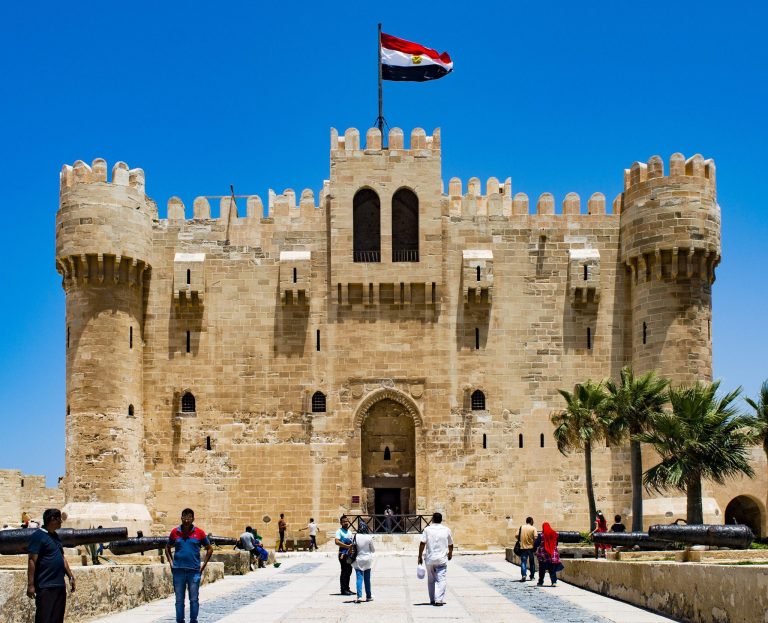
After its abandonment, the lighthouse’s remains were gradually quarried for building stone. In 1477, Qaitbay, a Mamluk sultan from Egypt’s military ruling elite, ordered a citadel on the site to defend Alexandria against the Ottoman threat. By 1480, stones from the lighthouse had been incorporated into the fort.
Underwater investigations
Interest in locating the submerged lighthouse grew during the twentieth century. Hermann Thiersch’s influential early-1900s study estimated a height of about 135 metres. In 1916, engineer Gaston Jondet’s soundings supported the proposed location of the foundations near the citadel; archaeologists Raymond Weill and, later, Leopold Halliday Savile also investigated the harbor. From the early 1960s, Alexandrian diver Kamel Abul Saadat explored the seabed and drew attention to large submerged blocks. In 1962, he persuaded the Egyptian navy to raise a colossal statue of Isis.
A UNESCO expedition led by marine archaeologist Honor Frost confirmed the lighthouse remains in 1968 and mapped the seabed with Abul Saadat. Work paused amid a shortage of specialist marine archaeologists and growing military restrictions in the area. Frost published the first scholarly article on the site in 1975. Franck Goddio began investigating the opposite side of the harbor in the early 1990s.
Jean-Yves Empereur’s underwater excavations in 1994–96 mapped the site and recorded more than 3,000 blocks, over two-thirds of them architectural. The team catalogued more than 3,300 pieces by the end of 1995. These discoveries supported a reconstruction about 110 metres high and led researchers to reject the enclosing wall included in Thiersch’s earlier reconstruction. Thirty-six granite fragments and other finds were restored and displayed in Alexandria museums. In 2025, an excavation led by archaeologist and architect Isabelle Hairy raised about twenty large blocks for study and digital recording, work intended to support a more detailed architectural reconstruction.
Remains
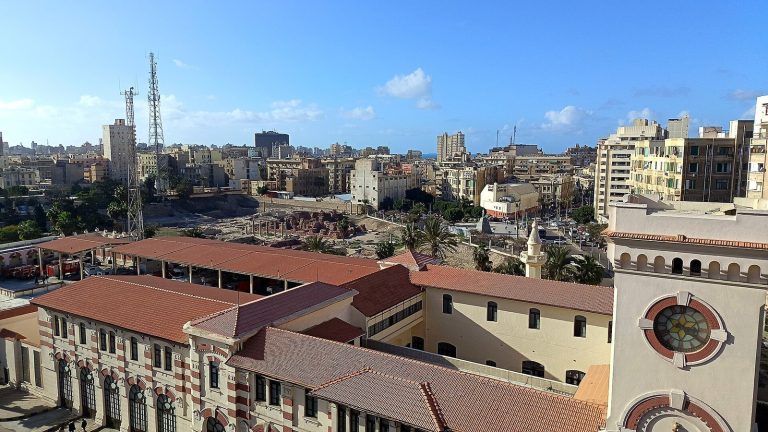
The lighthouse stood at the eastern end of Pharos, or possibly on a small island nearby, at the mouth of Alexandria’s harbor. Its submerged remains lie near the base of Qaitbay Citadel, and only a small part of Pharos remains above water. Reconstructions show a tall, tapering tower with a square lower section, an eight-sided middle stage, and a circular upper stage. Its exact height and precise form remain uncertain.
Tower form and interior
Reconstructed elevation
Archaeological reconstruction places the tower at about 110 metres high, with estimates ranging from 103 to 118 metres. Earlier proposals include Thiersch’s estimate of about 135 metres and the medieval geographer al-Idrisi’s figure of 162 metres. Even at the lower estimates, the lighthouse ranked among the tallest structures of the ancient world. Its square base is estimated at about 30 metres on each side.
One reconstruction assigns roughly 70 metres to the lower section, where an arched ramp led upward past about fifty rooms arranged around an interior ramp. These rooms may have housed maintenance workers or stored fuel. Windows set at varying positions followed the ramp’s course, which was broad enough for pack animals carrying fuel. A terrace above this level is reconstructed with a parapet about 2.3 metres high and four Tritons, sea beings in Greek mythology, blowing horns at its corners. The eight-sided middle stage is estimated at about 34 metres high and 18.3 metres wide, with an internal stairway leading to the top. The circular upper section is estimated at about 9 metres high and contained a staircase of eighteen steps.
Twelfth-century description
A description written in 1166 by the traveler Abu Haggag Youssef Ibn Mohammed el-Balawi el-Andaloussi gives a different account of the interior. It describes a four-storey base, with eighteen rooms on the second floor, fourteen on the third, and seventeen on the fourth. A covered masonry passage, about 1.89 metres wide, was broad enough for two riders to pass. The account gives the base as about 30 metres across on each side, the eight-sided level as 16.4 metres wide, and the cylindrical upper level as 8.7 metres in diameter. It also describes a connecting ramp about 300 metres long and 10 metres wide.
Stonework and summit
Masonry and construction
The tower was assembled from large blocks of light-colored stone, though the full range of materials is uncertain. Limestone and sandstone from the Wadi Hammamat quarries east of Alexandria are proposed for the main construction, while granite was used for major components such as door frames. Marble has also been suggested. Excavated blocks have lead pins or fastenings, and medieval descriptions mention lead filling the joints between masonry blocks.
Light, images, and later use
A mirror at the summit reflected sunlight by day, while a fire there served as a night signal. Alexandria’s Roman coins show a Triton at each corner of the tower and a statue at its peak, identified as Poseidon or Zeus. The summit figure’s identity remains uncertain: a first-century glass gem depicts Zeus, a second-century glass vessel from Afghanistan has been read as showing Poseidon, and a mosaic dated to 539 depicts Helios, the Greek sun god. In the ninth century, Ahmad ibn Tulun, a ruler of Egypt and founder of the Tulunid dynasty, installed a mosque at the tower’s summit.
Inscriptions
Strabo describes a dedication to the “Savior Gods” made with lead letters set into a wall. The dedication has been associated either with the Dioscuri or with Ptolemy I. Al-Masudi also describes an inscription to Zeus on the seaward face.
Submerged architecture and statuary
Entrance and architectural blocks
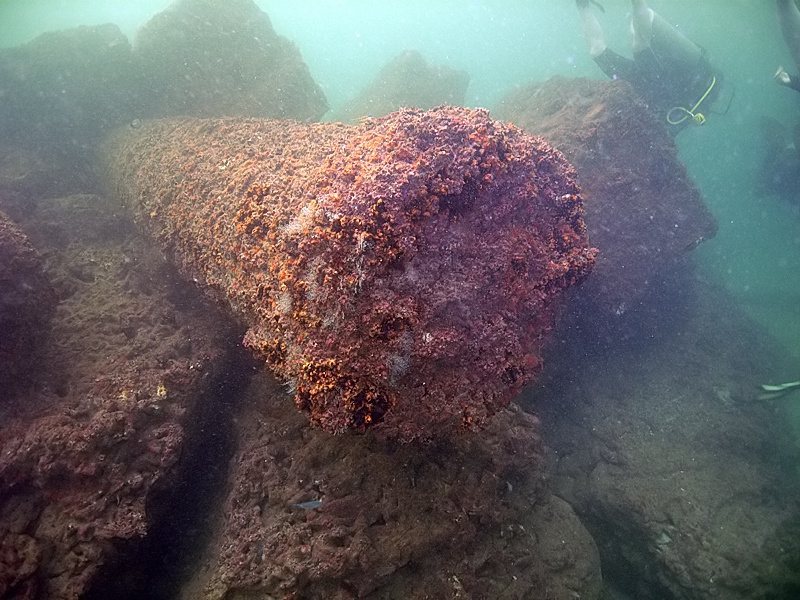
The seabed holds massive granite blocks, many broken into pieces, as well as fragments of columns and statues. Door frames found at the foot of the citadel include Aswan granite examples about 11.5 metres high and weighing more than 70 tonnes. Their scale, position, and lead fastenings support their identification as parts of the lighthouse. The blocks raised in 2025 include elements of a monumental entrance, a threshold, and large upright slabs that formed part of a wall. They also include parts of a previously unrecognized pylon, a monumental gateway combining Egyptian forms with Greek construction methods.
Egyptian monuments and reused elements
Underwater finds include about thirty sphinxes, among them examples associated with the reigns of Senusret II and Psamtik II. Obelisks linked to Seti I and columns bearing carvings or royal name frames of Ramses II have also been found. Some column bases and capitals were reused in later buildings.
Colossal statues
Two colossal statues recovered underwater near the citadel depict a Ptolemaic ruler as an Egyptian pharaoh and the goddess Isis. They may have stood before the lighthouse facing ships entering the harbor. The ruler may be Ptolemy II, while Isis may represent his wife Arsinoe II, who was deified after her death.