Alexandria Ancient Roman Theater: A Roman-Period Monument in Egypt


Site at a Glance
- Rating
- 4.4
- Popularity
- Medium
- Country
- Egypt
- Primary era
- Classical
- External website
- Open
- Eras represented
- Classical
- Civilizations
- Byzantine, Roman
- Site type
- Entertainment
- Remains
- Theatre
On this page5 sections
History
Alexandria Ancient Roman Theater is a Roman-period monument in Egypt, built at the beginning of the fourth century AD in the Kom al-Dikka area of central Alexandria. It is associated with the Byzantine Empire, the eastern continuation of the Roman Empire that ruled Egypt after the Roman imperial period and preserved aspects of its architectural and institutional traditions. The building is recognized as a heritage monument of historical importance.
Discovery and changing interpretations
The monument came to light by accident in 1960, when a Polish archaeological mission was clearing soil in a search for the tomb of Alexander the Great, the Macedonian king and conqueror. Marble seating appeared during the work, leading archaeologists to identify the structure as a Roman theater. Its original purpose, however, remained debated.
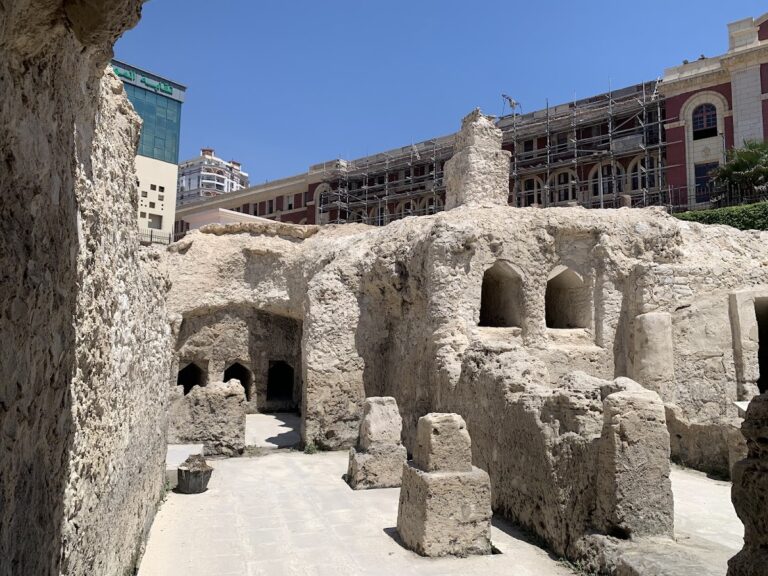
Excavation continued for about 30 years through cooperation between the Polish mission and Alexandria University. In February 2004, several study halls were found beside the auditorium. Their discovery led to the possibility that the building had first functioned as a large lecture hall for students, while also being used as a theater during festivals or other special occasions.
Remains
Auditorium and seating
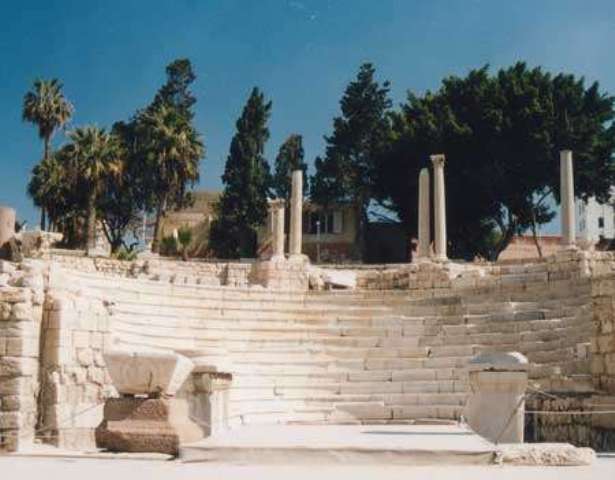
The main auditorium follows a horseshoe-shaped, or U-shaped, plan. It contains 13 rows of seating marked with Greek letters and numerals, an arrangement that organized places for an audience of approximately 600 people. The seating is described as marble, while the material is also identified as pink granite; the precise use of these two materials is unclear.
The seating rests on a thick limestone wall enclosed by a second outer wall. Arches and vaulted structures join the two walls, with the outer wall providing substantial support for the inner one. Above the seating were five boxes or compartments, of which two survive. Groups of columns supported their domed roofs.
Western entrance halls
Two halls at the western entrance contain mosaics with geometric decoration. They form part of the surviving architectural complex and add to the evidence for the building’s varied spaces beside the auditorium.