Roman Villa of the Birds: An Early Roman Residence in Alexandria

Site at a Glance
- Rating
- 4.8
- Popularity
- Very Low
- Country
- Egypt
- Primary era
- Classical
- Eras represented
- Classical
- Civilizations
- Roman
- Site type
- Domestic
- Remains
- Villa
On this page9 sections
History
The Roman Villa of the Birds is an early Roman private residence in Alexandria, Egypt, probably built during the first century AD. It formed part of the residential district of Kom el-Dikka, which developed between the first and third centuries. The villa takes its name from a prominent mosaic showing several bird species, a distinctive survival among the few remaining figural mosaics from Roman-period Alexandria.
Residential Alexandria
The villa was one of three Roman villas in Kom el-Dikka. A Roman villa was a substantial private house, often arranged around courtyards and furnished with durable mosaic floors. The building retained its original plan and decorated floors through later changes, preserving evidence of domestic life in Alexandria during the Early Roman Period.
Destruction and Urban Transformation
A fire destroyed the villa sometime in the late third century. Afterward, people removed parts of the building for construction materials, and the site continued to be occupied for a long period. The floor mosaics survived in relatively good condition despite these changes.
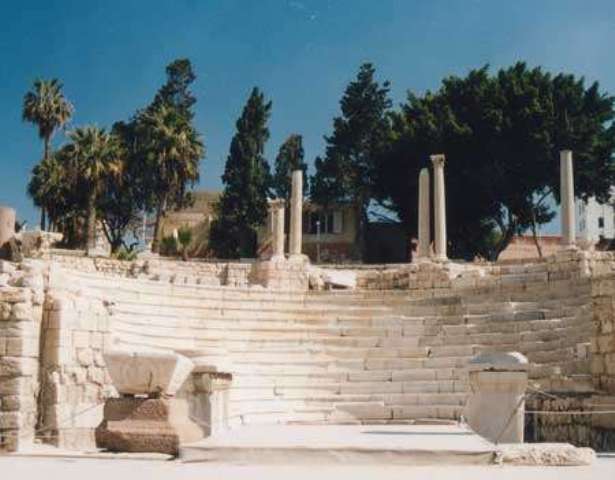
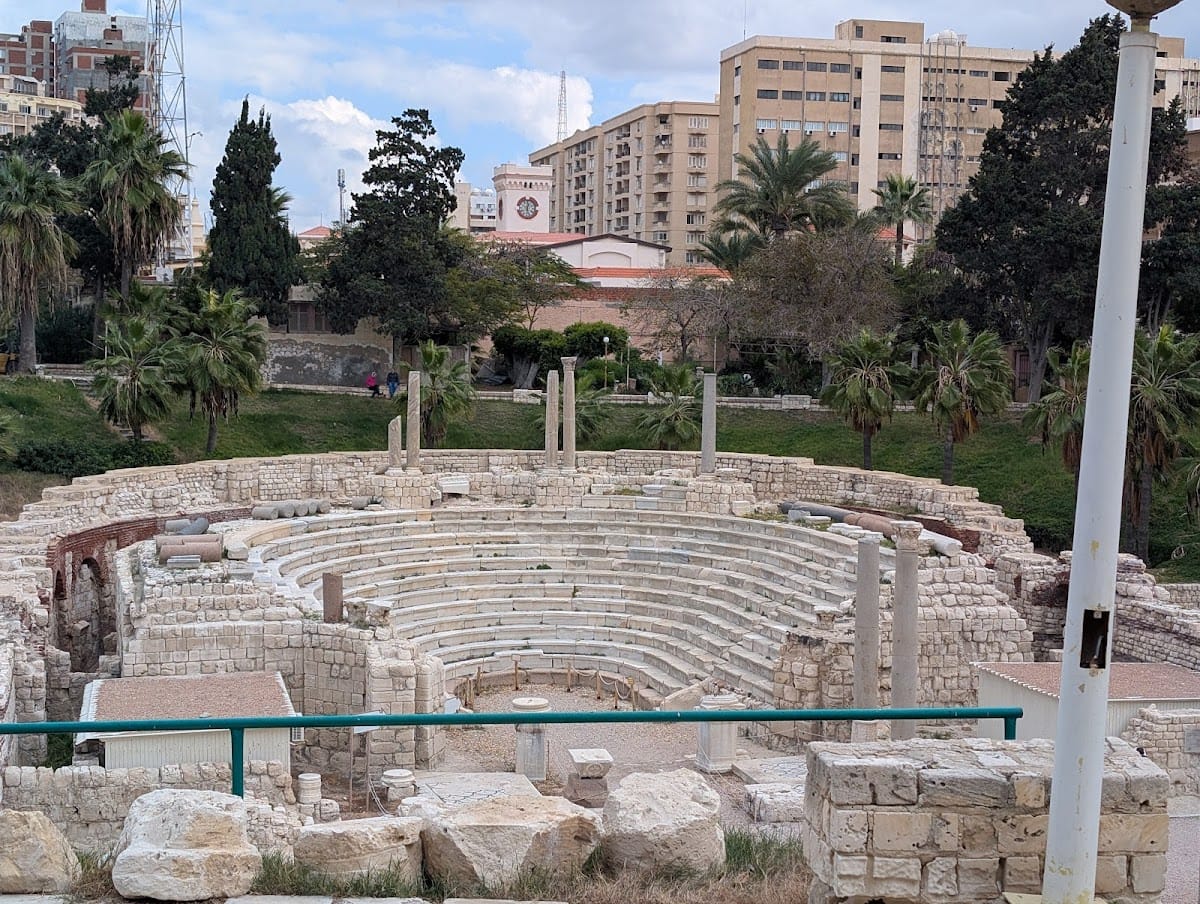
Kom el-Dikka suffered extensive damage during the late third century through the Palmyrene invasion, an attack by forces from the powerful eastern kingdom of Palmyra, the siege of Alexandria by the emperor Aurelian, and the repressions of the emperor Diocletian. From the fourth to the seventh centuries, private houses in the district were largely replaced by public buildings, including a bath complex, lecture halls, and a theater. Kom el-Dikka consequently became a major civic center of Alexandria.
Excavation and Conservation
Archaeological work at Kom el-Dikka began in 1960 under the Polish archaeologist Kazimierz Michałowski. Excavation and conservation have continued through a Polish-Egyptian expedition connected with the Polish Centre of Mediterranean Archaeology of the University of Warsaw and Egypt’s Ministry of Tourism and Antiquities, directed by Grzegorz Majcherek. In 1998, the American Research Center in Egypt began conserving, protecting, and displaying the villa’s mosaics and architecture with several Egyptian, Polish, and American partners. The principal conservation campaign ran from February 1998 to June 1999.
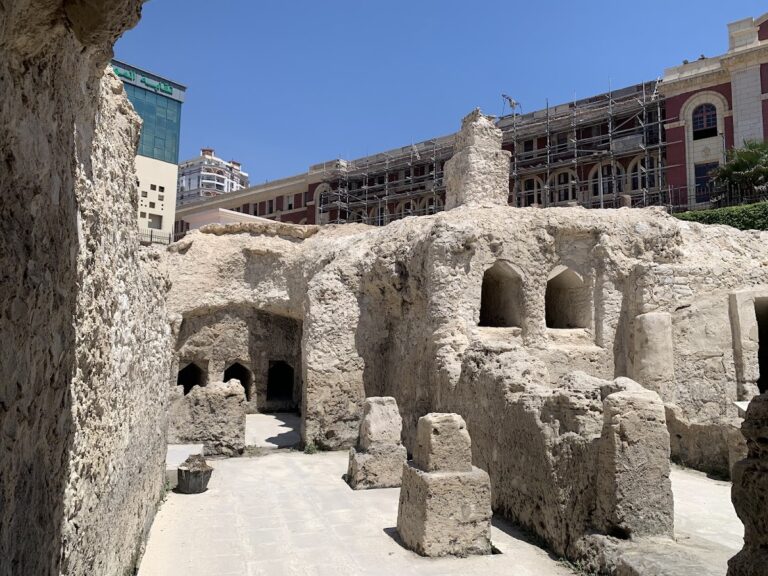
The villa lies within the archaeological park at Kom el-Dikka, which covers nearly 40,000 square meters and is substantially below the present street level. Kom el-Dikka is described as Alexandria’s largest and most complete above-ground archaeological site. The Roman Villa of the Birds is one of the three Early Roman villas preserved there, while much of the period’s other above-ground construction was lost through third-century destruction and the systematic removal of building materials.
Remains
House Plan and Rooms
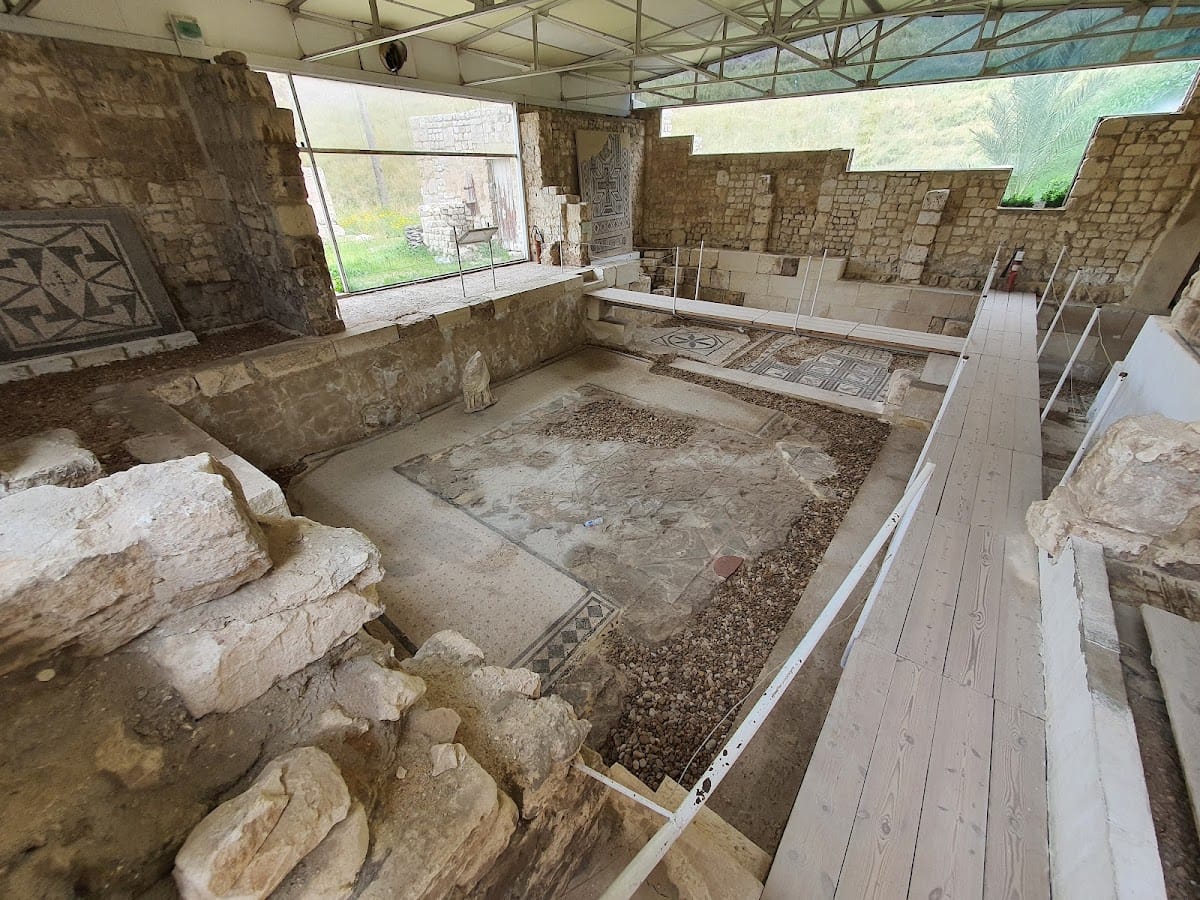
The villa preserves its original floor plan and was organized around a central courtyard. The largest room was a formal dining room, or triclinium, a Roman room used for hosted meals. Its entire floor carried a geometric mosaic, and the room opened onto the courtyard, making it one of the house’s most public spaces.
At the front of the villa, a room probably served as a bedroom, or cubiculum, a private Roman sleeping chamber. Its floor had an elaborate mosaic. A small annex behind it was separated from the bedroom by a thin screen wall and contained a simpler black-and-white mosaic.
Bird Mosaic
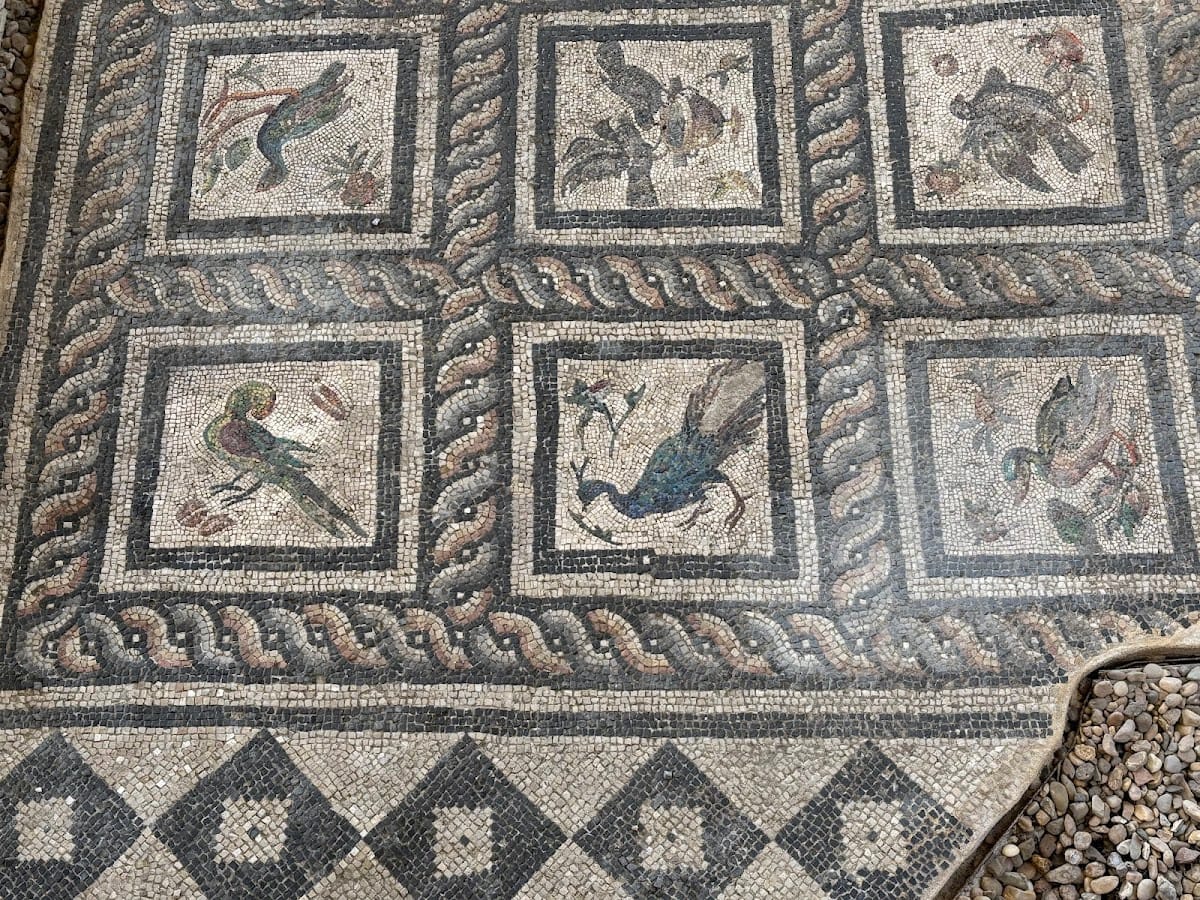
Four mosaics survive in the villa, covering almost 110 square feet. Two are fully preserved and two are partly preserved. The mosaic designated alpha-5 presents nine birds in nine separate squares. Its recognizable subjects include a parrot, purple gallinule, teal duck, peacock, pigeon, and a quail or partridge. The imagery has an Egyptian character while also reflecting artistic influences from the western provinces of the Roman world and from Pergamon, an ancient city in Asia Minor known for its artistic traditions.
Additional Mosaic Decoration
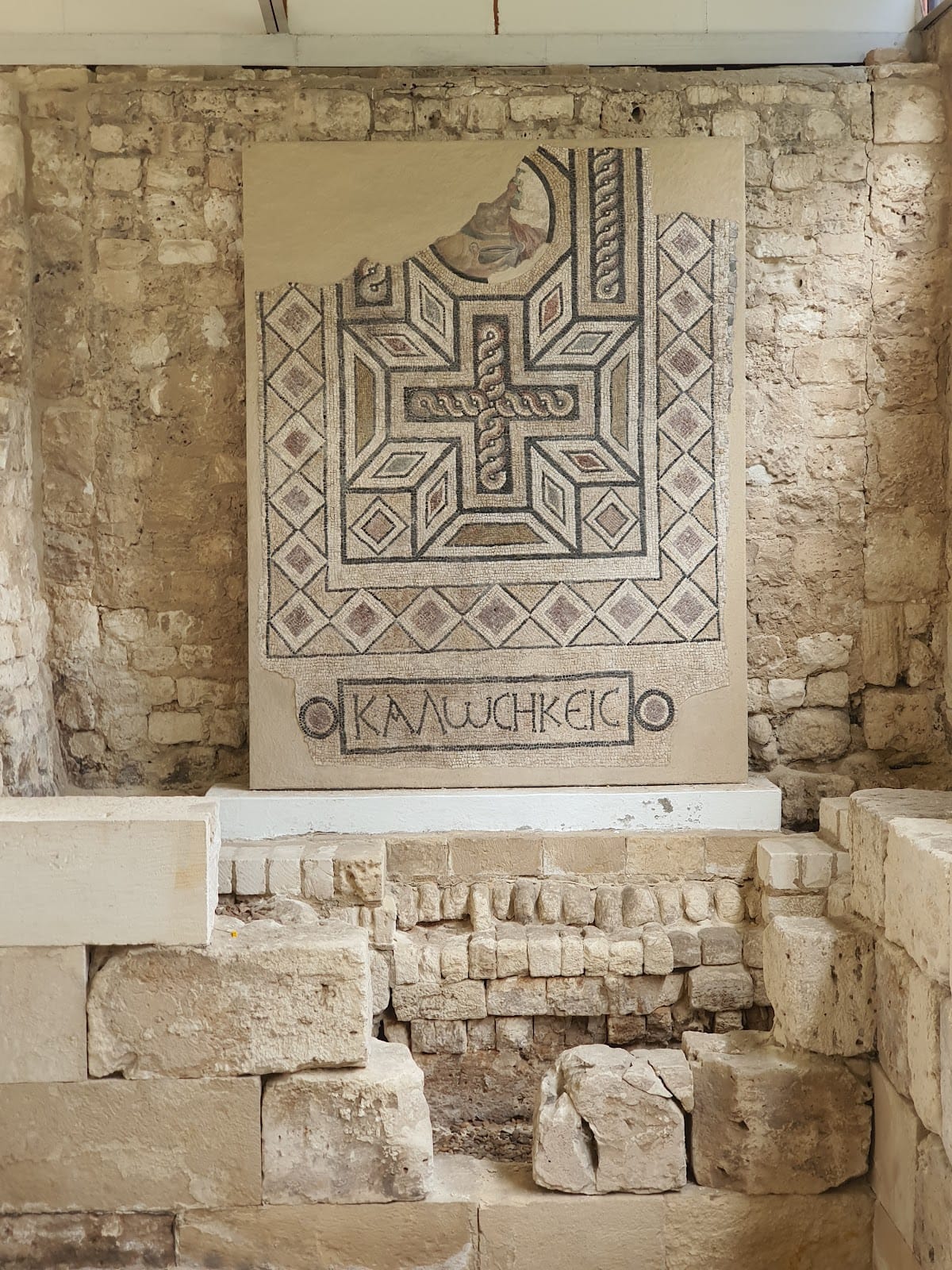
Other surviving decoration combines geometric patterns with floral motifs. A panther occupies the center of one composition. Another mosaic, found beneath the wall of a Byzantine building, contains geometric and floral designs with a panther at its center. A separate mosaic discovered at the nearby Roman theater bears the word “Welcome.”
Reconstructed Fabric and Protection
Some portions of the villa’s walls were rebuilt with limestone from Helwan, in the greater Cairo area, using traditional Roman construction techniques. The reconstructed sections were deliberately distinguished from the original fabric. A roofed building with glass walls now shelters the villa, protecting its brightly colored mosaics from fading in direct sunlight, while a wooden footbridge permits movement through the house without contact with the fragile floors.