Laxenburg Castles: Imperial Residences and Historic Estates in Austria
Visitor Information
Google Rating: 4.7
Popularity: High
Country: Austria
Civilization: Early Modern, Medieval European, Modern
Site type: Domestic
Remains: Palace
History
The Laxenburg castles are situated in the town of Laxenburg in present-day Austria and were originally established under the Habsburg dynasty. Their origins reach back to the medieval period when the estate was first held by the Lords of Lachsenburg before passing into Habsburg hands in the 14th century.
From the time of Emperor Charles VI and especially during the reign of Maria Theresa in the 18th century, Laxenburg became a favored imperial residence and a retreat closely linked to the court at Vienna. Maria Theresa improved connections to Vienna by creating a continuous avenue from Schönbrunn Palace and establishing a dedicated railway line to the Southern Railway at Mödling, facilitating easier access for court members. The castles continued as important aristocratic residences with several noble families, including the Esterházy and Daun, building villas nearby to remain close to imperial authority.
In the 19th century, Laxenburg remained significant to the imperial family. Emperor Franz Joseph I and Empress Elisabeth spent their honeymoon there in 1854, and two of their children, Archduchess Gisela and Crown Prince Rudolf, were born within its walls. At the outbreak of World War I, the Blue Court (New Castle) was repurposed as a military hospital. Later, Emperor Karl I moved his court to Laxenburg in 1917, concentrating near the military high command in Baden and maintaining a degree of political distance from Vienna until the end of the monarchy in 1918.
After the fall of the Austro-Hungarian monarchy, the Habsburg-Lorraine family properties in Laxenburg came under the management of the War Victims’ Fund. Attempts to operate the estate commercially in the early 1920s proved unsuccessful. Under Nazi rule, in 1938 Laxenburg was incorporated into Vienna, and during the Second World War, the Blue Court and its outbuildings served as a Wehrmacht warehouse, with valuable furnishings relocated to museums in Vienna. The Soviet army occupied the castle and parts of the surrounding park after 1945.
Postwar neglect left much of the site in poor repair until the early 1960s when a joint municipal company was formed to manage the castle and park restoration. Agricultural lands remained under the city of Vienna’s administration. These changes marked the beginning of modern preservation and adaptive reuse efforts at Laxenburg.
Remains
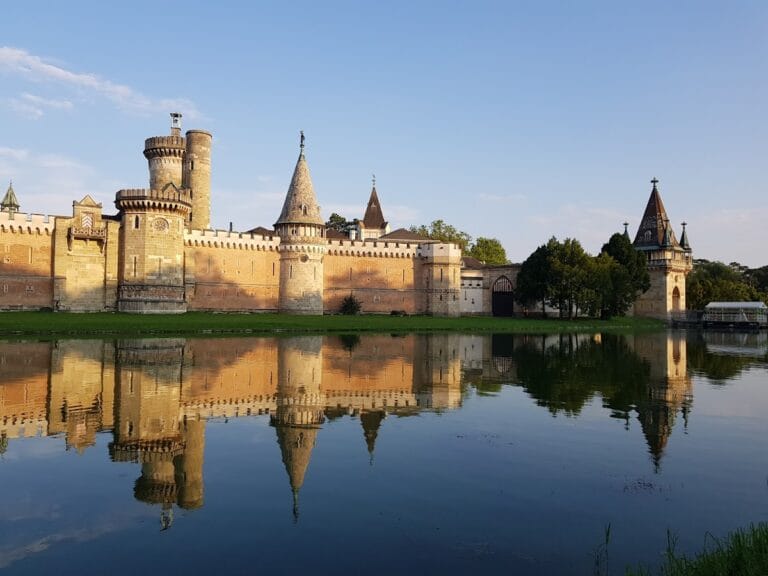
The castle complex at Laxenburg displays a layered history of medieval foundations, Baroque renovations, and 19th-century neo-medieval additions. It comprises three main historic structures surrounded by a large English-style landscape park with numerous ornamental and utilitarian features.
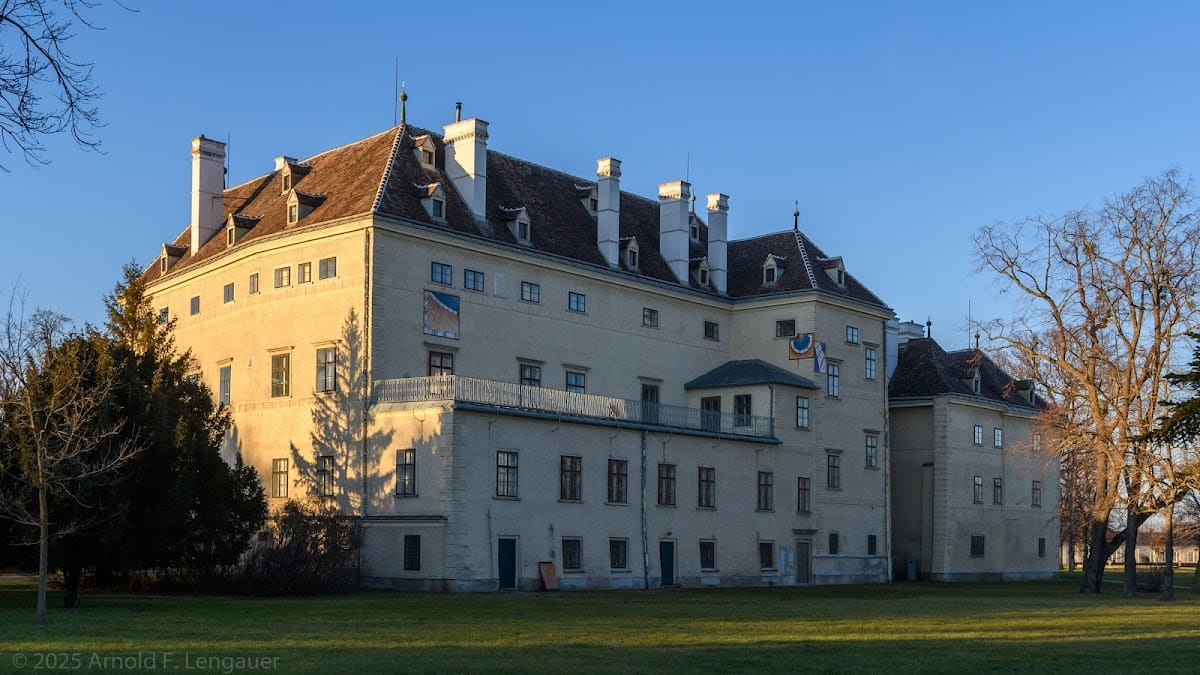
The Old Castle, dating to the 13th century, originated as a hunting lodge expanded by Albert III. After passing to the Habsburgs, it was remodeled in the Baroque style in the late 17th century by architect Lodovico Burnacini following destruction during the Second Turkish Siege of 1683. The building was reconstructed with an added upper floor and moats surrounding the structure were filled in during the 18th century. A chapel situated in one of the castle’s towers has existed since the 14th century, with a new building constructed in 1389 incorporating statues transferred from the Leopoldsberg chapel. Renovations in 1755 endowed the chapel with Baroque furnishings sourced from St. Anna’s Church in Vienna. The Old Castle served as a spring residence for the Habsburgs up to World War I and underwent extensive restoration in the 1970s. Today, it houses part of Austria’s Film Archive, while the chapel is used for concerts, weddings, and cultural events.
The Blue Court, also known as the New Castle, first appears in records from 1544 as a free court property. Its name derives from Sebastian von Ploenstein, whose family was known as von Blauenstein. The site underwent significant expansion under Reich Vice-Chancellor Friedrich Karl von Schönborn around 1710–1720, with Lucas von Hildebrandt responsible for architectural work. Later ownership passed to Count Adolf Metsch and the Daun noble family before Maria Theresa acquired it in 1762. She commissioned court architect Nikolaus Pacassi to further enlarge it between 1765 and 1767 to accommodate the large imperial household. Additions included the Belvedere with intricate illusionistic paintings dating to about 1774, a dining hall wing, and a castle theater. These interiors featured durable Kaiserstein limestone in prominent elements such as the column hall and grand staircase. The Blue Court was the birthplace of Crown Prince Rudolf in 1858. During World War I, it functioned as a military hospital, and Emperor Karl I relocated his court there from Schönbrunn in 1917, residing until early 1918. After World War II, Soviet forces used the castle as a command post during their occupation. Currently, some areas like the dining hall wing and theater are not open to the public; they are managed by the International Institute for Applied Systems Analysis and serve as a conference venue.
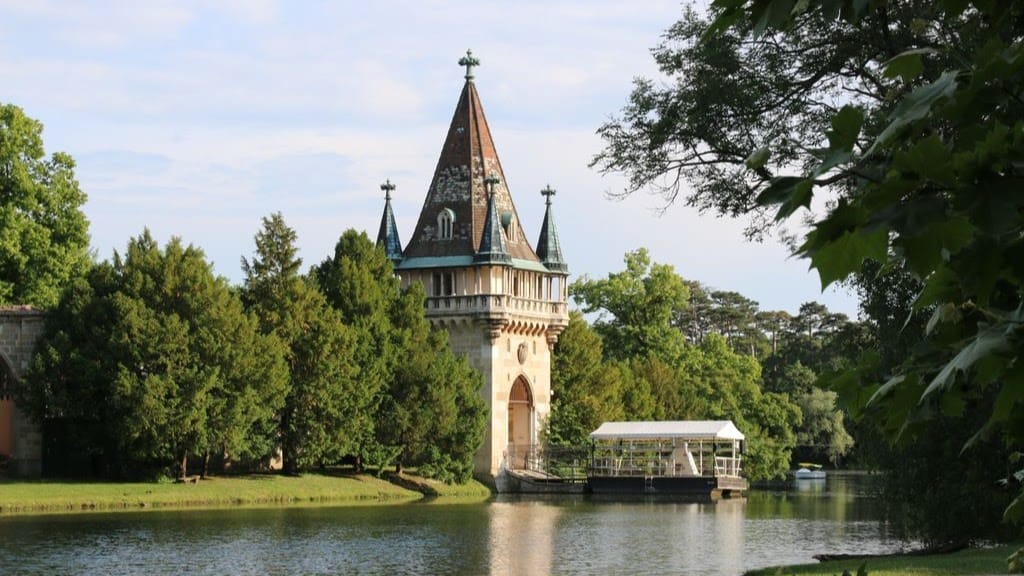
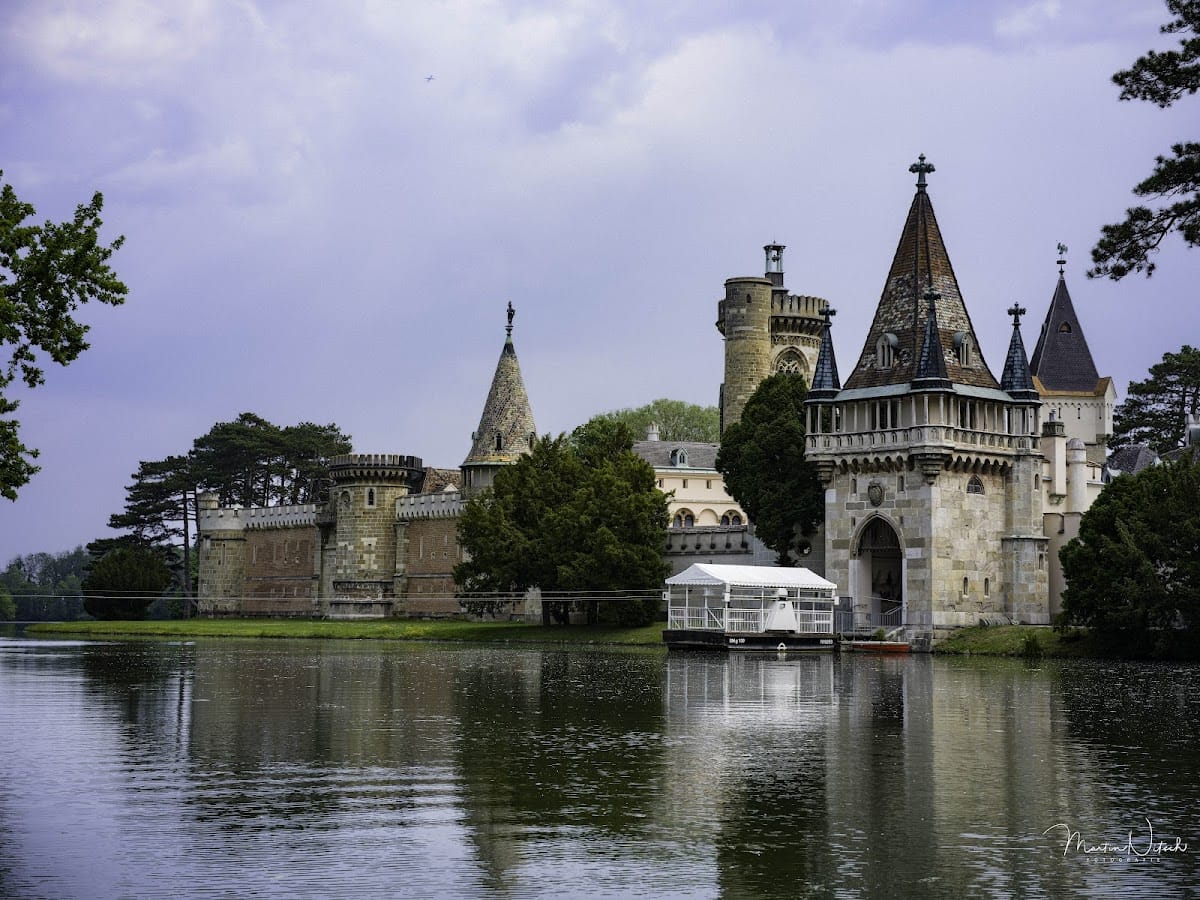
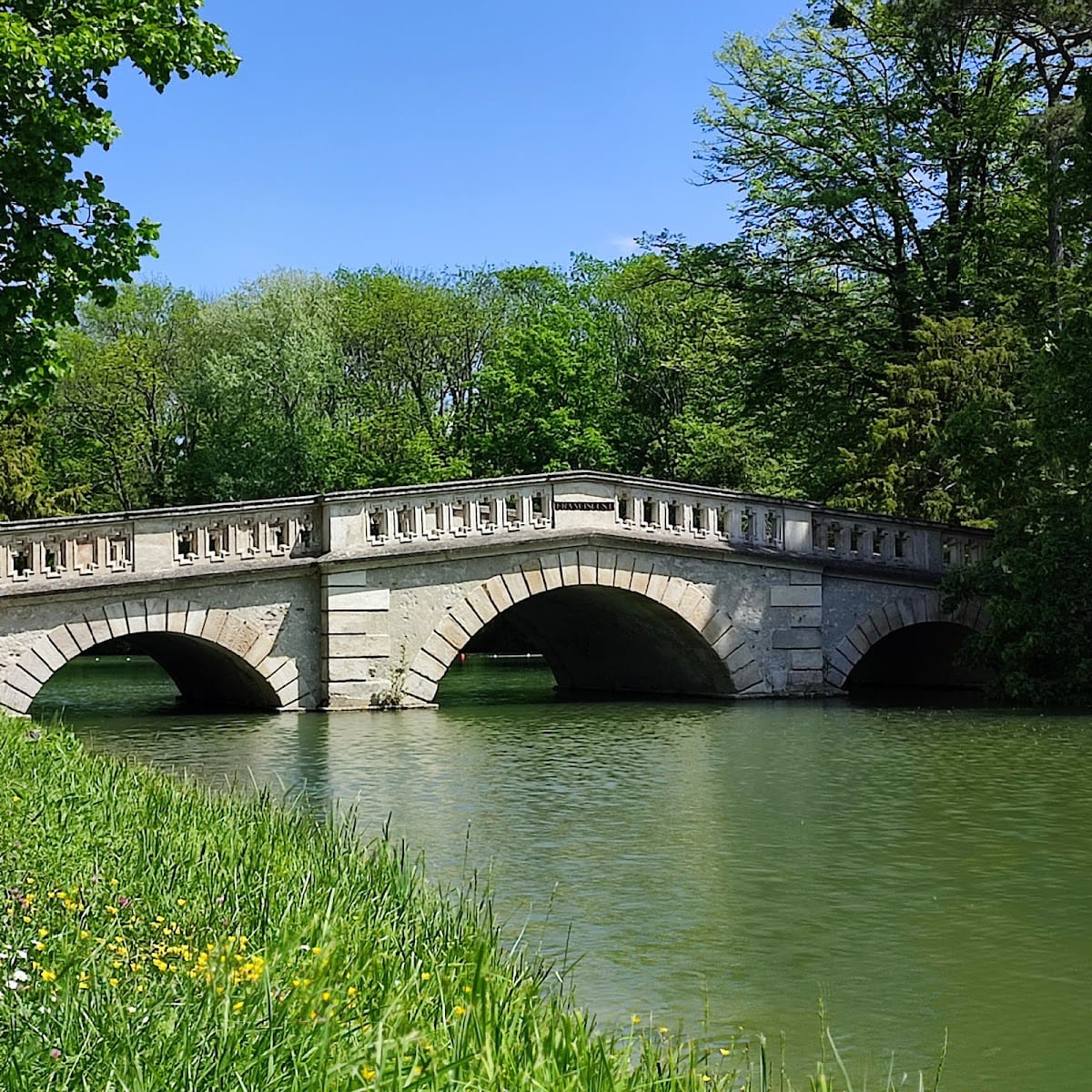
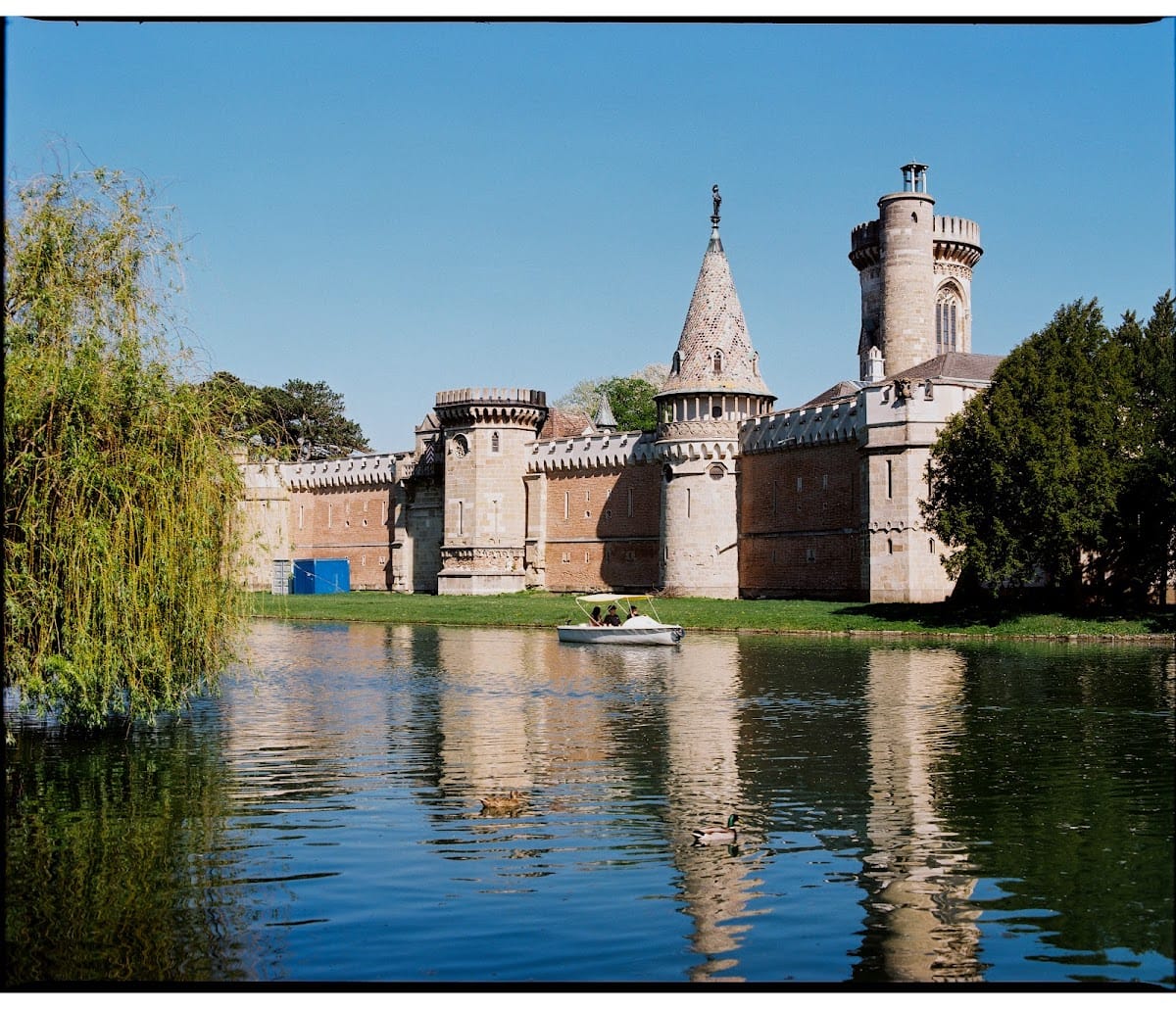
A later addition to the park is the Franzensburg, a neo-medieval castle built on an island within the extensive castle pond between 1801 and 1836 and named in honor of Emperor Franz II/I. The island is accessible via an iron bridge on its southern shore and by ferry or pontoon bridge from the north, maintaining historical connections to the waterway features.
The surrounding castle park spans roughly 280 hectares and was transformed during the late 18th century under Emperor Joseph II from a traditional French formal garden into a naturalistic English landscape park with winding paths, ponds, and varied watercourses. A distinct area called the Rittergau, created in the 1790s by Emperor Franz II/I, exemplifies the romantic garden style of the era and hosts several neo-medieval structures.
The extensive 25-hectare pond, the largest of its kind in Austria, was historically enjoyed by the imperial family for boating. The park contains numerous historic structures, including the Green Lusthaus, an octagonal pavilion dedicated to Diana, the Roman goddess of the hunt, favored by Empress Maria Theresa and featuring light treillage (lattice) architecture dating to about 1760. Nearby stands the Concordiatempel, a Corinthian columned round temple adorned with acanthus leaf decorations.
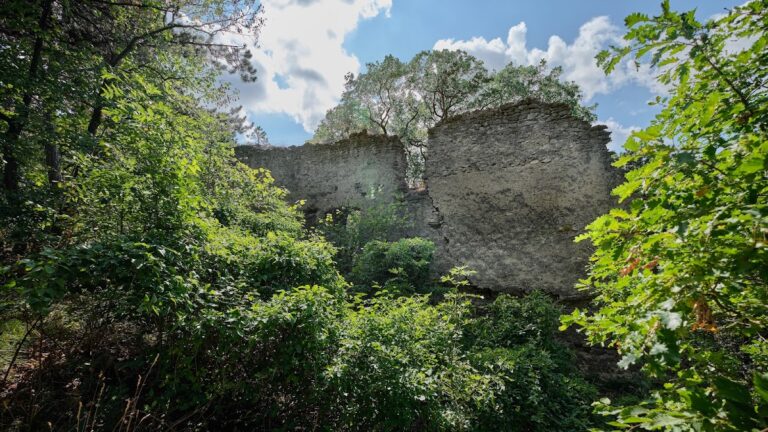
Other park features include the ruins of the House of Humor, originally constructed around 1798 by architect Johann Ferdinand Hetzendorf von Hohenberg; damaged during the Napoleonic wars and again in World War II, it was stabilized with a protective roof in recent restoration. The Rittergruft (knights’ crypt) and Ritter column relate to medieval knightly symbolism within the landscape. The Hofeiskeller served as an ice cellar where ice harvested from the pond was stored. Visitors would also notice a large bust of Emperor Franz I by Giovanni Battista Comolli, presented by Milan in 1836, and a dovecote standing for approximately two centuries.
The park’s water system derives primarily from the Triesting River through an 1801 canal, supplemented by the Heidbach stream; these waters drain eventually into the Schwechat River. Remnants of a former Chinese pavilion and bridge survive as a stone base near the Goldfish Pond. On Marianneninsel, Emperor Ferdinand I built a temple for his wife, Maria Anna, now preserved as a ruin.
The Forstmeisterkanal, built in the 18th century, crosses the Münchendorfer axis on a bridge and concludes at the Große Kaskade waterfall, demonstrating the intricate water engineering within the park.
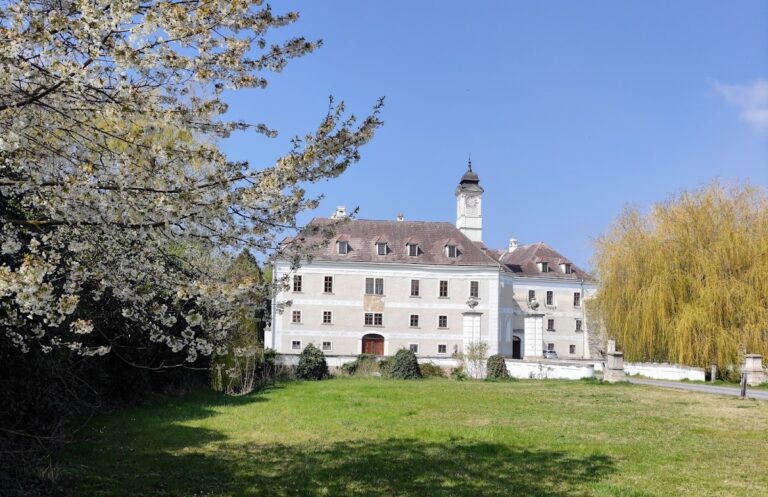
Adding to the historic ensemble is the former imperial railway station, the Kaiserbahnhof of Laxenburg, restored to its original mid-19th-century appearance and currently functioning as an event space and restaurant. Nearby, the Palais Kaunitz-Wittgenstein, once the residence of several prominent noble families, has served since 1912 as a convent and provincial house for the Sisters of the Cross. Part of this building today houses the International Anti-Corruption Academy, an institution dedicated to combating corruption at a global level.
Nearby sites