Landskrona: A Swedish Fortress on the Neva
Site at a Glance
- Popularity
- Very High
- Country
- Russia
- Primary era
- Medieval
- Eras represented
- Medieval, Early Modern
- Civilizations
- Swedish
- Site type
- Military
- Remains
- Fort
On this page12 sections
History
Landskrona was a Swedish fortress founded in 1300 at the meeting of the Okhta and Neva rivers in Russia. Sweden intended it as a strongpoint for expansion into Ingermanland, the historic region around the eastern Gulf of Finland and the Neva, and as a means of controlling the river route from Lake Ladoga to the sea, important to Novgorod’s trade.
Foundation and Swedish strategy
The fortress arose amid decades of rivalry between Sweden and the Novgorod Republic, the medieval political power centered on Novgorod. Swedish raids near the Neva in 1283 and 1284 were intercepted or defeated, and the two sides raided one another in 1292. Sweden established Vyborg as a base in 1293, then failed to hold Korela after Novgorod retook it in 1295. Only two members of the Swedish garrison escaped, and Sweden turned its efforts toward the Neva.
The expedition that founded Landskrona was led by Tyrgils Knutsson, Sweden’s marshal, a senior military officeholder who was then the country’s de facto ruler. Its fleet, estimated at 30 to 50 ships, carried about 1,100 men, an experienced Italian fortification specialist, Swedish builders, and ample food. It left Stockholm on 30 May 1300. The plan was for the main force to return to Sweden while a garrison stayed behind in a fortress built to withstand winter.
Before construction was complete, Novgorod assembled troops on an island in Lake Ladoga. A Swedish detachment of about 800 men travelled up the Neva to attack them, but a storm forced the men ashore for five days. They returned without completing their mission, and Swedish guards on Orekhovy Island withdrew to Landskrona as Novgorod’s army approached.
Siege and destruction
Novgorod’s first attack on the unfinished fortress included an attempt to burn the Swedish ships. Burning rafts sent down the Okhta were held back by a barrier of logs. Novgorod’s troops then crossed the ditch that had already been dug, but the defenders drove them back in a sortie. After a day-long truce, the attackers withdrew. The Swedes continued building into autumn and sailed for Stockholm on 29 September 1300.
A garrison of about 300 remained through the winter, isolated from Sweden. Spoiled food, disease, deaths, and hostility from local people weakened the defenders. Novgorod’s leaders sought to capture the fortress before the sailing season allowed Sweden to send reinforcements. Their forces blocked navigation at the mouth of the Okhta. A force from Tver, sent under Prince Mikhail Yaroslavich, did not reach the battle in time.
Grand Prince Andrei Alexandrovich led Novgorod’s main army to the fortress in mid-May 1301. The defenders’ sortie was driven back and their commander wounded. Fighting continued through the day and night; when fire broke out, the attackers entered the fortress. Most defenders were killed. The survivors withdrew into a tower and eventually surrendered. Landskrona fell on 18 May 1301, then was burned and destroyed.
The defeat ended Sweden’s largest effort up to that point to establish a foothold on the Neva. The war continued for more than 20 years, but Sweden launched no comparable offensive. The failed campaign contributed to Tyrgils Knutsson’s loss of power and eventual execution. In 1323, the Treaty of Nöteborg ended the conflict in a compromise that recognized the territories each side then held.
Later settlements on the site
Landskrona was not rebuilt for a long time, but settlements later grew around the strategically placed mouth of the Okhta. By the late 15th century, several dozen households and a village were recorded there. A settlement called Nevskoe Ustye developed in the early 16th century and had become a town by the end of that century, with a ruler’s trading yard, a customs house, and a cemetery church dedicated to Saint Michael. The church was probably on the former fortress site. A later name recorded in the century echoed the Russian rendering of Landskrona as “Crown of the Land.”
During the Time of Troubles, a period of political crisis and dynastic conflict in Russia around the turn of the 17th century, Sweden took control of the area. In 1611, Swedish forces began building Nyenskans on the former Landskrona site, while the settlement of Nyen grew on the Okhta’s right bank. Russian forces captured the fortress in 1703. Before their arrival, the Swedes burned the town and evacuated its people. The wooden defenses on the fortress earthworks were destroyed, and an explosion partly damaged the earthworks. The former fortress ground was later used for a plant nursery and then a shipyard; the former town site became the Okhta workers’ settlements.
Excavations and recent damage
Archaeological investigations at the Okhta Cape and nearby ground began in 1992. Large-scale excavations followed from 2006 to 2009, prompted by plans for a business district and skyscraper. They revealed Landskrona and evidence of earlier occupation. Public calls to preserve the cape for research led to cancellation of the skyscraper project. In May 2024, earthmoving for a construction project on the cape removed cultural deposits by machine and carried them to a landfill.
Remains
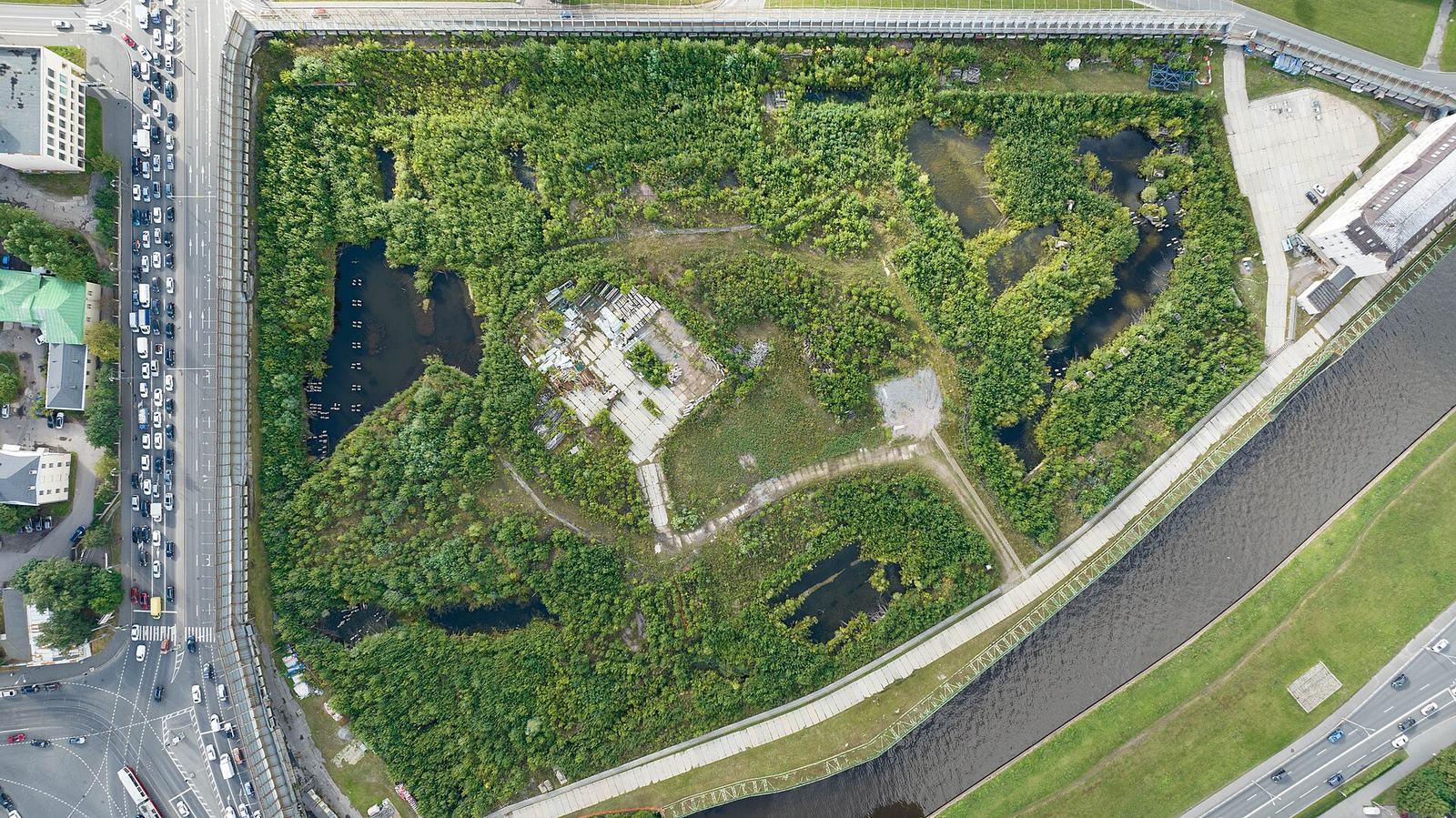
Landskrona stood on a cape above flood level, with the Okhta and Neva protecting three sides and the eastern approach open to attack. The Okhta also served as a natural harbor for the fleet. The fortress was built of timber and earth, within an outer defensive ditch around a roughly rectangular area of about 13,000 square metres. Its square inner plan measured about 90 metres on each side.
Ditches and raised platform
Two parallel ditches enclosed the fortress. Both were more than 2 metres deep and had sloping sides, lined with closely laid split pine logs. At the bottom, the outer ditch was about 15 metres wide and the inner one about 11 metres; a strip of ground 14 to 15 metres wide lay between them. Excavations traced stretches of the ditches for about 150 metres along the Okhta and 140 metres on the side facing present-day Komarovsky Passage. Some sections retained their full depth, and the ditches reached about 3.5 metres in places. Because the ground was uneven, builders filled low areas with branches, then laid a level timber-and-earth platform across the fortress. Rows of wooden compartments, 8 to 16 metres wide, were packed with turf, sand, and other material.
Timber defenses
A palisade, a defensive barrier of upright wooden stakes, and eight towers formed the fortress defenses. The towers had narrow openings for weapons. At the western side stood a square timber tower about 5.5 metres across, built from logs up to 30 centimetres in diameter. Its foundations extended about 2 metres below the Neva’s level, and a well lay within it. The tower may have served as a lookout or formed the lower part of a principal fortified tower. Its surviving underground portion was about 4 metres high. Burned timber structures were also found in the ditches, and the principal assault is understood to have come from the southeast.
Weapons and evidence of the assault
The garrison possessed siege engines and crossbows, including heavy crossbows mounted on fixed supports. Finds from the ditches include spearheads, crossbow bolts, arrowheads, and two iron bolts for mounted crossbows, each 19 centimetres long. Burn marks on timber structures are consistent with the fortress’s destruction by fire.
Burial in the southern ditches
A burial containing more than 300 people lay in the southern ditches. The remains were probably placed there by the Swedes during construction of Nyenskans, when the old Landskrona ditches were reused for the burial.
Earlier defensive work
A defensive feature predating Landskrona consisted of an 80-metre ditch about 3 metres wide and 2 metres deep, with part of a rampart behind it. Large pieces of timber in the ditch may have belonged to a defensive wall. The ditch had been filled before the Swedish fortress was built.
Neolithic settlement
The cape also held a Neolithic, or New Stone Age, settlement from a time before the Neva had formed, when the cape bordered an ancient sea.