Laimburg: A Medieval Hilltop Castle Ruin in South Tyrol


Site at a Glance
- Rating
- 4.3
- Popularity
- Very Low
- Country
- Italy
- Primary era
- Medieval
- External website
- Open
- Eras represented
- Medieval
- Civilizations
- Holy Roman Empire
- Site type
- Military
- Remains
- Castle
On this page6 sections
History
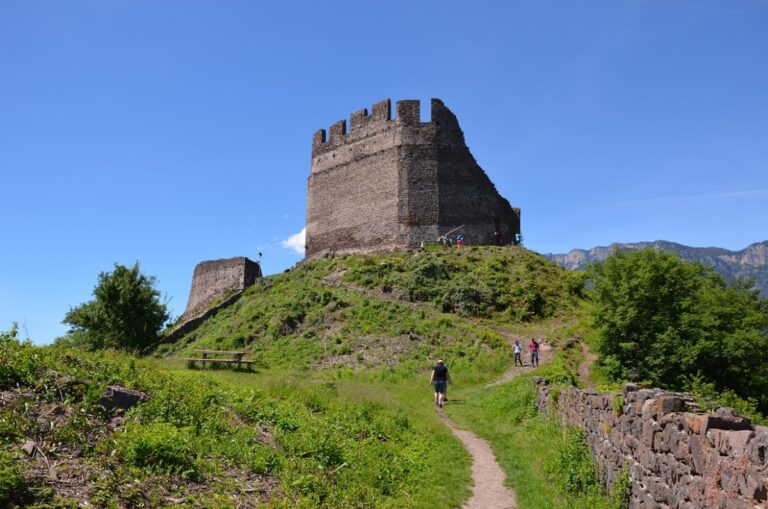
Laimburg is a medieval hilltop castle ruin in Italy, positioned on the Mitterberg at the Kreiter Saddle in South Tyrol. Construction probably took place during the second half of the thirteenth century, and the castle was first recorded in 1269, when Meinhard II, Count of Tyrol, granted the vest Layenburg to his confidant Heinrich Laian, a member of a Bolzano civic family.
Castle and Judicial District
The fortress briefly served as a judicial seat associated with Caldaro. From the late Middle Ages into the early modern period, it controlled its own territorial court district, known in 1488 as the Laymburger Gericht. This jurisdiction covered Pfatten’s Oberviertl and Unterviertl, along with the settlements of Stadl, Kreit, Klughammer, Gmund, and Piglon.
Damage, Expansion, and Abandonment
During the fourteenth century, Laimburg belonged to the Rottenburg family. Forces sent by the Bishop of Trent captured the castle in 1339 and again in 1341, inflicting severe damage. After the Rottenburgs regained possession, repairs and structural additions enlarged the fortress to the form it later retained.
In 1410, during the Rottenburg feud, Laimburg passed to Duke Friedrich IV, a fifteenth-century ruler of Austria and Count of Tyrol. In 1424, Friedrich granted the castle to his territorial administrator Wilhelm von Waltenhofen. Laimburg was abandoned at the end of the fifteenth century and deteriorated into a ruin during the seventeenth century.
Archaeology and Protection
The South Tyrol provincial government owns the site, which is protected as a cultural heritage monument. Between 1999 and 2001, the ruins were consolidated and archaeologically investigated. The agricultural and forestry experimental center below the castle takes its name and logo from Laimburg.
Remains
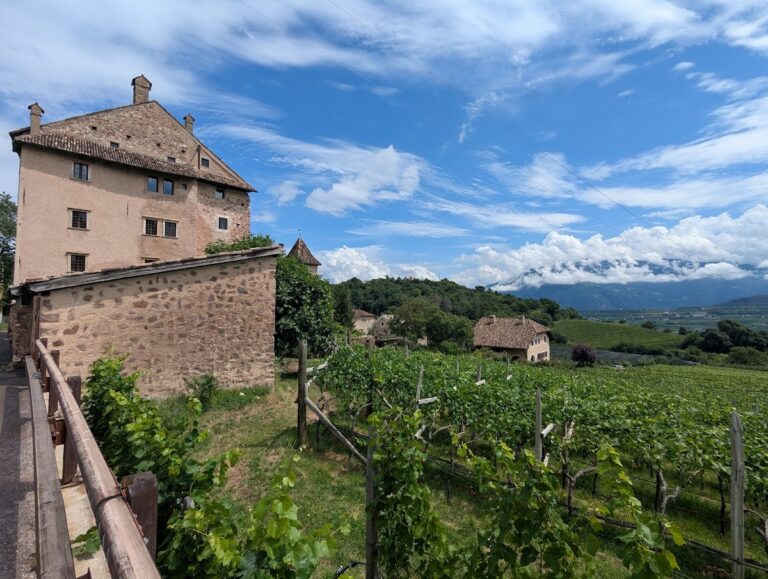
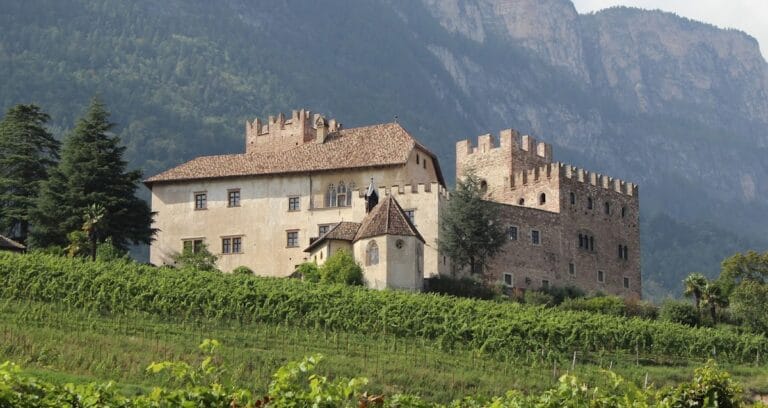
Laimburg survives as a hilltop fortress at the Kreiter Saddle, a passage between the Etschtal valley floor, also called the South Tyrolean Lowlands, and the Überetsch near Lake Caldaro. The complex is chiefly represented by its perimeter fortifications and part of its principal tower. Its roof has disappeared, leaving the castle as a ruin whose surviving structures reflect the enlarged form created after the fourteenth-century damage.
Perimeter Fortifications and Keep
The perimeter walls define the surviving fortified residence, while the keep, or bergfried, formed its principal defensive and refuge tower. Repairs and extensions after 1339 and 1341 brought these defenses to the extent the fortress subsequently possessed. Leuchtenburg stands on a rise immediately south of the saddle, and the Laimburg experimental center lies below the ruins to the east.
Nearby sites